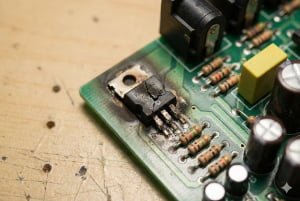
Selecting the right current sensor for high-power applications is stressful. One small mistake in the part number can lead to poor system performance or wasted budget on returns.
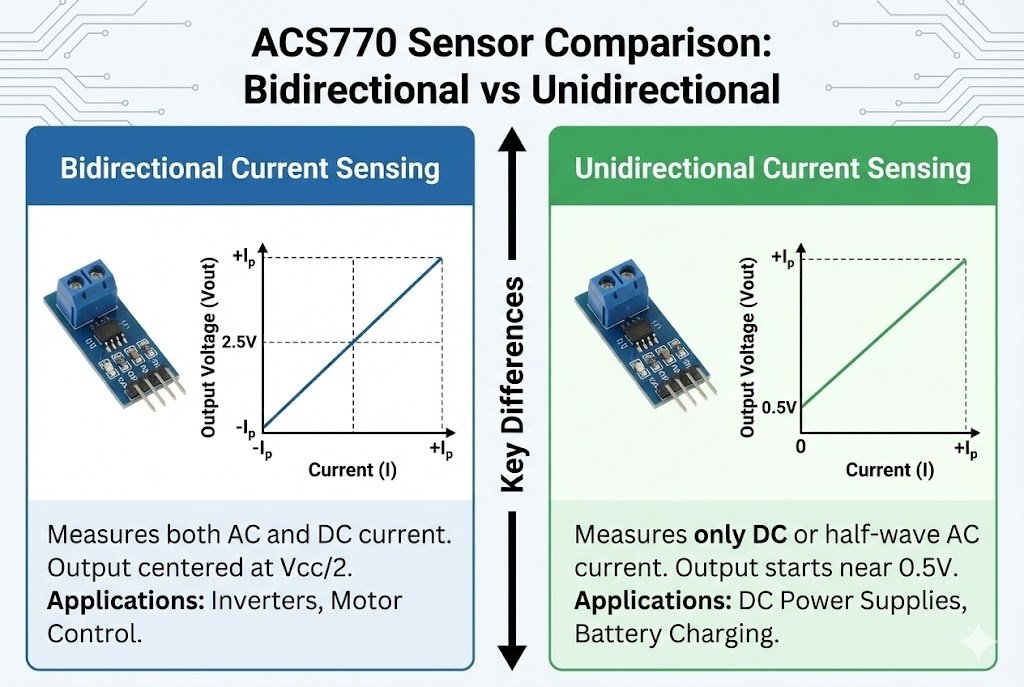
The main difference lies in the suffix. The ACS770LCB-050B1 is a bidirectional sensor2 designed for AC currents, with a zero point at 2.5V. The ACS770LCB-050U3 is a unidirectional sensor4 designed for DC currents, offering higher resolution by starting its output at 0.5V.
I see this problem happen frequently in my line of work. A procurement manager sees "50A Sensor" and buys the first one available. Then, the engineering team calls back saying the resolution is too low or the output makes no sense. At Nexcir, we want to stop this confusion before you place an order. It is important to understand exactly how these two chips behave differently.
Why is the ACS770 Series the Standard for High Current Sensing?
High current creates heat and noise, which makes accurate measurement very difficult. Engineers need a solution that is safe, isolated, and easy to integrate into a PCB.
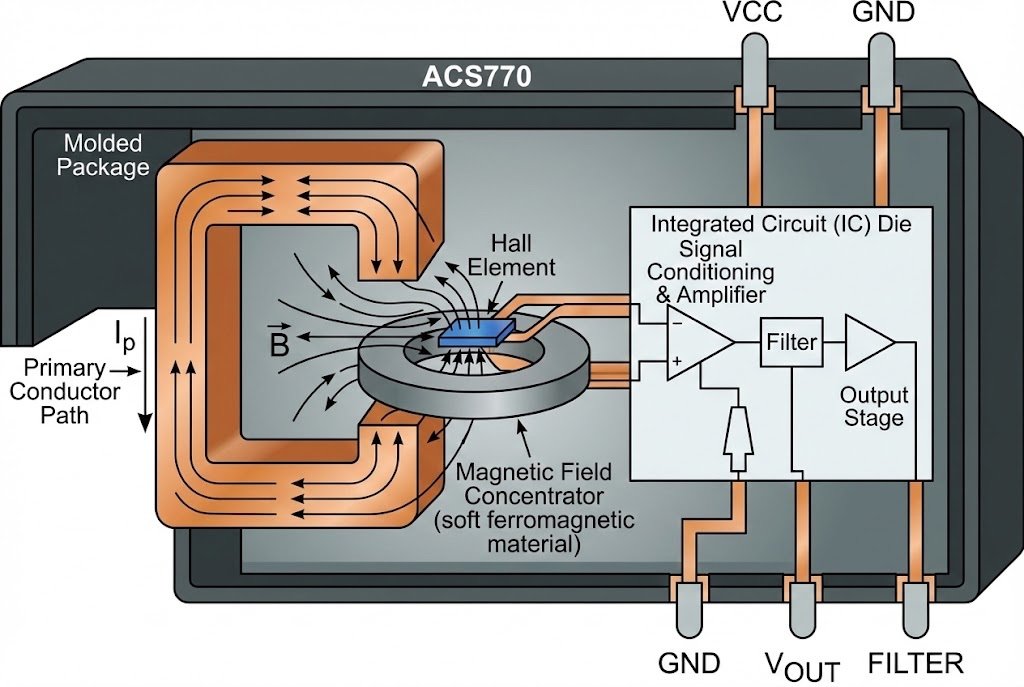
The ACS770 is a thermally enhanced, fully integrated Hall-effect linear current sensor5. It provides high precision, low noise, and 120kHz bandwidth, making it the industry standard for motor control6, inverters7, and heavy load detection8.
I want to dive deeper into why this specific part is so popular before we compare the models. When you are dealing with currents as high as 50A or 100A, using a simple shunt resistor is dangerous. The resistor gets very hot. You waste power. You also have to deal with the fact that the measurement is not electrically isolated from your high-voltage line.
The ACS770 solves these problems using the Hall Effect. The current flows through a thick copper conduction path inside the chip. This path is close to the Hall IC but not electrically connected to it. This provides galvanic isolation9. It protects your low-voltage microcontroller from the high-voltage side.
At Nexcir, we often recommend this series because of its packaging. It uses a 5-pin CB package10. This package is robust. It allows for easy heat dissipation. If you look at the market, many industrial inverters7 and automotive systems rely on this specific footprint. It is robust and reliable. However, the reliability depends entirely on picking the right version for your specific circuit.
Comparison: Hall Effect vs. Shunt Resistor
| Feature | ACS770 (Hall Effect) | Shunt Resistor |
|---|---|---|
| Isolation | Yes (Galvanic) | No (Direct Contact) |
| Power Loss | Very Low (Internal Resistance ~100μΩ) | High (Generates Heat) |
| Signal Level | Analog Voltage (Easy to read) | Very Low Voltage (Needs Op-Amp) |
| Complexity | Low (Integrated solution) | High (Requires extra components) |
When Should You Choose the ACS770LCB-050B1 Bidirectional Sensor?
If your application involves Alternating Current (AC), you have a specific requirement. You need to measure current that flows forward and backward.
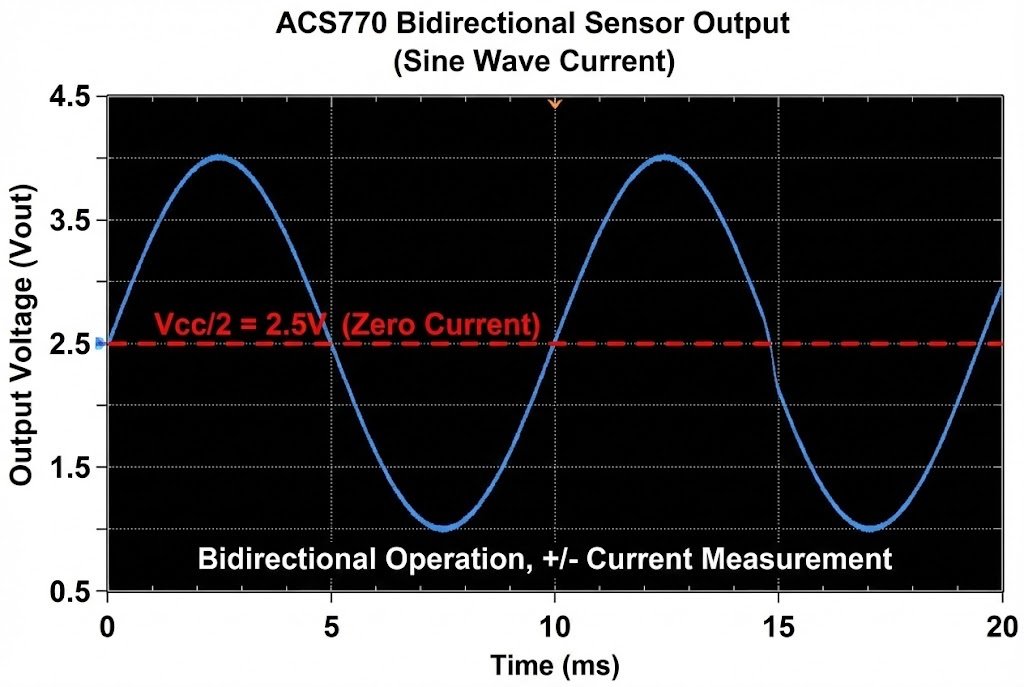
The "B" suffix stands for Bidirectional. It measures current flowing in both positive and negative directions. The zero-current output voltage11 is set at VCC/2 (usually 2.5V), allowing the signal to swing up and down for AC applications.
Let's break down the math and the application for the "B" type sensor. This is where critical thinking is required to match the sensor to the job. The ACS770 normally operates on a single 5V power supply.
In a bidirectional system, like a motor driver or a solar inverter, the current changes direction. It goes positive, then negative. But your microcontroller usually cannot read negative voltage. It can only read 0V to 5V. So, how do you represent negative current?
The ACS770LCB-050B1 solves this by offsetting the "zero" point. When no current is flowing (0 Amps), the sensor outputs 2.5V.
- If current flows positively (+50A), the voltage goes up towards 4.5V or 5V.
- If current flows negatively (-50A), the voltage goes down towards 0.5V or 0V.
This is perfect for an inverter. I remember a client building a three-phase motor control6ler. They needed to monitor the sine wave to control the motor speed. They had to use the "B" version. If they used the "U" version, the sensor would "clip" or ignore the negative half of the AC cycle. You would lose half your data.
However, there is a trade-off. Because you have to fit both positive and negative currents into the 5V range, you have less "room" for each Amp. Your sensitivity (mV per Amp)12 is lower compared to the unidirectional version. You are sacrificing resolution to gain the ability to see both directions.
Key Characteristics of Bidirectional (B)
- Zero Point: 2.5V (Vcc/2).
- Direction: Positive and Negative.
- Primary Use: Inverters, AC Motor Drives, Grid Monitoring.
Why is the ACS770LCB-050U3 Unidirectional Sensor Better for DC?
Sometimes, current only flows one way. If you are monitoring a battery discharging or a simple DC power supply, you do not need to measure negative current.
The "U" suffix means Unidirectional. It measures current flowing in only one direction. The zero-current output starts at 0.5V, utilizing the full remaining voltage range for higher resolution in DC applications.
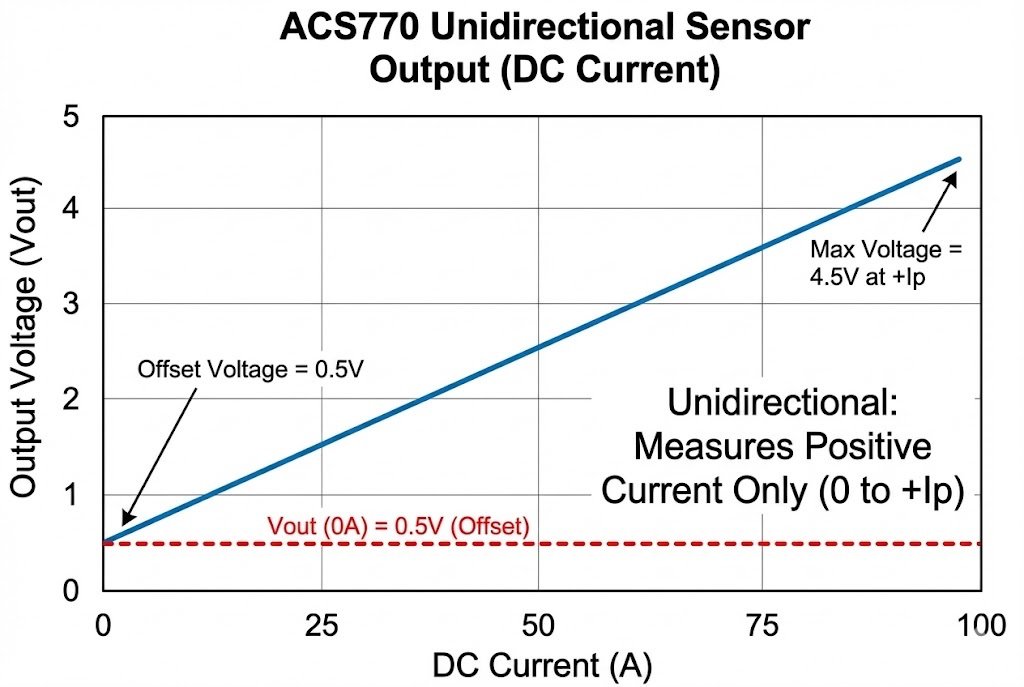
I often ask my customers: "Will the current ever reverse?" If the answer is "No," you should almost always use the "U" type.
Think about a DC system. You have a 5V supply for the sensor.
- If you use the "B" type (Bidirectional), your zero is at 2.5V. You only have 2.5V of "headroom" to measure your positive current. The bottom half (0V to 2.5V) is wasted space. It never gets used.
- If you use the "U" type (Unidirectional), your zero is at 0.5V. Now, you have from 0.5V all the way up to 4.5V to measure your current. You have 4V of usable range.
This is a massive advantage. It means the sensitivity (mV/A) is much higher. For the same 50A current, the "U" type gives you a larger voltage change than the "B" type. This makes it easier for your microcontroller to detect small changes in current. It improves the signal-to-noise ratio13.
I recall a project involving a large server power supply. The engineers used a "B" type initially. They complained that the reading was "jumpy" and not precise enough. I suggested they switch to the "U" type since the power only flowed one way. The resolution effectively doubled. Their readings stabilized immediately.
Using a "U" type for AC is a mistake. It will clip the signal. But using a "B" type for DC is also a mistake—it is a waste of potential performance.
Key Characteristics of Unidirectional (U)
- Zero Point: 0.5V.
- Direction: Positive only.
- Primary Use: DC/DC Converters, Battery Chargers, Load Detection.
How Do You Avoid Common Sourcing Mistakes with ACS770?
Buying electronic components seems simple, but the details matter. Obsolete parts, wrong temperature grades, and confused suffixes cause production delays.
Always verify the full part number including the suffix. Check if your load is AC or DC. Consult the datasheet for sensitivity values. If you are unsure, ask a professional distributor like Nexcir before ordering.
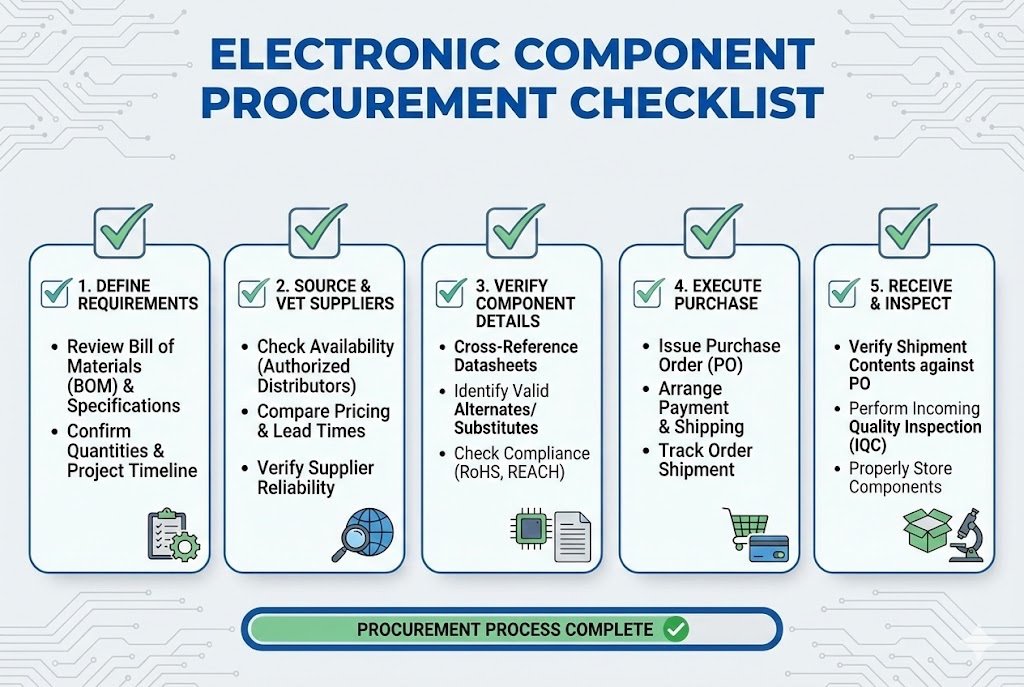
At Nexcir, we see ourselves as more than just sellers. We are part of your supply chain team. We have over 20 years of experience, and we use that to help you avoid risks. When sourcing the ACS770, there are three main things you must verify beyond just the "B" or "U" suffix.
First, check the Temperature Range14. The part number usually has a letter like "L" or "K" before the "CB".
- L typically means automotive grade or higher temperature range.
- E might mean a standard industrial range. If you put a standard range chip into a car engine bay, it will fail. We ensure the grade matches your environment.
Second, check the Sensitivity Code15. The "-050" means 50 Amps. But there are also -100 (100A) and -150 (150A) versions. If you put a 150A sensor in a 10A circuit, your signal will be tiny. It will be hard to read. If you put a 50A sensor in a 100A circuit, the output will "saturate" (hit the max voltage) and you won't see the peak current. You might even damage the sensor if the overcurrent is extreme.
Third, beware of fakes. The ACS770 is a popular chip. There are many counterfeits16 on the market that look the same but have bad internal resistance or poor isolation. A fake sensor can cause a fire. Nexcir only sources from authorized channels and original manufacturers. We guarantee authenticity. We want you to build your product once and have it work forever.
Selection Guide Table
| Application | Recommended Suffix | Reason |
|---|---|---|
| Solar Inverter (AC Side)17 | -050B | Needs to see full sine wave. |
| Battery Management System18 | -050U | Current usually flows out (or you use two sensors). |
| DC Motor Control | -050B | Motors generate back EMF and reverse current. |
| Power Supply (DC Output) | -050U | Maximize resolution for stable output. |
Conclusion
To summarize, choose the ACS770LCB-050B1 for AC applications to capture the full wave, and the ACS770LCB-050U3 for DC applications to get the best resolution.
Understanding the ACS770LCB-050B's features helps in selecting the right sensor for AC applications, ensuring accurate current measurement. ↩
Learning about bidirectional sensors helps in selecting the right sensor for applications where current flows in both directions. ↩
Exploring the benefits of the ACS770LCB-050U can guide you in choosing the best sensor for DC applications, maximizing resolution. ↩
Understanding unidirectional sensors aids in selecting the right sensor for applications where current flows in one direction. ↩
Discovering the Hall-effect linear current sensor's applications can help in understanding its role in high current sensing. ↩
Understanding the ACS770's use in motor control can guide you in selecting the right sensor for precise motor speed monitoring. ↩
Exploring the ACS770's role in inverters helps in understanding its effectiveness in handling high current and noise. ↩
Learning about heavy load detection with ACS770 helps in selecting the right sensor for applications with high current demands. ↩
Exploring galvanic isolation's importance helps in understanding how it protects low-voltage circuits from high-voltage lines. ↩
Learning about the 5-pin CB package's advantages can help in understanding its role in robust and reliable sensor design. ↩
Exploring zero-current output voltage helps in understanding how sensors represent current flow direction. ↩
Understanding sensitivity's impact on performance aids in selecting the right sensor for accurate current measurement. ↩
Understanding signal-to-noise ratio's importance aids in selecting sensors that provide clear and accurate readings. ↩
Exploring temperature range's impact helps in selecting sensors that can withstand specific environmental conditions. ↩
Understanding sensitivity code helps in selecting the right sensor for specific current ranges, ensuring accurate readings. ↩
Learning to identify counterfeits ensures you purchase authentic sensors, avoiding performance issues and safety risks. ↩
Understanding the use of ACS770LCB-050B in solar inverters helps in capturing the full sine wave for accurate monitoring. ↩
Exploring the ACS770LCB-050U's role in battery management helps in maximizing resolution for stable current monitoring. ↩