Choosing the right op-amp feels overwhelming. A bad choice can ruin your design, costing time and money. This guide makes selecting the perfect Analog Devices op-amp simple and clear.
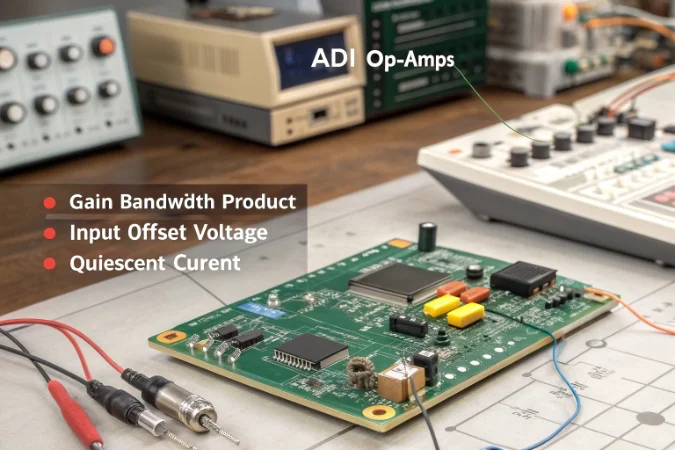
To select the right ADI op-amp, you must match its key specifications to your application's needs. Focus on Gain Bandwidth Product1 for speed, Input Offset Voltage2 for precision, Quiescent Current3 for low-power designs4, and voltage/current noise for sensitive measurements. Always start with your most critical requirement.
Choosing the right op-amp is about more than just matching numbers on a datasheet. It is about understanding the critical trade-offs between speed, precision, and power consumption for your specific project. Let's break down the most important factors you need to consider.
How Do You Choose an Op-Amp for High-Speed Applications?
Need a fast op-amp for your design? The wrong one creates signal distortion5 and slows your whole system down. Here’s how to pick the right one for speed.
For high-speed applications6, prioritize Gain Bandwidth Product1 (GBW) and Slew Rate7. A high GBW ensures amplification at high frequencies. A fast slew rate prevents signal distortion5. Look for ADI parts specifically designed for video, communication, or data acquisition systems.
When we talk about speed, two specifications are most important: Gain Bandwidth Product1 (GBW) and Slew Rate7. GBW tells you the maximum frequency an op-amp can amplify with a gain of one. If you need a gain of 10 for a 5 MHz signal, you need an op-amp with a GBW of at least 50 MHz. The Slew Rate7 is the maximum speed at which the output voltage can change. If the slew rate is too low, your output signal will be distorted, looking more like a triangle wave than a square wave. I remember a project where we used an op-amp with just enough bandwidth. It worked in simulation, but on the real board, we saw signal ringing8 and overshoot. The problem was stability. We switched to an op-amp with a slightly lower GBW but better phase margin and a higher slew rate. The signal cleaned up immediately. It was a clear lesson that speed is not just about bandwidth; it's also about control and stability.
| ADI High-Speed Op-Amp | Gain Bandwidth Product1 (GBW) | Slew Rate7 (V/µs) | Key Feature |
|---|---|---|---|
| ADA4817-1 | 1050 MHz | 870 V/µs | Low Distortion, Fast Settling |
| AD8065 | 145 MHz | 180 V/µs | Low Cost, Rail-to-Rail Output |
| LTC6268 | 500 MHz | 400 V/µs | Very Low Bias Current (fA) |
What Makes an Op-Amp Good for Precision DC Applications?
Are your sensor readings inaccurate or unstable? Tiny errors inside your op-amp can cause big problems in precision circuits. Let’s find the right part for the job.
For precision DC applications9, focus on low Input Offset Voltage2 (Vos) and low Input Bias Current10 (Ib). A low Vos minimizes output error. Low Ib is critical for high-impedance sensors. Also, consider low noise11 and minimal drift over temperature for stable performance.
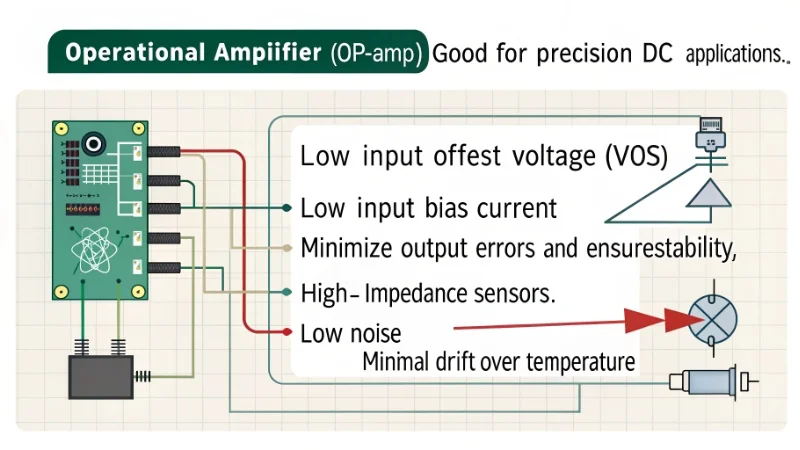
In precision designs, we are fighting against small, unwanted errors. The two biggest sources of error at DC are Input Offset Voltage2 (Vos) and Input Bias Current (Ib). Vos is a tiny voltage mismatch inside the op-amp's inputs. The op-amp amplifies this error along with your real signal. If you have a high-gain circuit, even a few microvolts of offset can lead to a large error at the output. Ib is the small current that must flow into the input terminals for the op-amp to work. If your signal comes from a high-impedance source, like a pH sensor, this bias current creates a voltage drop across that resistance, adding another error. I once worked on a medical device that measured very small biological signals. The initial design used a standard op-amp, and the readings would drift as the device warmed up. We switched to a zero-drift op-amp like the ADA4522, which has extremely low offset and temperature drift. The stability improved dramatically. This experience taught me to always check the temperature coefficient12 specs for any precision application.
| ADI Precision Op-Amp | Max Input Offset (Vos) | Max Input Bias Current (Ib) | Key Feature |
|---|---|---|---|
| ADA4522-1 | 5 µV | 220 pA | Zero-Drift, EMI Rejection |
| AD8628 | 5 µV | 30 pA | Zero-Drift, Rail-to-Rail |
| AD8551 | 5 µV | 20 pA | Auto-Zero, Low Power |
How Do You Select an Op-Amp for Low-Power and Battery-Operated Devices?
Is your device's battery draining much faster than you expected? The op-amp might be the hidden power hog. Let's find a component that sips power, not gulps it.
For low-power designs4, the most critical parameter is Quiescent Current3 (Iq). This is the current the op-amp draws when idle. Also, look for a wide supply voltage range and rail-to-rail input/output13 (RRIO) capability to maximize battery life and performance.
When designing for battery-powered devices, every microamp counts. The most important specification is the quiescent current, or Iq. This is the "standby" current the op-amp consumes just to be on, even with no signal. In a device that spends most of its time in sleep mode, Iq can be the single biggest drain on the battery. However, there is always a trade-off. Op-amps with very low Iq usually have lower bandwidth and higher noise. You have to balance the performance you need with the power budget you have. Another key feature is rail-to-rail input and output (RRIO). This allows the op-amp's input and output signals to swing very close to the power supply rails. For a device running on a single 3V battery, RRIO lets you use the entire voltage range, maximizing your signal's dynamic range. We were designing a small, battery-powered environmental sensor. The first op-amp we chose was great on performance, but it cut the battery life from one year to six months. We had to go back and find an op-amp with an Iq in the microamp range. It was a compromise on speed, but for a slow-moving temperature signal, it was absolutely the right choice.
| ADI Low-Power Op-Amp | Quiescent Current3 (Iq) | Supply Voltage Range | Key Feature |
|---|---|---|---|
| ADA4505-1 | 10 µA | 1.8V to 5V | Rail-to-Rail I/O, Low Iq |
| AD8500 | 1 µA | 1.8V to 5.5V | Micro-power, Tiny Package |
| LTC6255 | 6.5 µA | 2.5V to 5.25V | 6.5MHz GBW at Low Power |
Why is Noise a Critical Factor and How Do You Choose a Low-Noise Op-Amp?
Is your weak signal getting lost in a sea of electronic noise? A noisy op-amp can corrupt your measurements and make your entire design useless. Let's learn how to choose a quiet one.
To select a low-noise op-amp, look at the voltage noise density14 (nV/√Hz) and current noise density15 (pA/√Hz). The right choice depends on your source impedance. For low impedance sources, voltage noise is most important. For high impedance sources, current noise dominates.
Every electronic component generates some amount of random, unwanted noise. In an op-amp, this noise can be larger than the small signal you are trying to measure. We measure it in two ways: voltage noise and current noise. Voltage noise is an inherent property of the op-amp's internal transistors. Current noise becomes a problem when it flows through the resistance of your signal source, creating even more voltage noise. The total noise is a combination of both. This is why your source impedance is so important. If you are amplifying a signal from a 50-ohm source, you need an op-amp with the lowest possible voltage noise. If your source is a 1-megaohm photodiode, the current noise will be the bigger problem. On an audio preamplifier project, we initially ignored current noise because the voltage noise spec looked great. But the source was a high-impedance microphone. The resulting hiss in the audio output was terrible. We had to switch to a JFET-input op-amp with much lower current noise. It was a clear lesson in understanding the entire noise picture, not just one number from the datasheet.
| ADI Low-Noise Op-Amp | Voltage Noise (nV/√Hz) | Current Noise (fA/√Hz) | Best for Source Impedance |
|---|---|---|---|
| ADA4898-1 | 0.9 nV/√Hz | 2500 fA/√Hz | Low Impedance Sources |
| ADA4625-1 | 3 nV/√Hz | 7 fA/√Hz | High Impedance Sources |
| AD797 | 0.9 nV/√Hz | 2000 fA/√Hz | Ultralow-Noise Audio/Probes |
Conclusion
Selecting the right ADI op-amp means matching key specs like speed, precision, and power to your application. This guide helps you make the best choice for your design.
Understanding GBW is crucial for selecting op-amps that can handle high-frequency signals effectively. ↩
Learn how Vos impacts precision in your circuits and why it matters for accurate measurements. ↩
Discover how Iq influences battery life in low-power designs and why it’s a key specification. ↩
Discover strategies to optimize power consumption in battery-operated devices. ↩
Understanding the causes of distortion can help you select the right op-amp for your design. ↩
Explore the types of projects that require high-speed op-amps and their specific needs. ↩
Understanding slew rate helps prevent signal distortion in high-speed applications. ↩
Learn about signal ringing and how to avoid it in your op-amp designs. ↩
Learn about the critical requirements for op-amps used in precision DC circuits. ↩
Explore how Ib affects high-impedance sensor readings and overall circuit accuracy. ↩
Learn about the significance of noise in op-amps and how it impacts signal integrity. ↩
Understanding temperature coefficients is vital for maintaining stability in precision applications. ↩
Discover how RRIO capability maximizes signal range in battery-operated devices. ↩
Learn how voltage noise density affects the performance of op-amps in sensitive applications. ↩
Understanding current noise density is essential for selecting the right op-amp for high-impedance sources. ↩