leading paragraph: Are your older machines failing because of bad drivers? Finding the right replacement part quickly is hard, and production stops cost you money every single minute.
snippet paragraph: The A3987 offers finer microstepping1 (up to 1/16 step) for smoother motion compared to the A3982. However, the A3982 provides robust torque handling2 for simpler tasks. For maintenance of legacy 3D printers3 and textile machines4, choosing the right chip depends on whether you need high precision or basic raw driving power.
Transition Paragraph: I recently spoke with a factory manager whose textile line was down. He was panicked. He did not know which driver would fix his specific torque issue. This is a common problem. Let us look closely at these two chips to help you make the right choice.
LOOP START
How do the technical specifications and microstepping capabilities differ?
leading paragraph: You cannot choose a driver based on guessing. Using the wrong voltage or step resolution5 will burn out your board and waste your budget immediately.
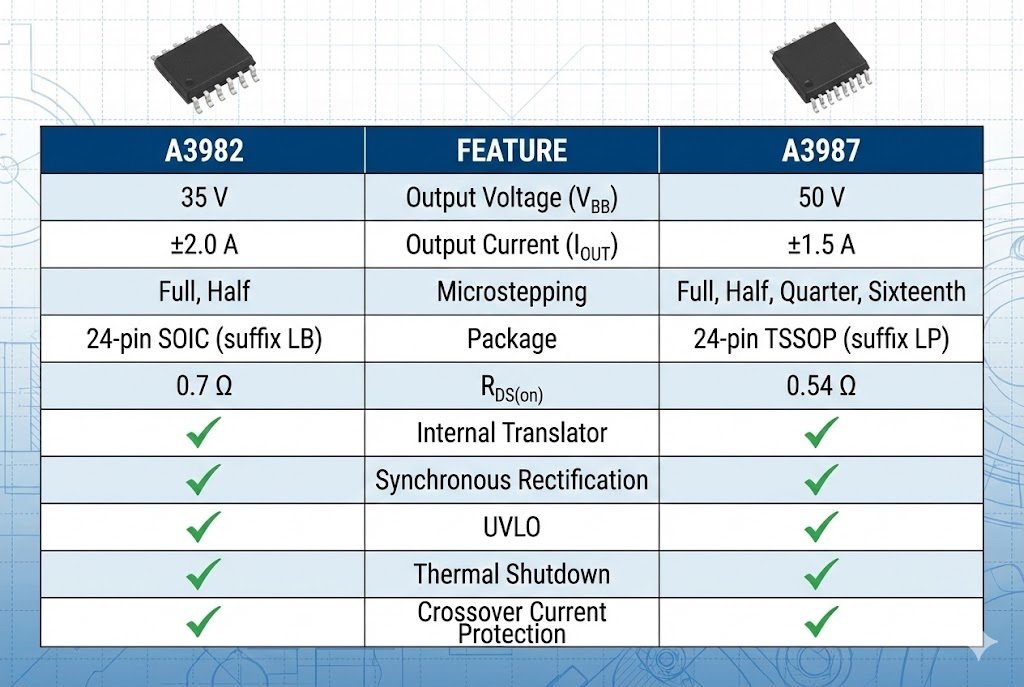
snippet paragraph: The main difference lies in step resolution5. The A3982 supports standard full and half steps. The A3987 supports up to sixteenth-step microstepping. Both handle up to 35V and ±2A, but the A3987 runs much smoother and quieter due to its finer control.
Dive deeper Paragraph: We need to look at the data inside these chips to understand why they act differently. Both chips come from Allegro MicroSystems. They look very similar on the outside. They usually come in the same package type. This makes people think they are the same. They are not.
The A3982 is a workhorse. It uses a built-in translator6 for easy operation. It is designed to drive bipolar stepper motors in full-step and half-step modes. This means it moves the motor in big "chunks." This is fine for simple movement. However, big chunks create vibration.
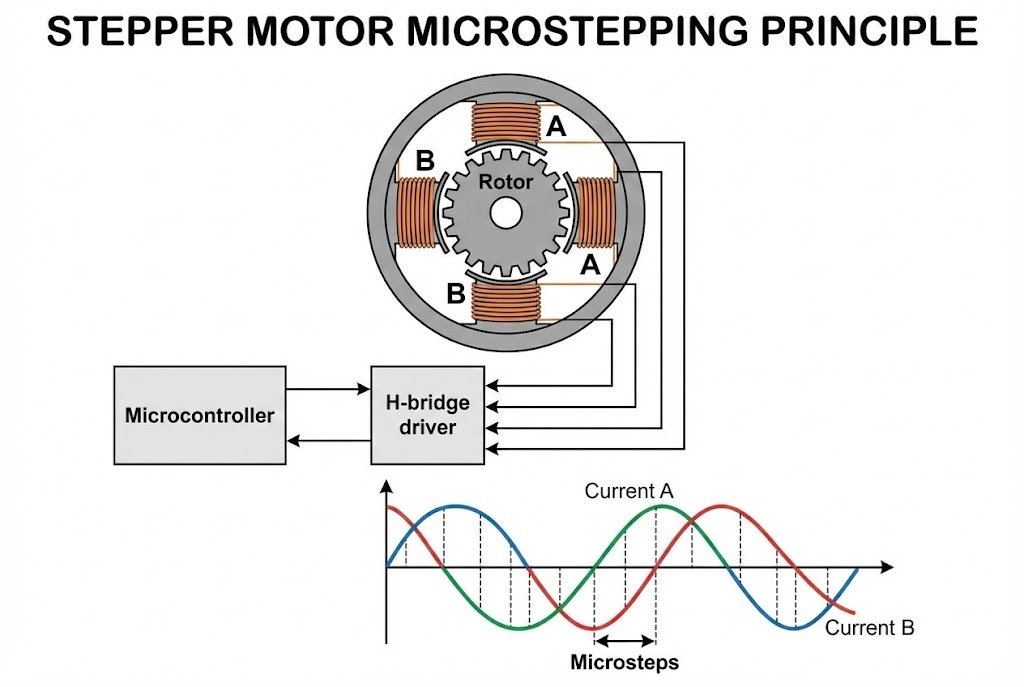
The A3987 is the refined version. It also has a translator, but it divides the steps into smaller pieces. It can do full, half, quarter, and sixteenth steps. When you break the step into sixteen parts, the motor moves like a liquid. There is less jumping. There is less noise.
Here is a simple breakdown of the core differences:
| Feature | A3982 | A3987 |
|---|---|---|
| Output Rating | 35 V, ±2 A | 35 V, ±2 A |
| Microstepping | Full, Half | Full, Half, Quarter, 1/16 |
| Logic Supply | 3.0 V to 5.5 V | 3.0 V to 5.5 V |
| Package | 24-pin SOIC | 24-pin SOIC |
| Primary Benefit | Simple Torque | Smooth Precision |
At Nexcir, I often see engineers try to swap these without checking the firmware settings. If your machine expects 16 microsteps and you put in an A3982, the motor will move four times faster than it should, or it might stall. You must match the chip to the control logic. The A3987 uses a mixed decay mode7 to manage current. This helps with the heat. The A3982 uses fixed off-time current regulation8. These technical details matter when you are trying to keep an old machine running for another five years.
LOOP END
LOOP START
Which industries rely on these specific drivers for maintenance and repair?
leading paragraph: New machines are great, but your factory runs on old equipment. When these legacy systems break, you cannot just buy a new robot. You must repair it.
snippet paragraph: These drivers are the standard for older 3D printers and industrial textile machinery9. The A3982 is often found in heavy-duty, low-precision movers. The A3987 is essential for textile machines4 that need smooth fabric handling and 3D printers that need fine layers.
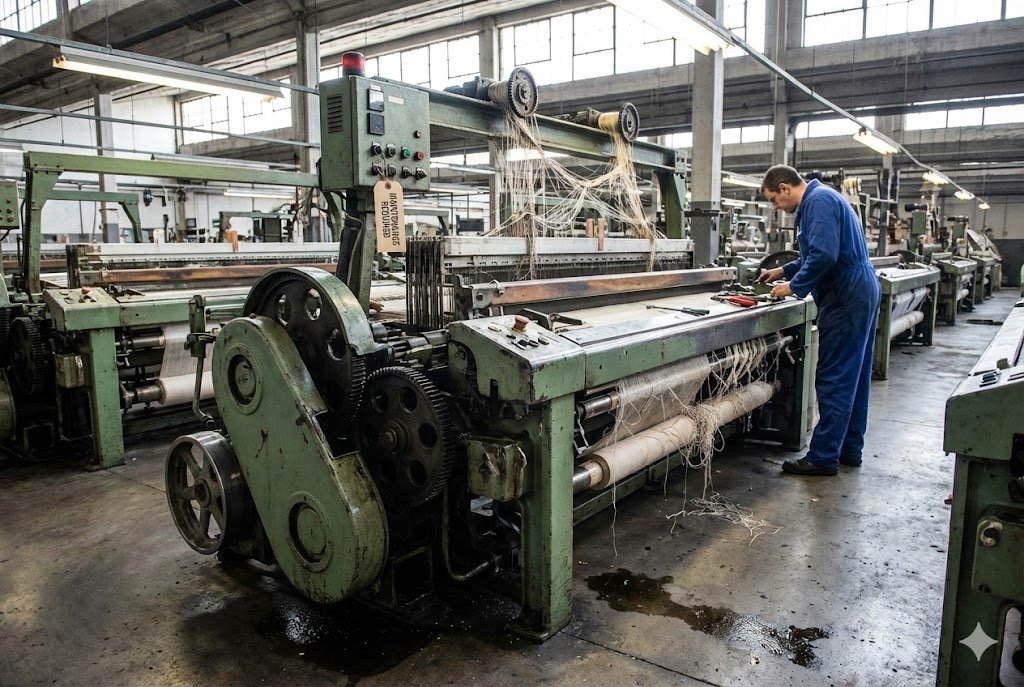
Dive deeper Paragraph: I have spent a lot of time helping clients in the manufacturing sector. Two industries always ask for these specific part numbers: 3D printing and textiles.
Let us talk about 3D printers first. Many classic printer models built ten years ago used the A3987. Why? Because of the "zebra stripe" effect. If a printer vibrates too much, you see ugly lines on the plastic model. The A3987 solves this with its 1/16 microstepping. It smooths out the resonance. If you are repairing a fleet of older printers, you cannot downgrade to the A3982. The print quality will drop instantly.
Now, consider textile machinery. These machines run 24 hours a day. They pull thread and fabric at high speeds. Tension is everything. If the motor jerks, the thread breaks. A broken thread stops the whole line. This costs thousands of dollars an hour. The A3987 is critical here because of that smooth motion control.
However, the A3982 still has a place. It is used in the parts of the machine that just need to move from point A to point B quickly. Examples include automatic door openers on CNC machines or simple feeder mechanisms. In these spots, the vibration does not matter. The torque matters.
The problem today is that these machines are aging. The original manufacturers might not support them anymore. This is the "aftermarket" reality. You are not building a new design. You are trying to keep a loyal, profitable machine alive. You need the exact part number. You cannot redesign the circuit board just because a chip is hard to find. This is where the difference between "repair" and "replace" becomes a financial decision.
LOOP END
LOOP START
How can you secure authentic stock10 without long lead times?
leading paragraph: Counterfeit chips destroy expensive machinery. Waiting months for a replacement part destroys your business schedule. You need a trusted partner11 who has the parts right now.
snippet paragraph: Sourcing legacy components requires a partner who verifies authenticity. at Nexcir, we specialize in spot sourcing12. We ensure authentic A3982 and A3987 chips are in stock. This means you get your repair parts immediately, without the risk of fake products.
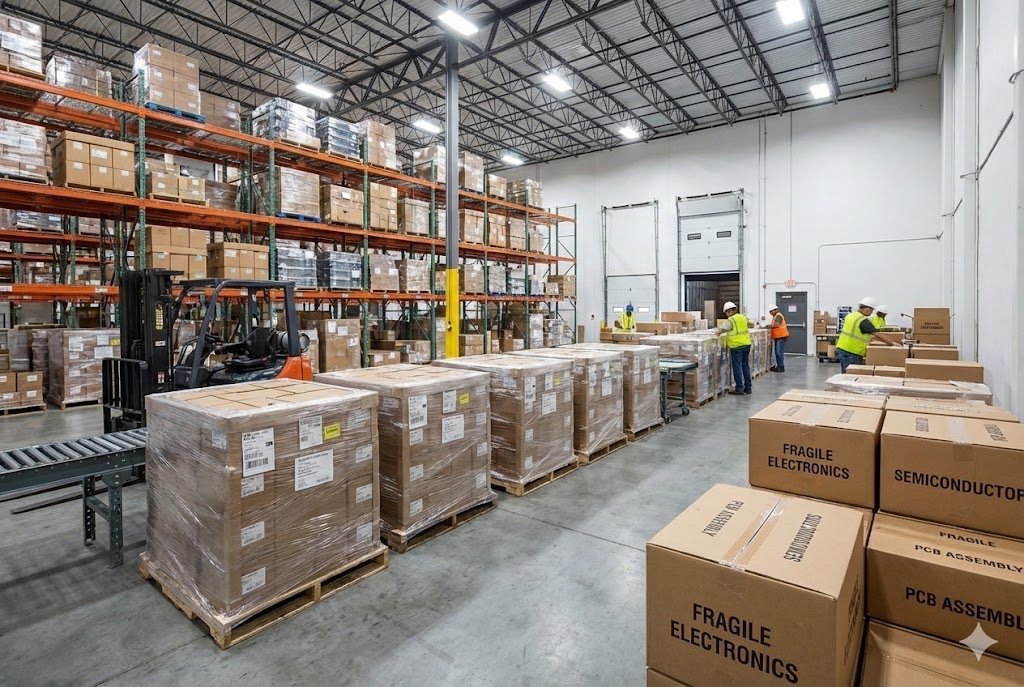
Dive deeper Paragraph: This is the most important part for my customers. You know you need an A3987. You know the specs. But where do you get it?
The market for older chips is dangerous. There are many fake chips out there. Bad sellers will take a cheaper chip, sand off the top, and print "A3987" on it. If you put that in your textile machine, it might explode. It might fry your main controller board. I have seen this happen. It is a nightmare.
At Nexcir, we treat this differently. We know that these parts are for maintenance. This means "Need It Now." If your line is down, you cannot wait 12 weeks for a factory lead time. You need spot stock. We keep these specific drivers in our inventory because we know they are high-demand repair items.
Our Process for Legacy Parts
- Verification: We do not just buy from anyone. We source from authorized channels and verify the labels.
- Stock Availability: We focus on "In Stock." We aim to have the parts in Hong Kong, ready to fly to you.
- Speed: We understand the cost of downtime.
When you buy an A3982 or A3987 from us, you are buying insurance. You are ensuring that the part is real. You are ensuring that it works.
Many distributors ignore these older parts. They only want to sell the newest, most expensive processors. But at Nexcir, we know that the industrial world runs on these classic chips. We support the aftermarket. We support the repair guys. We support the factory managers who just want to sleep at night knowing their machines will run tomorrow. Do not risk your production line on a random internet seller. Trust a team that has been doing this for 20 years.
LOOP END
Conclusion
The A3987 is best for precision and smoothness, while the A3982 handles basic torque. Nexcir provides authentic, in-stock options for both to keep your legacy machines running.
Understanding finer microstepping can help you achieve smoother motion in your machinery, reducing noise and improving precision. ↩
Robust torque handling ensures your machinery can perform heavy-duty tasks without compromising on power or efficiency. ↩
Exploring the reasons behind the continued use of legacy 3D printers can help you understand their reliability and cost-effectiveness. ↩
Discover how stepper motor drivers are crucial for maintaining smooth operation and preventing costly downtime in textile machines. ↩
Step resolution affects the precision and smoothness of motor movements, which is vital for high-quality output in various applications. ↩
A built-in translator simplifies the operation of stepper motors, making it easier to achieve desired movements without complex programming. ↩
Mixed decay mode helps manage current and reduce heat, enhancing the longevity and reliability of your stepper motor drivers. ↩
Understanding fixed off-time current regulation can help you optimize motor performance and prevent overheating in your machinery. ↩
Specific stepper motor drivers ensure smooth fabric handling and prevent costly production interruptions in textile machinery. ↩
Ensuring authentic stock prevents machinery damage and costly downtime, safeguarding your production line's efficiency. ↩
A trusted partner ensures you receive genuine components quickly, reducing downtime and maintaining production efficiency. ↩
Spot sourcing allows you to quickly obtain necessary components, minimizing downtime and maintaining production schedules. ↩