Are you struggling to pick the right transistor? If you pick the wrong one, you will cause heat issues. I will show you how to make the perfect choice.
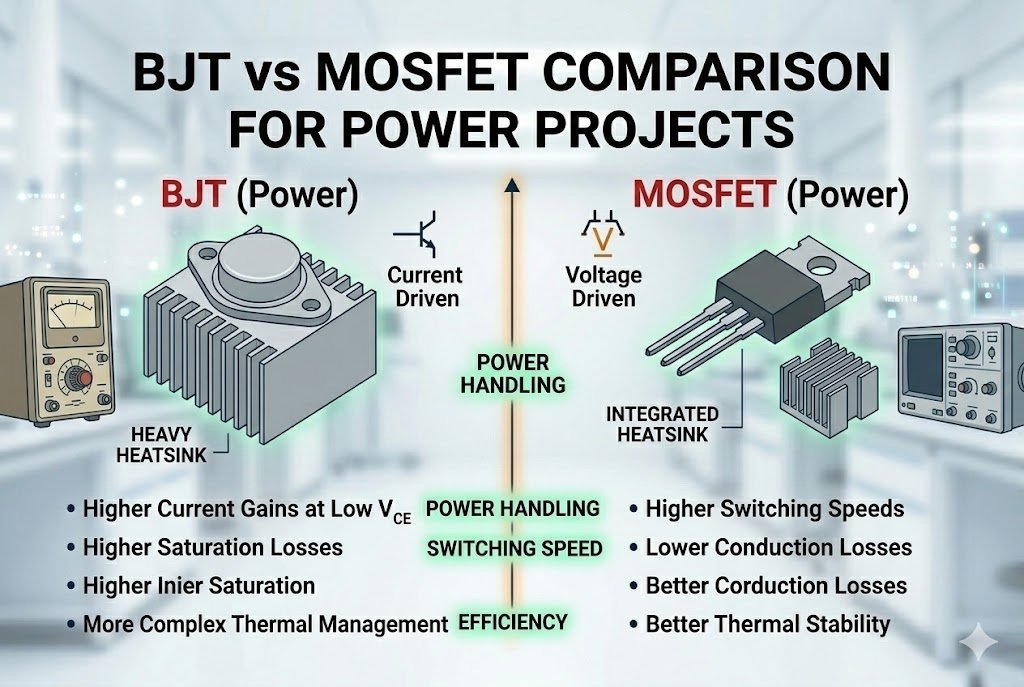
BJTs are current-driven devices1. They are best for low-frequency tasks. MOSFETs are voltage-driven devices2. They are ideal for fast switching. Your choice depends on your frequency needs3 and thermal limits4. I will help you match the right part to your project.
I have worked in the electronic components industry for 20 years. I have seen many engineers make the wrong transistor choice. A bad choice ruins your whole design. It will delay your production. But you do not need to worry. If you read this guide, you will understand how to pick the right part. You will avoid costly redesigns.
What are the basic differences between BJT and MOSFET?
You might feel confused by the basic specs. If you mix them up, you will get bad circuit performance. Let us look at the simple facts to clear your confusion.
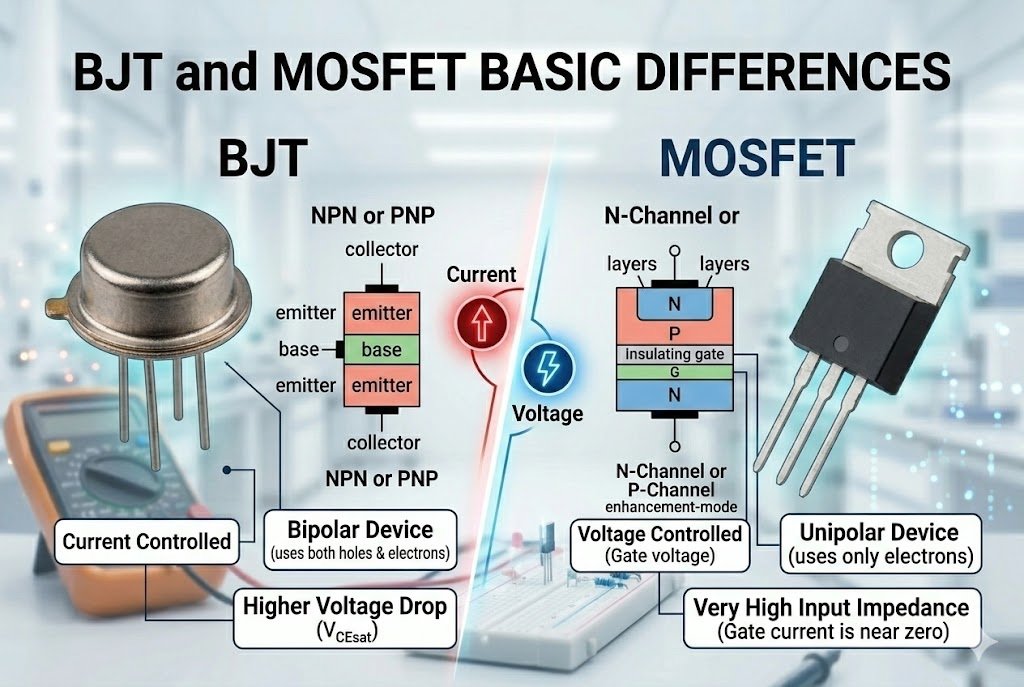
A BJT uses a small base current5 to control a larger collector current. A MOSFET uses a gate voltage6 to control the current flow. BJTs offer high gain. MOSFETs provide fast switching and low power loss.
Understanding the Physical Structures
I worked on an old motor drive project a long time ago. I learned a hard lesson about these structures. The BJT has three layers of semiconductor material. It relies on both electrons and holes to carry current. We call it a bipolar device because of this. The MOSFET uses only one type of charge carrier. This makes it a unipolar device.
Comparing the Key Metrics
You must look at the data sheets carefully. The input impedance7 is a huge factor. A BJT has low input impedance7. It draws power from your control circuit. A MOSFET has very high input impedance7. It draws almost zero steady current. This difference changes how you design your driver stage.
| Feature | BJT (Bipolar Junction Transistor) | MOSFET (Metal-Oxide-Semiconductor) |
|---|---|---|
| Control Method | Current-controlled | Voltage-controlled |
| Input Impedance | Low | Very High |
| Switch Speed | Slow to Medium | Very Fast |
| Temperature Stability | Poor | Good |
My team at Nexcir8 always tells our OEM clients to check these basic metrics first. If you skip this step, you will buy the wrong parts. We supply both types from original manufacturers. We keep your designs safe.
How do current-driven and voltage-driven models change your design?
Designing the driver circuit9 is hard. A weak driver causes the transistor to overheat. I will explain the driving mechanisms. You can build a safe and cool circuit.
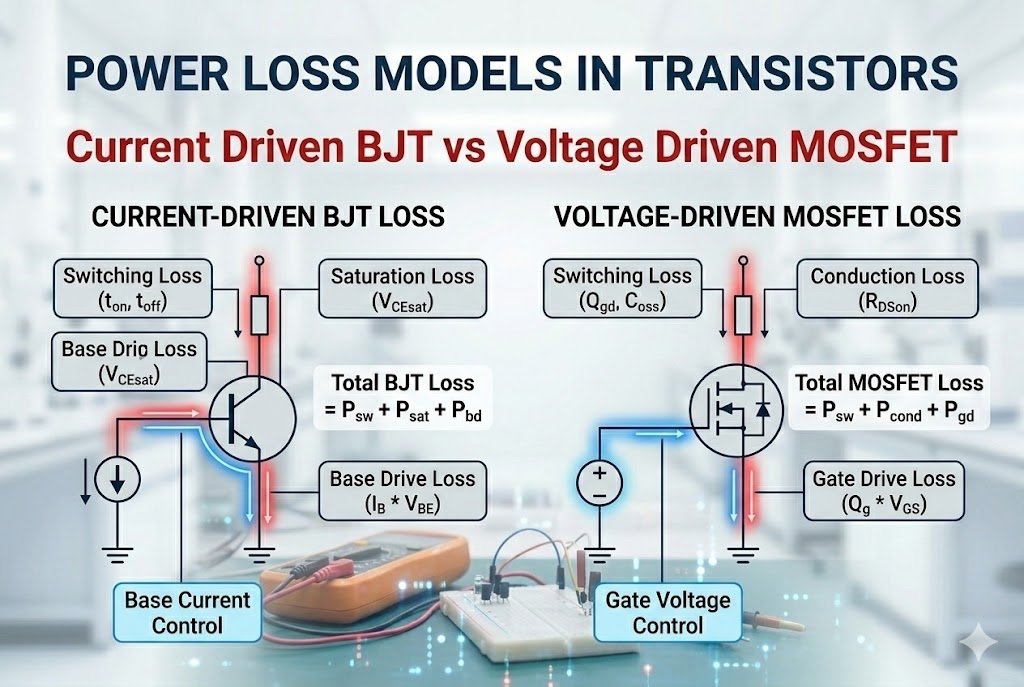
BJT current-driven models need continuous base current5. This wastes power. MOSFET voltage-driven models only need a voltage spike. They charge the gate capacitance10. MOSFETs require less steady power from your microcontroller. They make your overall design much more efficient.
The BJT Current Demand
A BJT acts like a current amplifier. You might want 10 Amps at the output. Your gain might be 50. You must provide 0.2 Amps at the base all the time. This steady current creates heat. I once saw a whole batch of IoT devices fail. The base resistors burned up. You must plan for this continuous power drain in your design.
The MOSFET Voltage Advantage
A MOSFET gate acts like a tiny capacitor. You only need a burst of current. This current charges the capacitor. The MOSFET turns on when the gate reaches the right voltage. It stays on without pulling more current. You just keep the voltage steady.
Drive Circuit Comparison
| Drive Metric | BJT Design | MOSFET Design |
|---|---|---|
| Steady Power Draw | High | Near Zero |
| Driver Complexity | Moderate | Simple |
| Microcontroller Drive | Hard for high power | Easy for logic-level |
MOSFETs are easier to drive. Many hardware engineers prefer them for new designs. You might need logic-level MOSFETs. My team at Nexcir8 can find the exact original parts for you. We check the market daily. We get you the best prices. We always put our customer needs first. We want to help you optimize your supply chain11.
Why do loss models matter in your power circuit?
Hidden power losses will destroy your project. Unchecked losses create massive heat. They melt your boards. Let us break down the loss models to protect your hardware.
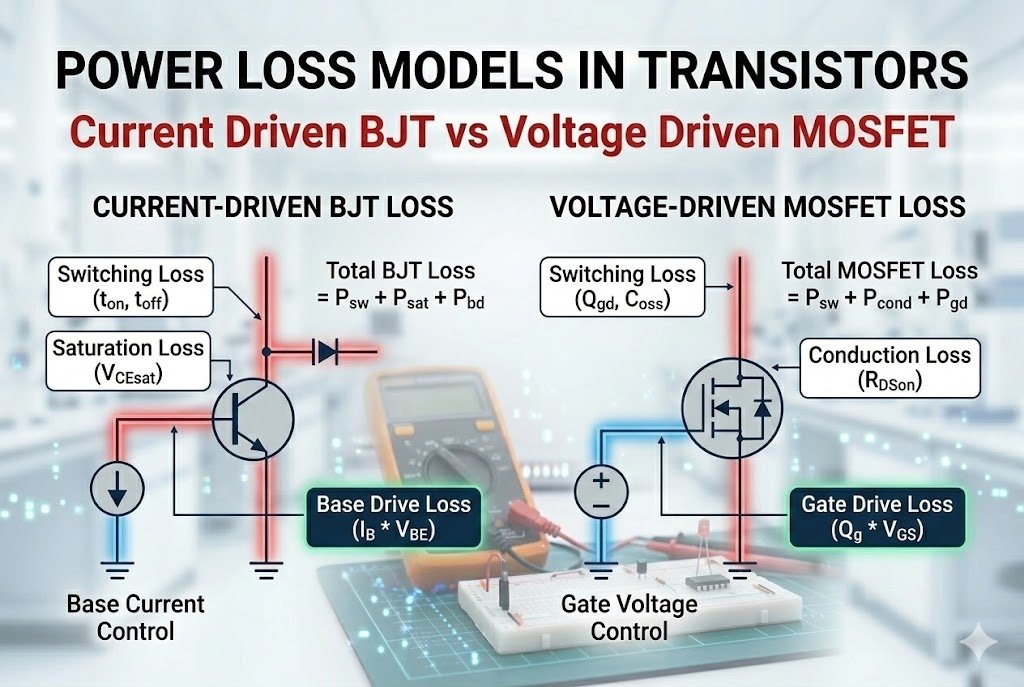
Loss models show where your power turns into heat. BJTs suffer from high conduction losses12. MOSFETs suffer from switching losses13. They have low conduction losses12. If you know this, you can pick the right heatsink. You will avoid thermal failures.
Breaking Down BJT Losses
BJTs have a fixed voltage drop. This happens when they are fully on. We call this the saturation voltage. You might push 10 Amps through a BJT. It might have a 2-volt drop. You will lose 20 Watts as heat. This conduction loss is constant. It is heavy. You will need a big heatsink to keep the system safe.
Breaking Down MOSFET Losses
MOSFETs act like a simple resistor. This happens when they are on. We call this on-resistance. If the resistance is very low, the conduction loss is tiny. But MOSFETs have another problem. They have switching losses13. You lose a little power every time the gate charges and discharges.
Comparing the Heat Sources
| Loss Type | BJT Characteristic | MOSFET Characteristic |
|---|---|---|
| Conduction Loss | High | Low |
| Switching Loss | High | Low to Medium |
| Drive Loss | High | Very Low |
I always ask clients about their thermal limits4. A cheap BJT might look good on paper. But you must buy a large heatsink. The extra cost makes it a bad deal. Nexcir8 helps you balance these costs. We find high-quality MOSFETs at great prices.
Which transistor wins in high-frequency switching scenarios?
High frequencies cause massive stress on basic parts. Slow switching leads to overlap losses. I will show you which device survives fast switching speeds.
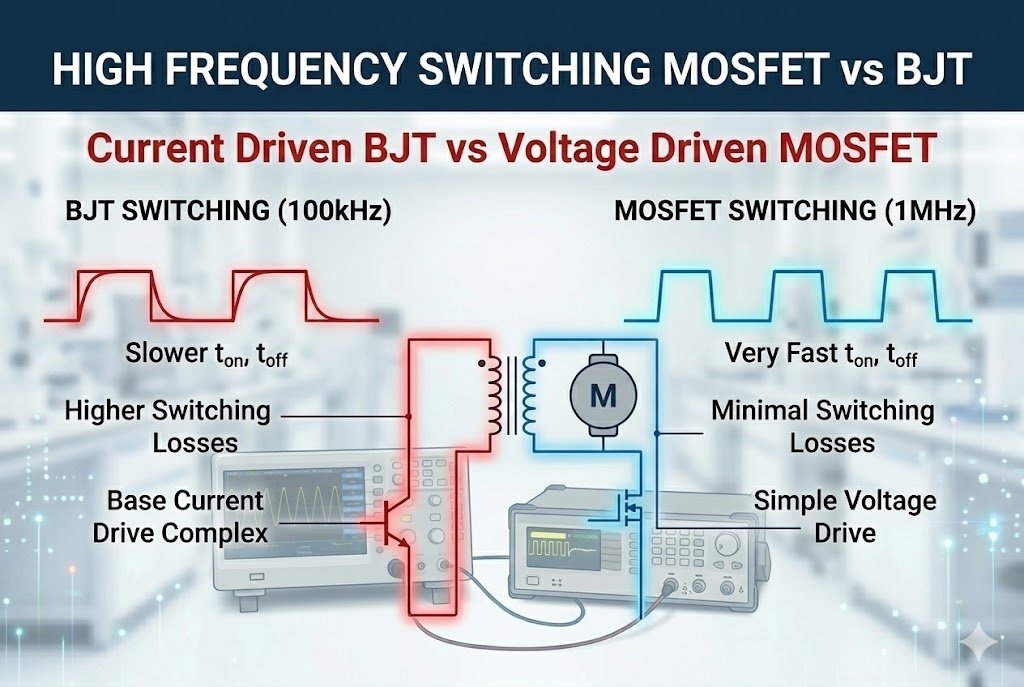
MOSFETs easily win in high-frequency switching scenarios. BJTs suffer from charge storage. This makes them very slow to turn off. MOSFETs do not have this problem. They can switch millions of times per second. They offer very high efficiency and low heat.
The Problem with BJT Speed
You might use a BJT as a switch. It enters a state of saturation. The base region fills up with charge carriers. You must wait for these carriers to clear out when you turn it off. This takes a lot of time. We call this storage time14. The BJT never fully turns off if your frequency is too high. It stays in a high-resistance state. It burns up quickly.
The MOSFET Speed Advantage
MOSFETs do not store charge in the same way. The only delay comes from the gate capacitance10. You can use a strong gate driver. You can push charge in and pull it out very fast. This makes MOSFETs perfect for modern power supplies. They are great for fast motor controllers.
Frequency Performance Data
| Application Frequency | Best Choice | Reason |
|---|---|---|
| Under 10 kHz | BJT or MOSFET | Both handle slow speeds well. |
| 10 kHz to 100 kHz | MOSFET | BJT switching losses13 get too high. |
| Over 100 kHz | MOSFET | BJT cannot turn off fast enough. |
Your production team might need fast MOSFETs for a new IoT device. You cannot risk buying fake parts15. Fake MOSFETs have high gate capacitance10. They fail at high speeds. Nexcir8 guarantees real components. We protect your high-frequency designs from bad parts.
How can you secure original transistors for your production line?
Fake parts ruin your perfect designs. Counterfeit transistors will fail in the field. They will destroy your brand reputation. I will tell you how to secure safe components.
You can secure original transistors easily. You just need to partner with a trusted distributor like Nexcir8. We source parts only from authorized channels. We guarantee full traceability. You will avoid fake parts15. You will get stable pricing. You will keep your production lines running.
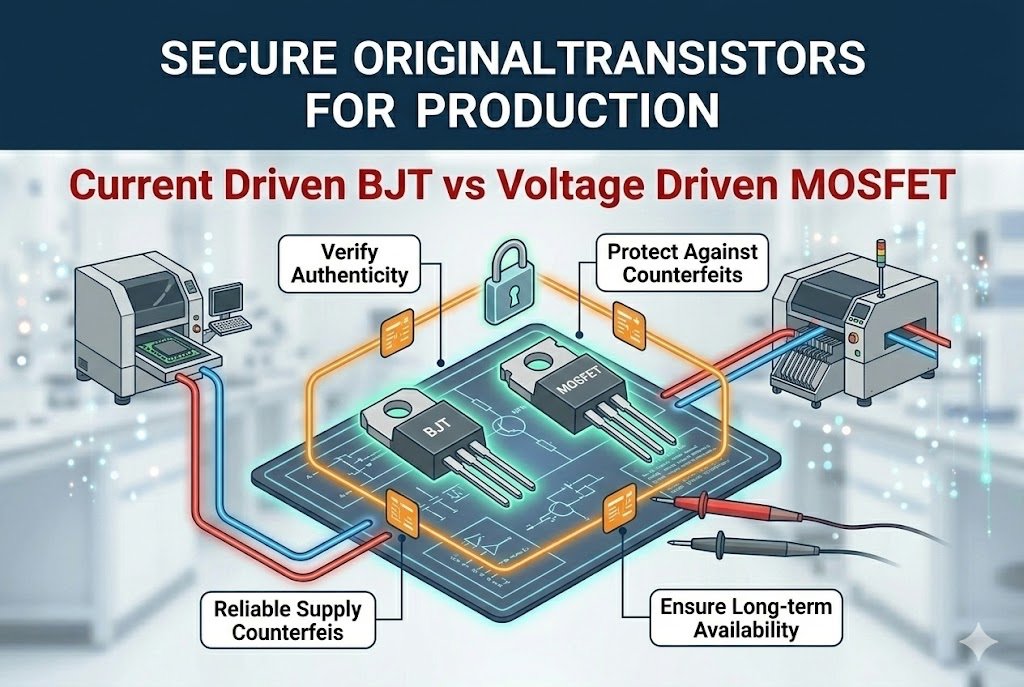
The Risk of the Open Market
I have talked to many procurement managers. They bought cheap parts from unknown brokers. Their hardware engineers tested the first batch. It worked fine. But the second batch was fake. The machines failed in the factory. This caused huge delays. They lost a lot of money. You must treat the supply chain11 as a critical part of your design.
Building a Safe Supply Chain
We solve this pain point at Nexcir8. Our founding team has over 20 years of experience. We know how to spot risks. We offer stable pricing. You do not suffer from market changes. We provide reliable global logistics. We deliver parts exactly when you need them.
Why Choose Nexcir8?
| Customer Need | Nexcir8 Solution |
|---|---|
| Real Parts | Authorized channels with full traceability. |
| Stable Pricing | Long-term partnerships and bulk buying power. |
| Reliable Delivery | Trusted global logistics partners. |
| Technical Support | Expert help with material alternatives. |
You might choose a BJT. You might choose a MOSFET. The part must be real. We are your trusted partner in the global supply chain11. We help you reduce costs. We improve your products.
Conclusion
Your choice between a BJT and a MOSFET depends on frequency and power. You must pick carefully. You must understand the losses. You must always source original parts from Nexcir8.
Understanding current-driven devices helps you choose the right transistor for low-frequency tasks, ensuring optimal performance. ↩
Voltage-driven devices are ideal for fast switching applications, making them crucial for high-frequency projects. ↩
Frequency needs determine whether a BJT or MOSFET is suitable, impacting your project's efficiency and thermal management. ↩
Thermal limits affect the heat management of your circuit, preventing overheating and ensuring reliable operation. ↩
Base current is essential for controlling a BJT, impacting power consumption and heat generation in your design. ↩
Gate voltage is crucial for MOSFET operation, offering fast switching and low power loss, ideal for efficient designs. ↩
Input impedance affects power draw from control circuits, influencing the design and efficiency of your driver stage. ↩
Nexcir provides trusted sourcing, stable pricing, and expert support, ensuring high-quality components for your designs. ↩
A well-designed driver circuit prevents overheating and ensures efficient operation, crucial for both BJTs and MOSFETs. ↩
Gate capacitance influences switching speed, making MOSFETs suitable for fast applications with strong gate drivers. ↩
A secure supply chain ensures reliable sourcing of original parts, preventing costly failures and production delays. ↩
Conduction losses impact heat generation and efficiency, influencing the choice of heatsinks and overall design. ↩
Switching losses affect power efficiency, making MOSFETs ideal for high-frequency applications due to lower losses. ↩
Storage time affects the speed at which BJTs turn off, impacting their suitability for high-frequency applications. ↩
Fake parts can lead to failures and damage your brand reputation, making it crucial to source from trusted distributors. ↩