
Struggling to pick the right capacitor? The wrong choice can ruin your design's performance and budget. Let's make this critical decision easier for you.
Choosing the right capacitor depends on your needs. Use ceramic for high-frequency filtering, electrolytic for high capacitance in power supplies, and tantalum for high-capacitance density and stability where space is tight. Each has unique trade-offs in performance, cost, and availability.
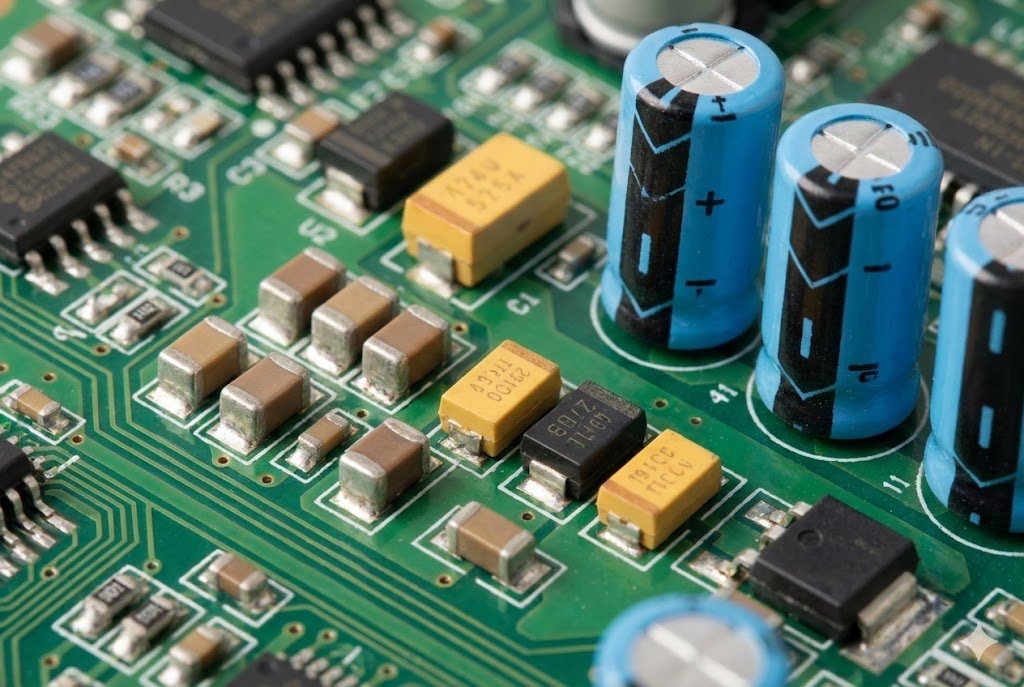
Choosing a capacitor feels like a simple task, but it's one of the most critical decisions in hardware design. A mismatch can lead to noise, instability, or even complete failure. I've seen projects delayed for months because a capacitor choice made early on didn't account for long-term supply. Let's break down the three most common types—ceramic, electrolytic, and tantalum—so you can make the right choice from the start and avoid future headaches.
What Makes Ceramic Capacitors a Go-To Choice for High Frequencies?
Dealing with high-frequency noise in your circuits? An unsuitable capacitor won't filter it out effectively. Ceramic capacitors offer the low ESR and ESL you need for clean signals.
Ceramic capacitors are ideal for high-frequency applications because of their very low equivalent series resistance (ESR)1 and inductance (ESL)2. This allows them to effectively bypass or filter out unwanted noise from power lines and signal paths, ensuring signal integrity in modern electronics.
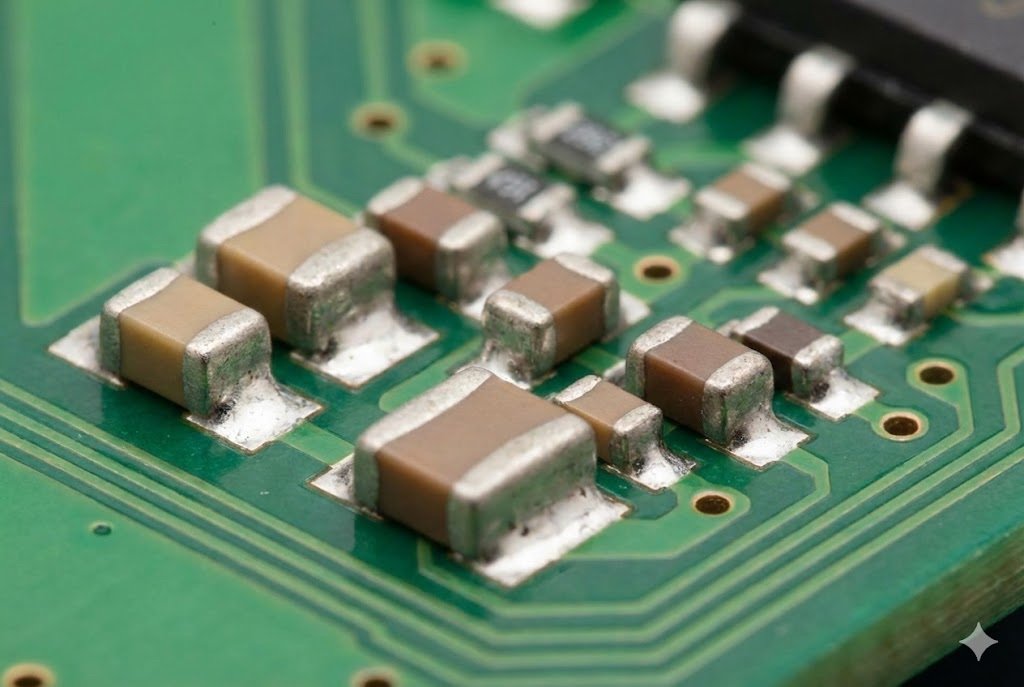
When you are designing a high-speed digital circuit, like one with a fast MCU or FPGA, ceramic capacitors3 are your best friend. Their excellent high-frequency response comes from their simple physical construction. This results in very low unwanted resistance (ESR) and inductance (ESL)2, which are the enemies of clean power and signals.
Understanding ESR and ESL
Think of ESR and ESL as tiny bits of resistance and inductance that exist inside every real-world capacitor. At very high frequencies, this internal inductance can make the capacitor behave more like an inductor, rendering it useless for filtering noise. Ceramic capacitors, especially Multi-Layer Ceramic Capacitors (MLCCs), are engineered to minimize these effects. This is why we place them as close as possible to the power pins of an integrated circuit. They act as a local reservoir of charge, ready to supply fast current demands and shunt high-frequency noise to ground.
Classes of Ceramic Capacitors
Not all ceramic capacitors3 are the same. They are generally split into two classes:
- Class 1 (e.g., C0G/NP0): These are incredibly stable. Their capacitance value doesn't change much with temperature, voltage, or time. They have lower capacitance values, but we use them in sensitive applications like filters and timing circuits where precision is everything.
- Class 2 (e.g., X7R, X5R): These offer much higher capacitance in the same package size. The trade-off is that their capacitance is less stable. It can vary with temperature and applied voltage. We use them for decoupling and bypassing where the exact capacitance value is less critical than just having a large local charge reservoir.
I remember a project where we had persistent jitter in a high-speed data line. The culprit was a Class 2 capacitor used in a place that required high stability. Switching to a C0G ceramic capacitor of the same value immediately solved the problem. It's a small component that makes a huge difference.
When Should You Choose Aluminum Electrolytic Capacitors?
Need a lot of energy storage for your power supply? Small capacitors just won't cut it. Aluminum electrolytic capacitors provide high capacitance at a very low cost.
Choose aluminum electrolytic capacitors4 for bulk energy storage and filtering in power supplies. They offer the highest capacitance per volume and are very cost-effective, making them perfect for smoothing out rectified AC voltage or holding up power during brief interruptions.
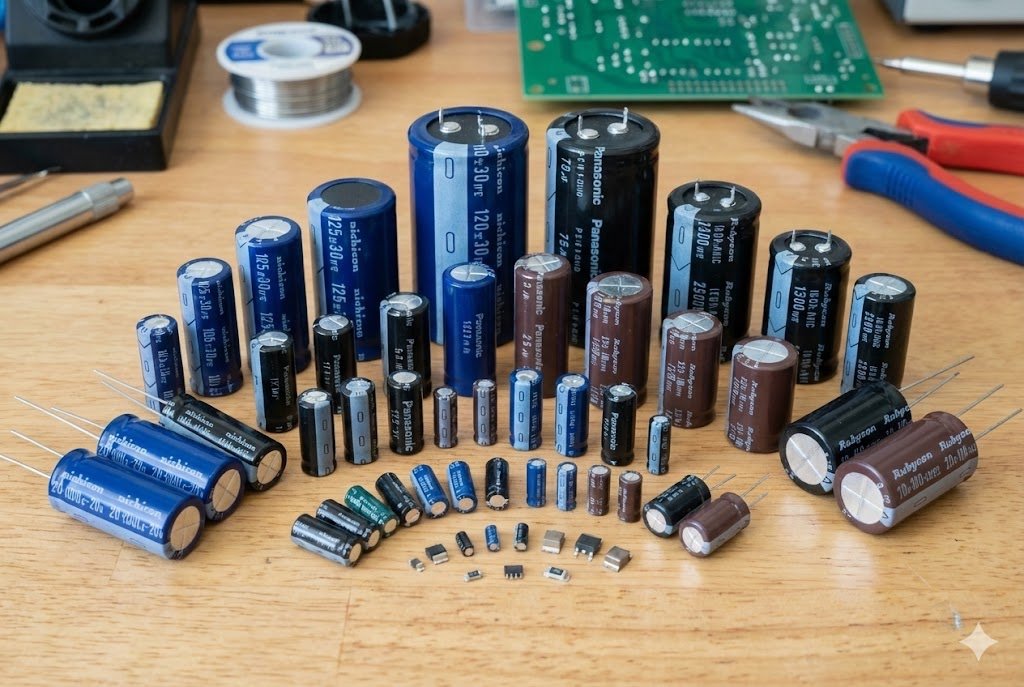
If ceramic capacitors3 are the sprinters of the capacitor world, then aluminum electrolytic capacitors4 are the marathon runners. They aren’t fast, but they have incredible stamina. Their main job is to store large amounts of energy, which we call "bulk capacitance5." You will find them in almost every power supply, from a simple wall adapter to a complex industrial power system. Their ability to provide microfarads (µF) or even millifarads (mF) of capacitance in a single component is unmatched for the price.
The Role of Bulk Capacitance
When you convert AC voltage to DC, the output is a bumpy, pulsating waveform. An electrolytic capacitor acts like a large water tank, smoothing these bumps into a steady, flat DC voltage that your electronics can use. This is called smoothing or filtering6. They also serve as a local energy reserve in a power supply, providing current during sudden load changes to prevent the voltage from dipping.
Polarity and Lifetime Considerations
One critical thing to remember is that most electrolytic capacitors are polarized. They have a positive and a negative terminal. If you install one backward, it can heat up, vent, and sometimes even explode. This is due to their internal chemical construction. Another factor is their limited lifespan. The liquid electrolyte inside can dry out over time, especially at high temperatures. This causes the capacitance to decrease and the ESR to increase, eventually leading to circuit failure. As a sourcing partner, we often help clients choose parts with long-rated lifetimes to ensure their final product is reliable for years. We always check the datasheet for the rated life at a specific temperature, for example, "2000 hours @ 105°C."
Why Are Tantalum Capacitors So Hard to Source Right Now?
Your project needs the high stability and small size of a tantalum capacitor. But you keep hitting "out of stock" notices. This shortage is disrupting production lines globally.
Tantalum capacitors are hard to source due to a combination of high demand and supply chain constraints7. The raw material, tantalum, is a conflict mineral, leading to ethical sourcing challenges. Increased use in automotive, 5G, and military applications further tightens the available supply.
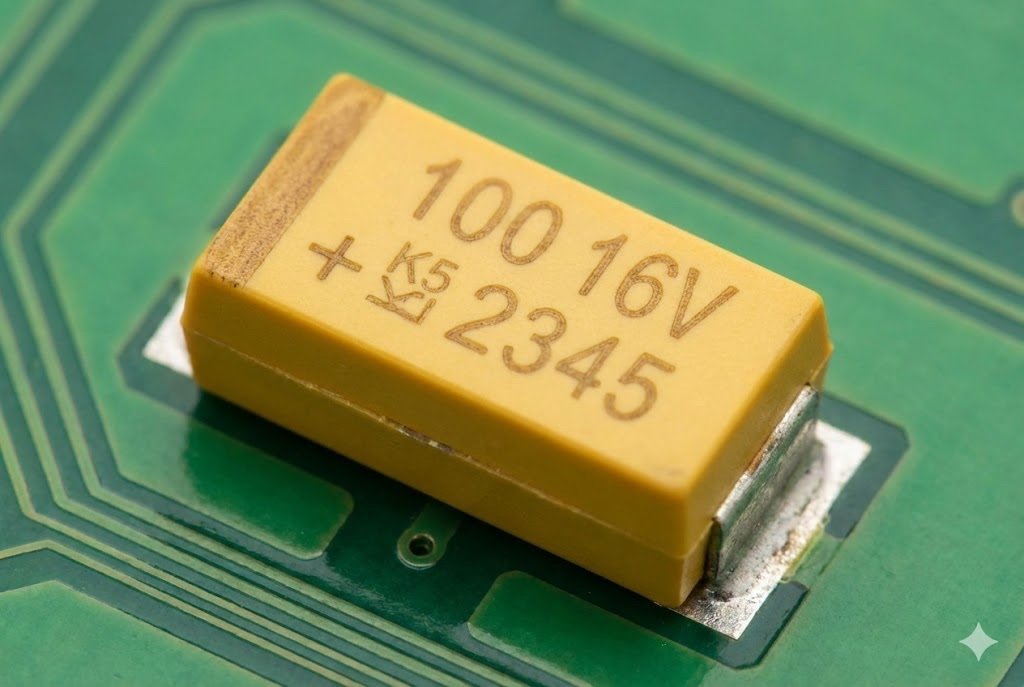
Tantalum capacitors are the premium choice in many designs, offering a fantastic blend of performance characteristics. They occupy a sweet spot between ceramic and electrolytic capacitors. They offer much higher capacitance than ceramic capacitors3 in a similar size, and they have better stability and lower ESR than aluminum electrolytic capacitors4. However, this high performance comes with a major challenge: availability.
The "Miracle" Properties of Tantalum
Why do engineers love them so much?
- High Volumetric Efficiency: They pack a lot of capacitance into a very small volume. This is critical for space-constrained designs like mobile devices and compact industrial sensors.
- Excellent Stability: Their capacitance value is very stable over temperature and time, and they don't have the voltage coefficient issues of Class 2 ceramic capacitors3.
- No Wear-Out Mechanism: Unlike aluminum electrolytic capacitors4, solid tantalum capacitors8 do not have a liquid electrolyte that can dry out, giving them a very long and reliable service life.
The Root of the Shortage
The problem lies in the supply chain. Tantalum ore is often mined in politically unstable regions, making it a "conflict mineral." This creates significant ethical and logistical challenges for sourcing raw materials responsibly. On top of that, demand has exploded. The automotive industry, 5G infrastructure, and military/aerospace applications all rely heavily on tantalum capacitors8 for their reliability and performance. This surge in demand from high-value sectors is squeezing out supply for other industrial and consumer products.
Just last month, a client in the industrial automation space came to us. Their production was about to halt because their primary supplier couldn't deliver a specific tantalum capacitor for another 52 weeks. It's a widespread problem, and it's not just about finding any part; it's about finding a reliable, original, and traceable one.
How Do You Compare These Three Capacitor Types Side-by-Side?
Feeling overwhelmed by the different capacitor specs? Choosing incorrectly can compromise your design. A clear comparison makes the decision process simple and risk-free.
A side-by-side comparison is key. Ceramic capacitors lead in high-frequency performance. Electrolytic capacitors offer the highest capacitance for the lowest cost. Tantalum capacitors provide a superior balance of high capacitance, small size, and stability, making them a premium choice.
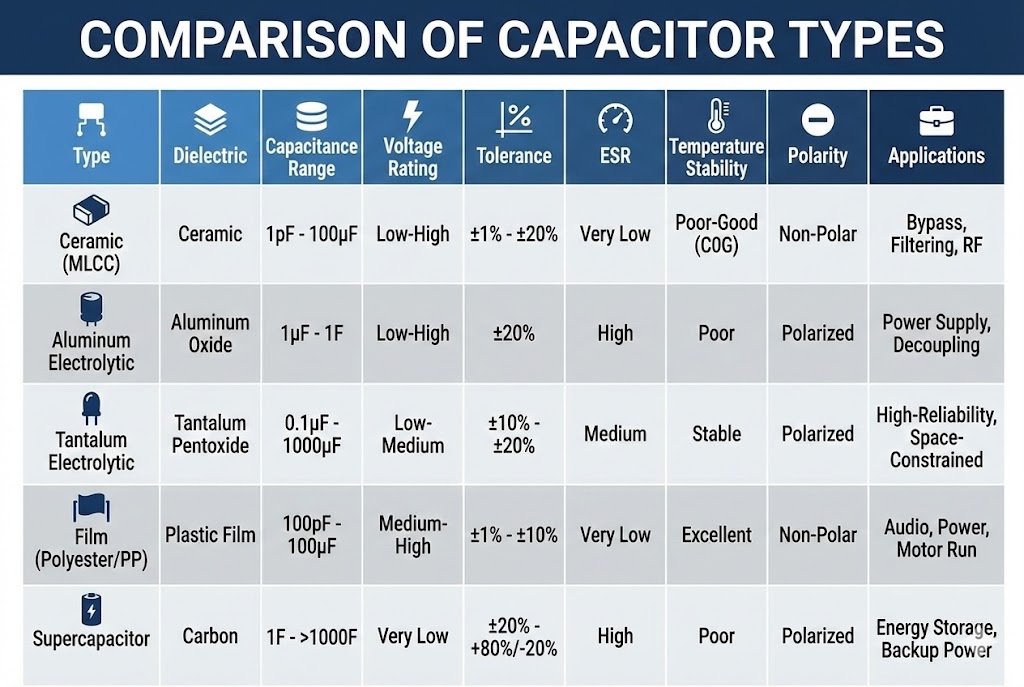
Choosing the right capacitor is a game of trade-offs. You are constantly balancing performance, size, cost, and availability. To make this easier, let's put the key characteristics of these three types into a simple table. This is the kind of analysis we do every day when helping our clients select components for their Bill of Materials (BOM)9.
Direct Comparison Table
| Characteristic | Ceramic (MLCC) | Aluminum Electrolytic | Tantalum |
|---|---|---|---|
| Capacitance Range | Low to Medium (pF to ~100µF) | High (µF to mF) | Medium to High (µF to ~1000µF) |
| Voltage Range | Low to High | Low to High | Low to Medium |
| ESR (Resistance) | Very Low | High | Low to Medium |
| Size (for same C/V) | Smallest | Largest | Small |
| Cost | Low (for small values) | Very Low | Medium to High |
| Stability | Varies (C0G is excellent, X7R is fair) | Fair (degrades with time/temp) | Excellent |
| Polarity | No | Yes | Yes |
| Primary Use Case | High-frequency decoupling, filtering, timing | Bulk energy storage, power supply smoothing | High-density power, filtering, coupling |
As you can see from the table, there is no single "best" capacitor. If you need to filter noise on a 1GHz signal line, a ceramic C0G is the only right answer. If you need to hold up a 5V rail for 100 milliseconds, a large electrolytic is your most cost-effective solution. But if you need 100µF of stable capacitance in a tiny package for a portable medical device, tantalum is often the ideal choice—if you can get it. Understanding these trade-offs is the first step to a robust and manufacturable design.
Worried that tantalum capacitor shortage10s will stop your production line? This uncertainty costs time and money. A strategic sourcing partner can secure the components you need.
Navigate tantalum shortages by partnering with a sourcing specialist like NexCir. We use our global network to find original, traceable components, identify viable alternatives, and provide market intelligence11 on lead times and pricing. This proactive approach ensures your production continues.

Knowing which capacitor you need is one thing; actually getting it is another. For components like tantalum capacitors8, the standard distribution channels are often depleted, with lead times stretching over a year. This is where a sourcing strategy12 becomes more important than just a purchasing process.
Beyond Traditional Distribution
Traditional distributors sell what they have in stock. When they run out, you have to wait. At NexCir, we operate differently. We are not an inventory-driven seller; we are a capability-driven sourcing partner. Our strength is our global network and our market expertise. When a part is unavailable through normal channels, we begin a global search through our network of vetted and trusted suppliers to find original, traceable stock.
The Power of a Global Network
Our job isn't to sell you what we have in a warehouse. It's to understand your Bill of Materials (BOM)9 and your project's lifecycle. When a tantalum part is on a 60-week lead time, we don't just tell you to wait. We activate our network to find available stock from other regions, or we leverage our relationships to get better allocation from manufacturers. We provide you with real-time market intelligence11 so you can make informed decisions about your inventory and production planning.
Finding Alternatives and Ensuring Quality
Sometimes, the original part is truly unavailable. In these cases, we work with your engineering teams to find and qualify a suitable replacement. This might be a polymer tantalum capacitor, a high-capacitance MLCC, or a part from a different manufacturer with identical form, fit, and function. We assist in the cross-referencing process and ensure any alternative meets your quality and reliability standards. This proactive approach is what we mean by being a value-driven partner, focused on keeping your production lines moving.
Conclusion
Choosing the right capacitor is vital, but so is securing its supply. With tantalum shortages ongoing, a strong sourcing strategy12 is your best defense against production delays.
Understand the impact of ESR on capacitor performance and why it matters in circuit design. ↩
Explore the significance of ESL in capacitors and how it affects high-frequency applications. ↩
Explore the advantages of ceramic capacitors for high-frequency applications and how they ensure signal integrity. ↩
Learn why aluminum electrolytic capacitors are ideal for energy storage and their cost-effectiveness in power supplies. ↩
Find out how bulk capacitance stabilizes power supplies and supports sudden load changes. ↩
Learn how capacitors are used to smooth and filter voltage in power supply circuits. ↩
Understand the impact of supply chain constraints on component availability and production. ↩
Discover the unique properties of tantalum capacitors that make them essential for high-performance designs. ↩
Discover the significance of a BOM in electronics design and component sourcing. ↩
Explore the reasons behind the tantalum capacitor shortage and its impact on production. ↩
Discover how market intelligence can guide sourcing decisions and improve supply chain management. ↩
Learn how a strategic sourcing approach can mitigate component shortages and ensure supply. ↩


