leading paragraph: You might feel confused when you look at different coin cell batteries1 for your electronics project. If you choose the wrong one, your device might fail or stop working too soon.
snippet paragraph: The main difference is size and capacity2. The CR24503 is 5.0mm thick with a capacity of about 620mAh, while the CR2032 is 3.2mm thick with only 225mAh. You cannot easily swap them because the CR24503 will not fit into a holder designed for the thinner CR2032.
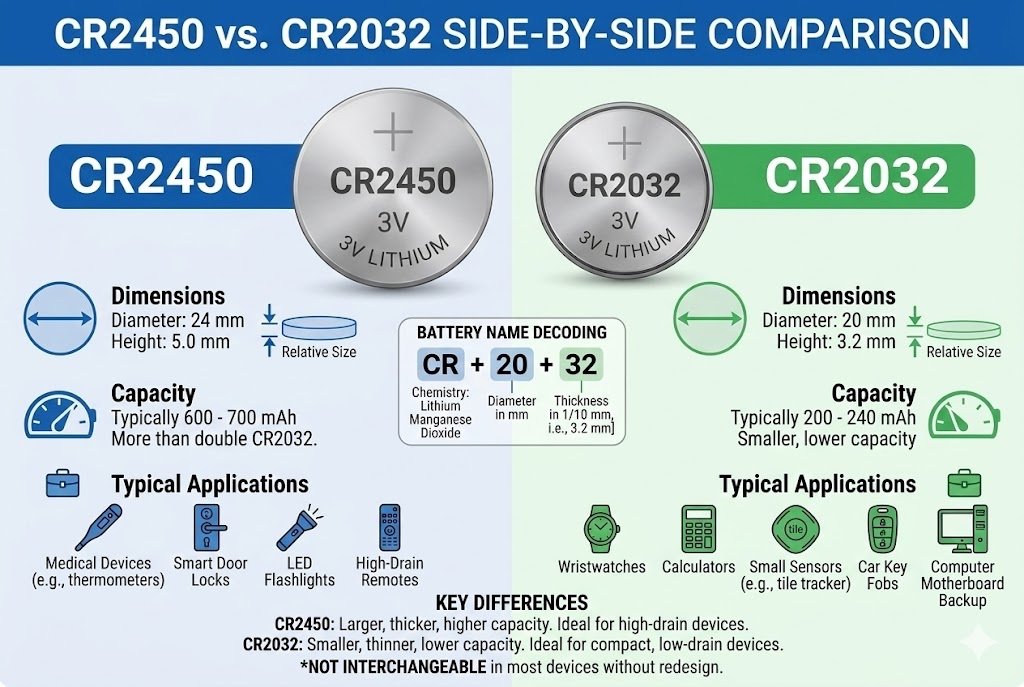
Transition Paragraph: I have seen many engineers make mistakes with these batteries because they look similar from the top. I want to explain the specific details so you can make the best choice for your product design.
LOOP START
What Do the Numbers CR24503 and CR2032 Actually Mean?
leading paragraph: You probably wonder why these batteries have such specific names and numbers. The International Electrotechnical Commission (IEC)4 uses these numbers to tell us the exact physical size of the battery.
snippet paragraph: The first two numbers, "24" and "20," represent the diameter in millimeters5. The last two numbers, "50" and "32," represent the height or thickness. So, a CR24503 is 5.0mm tall, and a CR2032 is only 3.2mm tall.
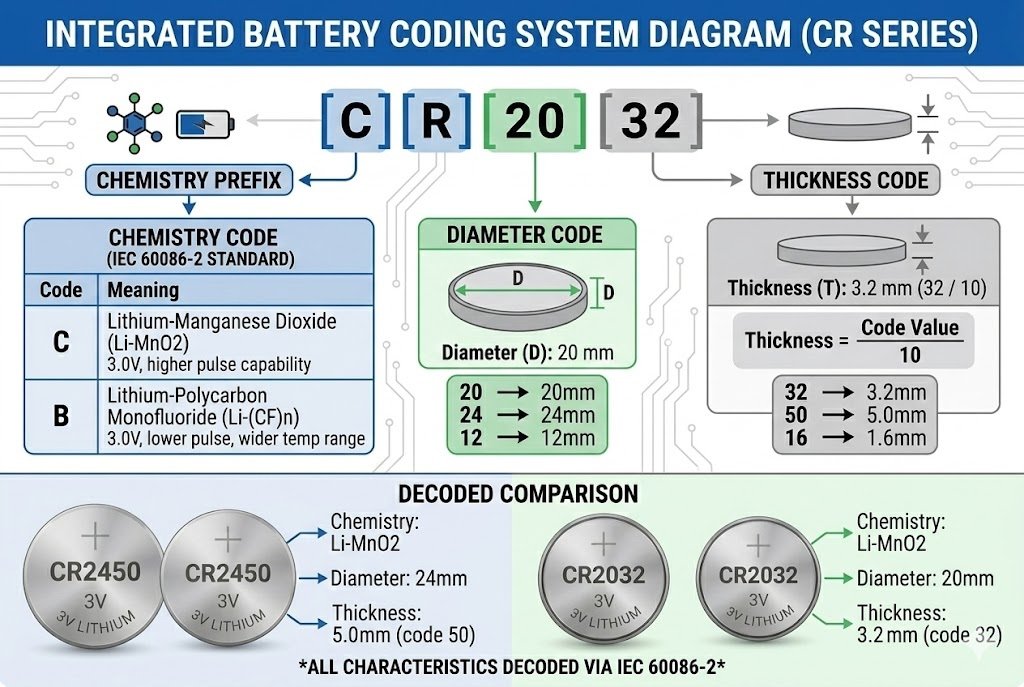
Dive deeper Paragraph: I want to break down these numbers further so you understand exactly what you are buying. In the electronics industry, space is very important. Even a small difference of 1.8mm in thickness can ruin a PCB design. The "C" in the name stands for Lithium Manganese Dioxide chemistry6. The "R" simply stands for Round.
When we look at the physical volume7, the CR24503 is significantly larger internally. This is not just about the outer shell. The internal volume allows manufacturers to pack more anode and cathode material inside. Here is a simple breakdown of the physical specs:
| Feature | CR2032 | CR24503 | Difference |
|---|---|---|---|
| Diameter | 20 mm | 24.5 mm | CR24503 is wider |
| Height (Thickness) | 3.2 mm | 5.0 mm | CR24503 is thicker |
| Typical Weight | 3.0 grams | 6.8 grams | CR24503 is heavier |
| IEC Code | CR2032 | CR24503 | Standard Naming |
You can see from the table that the CR24503 is more than double the weight of the CR2032. This extra weight is mostly the active chemical material. If you are designing a very small wearable device, like a fitness tracker, the 5.0mm thickness of the CR24503 might be too big. However, if you have the space, the CR24503 offers much more "fuel" for your device. At Nexcir8, I always tell my clients to measure their enclosure first. You cannot force a thick battery into a thin case without breaking the plastic or the circuit board.
LOOP END
LOOP START
How Does the Capacity Difference Impact Device Runtime?
leading paragraph: You care most about how long your device will run before the battery dies. The capacity difference between these two batteries is huge and will change your product's performance.
snippet paragraph: The CR24503 usually has a capacity of 620mAh, while the CR2032 only has around 225mAh. This means the CR24503 can last almost three times as long as the CR2032 in the same device.
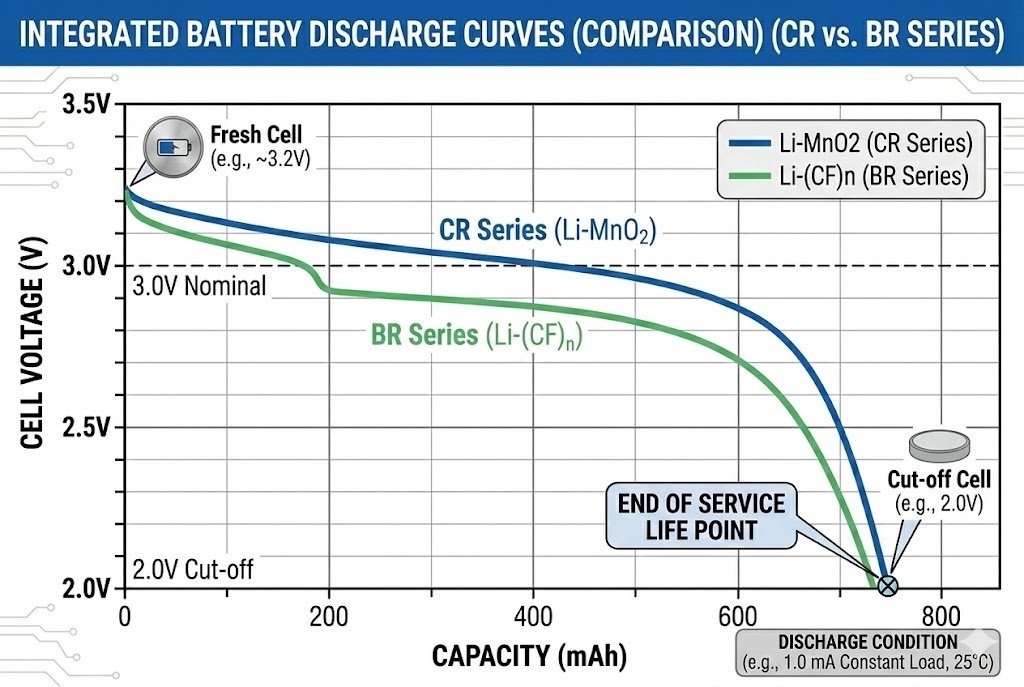
Dive deeper Paragraph: I want to discuss the "mAh" rating deeply because this is where many procurement managers get confused. mAh stands for milliampere-hour. It is like the size of the gas tank in a car. The CR2032 is the industry standard for computer motherboards and car key fobs because 225mAh is enough for those low-power jobs. However, 225mAh is quite small for modern IoT devices.
The CR24503 offers roughly 620mAh. This is a massive jump. It is nearly triple the energy storage. If you have a device that draws a constant small current, the math is simple.
Theoretical Runtime Calculation
| Battery Type | Capacity | Load Current (Example) | Estimated Runtime |
|---|---|---|---|
| CR2032 | 225 mAh | 0.5 mA | 450 Hours |
| CR24503 | 620 mAh | 0.5 mA | 1,240 Hours |
You can see the difference clearly in the table. If you use a CR24503, you reduce the number of times your customer has to change the battery. This is vital for industrial sensors or remote controls where changing a battery is difficult. Also, the larger CR24503 often has a lower internal resistance. This helps it maintain voltage better when the battery is getting old. If you choose the smaller battery just to save space, you might hurt the user experience because the device will die too quickly.
LOOP END
LOOP START
Can You Interchange These Batteries in a PCB Battery Holder?
leading paragraph: You might think you can just swap these batteries if the voltage is the same. I strongly advise you not to do this because the physical fit will cause major electrical problems.
snippet paragraph: The 5.0mm vs 3.2mm thickness difference affects the PCB battery holder9 design. A CR24503 will physically not fit into a CR2032 holder, and a CR2032 will be too loose in a CR24503 holder.
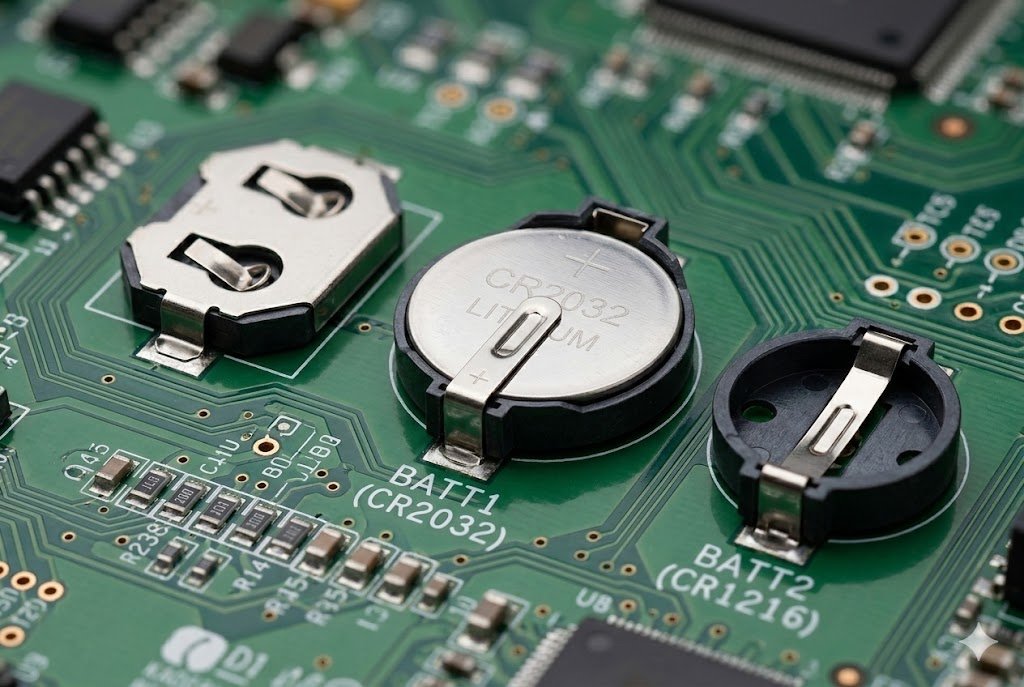
Dive deeper Paragraph: I have seen engineers try to force these batteries to work, and it usually ends badly. Let's look at the mechanics of the battery holder. The battery holder relies on spring tension10 to keep the metal contacts touching the battery.
If you have a holder designed for the 5.0mm thick CR24503, and you put a 3.2mm thick CR2032 inside, there is a 1.8mm gap. The top contact will not touch the battery. The circuit will remain open, and the device will not turn on. Some people try to bend the metal clip down to make contact. This is dangerous. It puts stress on the solder joints connecting the holder to the PCB. Eventually, the holder will snap off the board.
On the other hand, if you try to put a thick CR24503 into a thin CR2032 holder, you will likely break the plastic housing. Even if you force it in, the pressure on the PCB is too high. This can cause the circuit board to warp or crack.
Design Considerations for Holders
- Vertical Clearance11: Ensure your device casing has room for the 5.0mm height of the CR24503.
- Footprint Width: The CR24503 is 24.5mm wide. It needs more board space than the 20mm CR2032.
- Vibration: In automotive or industrial use, a loose battery (CR2032 in a large holder) will disconnect constantly.
At Nexcir8, we source specific holders for specific batteries. We recommend you decide on the battery first, then select the holder. Do not try to make one holder do both jobs.
LOOP END
LOOP START
Why Is the CR24503 Better for High-Frequency Wireless Devices?
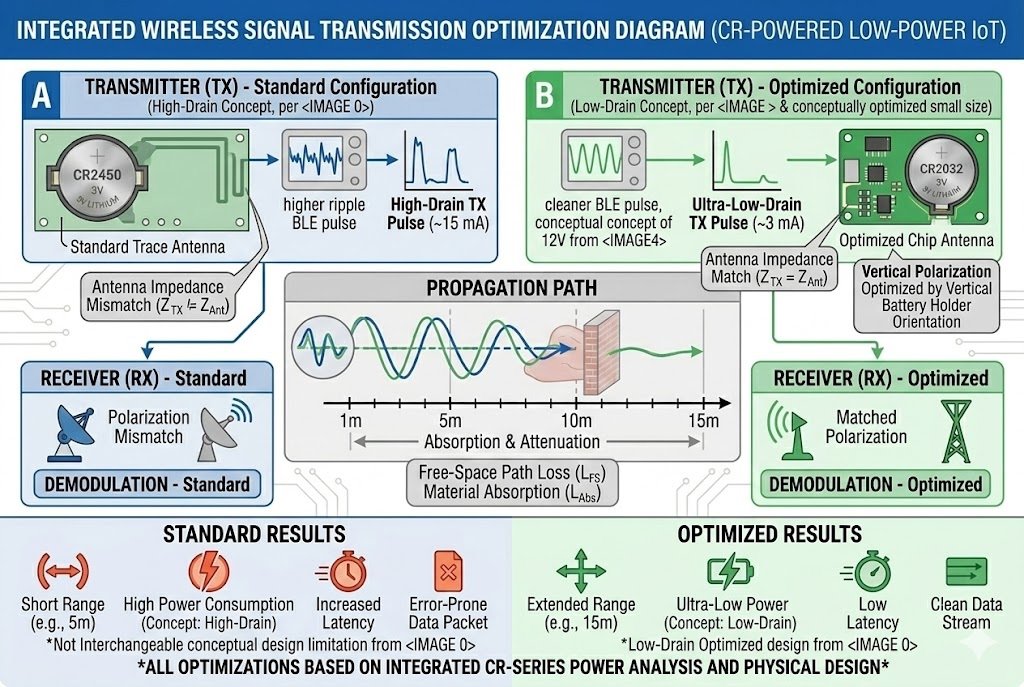
leading paragraph: You are likely building devices that connect to Bluetooth, Zigbee, or LoRaWAN. These wireless technologies need bursts of power, and the CR24503 handles this much better than the smaller CR2032.
snippet paragraph: Wireless devices use high pulses of energy. If you force a replacement with a CR2032, the voltage drops too fast under load. This can reduce your total battery life by more than 60%.
Dive deeper Paragraph: This is the most critical insight I can share with you today. Many people look at the capacity (mAh) and think the difference is linear. They think, "The CR2032 is 1/3 the size, so it will last 1/3 as long." This is wrong for wireless devices.
Wireless chips (like a Bluetooth module) sit idle most of the time but "wake up" to send data. When they wake up, they pull a high current pulse (maybe 10mA to 30mA) for a split second. This is a heavy load for a coin cell.
The CR2032 has a smaller surface area for chemical reaction. When that high pulse hits, the voltage inside the CR2032 drops momentarily. If the voltage drops below the "cutoff voltage12" of your chip (usually 2.0V or 1.8V), the device shuts down. This happens even if the battery still has 50% capacity left!
The "60% Reduction" Reality
Because the CR24503 is larger, it handles these pulses better. It stays above the cutoff voltage12 for longer.
- Scenario: You design a sensor for a CR24503.
- Mistake: You decide to switch to a CR2032 to save space.
- Result: You don't just lose 65% of your capacity (620mAh to 225mAh). You actually lose effective runtime13 because the CR2032 hits the voltage cutoff much earlier under pulse load.
I have seen reliable data showing that in high-pulse applications, switching to the smaller battery reduces useful life by over 60% compared to the theoretical calculation. Always use the CR24503 if you have frequent data transmissions.
LOOP END
Conclusion
The CR24503 is thicker and holds three times more energy, making it essential for long-life wireless devices, while the CR2032 is best for small, low-power memory backup.
Understanding the variety of coin cell batteries helps you choose the right one for your electronics project. ↩
Discover how the size and capacity of a battery influence its performance and compatibility with devices. ↩
Learn about the CR2450's specifications to see if it fits your device's power and size requirements. ↩
Understand how the IEC's naming conventions help identify battery specifications. ↩
Learn how battery diameter is measured to ensure proper fit in your device. ↩
Explore the benefits of Lithium Manganese Dioxide chemistry in enhancing battery performance. ↩
Understand how the physical volume of a battery affects its energy storage capabilities. ↩
Explore Nexcir's battery solutions to find the best fit for your electronic projects. ↩
Find out how PCB battery holders secure batteries and ensure proper electrical contact. ↩
Learn how spring tension in battery holders affects the stability and connection of batteries. ↩
Understand the importance of vertical clearance in ensuring battery fit and device integrity. ↩
Explore the concept of cutoff voltage to prevent device shutdowns due to battery issues. ↩
Understand how to calculate effective runtime to optimize battery usage in devices. ↩