You ordered the TJA1051T transceiver, but your circuit board is dead. Production has stopped, and your engineers are blaming the components. The problem is likely not the chip quality, but a tiny detail in the part number suffix.
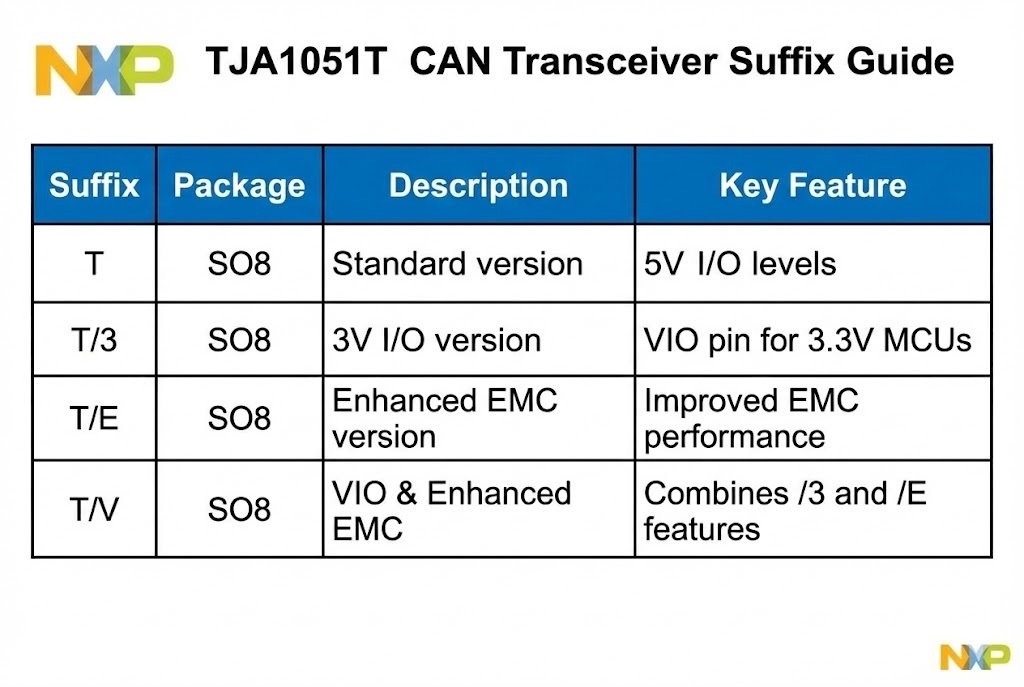
The TJA1051T suffixes define critical electrical features and packaging types. Specifically, the /3 suffix1 indicates a VIO pin2 for 3V-5V interfacing, which is essential for modern 3.3V microcontrollers3. Meanwhile, suffixes like /CM, /1T, and /118 denote packaging forms like reels or tubes. Choosing the wrong one causes system failure.
I have seen this situation happen many times in my 20 years in the electronics industry. A procurement manager buys the base part number because it looks cheaper or is available. Then, the engineering team discovers the MCU cannot talk to the transceiver. It is a small mistake with a huge cost. Let us look at the details so you do not make this mistake again.
Why is the /3 suffix1 critical for your MCU voltage?
Your 3.3V microcontroller cannot communicate with the CAN bus4, even though the connections look correct. You checked the code, but the hardware remains silent. The problem is almost certainly a voltage level mismatch.
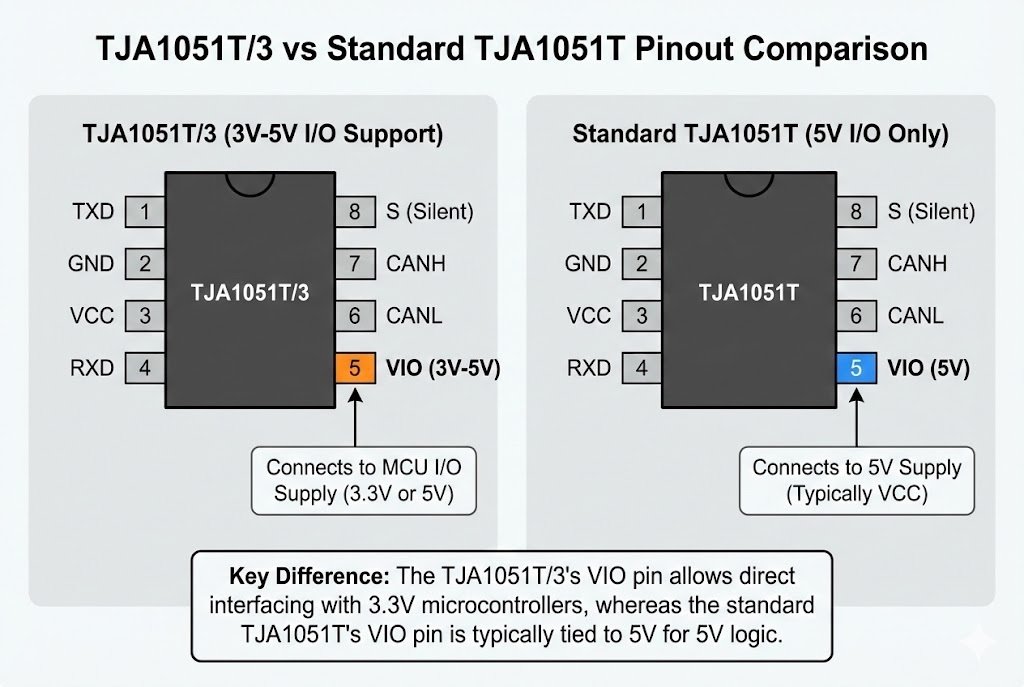
The /3 suffix1 (as in TJA1051T/3) indicates the presence of a VIO pin2. This pin allows the transceiver to interface directly with 3.3V microcontrollers3 without external level shifters. Without the /3, the part operates on 5V logic. If you use a standard TJA1051T with a 3.3V MCU, communication will fail.
I want to dive deep into this because it is the most common technical pain point I see at Nexcir. The TJA1051 is a high-speed CAN transceiver. It provides the interface between a Controller Area Network (CAN) protocol controller and the physical two-wire CAN bus4. However, the world of microcontrollers (MCUs) has changed. Years ago, almost every chip ran on 5V. Today, modern MCUs like the STM32, ESP32, or newer NXP automotive chips run on 3.3V or even lower voltages.
This creates a gap. The CAN bus4 itself requires specific voltage levels to operate, usually driven by a 5V supply (VCC). But the signals coming from your MCU (TXD and RXD) are at 3.3V.
If you buy the Standard TJA1051T5 (without /3): The chip expects the logic signals to match the VCC supply, which is 5V. If your MCU sends a 3.3V signal, the transceiver might not recognize it as a "High" signal. Or worse, the transceiver might send a 5V signal back to your 3.3V MCU, potentially damaging your processor.
If you buy the TJA1051T/3: This version re-purposes Pin 5. On the standard version, Pin 5 is often not connected or used for a split termination. On the /3 version, Pin 5 is the VIO pin. You connect this pin to your MCU's power supply (3.3V). The internal logic of the transceiver then automatically adjusts the thresholds. It translates the 3.3V signals from the MCU up to the levels needed for the CAN bus4, and scales the received signals back down to 3.3V for the MCU.
Here is a simple breakdown to help you check your Bill of Materials (BOM):
| Feature | Standard TJA1051T5 | TJA1051T/3 |
|---|---|---|
| Pin 5 Function6 | Not Connected / SPLIT | VIO (Supply Voltage for I/O) |
| Logic Voltage Support7 | 5V Only | 3V to 5V (Matches VIO) |
| Target MCU | Legacy 5V MCUs | Modern 3.3V MCUs |
| Risk of Wrong Use | High (Logic Mismatch) | Low (Flexible) |
At Nexcir, when a client asks for a quote on "TJA1051", I always ask: "What is your MCU voltage?" This simple question saves them weeks of debugging. If you are building an IoT device or a modern automotive module, you almost certainly need the /3 suffix1.
What is the difference between /CM, /118, and /1T packaging codes?
The reel does not fit your pick-and-place machine, or you received a partial reel when you needed a full one. The production line manager is calling you with complaints. This logistical nightmare happens when you ignore packaging codes.
These suffixes indicate how the chips are physically packed and where they were finished. /118 usually means a standard tape and reel. /CM often denotes industrial packing or specific manufacturing origins. While the silicon inside is the same, the reel size or quantity affects your manufacturing automation process.
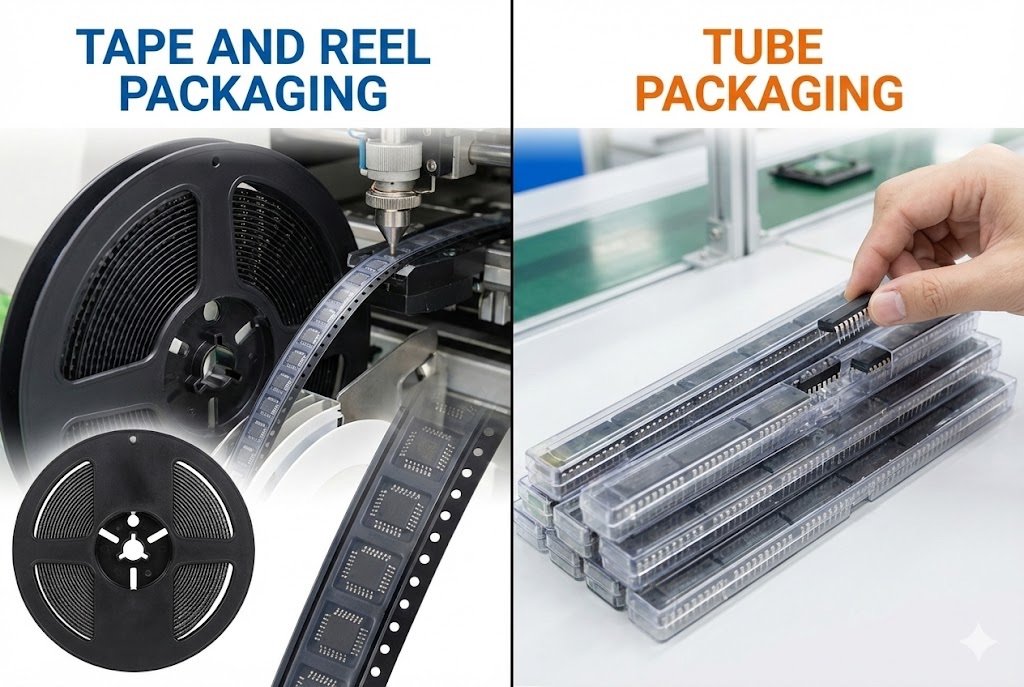
This is where things get confusing for many buyers. Unlike the /3 suffix1, which changes the electrical behavior, suffixes like /118, /1T, /CM, or /J do not change how the chip works. However, they change how the chip is delivered. In my experience, ignoring this leads to production delays, even if the chip is technically correct.
NXP (and formerly Philips) uses a complex system for these codes. They often represent the "Packing Suffix".
- The /118 Suffix: This is the most common code you will see. It typically represents a standard 13-inch reel holding roughly 2,500 pieces. It is designed for high-volume automated assembly lines. If you are buying for a large production run, this is usually what you want.
- The /CM Suffix: This code often appears on newer NXP parts or parts coming from specific assembly sites (like their plants in Asia). Sometimes, /CM replaces /118 in their ordering system. It usually still means Tape and Reel8, but it might indicate a different "Carrier Material" or a different moisture sensitivity level packing.
- The /1T or /1J Suffix: Sometimes you will see codes that indicate a "Tube" or "Tray". If you order a /112 (often tube) but your factory uses a high-speed pick-and-place machine, they cannot use the parts easily. They have to manually load them or re-reel them, which costs money and risks bending the pins.
I have also seen issues with "Cut Tape9". If you buy from a catalog distributor, they might cut a strip off a /118 reel. But if you need a full manufacturer-sealed reel for moisture protection, you must order the full quantity associated with that suffix.
Here is a guide to help you interpret these logistical codes:
| Suffix Code | Typical Meaning | Typical Quantity | Best For |
|---|---|---|---|
| /118 | Tape & Reel (13") | ~2500 pcs | Mass Production |
| /1J or /112 | Tube / Rail | ~50 to 100 pcs | Prototyping / Manual Assembly |
| /CM | Tape & Reel (Industrial) | ~2500 - 3000 pcs | Mass Production (Check Datasheet) |
| /Z | Reel (Lead-Free) | Varies | Green Compliance |
When we source at Nexcir, we check the "Ordering Information" section of the datasheet for you. We confirm if your factory needs a specific reel size. We also ensure that if the part number changes (e.g., NXP updates /118 to /CM for a specific line), we inform you that the part is electrically identical. This transparency builds trust and keeps your lines moving.
How can you avoid production stops by choosing the right suffix?
Replacing wrong components takes weeks and costs thousands of dollars in downtime. Your competitors are shipping products while you wait for new parts. You need a verified way to get it right the first time.
To avoid downtime, you must verify the full part number against your MCU specifications and assembly requirements. Do not just look at the base part number "TJA1051". Partnering with a distributor who understands these technical nuances ensures you receive the exact component your design needs.
The cost of a TJA1051 transceiver is less than a dollar. But the cost of stopping a production line in an automotive or industrial factory can be thousands of dollars per hour. I founded Nexcir with a vision: "Next Circuit, Next Future10." To reach that future, we have to eliminate the errors of the past. The most common error is lack of attention to detail in procurement.
Here is how you can use critical thinking to secure your supply chain:
1. The "Base Part" Trap Many ERP systems truncate part numbers. Your engineer might write "TJA1051" in the description. You search for "TJA1051" and buy the cheapest one, which is likely the 5V version without the /3. Action: Always force your engineering team to provide the full ordering code, including suffixes.
2. The Revision Factor11 NXP updates their silicon. You might see TJA1051T/3 vs TJA1051TK/3. The "K" might imply a generic package (HVSON8) versus the "T" (SO8). If you buy the "K" version, it will not fit on the "T" footprint on your PCB. Action: Verify the package type (SOIC-8 vs DFN/HVSON) visually before ordering.
3. The Counterfeit Risk12 This is a dark reality of our industry. High-demand parts like the TJA1051T/3 are often targets for counterfeiters. Bad actors will take a cheap, standard TJA1051T (5V only), sand off the top, and re-print "TJA1051T/3" on it. You buy it, install it, and your 3.3V MCU fails. Action: Only buy from authorized distributors or trusted partners like Nexcir who have full traceability. We source exclusively from authorized channels. We know how to spot a re-marked chip.
4. The Nexcir Advantage13 We do more than move boxes. We act as a filter. When you send us a BOM, we look for these inconsistencies. If we see a 3.3V MCU on your list but a 5V transceiver, we will flag it. We provide this technical support because we want long-term partners, not just a one-time sale.
Here is a checklist we use at Nexcir that you can use too:
| Checkpoint | Question to Ask | Why it Matters |
|---|---|---|
| Voltage | Is the MCU 3.3V or 5V? | Determines need for /3 suffix. |
| Package | Is the footprint SOIC-8 or HVSON? | Determines T vs TK letter. |
| Packing | Does the machine need Reel or Tube? | Determines /118 vs /112. |
| Origin | Is the source authorized? | Prevents re-marked fake suffixes. |
By paying attention to these suffixes, you protect your production schedule. You ensure that the "Next Circuit" you build actually works.
Conclusion
Suffixes are not just random numbers; they define voltage compatibility (/3) and manufacturing logistics (/CM, /118). Ignoring them leads to hardware failure or assembly jams. At Nexcir, we decode these details for you, ensuring you get the authentic, correct components to keep your business running smoothly.
Understanding the /3 suffix is crucial for ensuring compatibility with modern 3.3V microcontrollers, preventing costly communication failures. ↩
The VIO pin allows direct interfacing with 3.3V microcontrollers, eliminating the need for external level shifters and ensuring seamless communication. ↩
3.3V microcontrollers are widely used in modern electronics, and understanding their voltage requirements is key to selecting compatible components. ↩
The CAN bus is essential for communication in automotive and industrial applications, making it vital to understand its voltage requirements. ↩
Using the Standard TJA1051T with 3.3V MCUs can lead to communication failures due to voltage mismatches, highlighting the need for the /3 suffix. ↩
Pin 5's function varies between standard and /3 versions, affecting voltage compatibility and communication success. ↩
Understanding logic voltage support helps in selecting the right transceiver for your MCU, preventing potential damage and failures. ↩
Tape and Reel packaging is crucial for automated assembly lines, ensuring efficient and error-free component placement. ↩
Cut Tape can lead to moisture protection issues and manual handling, affecting production efficiency and component integrity. ↩
This vision emphasizes eliminating procurement errors to build reliable, future-ready electronic systems. ↩
The Revision Factor affects compatibility with existing designs, making it crucial to verify package types before ordering. ↩
Counterfeit components can cause failures and damage, so sourcing from authorized distributors is essential for quality assurance. ↩
Nexcir offers technical support and verification, ensuring you receive the correct components and avoid costly errors. ↩