You spend weeks designing a circuit, but the signal is noisy. You check the processor, but the problem is actually the switch. Choosing the wrong switch type can destroy your signal integrity1.
An SPDT switch2 connects one input to two outputs, while a DPDT controls two separate circuits simultaneously. For power, use mechanical switches3. For high-frequency data4 or audio, you must use an Analog Switch IC5 like the TI TS5A31596 to prevent signal loss and noise.
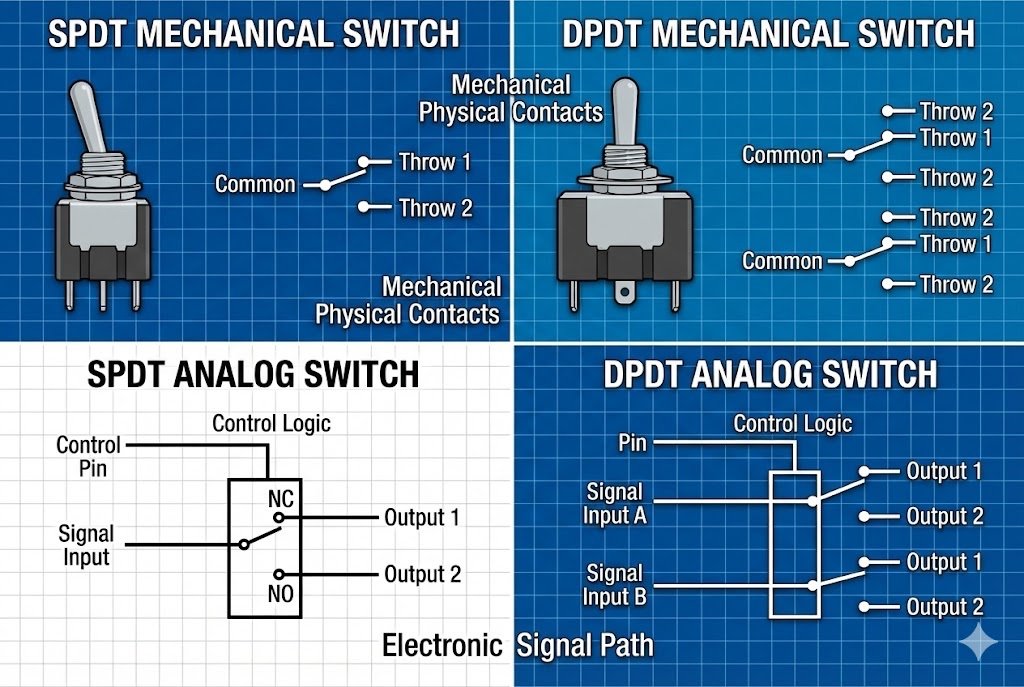
I remember a project early in my career where I tried to use a simple mechanical relay to switch a high-speed data line. The system failed miserably because of contact bounce7. I learned the hard way that understanding the core difference between mechanical switching and analog IC switching is vital. In this guide, I will walk you through the basics of SPDT and DPDT, and then explain why you need to move to Analog Switch IC5s for modern electronics.
What Are the Fundamental Differences Between SPDT and DPDT Switches?
Do you feel confused by the acronyms on component datasheets? You are not alone. Before we talk about chips, we need to understand the basic logic of "Poles" and "Throws."
SPDT (Single Pole Double Throw) has one input and two output choices. DPDT (Double Pole Double Throw) is essentially two SPDT switch2es combined into one housing, controlled by a single mechanism. SPDT selects between A and B; DPDT switch8es two pairs of lines at once.
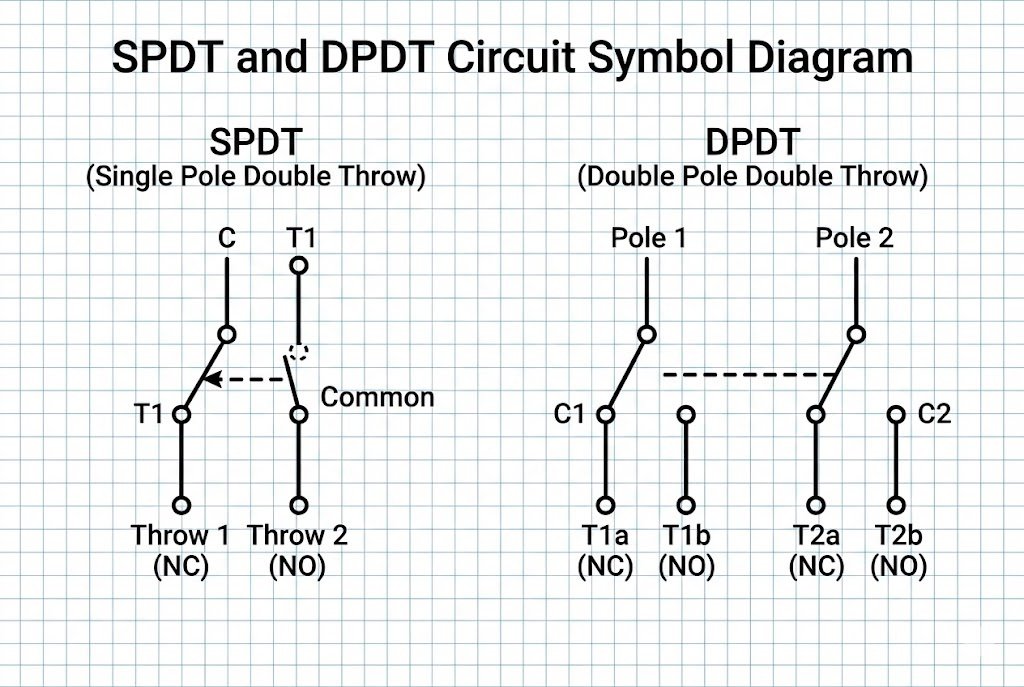
Let us dig deeper into the mechanics of these switches. The terms "Pole" and "Throw" describe the switch variations. The "Pole" refers to the number of separate circuits the switch controls. The "Throw" refers to the number of positions the switch can connect to.
I often explain it to my clients like this: think of an SPDT switch2 as a simple railroad track diverter. A train comes in on one track, and you decide if it goes left or right. A DPDT switch8 is like having two parallel tracks with diverters that move at the exact same time.
Common Use Cases
To help you visualize where to use each type, I have created this breakdown:
| Feature | SPDT (Single Pole Double Throw) | DPDT (Double Pole Double Throw) |
|---|---|---|
| Structure | 3 Terminals (1 Common, 2 Outputs) | 6 Terminals (2 Common, 4 Outputs) |
| Primary Function | Toggling between two modes (e.g., On/Standby). | Reversing polarity or switching two signals. |
| Typical Application | Simple sensor selection or light switching. | Motor direction control (H-Bridge logic9). |
| Complexity | Low complexity, easier to route on PCB. | Higher complexity, requires more PCB space10. |
Critical Thinking: The Mechanical Limit
While these definitions apply to both mechanical switches3 and ICs, the physical implementation matters. If you are building a toy car, a mechanical DPDT toggle switch is perfect for making the motor go forward and backward. However, if you are routing USB signals, a mechanical switch is a disaster. It is too large, and the metal contacts inside bounce when they hit each other. This brings us to the most important decision factor: signal frequency.
Why Do Mechanical Switches Fail in High-Frequency Applications?
is your signal looking distorted on the oscilloscope? If you are using a mechanical relay or toggle for data, the physical contacts are likely bouncing and creating interference.
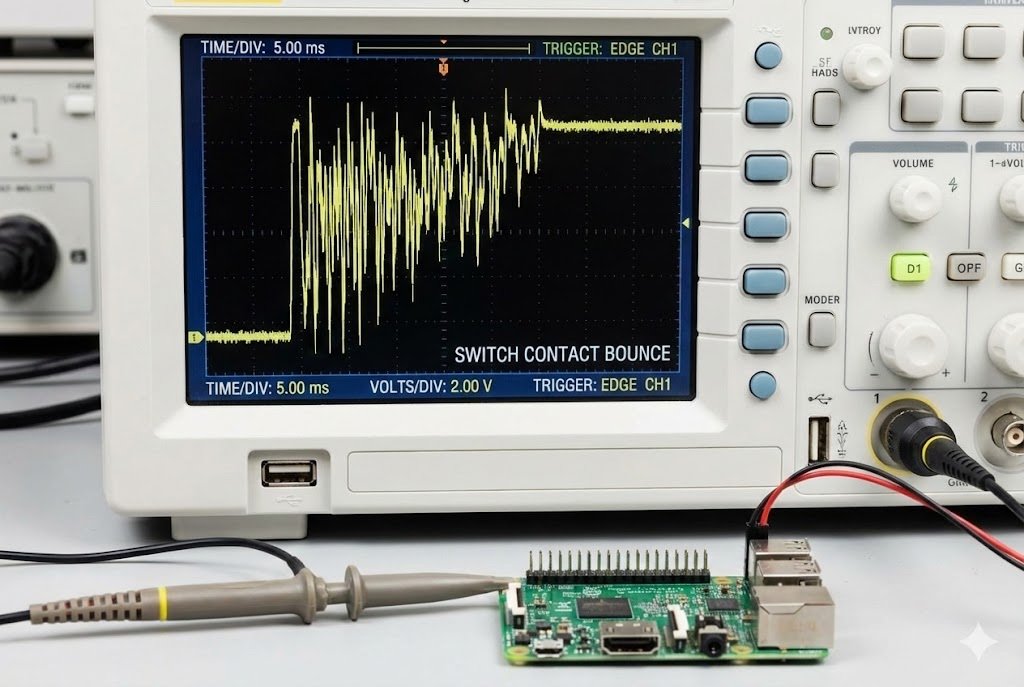
Mechanical switches rely on physical metal parts touching. This causes "contact bounce7," where the signal flickers on and off rapidly for milliseconds. In high-speed circuits, this bounce corrupts data, making mechanical switches3 unsuitable for signals above a few kilohertz.
When we talk about "high frequency," we are not just talking about radio waves. Even modern digital audio11 or sensor data is fast enough to be ruined by a mechanical switch.
The Physics of Failure
I have seen many engineers try to save money by using a cheap mechanical relay to switch audio inputs. The result is always a "pop" sound in the speakers. This happens because mechanical switches3 are slow.
- Contact Bounce: When you flip a switch, the metal piece inside does not just stick. It bounces like a dropped ball. For a light bulb, you do not see this. For a microprocessor reading data, that bounce looks like 100 different on-off signals.
- Size and Reliability: Mechanical parts wear out. Springs lose tension. Contacts oxidize. In a professional device, you cannot afford a part that fails after 10,000 uses.
- Impedance Mismatch: High-frequency signals need a smooth path. A mechanical switch is a giant abrupt change in the wire. This causes signal reflections12.
Why You Need a Different Solution
If you are designing a system that routes video signals, USB data, or precision analog sensor readings, you cannot use a mechanical lever. You need a device that acts like a switch but has no moving parts. This is where the Analog Switch IC5 comes in. It uses transistors (MOSFETs13) to open and close the circuit. It is silent, instant, and lasts forever. At Nexcir, we see a huge shift in demand from mechanical toggles to silicon-based switches for this exact reason.
When Should You Choose an Analog Switch IC5 Like the TS5A3159?
Do you need to switch signals instantly without taking up board space? If you are working with sensitive data or limited space, a mechanical switch is simply not an option.
You should choose an Analog Switch IC5 when you need high switching speed, low resistance, and high reliability. The TI TS5A31596 is an industry-standard SPDT analog switch that handles signals with minimal distortion and fits in tiny spaces.
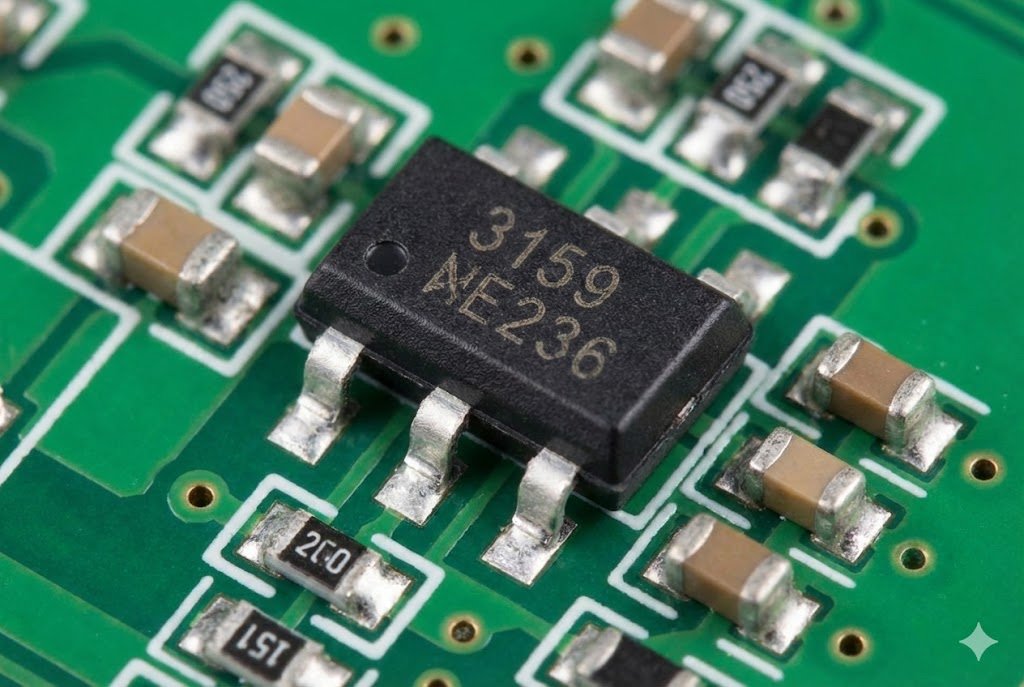
At Nexcir, we supply components to many OEM manufacturers. I often recommend the TS5A3159 from Texas Instruments when a customer asks for a reliable SPDT solution for signal routing.
Why the TS5A3159?
This chip is a perfect example of why ICs beat mechanical parts for electronics. It is a Single-Pole Double-Throw (SPDT) analog switch. However, unlike a toggle switch, it operates with a specific voltage and has "On-State Resistance%%%FOOTNOTE_REF14%%%" ($R{ON}$).
Key Performance Indicators
Let's break down why an engineer would choose this specific part over a generic mechanical switch:
| Parameter | Mechanical Switch | Analog Switch IC5 (TS5A3159) |
|---|---|---|
| Switching Speed | Milliseconds (Slow) | Nanoseconds (Fast) |
| Contact Bounce | Yes (High noise) | No (Clean signal) |
| On-Resistance ($R_{ON}$) | Very Low (< 0.1 $Omega$) | Low (1.1 $Omega$ typical for TS5A3159) |
| Size | Large (Requires panel space) | Tiny (SC70-6 package) |
| Control Logic | Manual hand or solenoid | Digital Logic (GPIO from MCU) |
Deep Dive into On-Resistance ($R_{ON}$)
You might notice the mechanical switch has lower resistance. That is true. It is just a piece of metal. But the TS5A3159 has an $R_{ON}$ of about 1 $Omega$. For data signals, this is negligible. The benefit is that the TS5A3159 has excellent "On-Resistance Flatness." This means the resistance stays stable even if the voltage changes slightly. This is crucial for audio. If the resistance changes with the music volume, you get distortion. This chip prevents that.
Also, this IC has a "Break-Before-Make" feature. This ensures that the first connection is broken before the new one is made. This prevents short circuits between two power sources or signal lines. A standard mechanical switch might accidentally bridge both connections for a split second, frying your board.
How Do You Select the Right Switch for Your Project?
Are you worried about picking the wrong part and delaying production? Selecting between mechanical and analog requires looking at your voltage, current, and frequency needs simultaneously.
To select the right switch, look at the signal type first. If it is high current (>1A), use mechanical. If it is high frequency or logic-level data, use an Analog Switch IC5. Always check the bandwidth15 and voltage range16.
I have helped many procurement managers optimize their BOM (Bill of Materials17). Often, they specify a mechanical switch for a function that should be digital. Here is my thought process for selection.
The Decision Matrix
When you look at your schematic, ask these three questions:
-
What is the voltage?
- If you are switching 110V AC mains power, you generally need a mechanical relay.
- If you are switching 3.3V or 5V logic signals, an Analog Switch IC5 is safer and cheaper. The TS5A3159 operates from 1.65V to 5.5V, making it perfect for battery-powered devices.
-
How fast is the signal?
- DC to 100 Hz: Mechanical is fine.
- 100 Hz to 10 MHz+: You need an Analog Switch IC5. The TS5A3159 has a bandwidth15 of over 100 MHz. This means it can pass high-speed data without cutting off the details.
-
How often will it switch?
- Once a day: A mechanical toggle is fine.
- 100 times a second: Mechanical parts will break in a week. An IC has no moving parts and has an infinite lifecycle regarding switching cycles.
Supply Chain Considerations
As a distributor, I also look at availability. Mechanical switches are bulky and shipping them is expensive. Analog Switch IC5s come on reels of 3000 units. They are easier to store and automate during assembly (SMT).
At Nexcir, we ensure that chips like the TI TS5A31596 are sourced from authorized channels. Counterfeit chips often have much higher resistance or lower bandwidth15. If you use a fake chip, your signal will degrade, and you won't know why until the product fails in the field. We verify the authenticity so you can trust the specs in the datasheet.
Conclusion
To summarize, use mechanical SPDT/DPDT switch8es for power and simple toggling, but switch to Analog Switch IC5s like the TS5A3159 for high-speed data, audio, and reliable long-term performance.
Learn techniques to ensure your circuit designs maintain high signal integrity. ↩
Understanding SPDT switches is crucial for selecting the right components in circuit design. ↩
Understanding the limitations of mechanical switches can guide better design choices. ↩
Explore the unique challenges of handling high-frequency data in electronics. ↩
Explore the advantages of Analog Switch ICs for high-frequency applications. ↩
Discover why the TI TS5A3159 is a preferred choice for reliable signal routing. ↩
Understanding contact bounce can help you avoid signal integrity issues in your designs. ↩
Learn about DPDT switches to effectively control multiple circuits in your projects. ↩
Discover how H-Bridge logic is used for controlling motor direction in circuits. ↩
Explore strategies for efficient PCB design to accommodate various components. ↩
Learn about the specific needs for handling digital audio in circuit design. ↩
Understanding signal reflections can help you design better high-frequency circuits. ↩
Explore the role of MOSFETs in enhancing the performance of Analog Switch ICs. ↩
Learn about On-State Resistance to understand its impact on signal quality. ↩
Understanding bandwidth is crucial for ensuring your circuits perform as expected. ↩
Learn how to select components based on voltage requirements for your designs. ↩
Understanding BOM is essential for effective procurement and project management. ↩