Choosing the right switch can feel overwhelming. A wrong choice leads to system failure, costing time and money. But understanding two key types makes the decision much simpler.
An electromagnetic relay1 (EMR) is best for high-current, cost-sensitive uses needing physical isolation. A solid state relay2 (SSR) is better for high-speed, long-life, and quiet applications. Your choice depends on switching speed3, required lifespan, electrical noise4, and the type of load.
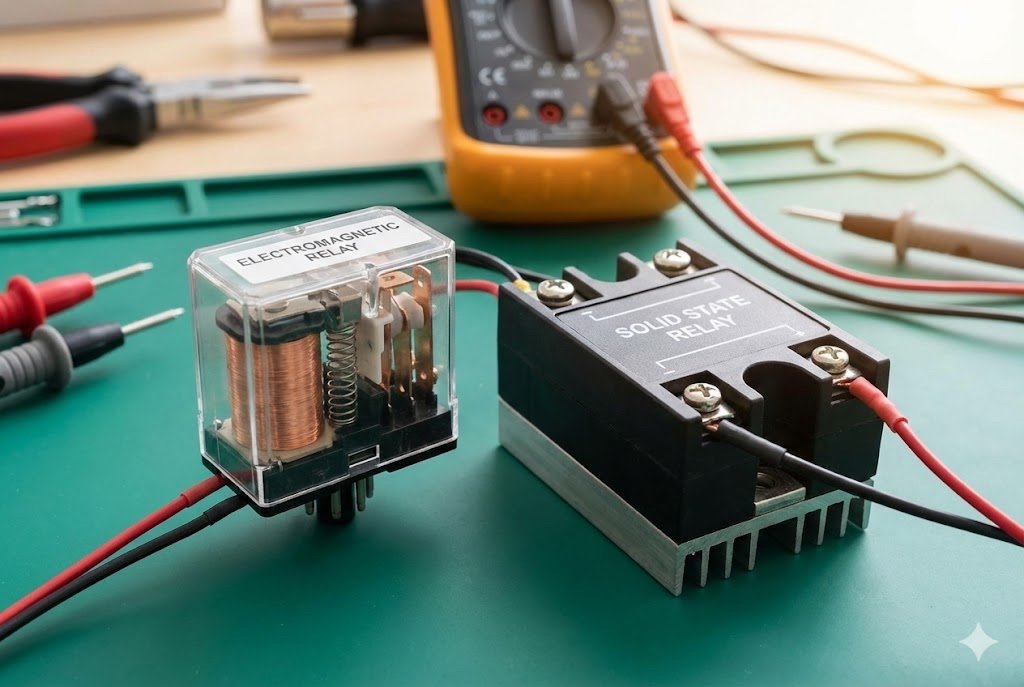
The choice between a classic electromechanical relay and a modern solid state one isn't always simple. Each has unique strengths that make it perfect for some jobs and a poor fit for others. Let's break down the details to help you pick the perfect relay for your specific project.
How Do Electromagnetic Relays Actually Work?
You know EMRs use a coil, but what is really happening inside? Not knowing the mechanism can make it hard to troubleshoot or select the right one for your load.
An electromagnetic relay1 uses a low-power coil to create a magnetic field. This field pulls an armature, physically moving a set of contacts to switch a much higher-power circuit. It provides complete electrical isolation between the control and load circuits through an air gap.
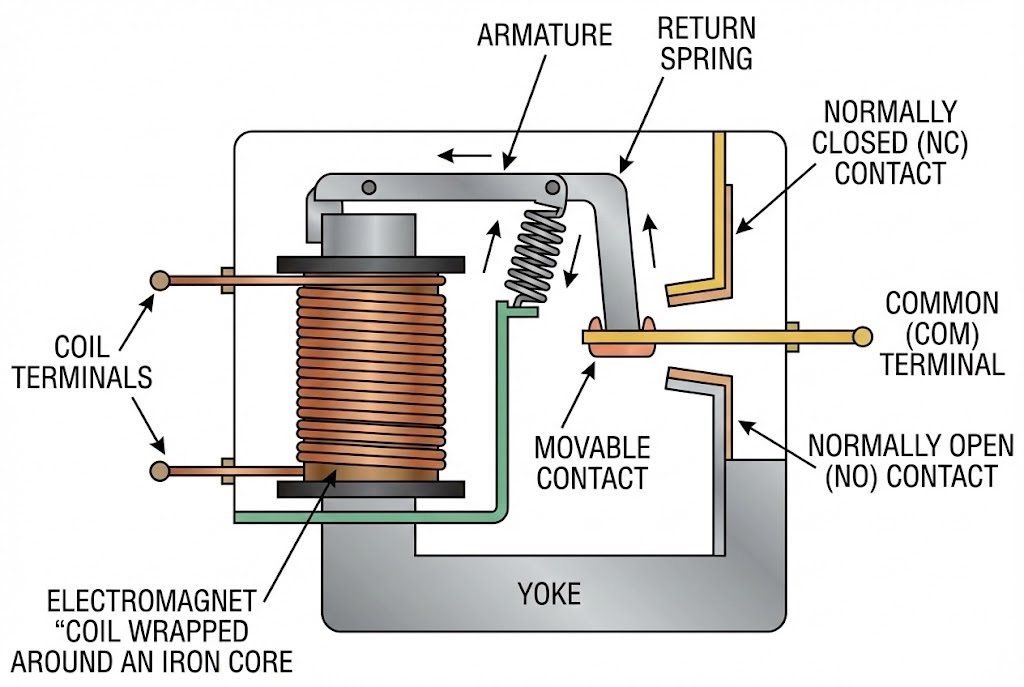
At its heart, an electromagnetic relay1 is a simple and clever device. When you apply a small control voltage to its coil, it becomes an electromagnet. This magnetic force attracts a movable metal arm called an armature. The armature is connected to a set of contacts. As it moves, it either pushes two contacts together (making a connection) or pulls them apart (breaking a connection). I remember first learning this and hearing that satisfying "click" – that's the sound of physical parts moving to do their job. This mechanical action is what makes EMRs so robust. They create a true air gap when open, meaning there is zero current leakage.
There are many types of switches and configurations for these relays. You will often see terms like DPDT, which stands for "Double Pole Double Throw."
| Abbreviation | Full Name | Description |
|---|---|---|
| SPST | Single Pole Single Throw | A simple on-off switch. One circuit, one connection. |
| SPDT | Single Pole Double Throw | One input can be connected to one of two outputs. |
| DPDT | Double Pole Double Throw | Controls two separate circuits, connecting each to one of two outputs. |
This physical separation makes EMRs great for handling high voltage spikes and switching both AC and DC loads without much fuss.
What Makes Solid State Relays Different?
Solid state relays seem like magic boxes with no moving parts. How do they switch circuits? Without understanding their function, you might misapply them and cause a failure.
A solid state relay2 uses an optical signal, like an LED, to control a semiconductor switch, like a TRIAC5 or MOSFET6. It has no moving parts. This allows for silent, extremely fast switching and a very long operational life, but they generate more heat.
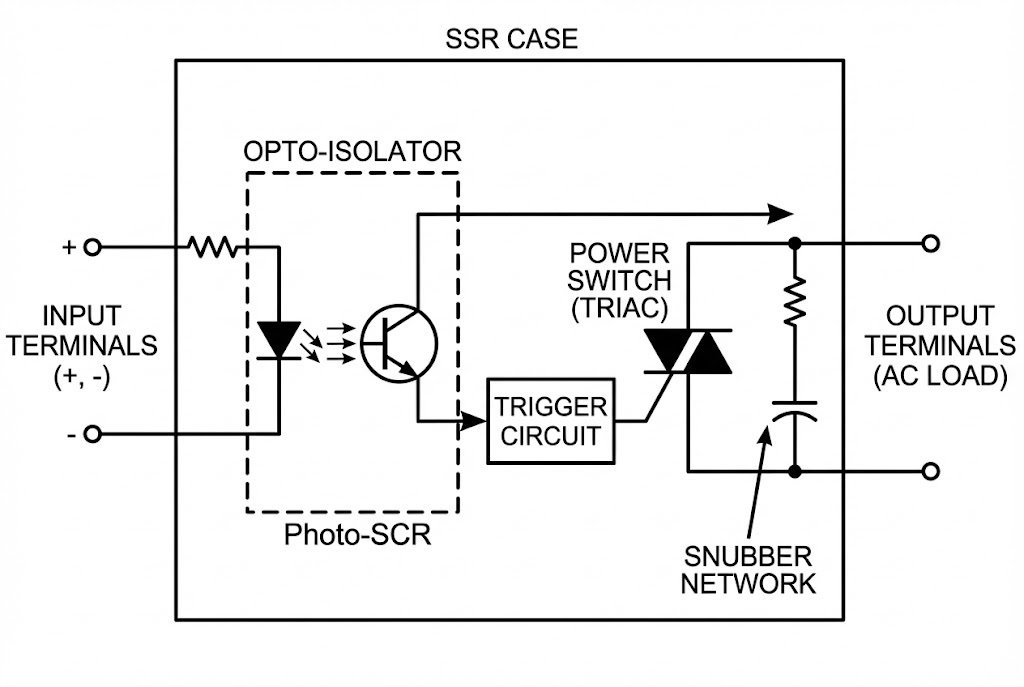
Instead of a coil and moving contacts, an SSR uses a technology called opto-isolation7. Here’s how it works: a small input current turns on an internal LED. The light from this LED shines on a photosensitive semiconductor. This light-sensitive part then triggers a powerful semiconductor switch, like a TRIAC5 for AC loads or a MOSFET6 for DC loads, allowing current to flow through the load circuit. Because the only connection between the input and output is a beam of light, you get excellent electrical isolation.
Since there are no moving parts, an SSR has an incredibly long lifespan, often into the billions of cycles. I once worked on a project with a fast-pulsing heater, and an EMR would have failed in weeks. We switched to an SSR, and it ran for years without a single issue. This also means they are completely silent and can switch much faster than any mechanical relay. However, this technology comes with a trade-off. The semiconductors generate heat while conducting, so SSRs often need a heatsink8 to operate correctly. They also have a tiny amount of leakage current when "off" and are more sensitive to voltage spikes than their mechanical cousins.
Which Relay is Right for My Application?
You know the basics of both relay types, but now you face the real decision. Choosing incorrectly can lead to early failure, high costs, or poor performance in your final product.
Choose an electromagnetic relay1 for high-power, infrequent switching, or when cost is the main driver. Select a solid state relay2 for applications needing high speed, long life, frequent switching, and silent operation, like in control systems or medical devices9.
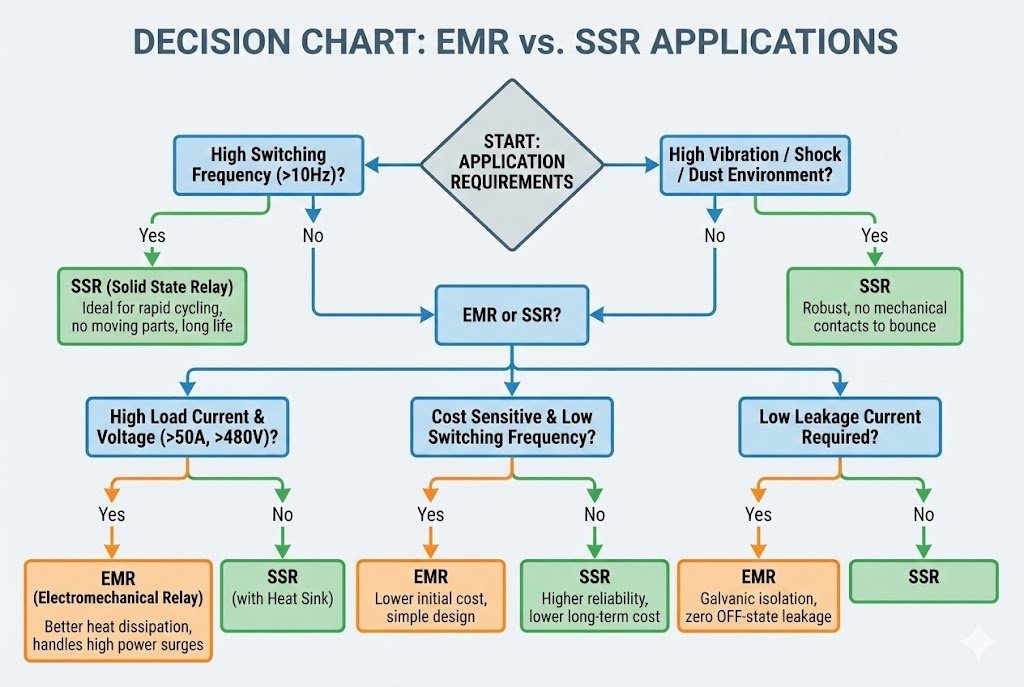
The best way to decide is to compare them directly based on what your project needs most. In my experience as a sourcing partner, I guide engineers through this exact process. We look at the application and weigh the pros and cons. For example, a simple motor contactor that operates a few times a day is a perfect job for a low-cost, robust EMR. But for a precise temperature control system that needs to cycle a heater multiple times per second, an SSR is the only reliable choice. The initial cost of the SSR is higher, but it prevents the much larger cost of constant replacement and system downtime.
Let's look at a head-to-head comparison:
| Feature | Electromagnetic Relay (EMR) | Solid State Relay (SSR) |
|---|---|---|
| Lifespan | Limited by mechanical wear10 (100k to 1M cycles) | Extremely long (billions of cycles) |
| Switching Speed | Slower (5-15 ms) | Very Fast (<1 ms) |
| Noise | Audible click, can create electrical noise4 (EMI) | Silent, little to no EMI |
| Durability | Sensitive to shock and vibration | Highly resistant to shock and vibration |
| Heat | Generates very little heat | Generates heat, often needs a heatsink8 |
| Off-State | True air gap, zero leakage current | Small leakage current |
| Cost | Lower initial cost | Higher initial cost |
| Load Type | Switches AC or DC loads easily | Usually specific to AC or DC loads |
Think about your priorities. If you are building a product where cost is critical and it only switches occasionally, the EMR is your winner. If you need silent, fast, and reliable switching for millions of cycles, the SSR is worth the investment.
Conclusion
Choosing between EMRs and SSRs depends entirely on your application's needs for speed, lifespan, and load. By assessing your priorities, you can confidently make the right decision every time.
Explore this link to understand the fundamentals of electromagnetic relays and their applications. ↩
Discover the benefits of solid state relays and why they might be the right choice for your project. ↩
Understand the importance of switching speed in relay performance and its impact on your projects. ↩
Find out how electrical noise can affect relay systems and ways to mitigate it. ↩
Learn about TRIACs and their role in solid state relays for controlling AC loads. ↩
Discover how MOSFETs function in solid state relays and their advantages in DC applications. ↩
Understand the concept of opto-isolation and its significance in relay technology. ↩
Explore the reasons why heatsinks are essential for solid state relays and their operation. ↩
Explore the critical role of relays in medical devices and their importance in safety and reliability. ↩
Learn about mechanical wear in relays and how it affects their lifespan and performance. ↩