
Choosing between FinFET1 and MOSFET2 technology can feel overwhelming. The wrong decision can cause production delays and sourcing headaches, putting your project at risk. Understanding the differences is critical for success.
FinFET1s are 3D transistors3 that offer superior performance and power efficiency4 over traditional 2D planar MOSFET2s. However, their complex manufacturing means a tighter, more volatile supply chain5. This requires careful, long-term sourcing strategies to secure a stable supply for your production.
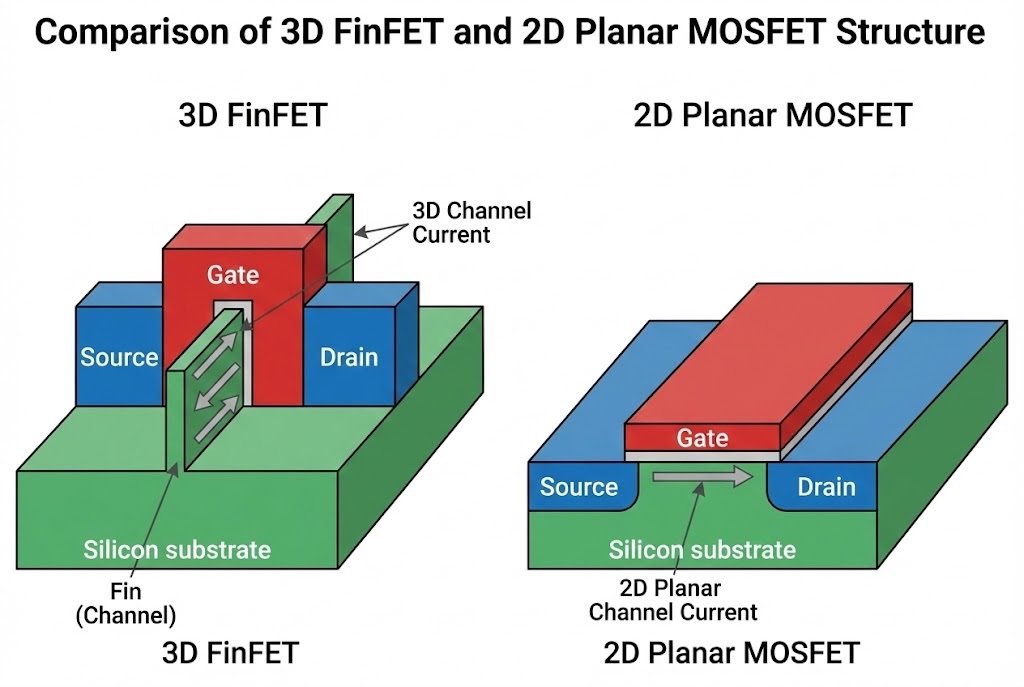
The technical specifications often tell an exciting story about performance gains6. Many engineers are naturally drawn to the latest and greatest technology. But the story doesn't end with performance. As a sourcing partner, I've learned that the manufacturing and supply chain5 realities are just as important. A chip you can't get is a chip you can't use, no matter how good it is. Let's look at what these differences really mean for your designs and your production lines.
What Really Sets FinFET1 and MOSFET2 Apart Technologically?
Are you struggling to see the real difference beyond the marketing buzzwords? This confusion can lead to over-designing a product or, worse, choosing a component that underperforms. Let's clarify the core concepts.
The main difference lies in their physical structure. FinFET1s use a three-dimensional "fin" that the gate wraps around on three sides. This gives it excellent control over the flow of electricity. Planar MOSFET2s have a flat, two-dimensional structure, offering the gate less control over the channel.
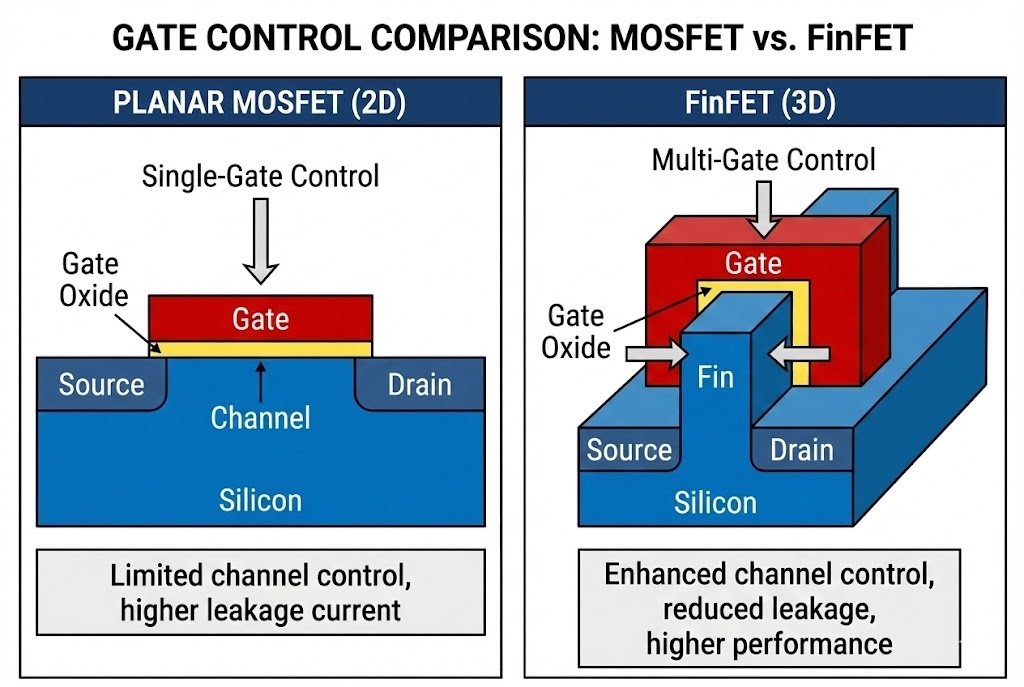
A simple way to think about it is like a water valve. A planar MOSFET2 is like pushing down on a lever from the top to stop the water. It works, but some water might still leak around the sides. A FinFET1 is like gripping the pipe with your whole hand from three sides. You have much more control and can shut off the flow completely, stopping any leaks. This superior control is why FinFET1s are so much more power-efficient and perform better, especially as chips get smaller and smaller. This structural difference is the foundation for everything else, from performance to manufacturing complexity7.
Here is a breakdown of their key technical differences:
| Feature | Planar MOSFET2 | FinFET1 |
|---|---|---|
| Structure | 2D (Planar) | 3D (Fin-shaped) |
| Gate Control | From one side (top) | From three sides |
| Leakage Current | Higher, especially at small nodes | Very low (excellent control) |
| Performance | Good for mature nodes (>28nm) | Higher speed and performance |
| Power Consumption | Higher | Lower (more efficient) |
| Typical Use | Power devices, analog ICs, older logic | Advanced CPUs, GPUs, MCUs, SoCs |
Why Does FinFET1's Advanced Design Create Supply Chain Headaches?
Are you excited by the performance of FinFET1s but worried about getting them on time? Ignoring these supply chain5 risks can bring your entire production line to a halt without warning.
The advanced 3D structure of FinFET1s requires extremely complex manufacturing processes. They can only be produced at a handful of the world's most advanced foundries, like TSMC and Samsung. These factories cost billions of dollars to build and have limited capacity, which is in very high demand.
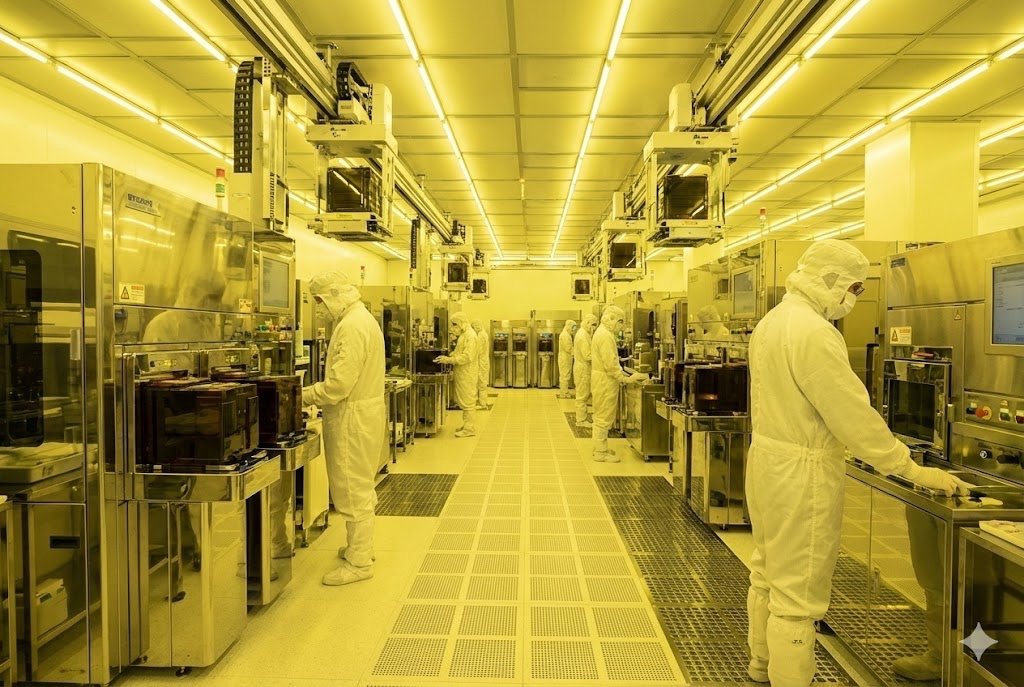
This limited capacity creates a huge bottleneck in the global supply chain5. I've personally seen many clients get excited about a new FinFET1-based processor, only to find out the official lead time is over 52 weeks. The reality is that major players in automotive, data centers, and consumer electronics are all competing for the same production slots. This fierce competition leads to allocations, where foundries decide which customers get parts. It also causes price volatility. When demand is high, prices can increase quickly. As a sourcing partner, our job is to navigate this complex landscape. We provide market intelligence on lead times and pricing trends so you can plan effectively and avoid being caught by surprise when a critical component suddenly becomes unavailable.
How Should You Plan Your Sourcing Strategy for These Technologies?
Are you unsure how to secure a stable supply of either MOSFET2s or FinFET1s? A reactive "firefighting" approach to sourcing almost always leads to higher costs, production delays, and immense stress.
Your sourcing strategy8 must match the technology. For advanced FinFET1s, you need to be proactive and plan for the long term. For mature MOSFET2s, the focus shifts to ensuring quality and managing end-of-life risks. A solid plan is your best defense against supply chain5 disruptions.
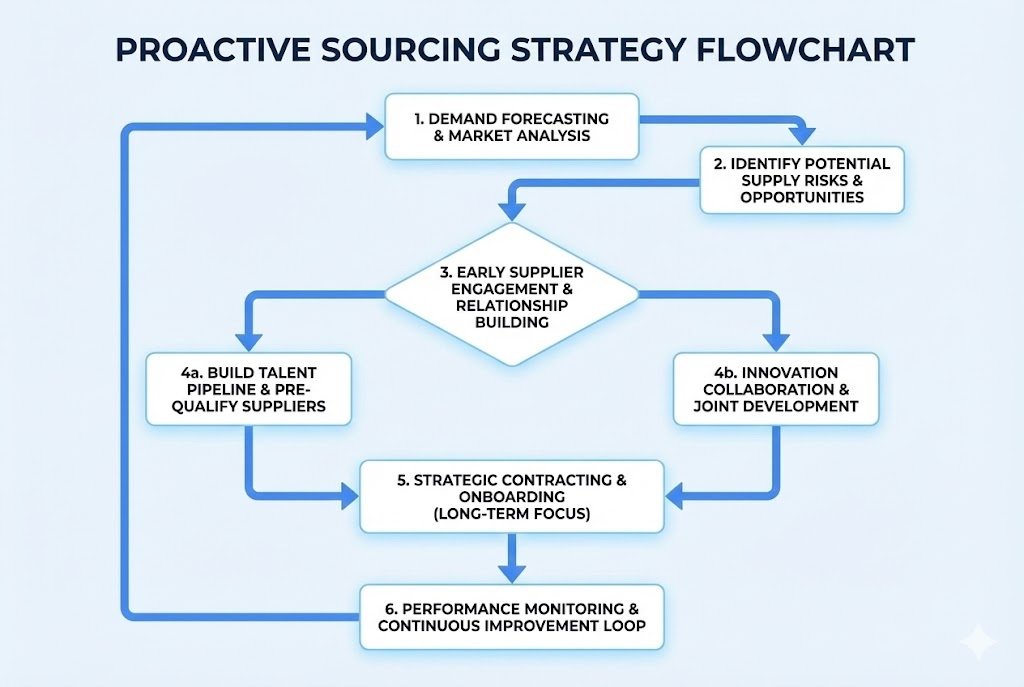
We help our clients build robust sourcing plans tailored to their specific needs. It's not about just finding the lowest price today; it's about ensuring you have the parts you need for the entire lifecycle of your product. This requires a different mindset for each technology.
For FinFET1-Based Components
With FinFET1s, you are competing for limited, high-value capacity. Your strategy must be built on foresight and partnership.
- Long-Term Forecasting: Provide your sourcing partners with forecasts as early as possible. This allows us to book capacity and negotiate better terms on your behalf.
- Buffer Stock: For critical components, holding a strategic buffer stock9 can be a lifesaver. It protects you from unexpected lead time extensions or allocation issues.
- Design Flexibility: Where possible, work with your engineering team to qualify alternative parts. This gives you more options if your primary choice becomes unavailable.
For Planar MOSFET2s
With mature MOSFET2s, the challenge isn't capacity but navigating a vast market filled with varying quality.
- Supplier Verification: The market for older nodes is huge. It's critical to work with partners who have strict quality control and can verify that components are original and traceable.
- Lifecycle Management: Many mature MOSFET2s are at risk of becoming Not Recommended for New Designs (NRND) or End-of-Life (EOL). We monitor this and help you plan for last-time buys or find suitable replacements to avoid redesigns.
- Cost Optimization: Since the technology is mature, there are opportunities for cost optimization10. We use our global network to source competitively without sacrificing quality.
Here is a simple comparison of the sourcing approaches:
| Sourcing Factor | FinFET1 Strategy | MOSFET2 Strategy |
|---|---|---|
| Primary Goal | Secure Capacity & Availability | Ensure Quality & Manage Lifecycle |
| Planning Horizon | Long-Term (12-24 months) | Mid-Term (3-6 months) |
| Key Risk | Allocations & Long Lead Times | Counterfeits & EOL Notices |
| Partner Role | Strategic Planning & Market Intel | Quality Assurance & Lifecycle Support |
Conclusion
Ultimately, choosing between FinFET1 and MOSFET2 requires balancing performance with supply chain5 reality. Proactive sourcing is essential, especially for advanced FinFET1s, to ensure your production runs smoothly.
Explore the benefits of FinFET technology to understand its impact on performance and efficiency. ↩
Learn about MOSFET technology and its applications to see how it stacks up against FinFET. ↩
Discover the workings of 3D transistors and their advantages in modern electronics. ↩
Understand the significance of power efficiency in semiconductor design for better performance. ↩
Gain insights into the complexities of semiconductor supply chains and how to navigate them. ↩
Discover how advancements in semiconductor technologies lead to significant performance improvements. ↩
Explore the factors that lead to manufacturing complexity in semiconductor technologies. ↩
Explore effective sourcing strategies to ensure a stable supply of semiconductor components. ↩
Learn how buffer stock can mitigate risks in supply chain management for semiconductors. ↩
Learn strategies for cost optimization in semiconductor sourcing without compromising quality. ↩


