
Struggling with performance limits in your designs? Traditional transistors are hitting a wall, causing power-hungry, hot devices. FinFET technology1 is the essential leap forward for modern, efficient electronics.
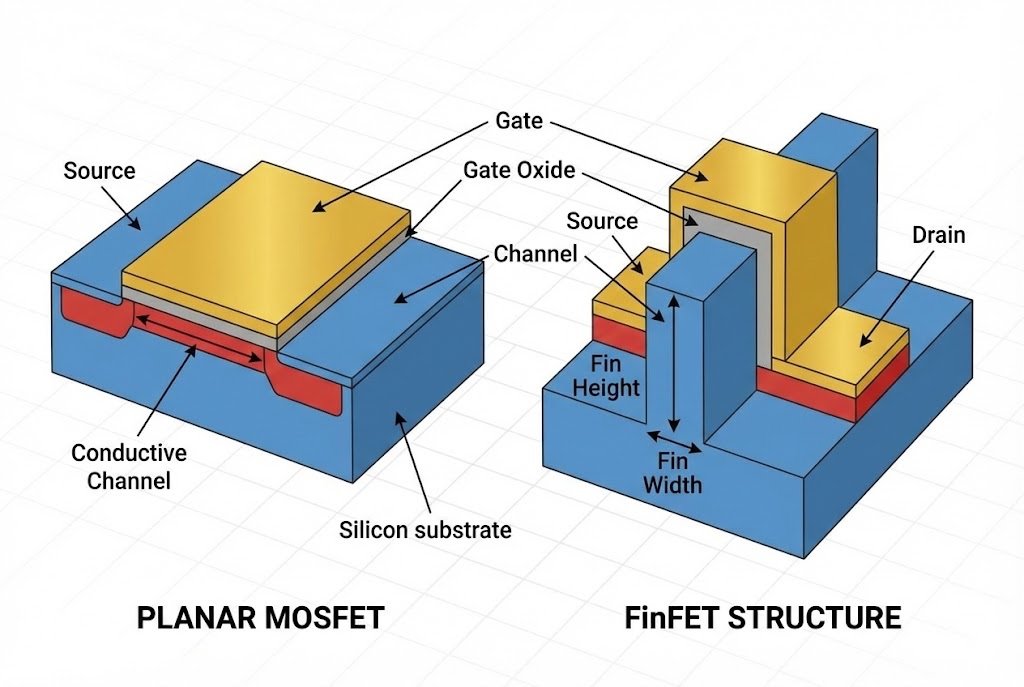
The core reason for the switch is control. FinFETs use a 3D "fin" structure, allowing the gate to wrap around the channel on three sides. This superior control drastically reduces current leakage2 and improves power efficiency3, enabling smaller, faster, and cooler processors than traditional planar MOSFETs4.
As someone who sources components for a living, I've seen this shift happen firsthand. For years, we relied on the steady progress of planar MOSFETs4. They got smaller and faster with each generation. But eventually, the physics caught up. Engineers I work with started complaining about power leakage and heat issues, especially in advanced nodes. The solution wasn't just to shrink things further; it was to build them differently. This is where FinFETs came in and completely changed the game. Let's explore why this change was so necessary and what it means for the components you use every day.
What Exactly Makes FinFETs More Efficient Than Planar MOSFETs?
Your designs demand more power, but shrinking transistors is causing massive leakage. This inefficiency creates heat and wastes energy. The answer isn't a tweak; it's a total structural change.
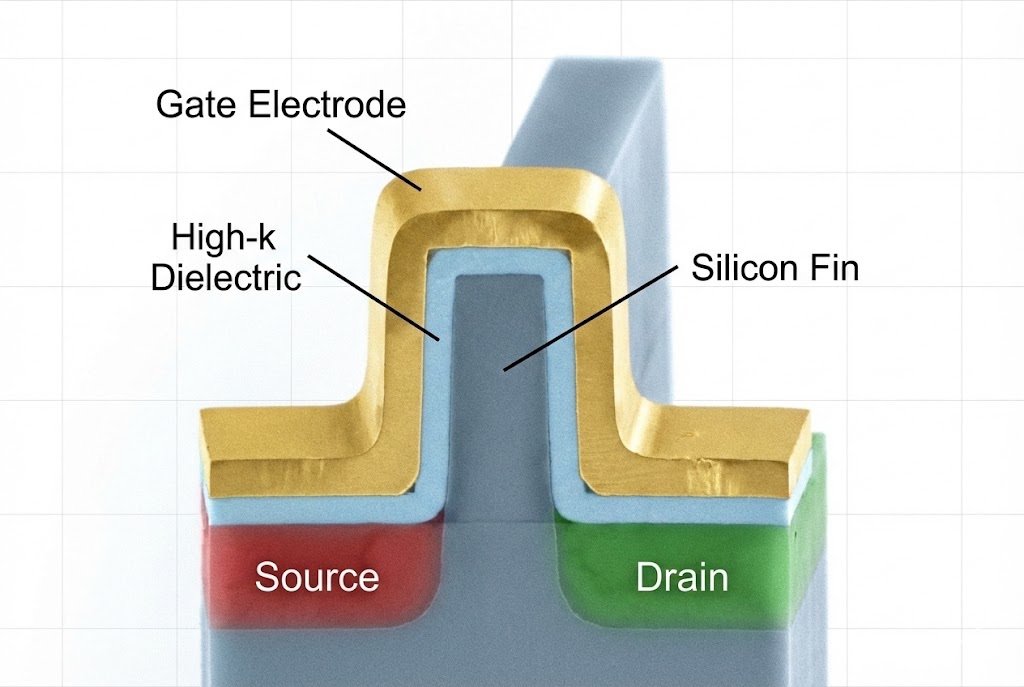
A FinFET's 3D design5 gives the gate far better control over the flow of electricity. By wrapping the gate around the channel on three sides, it can shut off the current more completely, slashing the leakage that plagues tiny planar MOSFETs4 and boosting overall efficiency.
To really get it, you have to picture the structure. A classic planar MOSFET is flat, like a light switch lying on the floor. The gate sits on top of a channel, and it tries to control the flow of current from source to drain. As these transistors got smaller and smaller, the gate's control got weaker. The source and drain got so close that current would leak through even when the switch was supposed to be "off." We call this a "short-channel effect6." It’s like a faulty faucet that keeps dripping, wasting water.
FinFETs solve this by turning the whole structure on its side. The channel is no longer a flat plane but a vertical "fin" of silicon. The gate is then draped over this fin like a saddle on a horse. This simple change is revolutionary. Now, the gate controls the channel from three sides, not just one. This multi-gate control is much stronger and can shut off the flow of electrons almost completely.
Key Structural Differences
| Feature | Planar MOSFET | FinFET (Tri-Gate) |
|---|---|---|
| Structure | 2D (Planar) | 3D (Vertical Fin) |
| Gate Control | Top surface only | Three sides of the channel |
| Leakage Current | High at small nodes | Very Low |
| Performance | Limited by leakage | Higher switching speeds |
| Power Consumption | High (due to leakage) | Low (due to better control) |
This improved structure directly translates to better performance and lower power consumption, which is the ultimate goal for any modern electronic device.
How Does This Switch Impact Real-World Performance and Power Consumption?
Are you frustrated by devices that get hot and have short battery life? This is often due to inefficient processors wasting power as heat. FinFET technology1 directly tackles this core problem.
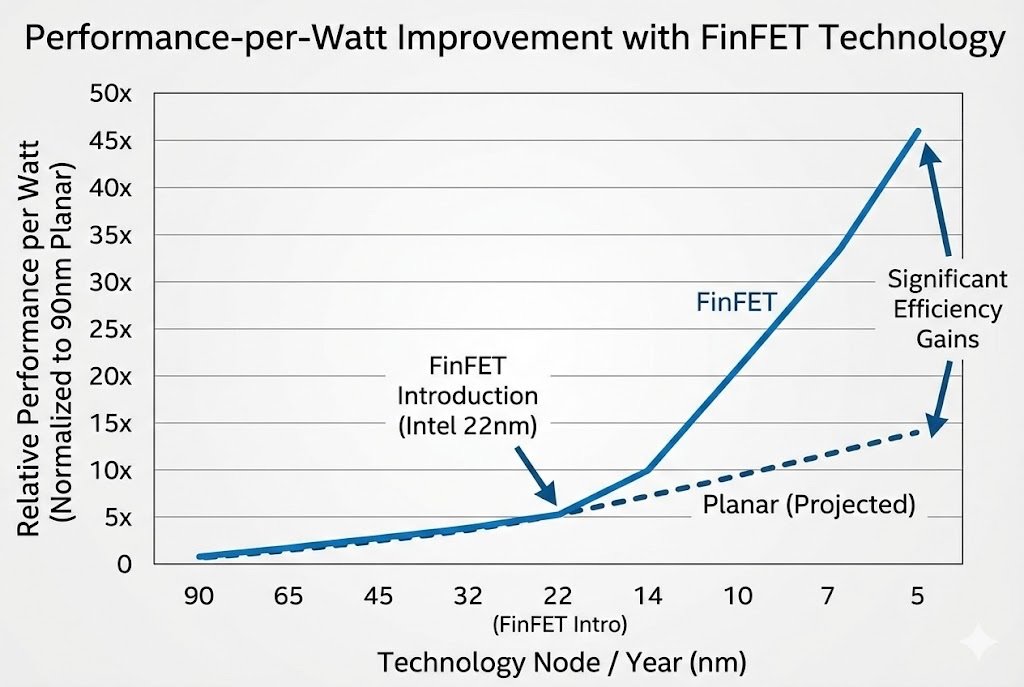
FinFETs allow processors to run faster while using less voltage. This breakthrough results in a huge jump in performance-per-watt7, meaning your devices get more powerful without draining the battery or getting uncomfortably hot. You get both speed and endurance.
I often talk to hardware engineers who are trying to squeeze every last bit of performance out of their designs while staying within a strict power budget. This is where the theory of FinFETs becomes a practical advantage. The benefits aren't just numbers on a datasheet; they change how a final product feels and operates.
Higher Clock Speeds at Lower Voltages
One of the biggest wins with FinFETs is the ability to achieve high switching speeds at a lower operating voltage. With planar MOSFETs4, you often had to pump in more voltage to make them switch faster, which increased power consumption exponentially. FinFETs' superior gate control allows them to switch very quickly without needing as much voltage. This means a CPU core can hit higher gigahertz speeds without generating massive amounts of heat.
Reduced Static Power Consumption
Static power consumption is the energy a chip uses when it's idle. In planar MOSFETs4, leakage current was a huge contributor to this "vampire" power drain. Your phone would lose battery even when the screen was off. Because FinFETs cut leakage current so effectively, they dramatically reduce static power draw. This is a major reason why modern smartphones and laptops have such improved standby times.
Improved Performance-per-Watt
| Technology | Operating Voltage | Relative Speed | Power Efficiency |
|---|---|---|---|
| Planar MOSFET | High | Good | Low |
| FinFET | Low | Excellent | High |
Ultimately, it all comes down to performance-per-watt7. This metric tells you how much computational work you get done for every watt of power you consume. FinFETs deliver a massive improvement here. For a data center8, this means lower electricity bills. For a battery-powered IoT device9, it means it can run for months or years on a single charge. For a high-end gaming PC, it means more frames per second without the cooling system sounding like a jet engine. This efficiency is the single most important driver for the adoption of FinFET technology1 across the entire semiconductor industry.
Which High-End Processors and FPGA10s Are Using FinFET Technology Today?
Need to select a component for a demanding application? Choosing a part based on older technology can limit your product's potential. To get leading performance, you must use modern components.
Today, nearly all high-end CPUs11, GPUs, and FPGA10s are built using FinFET processes. Industry leaders like AMD (Ryzen CPUs, Xilinx FPGA10s), Intel (Core CPUs, Agilex FPGA10s), and Apple (M-series chips) all rely on FinFETs for their flagship products.
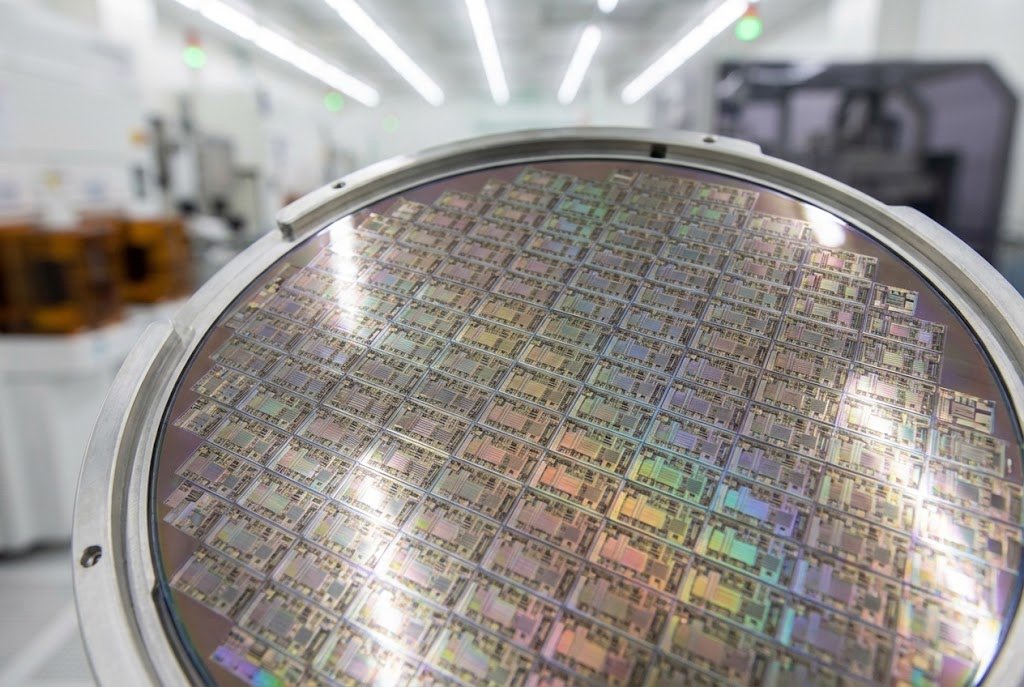
At NexCir, a huge part of my job is helping clients source these advanced components. When a customer needs a processor for an AI application or a powerful FPGA10 for industrial automation, the conversation always involves FinFET-based parts. They have become the standard for any application that requires a combination of high performance and power efficiency3. The transition is no longer happening; it has happened.
Let's look at some concrete examples.
Leading Components Built on FinFETs
| Category | Manufacturer | Example Product/Series | Process Node |
|---|---|---|---|
| CPU | AMD | Ryzen 7000 Series | 5nm FinFET |
| CPU | Intel | 13th Gen Core "Raptor Lake" | Intel 7 (10nm) FinFET |
| CPU (Mobile) | Apple | M2 / M3 Series | 5nm / 3nm FinFET |
| FPGA10 | AMD (Xilinx) | Versal AI Core Series | 7nm FinFET |
| FPGA10 | Intel (Altera) | Agilex F Series | Intel 7 (10nm) FinFET |
| GPU | NVIDIA | GeForce RTX 40 Series | 4nm FinFET |
You can see that the most competitive products on the market are all using this technology, often at very advanced nodes like 7nm, 5nm, and even 3nm. For CPUs like AMD's Ryzen and Intel's Core series, FinFETs allow them to pack more cores onto a single chip, running at high clock speeds12, which is perfect for gaming and content creation. For FPGA10s from Xilinx and Intel, the efficiency of FinFETs is critical. These devices are used in everything from 5G base stations to data center8 accelerators, where processing massive amounts of data efficiently is key. The low power consumption means they can be deployed in more thermally constrained environments. The switch to FinFETs wasn't just an option; it was a requirement to achieve the performance goals of these next-generation products.
Conclusion
FinFET technology1 is not an incremental update. It is a fundamental shift that enables the performance and efficiency required by modern electronics, from data center8s to your smartphone.
Explore how FinFET technology revolutionizes efficiency and performance in modern electronics. ↩
Learn about the impact of current leakage on device performance and how to mitigate it. ↩
Understand the significance of power efficiency in designing modern electronic devices. ↩
Discover the differences between planar MOSFETs and FinFETs for better design choices. ↩
Find out how 3D designs enhance semiconductor performance and efficiency. ↩
Gain insights into the short-channel effect and its implications for transistor performance. ↩
Learn about the importance of performance-per-watt in evaluating electronic devices. ↩
Find out how FinFET technology enhances efficiency and performance in data centers. ↩
Learn how FinFETs improve battery life and performance in IoT applications. ↩
Understand the role of FPGAs in various applications and their benefits. ↩
Discover the leading CPUs that leverage FinFET technology for superior performance. ↩
Explore the advantages of high clock speeds for improved computing performance. ↩


