You need a reliable, low-cost op-amp, but supply chain issues and confusing datasheets keep delaying your production schedule.
The LM3581 is a dual operational amplifier known for its low power consumption and wide voltage range. It is the industry standard for basic signal conditioning. Understanding its pinout, varying manufacturer specs (TI, ST, Onsemi), and reliable sourcing channels ensures your production line never stops.
I have seen many projects stall because of simple component issues, so let me guide you through the details of this essential chip.
What Are the Key Technical Specifications and Pin Definitions of the LM3581?
Reading datasheets takes time, and missing a small detail about voltage or pin configuration can cause your entire circuit to fail.
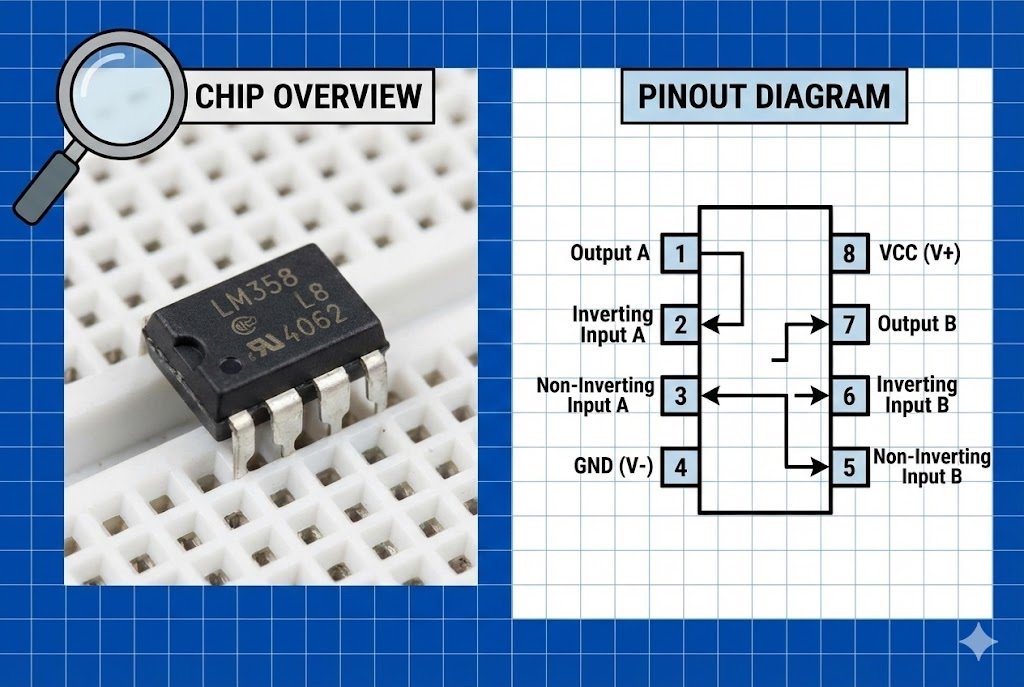
The LM3581 features two independent, high-gain, internal frequency-compensated op-amps. It operates from 3V to 32V. The 8-pin package includes two outputs, two inverting inputs, two non-inverting inputs, ground, and VCC.
I want to look closer at why this chip is called the "Jack of all trades" in the industry. The LM3581 is very popular because it is easy to use. It comes in a standard 8-pin package. This makes it easy to place on a printed circuit board. You need to know the pin functions clearly. Pin 1 is the output for the first amplifier. Pin 2 and Pin 3 are the inputs for the first amplifier. Pin 4 connects to the ground. On the other side, Pin 8 connects to the power supply. Pin 5, 6, and 7 handle the second amplifier.
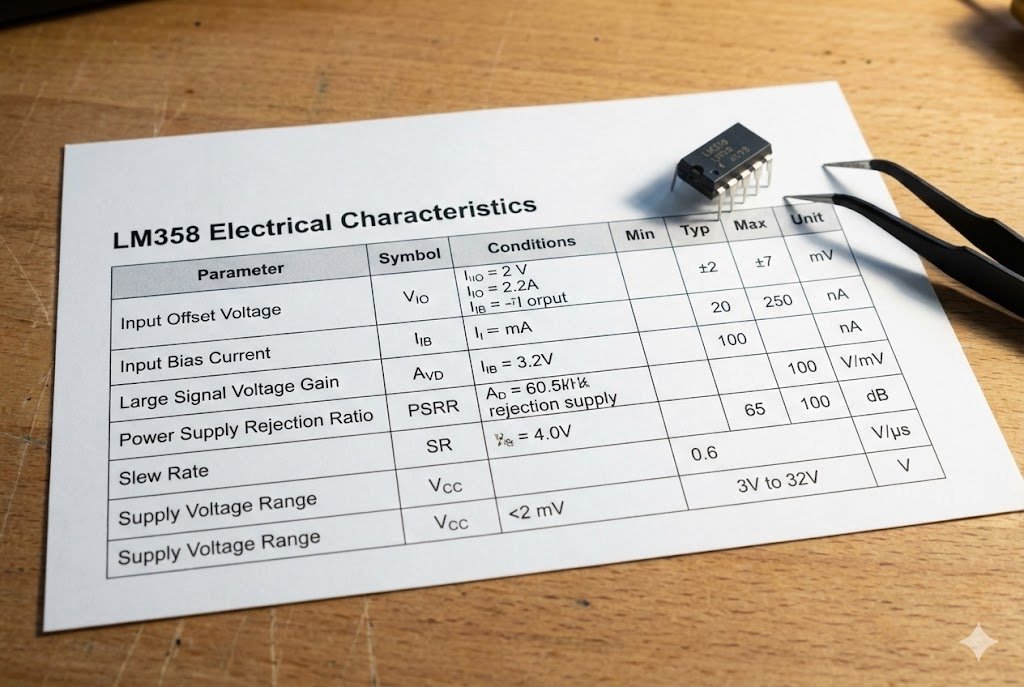
The voltage range is a big advantage. You can use it with a single power supply. This ranges from 3V up to 32V. This is great for battery-operated devices. I often see engineers choose it because they do not need a dual power supply. This saves space and cost. Also, the bandwidth is 1 MHz. This is enough for most general control systems.
Below is a table of the key specs you should know:
| Parameter | Value | Note |
|---|---|---|
| Supply Voltage | 3V to 32V | Single Supply |
| Channels | 2 | Dual Op-Amp |
| Bandwidth | 1 MHz | Unity Gain |
| Input Bias Current | 45 nA | Low power |
| Operating Temp | 0°C to 70°C | Commercial Grade |
You must check these numbers against your project needs. If you need higher precision, you might need a different version. But for general use, these specs are very solid.
Which Typical Circuit Designs Utilize the LM3581 Effectively?
Designing a new circuit is hard when you are unsure if the op-amp can handle the specific task or signal processing required.
The LM3581 excels in transducer amplifiers2, DC gain blocks, and all conventional op-amp circuits. It is perfect for single power supply systems3, allowing direct interface with logic systems without extra power rails.
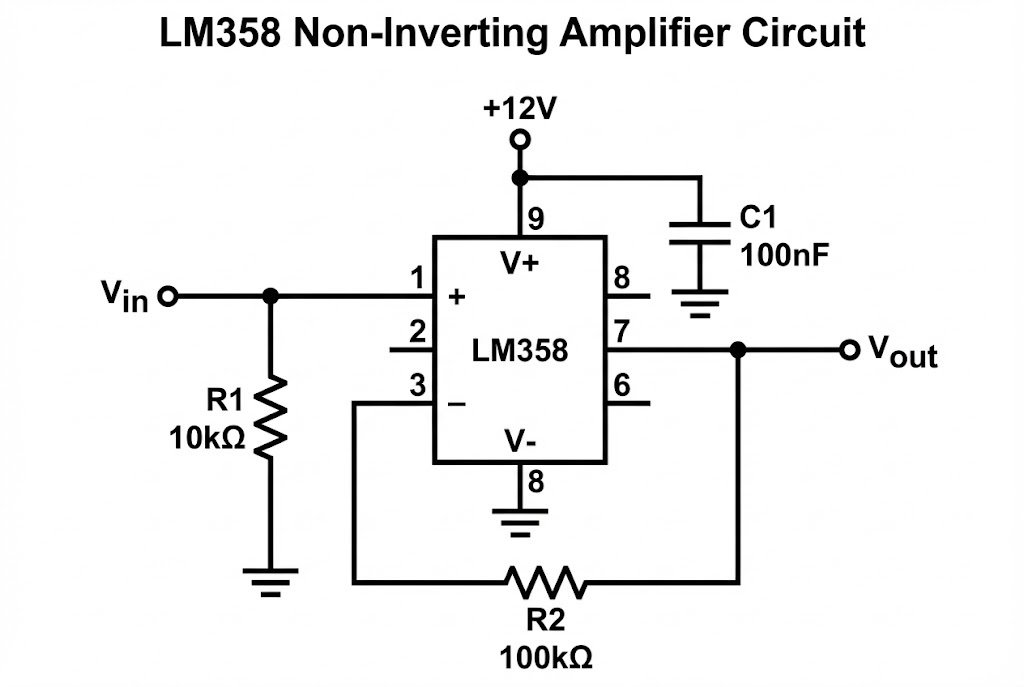
I want to share how this component fits into real-world applications. The most common use I see is in sensor circuits. For example, you might have a temperature sensor. The signal from the sensor is very weak. You can use the LM3581 to make this signal stronger. This is called amplification. The chip has a high DC voltage gain of 100 dB. This means it is very sensitive.
Another common use is as a voltage follower. In this setup, the output voltage follows the input voltage. You might ask why this is useful. It acts as a buffer. It prevents the load from drawing too much current from the signal source. This protects your sensitive sensors.
I also see it used often in DC/DC converter modules. It helps regulate the voltage. Because it works with a single supply voltage, you do not need complex power management. It simplifies the design process significantly.
Here are the most common circuit types:
1. Non-Inverting Amplifier
This increases the voltage of your signal without changing its phase. It is the standard way to boost sensor signals.
2. Comparator
You can use the LM3581 to compare two voltages. If one is higher, the output switches. This is useful for turning things on or off based on a sensor reading.
3. Active Filters
It can filter out noise from a signal. This is crucial in audio or radio applications where clarity is important.
Supply shortages happen, and stopping production because of one missing chip is a nightmare for any manufacturer or procurement team.
If the specific LM3581 is out of stock, reliable alternatives include the LM324 (quad op-amp), LM2904 (automotive grade), or brand variations like LM3581B from different manufacturers. Knowing these saves your timeline.
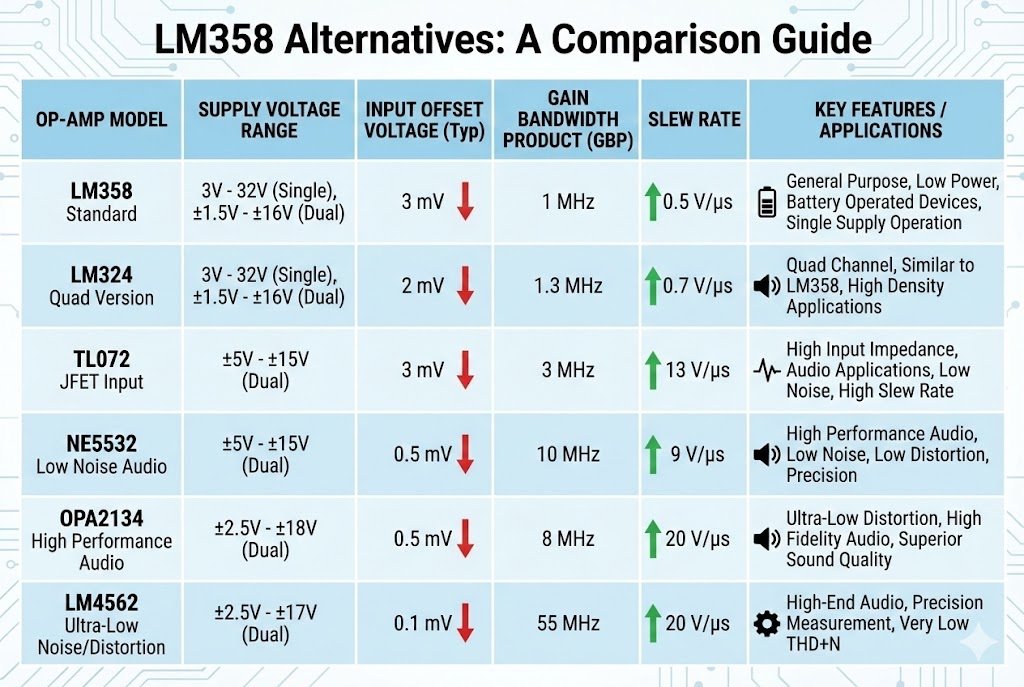
You need to be flexible with your Bill of Materials (BOM). I have seen lines stop because a buyer only looked for one specific part number. The LM3581 is made by many companies. Texas Instruments (TI), STMicroelectronics, and Onsemi all make this chip. They are mostly the same. However, there are small differences. For example, the LM3581B from TI has better precision than the older LM3581.
If you cannot find the 8-pin LM3581, look at the LM324. The LM324 has 14 pins. It contains four op-amps instead of two. It is electrically very similar. You can use it if you have space on your board. If you are working on a car project, look for the LM2904. It is the automotive version. It handles heat and stress better.
At NexCir, we help you find these options. We do not just say "no stock." We look for cross-references. Here is a quick guide to alternatives:
| Primary Part | Alternative | Difference | Manufacturer Options |
|---|---|---|---|
| LM3581 | LM2904 | Automotive Grade | TI, ST, Onsemi |
| LM3581 | LM324 | Quad Channel (4 vs 2) | TI, ST, Onsemi, Fairchild |
| LM3581 | NE5532 | Lower Noise (Audio) | TI, Onsemi |
| LM3581 | TL072 | Higher Speed (JFET) | TI, ST |
You must check the datasheet before swapping. But usually, switching brands (like from ST to TI) is safe and easy. This strategy keeps your factory running.
How Should You Handle Sourcing to Avoid Counterfeits and Delays?
The market is full of fake chips and unreliable brokers, putting your product quality and brand reputation at serious risk.
You must prioritize traceability and lifecycle management over just finding the lowest price. At NexCir, we do not just stock parts; we verify sources across global networks to ensure you get genuine TI, ST, or Onsemi components.

I know that sourcing components4 is stressful right now. You might see the LM3581 listed on many websites. But are they real? The LM3581 is very popular. This makes it a target for fakes. I have seen companies buy cheap parts that fail after a week. This costs much more money in the long run.
At NexCir, we work differently. We are not a simple stockist who tries to sell you what sits on our shelf. We are a sourcing partner. We focus on your specific needs. If you need the TI version, we find the TI version. If you need the ST version, we find that. We use a global network. We verify the quality. We make sure the parts are original.
We also look at the lifecycle. Is the part going to be discontinued (EOL)? We warn you. We help you plan for the long term. This is important for OEMs and ODMs. You need a stable supply for years, not just for one order.
Here is how we secure your supply:
Global Access
We do not rely on one region. We check Europe, North America, and Asia. This helps us find stock when others cannot.
Brand Variety
We source from all major manufacturers. We can get you LM3581s from Texas Instruments, Onsemi, STMicroelectronics, and Diodes Incorporated.
Strict Quality Control
We check the labels. We check the packaging. We ensure traceability. You get exactly what you ordered.
Conclusion
The LM3581 is vital for electronics, and NexCir ensures you get genuine parts from top brands like TI and ST to keep your production running smoothly.
Explore the versatility and applications of the LM358 op-amp to enhance your circuit designs and ensure reliable performance. ↩
Discover how the LM358 enhances signal amplification in transducer applications, improving sensor performance. ↩
Learn how the LM358 simplifies power management in single supply systems, saving space and cost in your designs. ↩
Understand the importance of reliable sourcing to avoid counterfeits and ensure quality in your electronic projects. ↩