You might worry about fire hazards1 or equipment failure2 if you select the wrong wire size for your industrial projects. These risks are real and can cause costly production downtime or dangerous safety violations in your facility. You need a reliable guide to ensure your wiring handles the load without overheating.
10 AWG wire3 is a standard choice for circuits carrying up to 30 amps of current. It balances flexibility with capacity, making it perfect for medium-load applications. To use it correctly, you must verify the insulation rating4, calculate the voltage drop5 over distance, and ensure your termination points are secure.
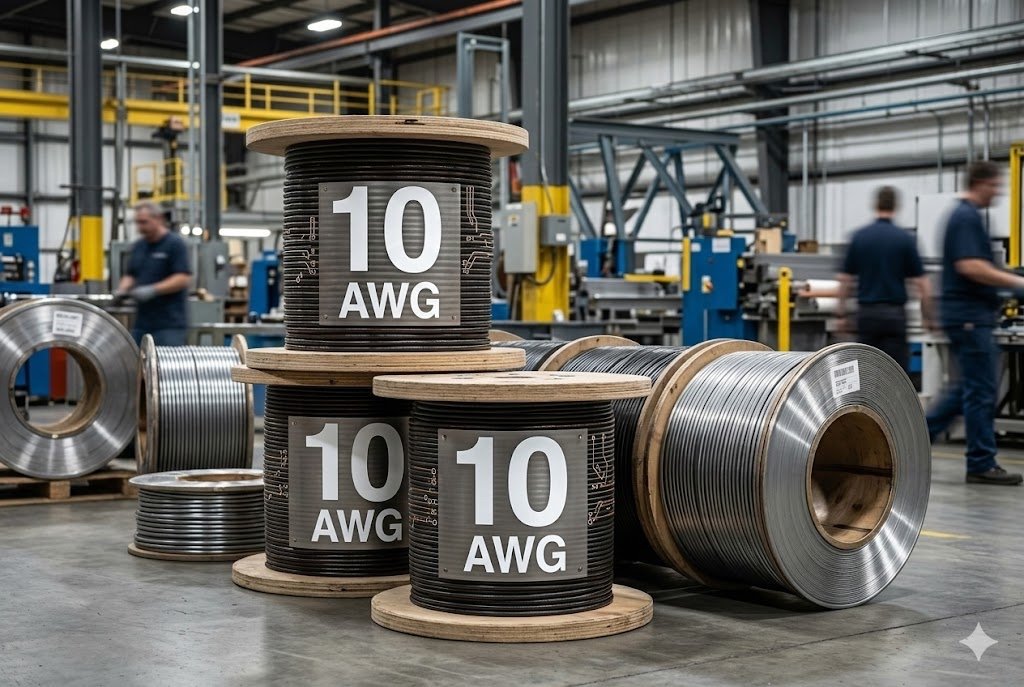
Choosing the right wire gauge is the first step in any safe electrical installation. If you get this wrong, your breakers might trip, or your motors might burn out. I want to walk you through the technical details of 10 AWG wire3 so you can specify it with confidence.
What Is the Maximum Amperage Load a 10 AWG Wire Can Handle?
Many procurement managers feel confused when they look at complex ampacity tables6 and see different numbers for the same wire size. You do not want to guess the wrong number and risk melting the insulation on your expensive equipment.
According to the National Electrical Code (NEC)7, 10 AWG copper wire is generally rated for 30 amps. However, this rating changes based on the temperature rating of the wire's insulation. For example, wire rated at 60°C handles less current than wire rated at 75°C or 90°C.
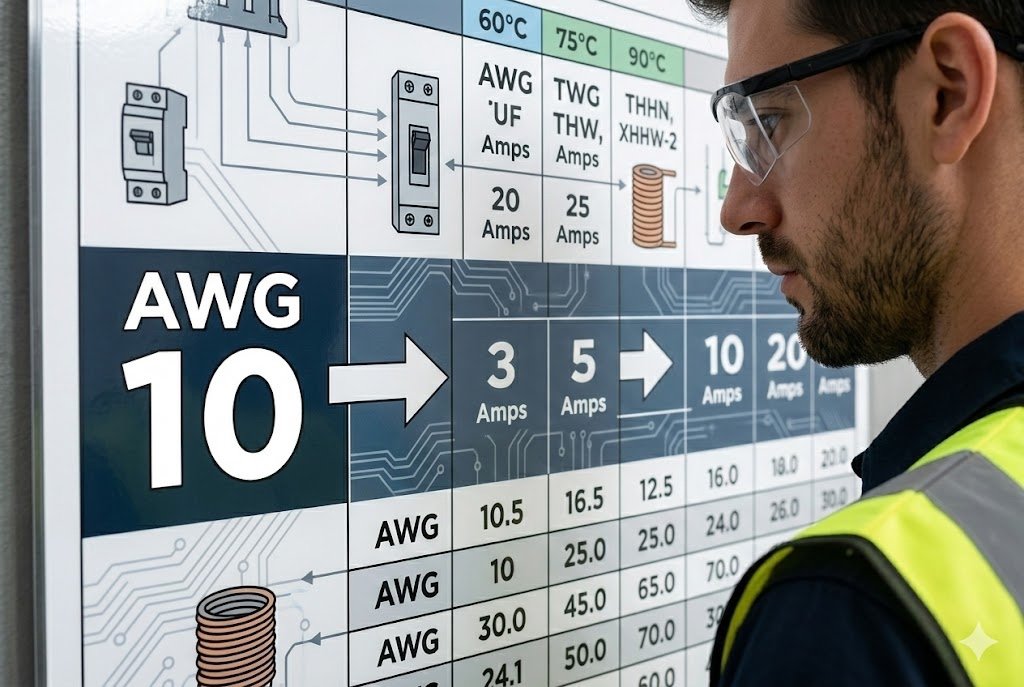
Understanding the nuances of ampacity is critical for industrial safety. I have spent years in the electronics supply chain, and I often see people overlook the insulation type. The metal conductor is the same size, but the plastic coating determines how hot the wire can get before it fails.
The Importance of Insulation Ratings
You cannot just look at the wire gauge. You must look at the code printed on the wire jacket. Common types include TW, THHN, and XHHW-2. The NEC Table 310.168 is the standard we use to determine these limits.
- 60°C Rating (TW, UF): This column is often the default for standard connections. Here, 10 AWG is rated for 30 Amps.
- 75°C Rating (THW, RHW): Many terminals on breakers are rated for this temperature.
- 90°C Rating (THHN, XHHW-2): This allows for higher heat, officially up to 40 Amps for derating9 purposes, but you are usually limited to 30 Amps by the breaker or termination point.
Derating Factors
You must also consider the environment. If you bundle more than three current-carrying wires in a single conduit, heat builds up faster. You have to lower the allowed amperage. This is called "derating9." Also, if the ambient temperature in your factory is very high, the wire cannot carry as much current.
Comparison of Common 10 AWG Insulation Types
| Insulation Type | Temperature Rating | Primary Use | Resistance Properties |
|---|---|---|---|
| TW | 60°C | General Purpose | Moisture Resistant |
| THHN | 90°C (Dry) | Industrial Conduit | Heat, Oil, Gas Resistant |
| THWN-2 | 90°C (Wet/Dry) | Outdoor/Conduit | Moisture, Heat Resistant |
| XHHW-2 | 90°C | Harsh Industrial | High Heat, abrasion |
When I source components for clients at Nexcir10, I always ask about the operating environment. If you are running 10 AWG wire3 near hot injection molding machines, standard TW wire will not last. You need high-temperature insulation like XHHW-2 to maintain that 30-amp capacity safely.
How Does Distance Affect Voltage Drop in 10 AWG Circuits?
Have you ever installed a motor that hums but fails to start, or a sensor that gives weird readings? This often happens because the wire run is too long, and the voltage drop5s before it reaches the device.
Voltage drop occurs when the resistance in the wire eats up some of the electrical pressure over a long distance. For 10 AWG wire3, you should generally keep voltage drop5 below 3% for sensitive electronics and 5% for motors to ensure your equipment operates correctly.
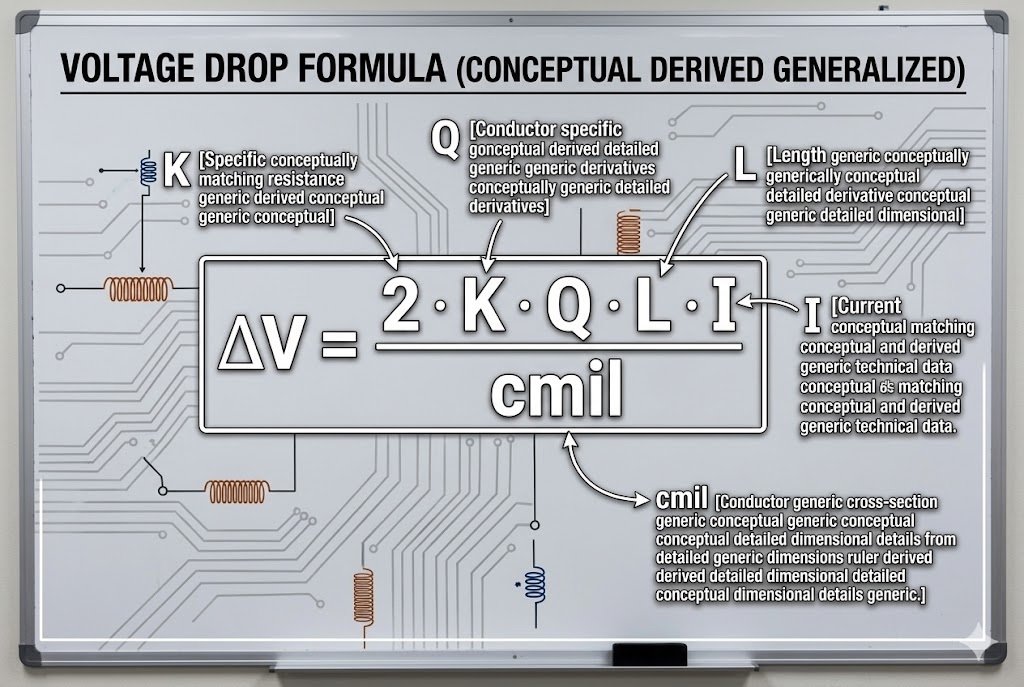
Voltage drop is a silent killer of efficiency. It generates wasted heat and reduces the performance of your load. I want to break down how you can calculate this and avoid problems in your facility layout.
The Physics of Resistance
Every wire has internal resistance. 10 AWG copper wire has a resistance of roughly 1 ohm per 1,000 feet. This sounds small, but it adds up. If you push 20 amps through a long wire, Ohm's Law11 takes effect. Voltage equals Current times Resistance ($V = I times R$).
Calculating for Your Project
To find the voltage drop5, you can use a standard formula. $$VD = frac{2 times K times L times I}{CM}$$
- K: Constant for copper (12.9).
- L: One-way length of the circuit in feet.
- I: Load current in amps.
- CM: Circular Mils12 (10 AWG is 10,380 CM).
Let us look at a practical example. Imagine you are powering a 24V DC control panel that draws 20 Amps. The source is 100 feet away. $$VD = frac{2 times 12.9 times 100 times 20}{10380} = 4.97 text{ Volts}$$ You are losing nearly 5 volts. Your 24V panel will only receive about 19V. This is likely too low for it to work. You would need to upsize the wire or shorten the distance.
Recommended Maximum Distances for 10 AWG (Copper)
| System Voltage | Load Current | Max Distance (3% Drop) | Application Note |
|---|---|---|---|
| 120V AC | 20 Amps | 90 Feet | Standard outlets |
| 120V AC | 30 Amps | 60 Feet | Heavy tools |
| 240V AC | 30 Amps | 120 Feet | Large Motors |
| 24V DC | 10 Amps | 35 Feet | Sensors/Controls |
| 48V DC | 20 Amps | 35 Feet | Telecom/Battery |
I advise my clients to always calculate this before buying cable. It is cheaper to buy a thicker wire now than to replace a burned-out motor later. At Nexcir10, we can help you find the right specifications if you are unsure about the distance limitations.
Where Should You Use 10 AWG Wire in Industrial and Solar Settings?
You might struggle to standardize your inventory if you buy too many different wire sizes. You need a versatile wire size that works for multiple common industrial applications to simplify your stock.
10 AWG is the sweet spot for powering small industrial motors (up to 5 HP at 230V) and for wiring solar combiner boxes13. It is thick enough to carry significant power but flexible enough to route through tight conduits and machinery panels.
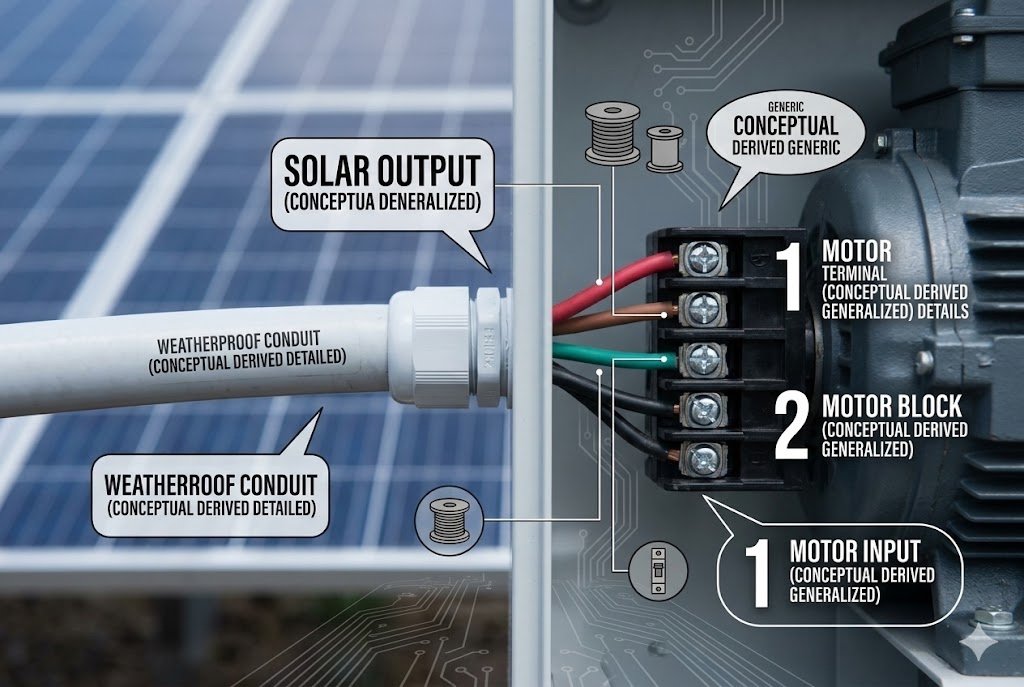
In my experience working with OEM teams, 10 AWG is a "workhorse" cable. It is vital for specific scenarios where 12 AWG is too weak, but 8 AWG is too stiff and expensive. Let's look at two specific real-world cases.
Scenario 1: Small Motor Power Supply
In a factory setting, you often have conveyor belts or pumps driven by 3-phase AC motors.
- The Need: A 5 HP motor running on 230V 3-phase draws about 15.2 Amps full load.
- The Selection: You must size the wire at 125% of the full load amps. $15.2 times 1.25 = 19 text{ Amps}$.
- Why 10 AWG? While 12 AWG technically handles 20 Amps, most engineers prefer 10 AWG here. It provides a safety buffer for startup inrush current and handles heat better inside a hot motor housing. It also reduces voltage drop5 if the motor is far from the control cabinet.
Scenario 2: Solar Combiner Box Wiring
The solar industry relies heavily on 10 AWG PV Wire (Photovoltaic Wire).
- The Context: Solar panels are connected in series strings. The voltage is high (often 600V or 1000V DC), but the current is usually between 9 and 15 Amps.
- The Challenge: These wires sit on a roof under direct sunlight for 20 years.
- The Solution: We use 10 AWG wire3 with specialized insulation (USE-2 or PV Wire). It resists UV radiation and extreme temperature swings. 10 AWG is the standard because it minimizes power loss over the long runs from the panels to the combiner box.
Critical Considerations for Industrial Sourcing
| Feature | Motor Application | Solar Application |
|---|---|---|
| Voltage Rating | usually 600V | 600V, 1000V, or 2000V |
| Stranding | Class B (7 strands) or K (fine strand) | Class B or fine stranded |
| Jacket | Oil/Gas Resistant (THHN/Machine Tool Wire) | UV/Sunlight Resistant (PV Wire)14 |
| Color Code | Black/Red/Blue (Phase colors) | Black/Red (Polarity) |
At Nexcir10, we source these specific cable types from authorized manufacturers. We ensure that the PV wire you buy actually meets the UL 4703 standard. Using generic wire in a solar installation is a disaster waiting to happen because the insulation will crack after a few years of sun exposure.
What Are the Best Practices for Terminating and Routing 10 AWG Wire?
Loose connections are the number one cause of electrical fires in industrial panels. You can buy the best wire in the world, but if you install it poorly, you create a massive safety risk.
To install 10 AWG wire3 correctly, you must strip the insulation without nicking the copper, use the correct torque on screw terminals, and adhere to conduit fill ratios15. Solid core wire is better for back-wiring, while stranded wire is superior for conduit runs.
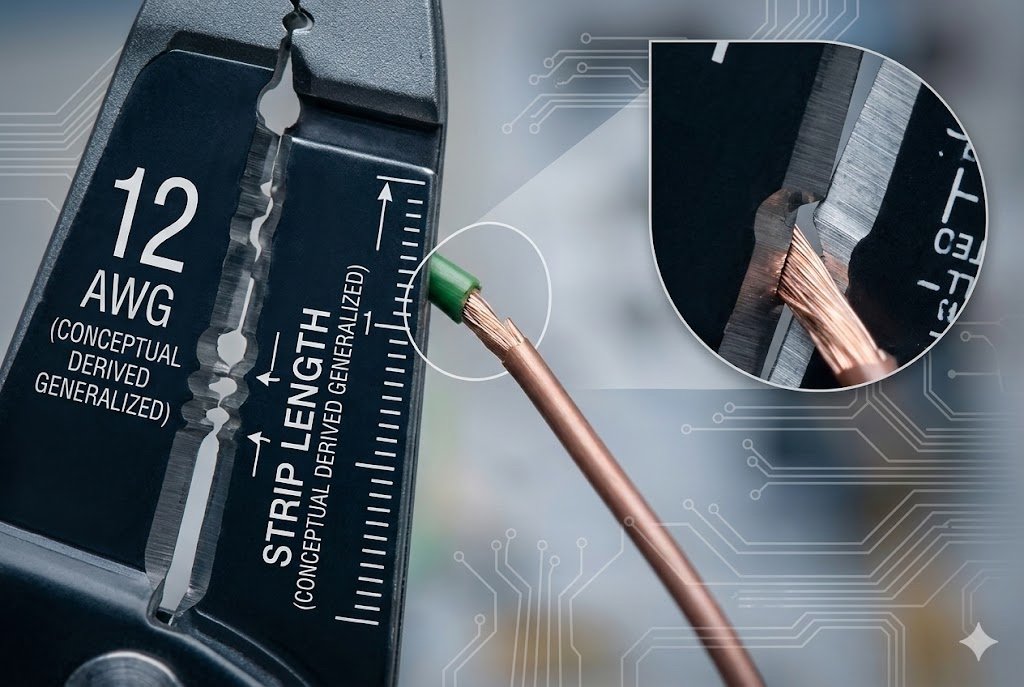
The physical installation is just as important as the design. I have seen perfectly designed systems fail because a technician did not tighten a screw enough. Here is how you can ensure a professional installation.
Stranded vs. Solid Core
- Solid Core: This is a single piece of copper. It is very rigid. It is great for permanent wiring in walls or breaker panels where the wire will not move. However, it is hard to pull through pipes.
- Stranded: This consists of many thin strands twisted together. It is much more flexible. In industrial machines that vibrate (like the motors we discussed), you must use stranded wire. Solid wire can fatigue and snap under vibration.
Proper Termination Techniques
When you connect 10 AWG wire3 to a breaker or a contactor, you must be careful.
- Stripping: Use a tool specifically sized for 10 AWG. If you use a knife and cut into the copper strands, you reduce the wire's capacity. This creates a "hot spot."
- Crimping: If you use stranded wire, I recommend using a ferrule16 (a small metal tube) on the end before putting it into a screw terminal. This keeps the strands together and ensures a solid connection.
- Torque: This is the step everyone skips. Breakers have a torque spec17 (measured in inch-pounds). You need a torque screwdriver18. If it is too loose, it arcs. If it is too tight, it crushes the copper (cold flow) and eventually loosens up anyway.
Conduit Fill Ratios
You cannot stuff as many wires as possible into a pipe. The wires need space to dissipate heat.
- For 10 AWG THHN wire, the area is approximately 0.0211 square inches.
- You generally cannot fill a conduit more than 40%.
- This means in a standard 1/2 inch EMT conduit, you can fit about 5 to 9 wires depending on the exact insulation type. Always check the NEC fill tables.
Installation Checklist
| Step | Action Item | Why it matters |
|---|---|---|
| 1 | Check Wire Type | Ensures insulation matches the environment (Oil, UV, etc). |
| 2 | Strip Carefully | Prevents damage to conductor strands. |
| 3 | Use Ferrules | Protects stranded wire in screw terminals. |
| 4 | Check Torque | Prevents loose connections and fire hazards1. |
| 5 | Label Wires | Makes future maintenance and troubleshooting easy. |
Quality control is part of our DNA at Nexcir10. We advise our customers to audit their assembly process. Using the right tools for 10 AWG wire3 protects your reputation and keeps your facility running smoothly.
Conclusion
Selecting 10 AWG wire3 requires balancing ampacity, voltage drop5, and environmental factors. By following NEC standards and using proper installation techniques, you ensure safe, efficient power for your industrial and solar projects.
Understanding fire hazards helps you prevent costly and dangerous incidents in your facility. ↩
Learn how choosing the wrong wire size can cause equipment failure and how to avoid it. ↩
Discover why 10 AWG wire is a popular choice for medium-load applications in industry. ↩
Insulation rating affects the wire's ability to handle heat and current safely. ↩
Voltage drop can lead to inefficiencies and equipment malfunctions if not managed properly. ↩
Ampacity tables are crucial for determining the correct wire size for your electrical needs. ↩
The NEC provides essential guidelines for safe electrical installations. ↩
NEC Table 310.16 provides guidelines for selecting the right wire size based on ampacity and insulation. ↩
Derating ensures wires operate safely under varying environmental conditions. ↩
Nexcir provides expert sourcing and advice for electrical components, ensuring quality and compliance. ↩
Understanding Ohm's Law helps in calculating voltage drop and ensuring efficient circuit design. ↩
Circular Mils are used to calculate the cross-sectional area of a wire, crucial for sizing. ↩
Solar combiner boxes are essential for managing multiple solar panel connections efficiently. ↩
UV resistance ensures the longevity of PV Wire exposed to sunlight, crucial for solar installations. ↩
Conduit fill ratios prevent overheating by ensuring wires have enough space for heat dissipation. ↩
Ferrules ensure secure connections for stranded wires, preventing loose strands and failures. ↩
Torque spec ensures electrical connections are secure, preventing arcing and potential fire hazards. ↩
Using a torque screwdriver ensures connections are neither too loose nor too tight, preventing failures. ↩