
Struggling to select the right automotive connector1? A wrong choice can lead to connection failures and costly vehicle recalls. Let's ensure your design is robust and reliable from the start.
To choose the right automotive connector1, you must evaluate the application's environment, power requirements, and mechanical stress2. Focus on connectors that meet specific automotive standards like USCAR-23 and have the correct IP rating4 for protection against dust and water, ensuring long-term reliability and performance.
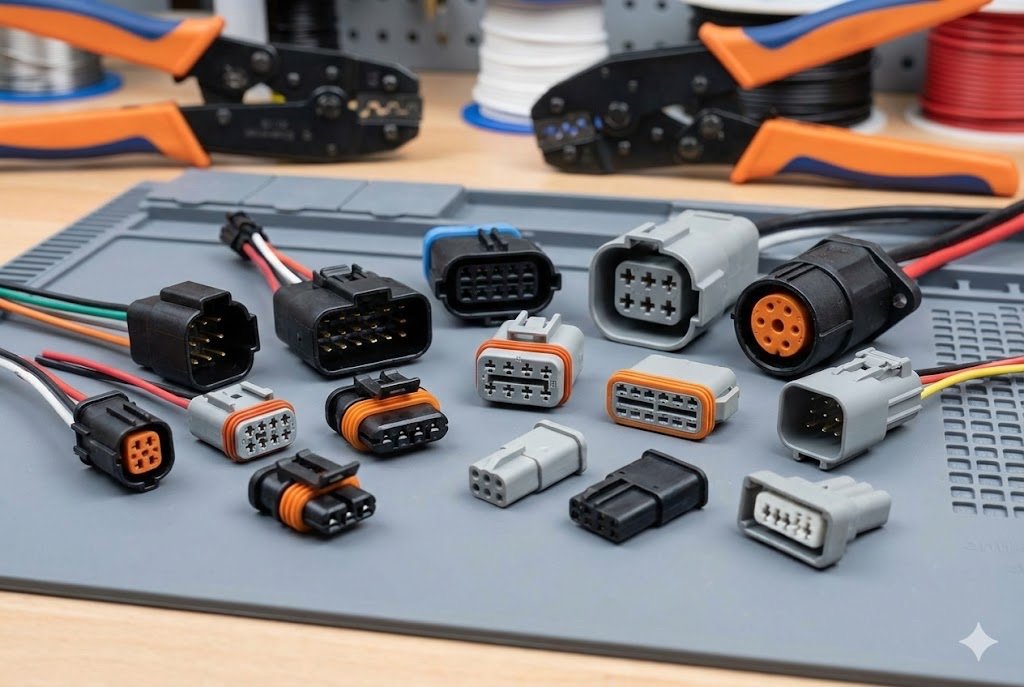
Choosing a connector feels like a small decision, but in the automotive world, it has huge consequences. The right one works invisibly for years, while the wrong one can bring a multi-ton vehicle to a standstill. I've seen projects delayed for months because an initial connector choice couldn't pass validation. That's why I believe a deep understanding of these components is not just for specialists; it's essential for every engineer and procurement manager in this industry. Let's break down what you need to know to make the right call every time.
What Are the Main Types of Automotive Connectors?
The sheer number of connector types can be overwhelming. Using a generic connector in a high-vibration area is a recipe for disaster. Let's break down the common types to simplify your choice.
Automotive connectors are typically categorized by their function and structure. Key types include wire-to-wire5 for joining harnesses, wire-to-board6 for connecting to ECUs, and board-to-board7 for stacking PCBs. Each is designed for specific mechanical and electrical demands within the vehicle.
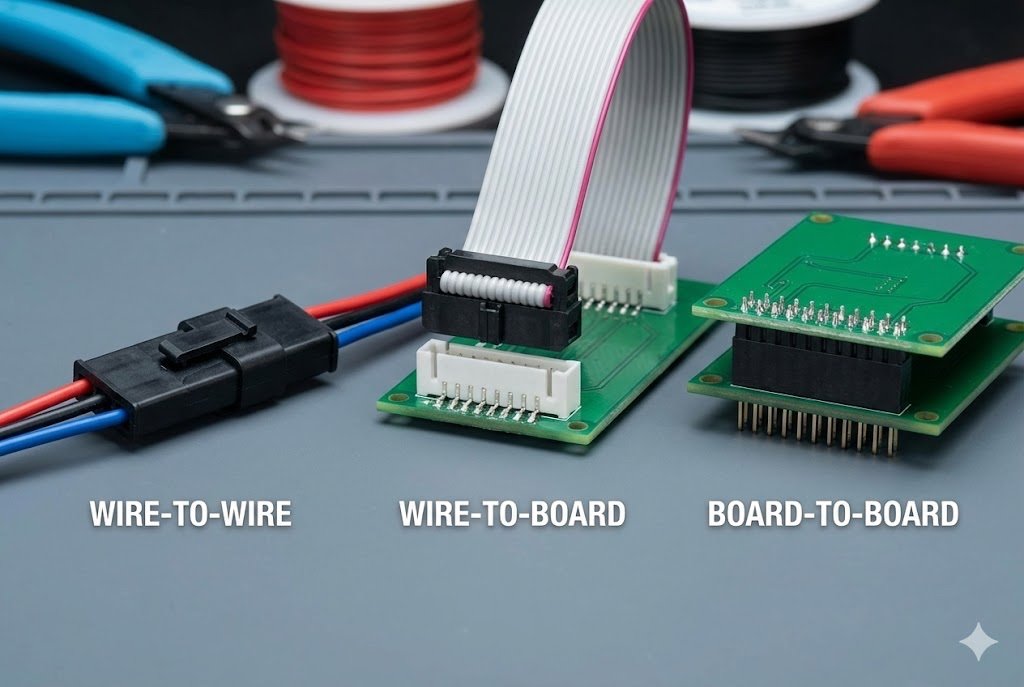
When we help our OEM clients, the first question we ask is always about the connection's purpose. This immediately narrows down the options. For example, a client recently needed a solution for their new EV battery management system. The design required connecting multiple cell monitoring boards together inside a single enclosure. This was a clear case for a high-density, board-to-board7 connector. In contrast, connecting a door lock actuator to the main body harness requires a completely different solution: a sealed, wire-to-wire5 connector with a secure locking mechanism. Understanding these fundamental categories is the first step in the selection process.
Connector Categories and Uses
| Connector Type | Primary Use Case | Common Location | Key Feature |
|---|---|---|---|
| Wire-to-Wire | Joining two separate wire harnesses. | Throughout the vehicle, chassis, engine bay. | Robustness, sealing. |
| Wire-to-Board | Connecting a wire harness to a PCB (e.g., ECU, sensor). | ECUs, sensor modules, lighting. | Secure latching, pin density. |
| Board-to-Board | Connecting two PCBs directly. | Infotainment stacks, ADAS modules. | High density, small footprint. |
Why Are Automotive Standards Like USCAR-23 So Important?
Are industry standards just another box to check? Ignoring them can mean your product fails validation testing, causing major project delays. These standards are your guide to guaranteed reliability.
Automotive standards like USCAR-23 are critical because they define the performance requirements for vehicle connectors. They ensure components can withstand harsh conditions like extreme temperatures, vibration, and humidity. Compliance guarantees reliability, safety, and interoperability between different suppliers' parts.
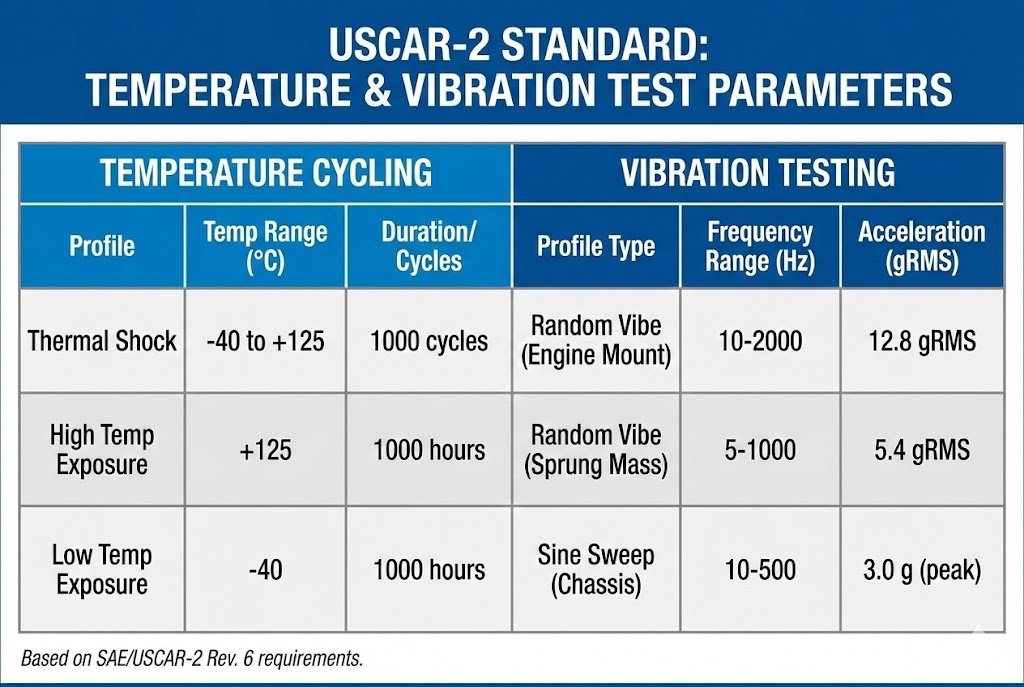
I can't stress this enough: automotive-grade8 is not just a marketing term. It signifies that a component has passed a brutal series of tests. I remember a case where a team tried to use a consumer-grade connector in a prototype because it was cheaper and available. It failed within the first hour of vibration testing9. The project was set back weeks as they scrambled to source and validate a proper USCAR-23 compliant part. As a sourcing partner10, we see our role as a gatekeeper. We ensure the components we provide, especially for automotive applications, are fully traceable and certified to the required standards. This isn't just about finding a part; it's about protecting your production and reputation.
Key USCAR-23 Performance Tests
- Thermal Shock & Humidity: The standard requires connectors to survive rapid temperature swings, often from -40°C to +125°C, while also being exposed to high humidity. This simulates a car sitting in a cold climate and then having its engine start, generating intense heat.
- Vibration & Mechanical Shock: Connectors undergo hours of intense vibration on multiple axes to simulate a lifetime of road imperfections. They must maintain a stable electrical connection throughout.
- Durability: The standard defines how many times a connector can be mated and unmated without degrading its performance or locking mechanism.
How Do IP Ratings Define Connector Sealing and Protection?
Your connector looks solid, but will it survive a pressure wash or a dusty road? Water or dust ingress means certain failure. IP rating4s provide the clear answer you need.
IP (Ingress Protection) ratings classify a connector's sealing effectiveness against solids and liquids. The first digit indicates protection from solids (like dust), and the second from liquids (like water). For example, IP67 means it's dust-tight and can be submerged in water.
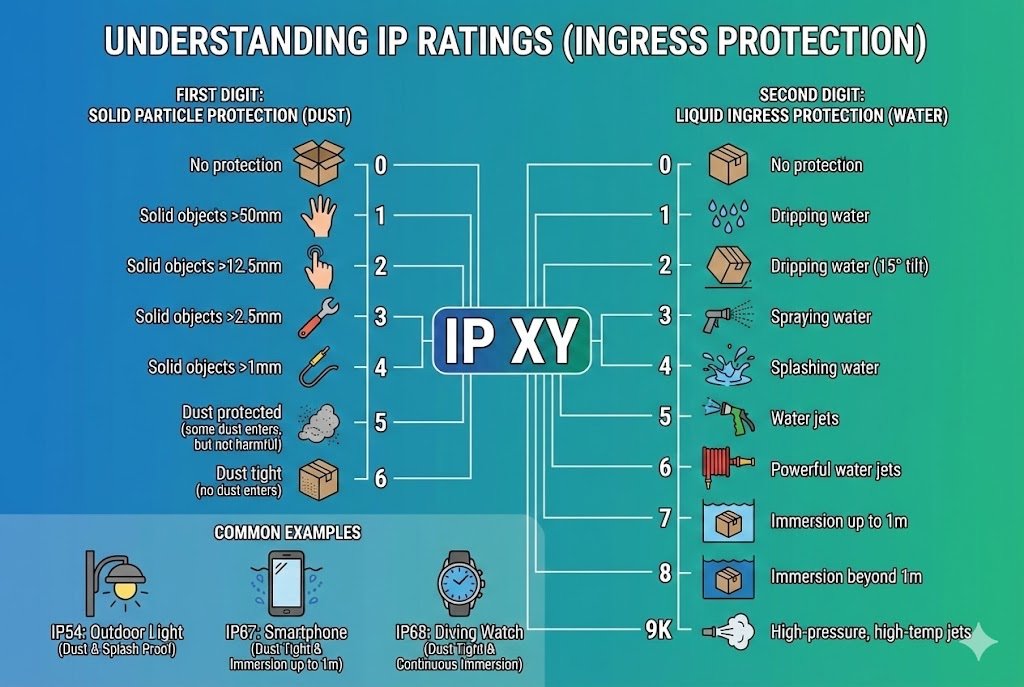
The location of the connector inside the vehicle is everything when it comes to IP rating4s. You wouldn't use the same part inside the cabin as you would on the undercarriage. For a connector on an ABS wheel speed sensor, it will be constantly exposed to water, salt, and dirt. Here, nothing less than IP67 or even IP69K is acceptable. IP69K is the highest rating, signifying protection against high-pressure, high-temperature water jets. In contrast, a connector for an interior dome light is in a protected environment and likely doesn't need any sealing at all. Misjudging this can lead to two problems: over-specifying, which adds unnecessary cost, or under-specifying, which leads to field failures.
Common Automotive IP Ratings
| IP Rating | Protection Level | Typical Application |
|---|---|---|
| Unsealed | No protection from dust or water. | Inside the cabin (e.g., infotainment, dashboard). |
| IP54 | Dust protected; protected against water spray. | Protected areas in the engine bay. |
| IP67 | Dust-tight; protected against temporary immersion. | Exposed chassis, engine components, sensors. |
| IP69K | Dust-tight; protected against high-pressure steam jets. | Heavy-duty trucks, agricultural equipment, underbody. |
What Key Factors Should Guide Your Connector Selection?
You know the types, standards, and ratings. But how do you put it all together for your specific BOM? Making the wrong trade-off can still compromise your design and your entire supply chain.
Your final connector selection should be a balanced decision based on four key factors: electrical requirements (current/voltage), mechanical demands (vibration/mating cycles), environmental exposure11 (temperature/IP rating4), and commercial constraints12 (cost/availability). A systematic approach prevents costly errors.
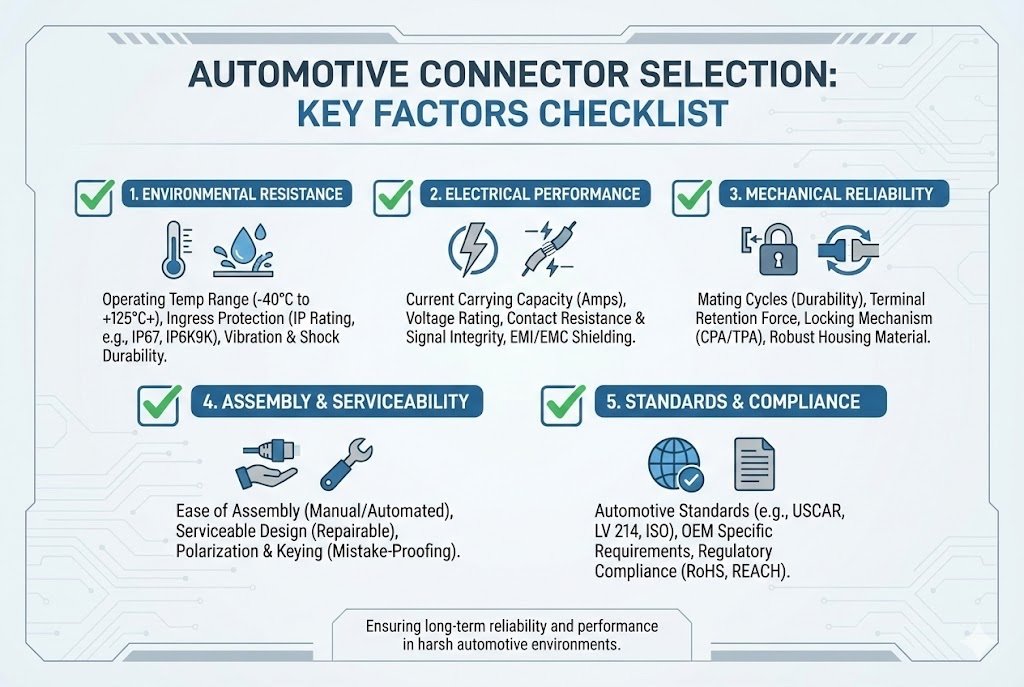
This final step is where everything comes together. It's a balancing act. For instance, you might find a connector that meets all the technical requirements but has a 52-week lead time13 or is at risk of going End-of-Life (EOL)14. This is where our role as a sourcing partner10 becomes critical. We don't just look at a datasheet. We look at the market, the lead time13s, and the manufacturer's roadmap. We recently helped a client who designed their system around a specific automotive-grade8 PMIC and its associated connector. The problem? That connector series was allocated globally. We were able to propose and source a cross-reference alternative that met the same USCAR standard and IP rating4 but was available from a more stable channel, saving their production schedule.
Your Final Selection Checklist
- Electrical Performance: What is the maximum current and voltage? Is it for a low-power signal or a high-power line? Signal integrity needs are crucial for high-speed data lines in ADAS and infotainment.
- Mechanical Integrity: How much vibration will it see? Does it need a secondary locking mechanism? How many times will it be serviced (mating cycles)?
- Environmental Resilience: What is the operating temperature range? Does it need to be sealed (IP rating4)? Will it be exposed to chemicals like oil or coolant?
- Sourcing & Lifecycle: Is the part readily available? What is the lead time13? Is it an active product, or is it marked NRND (Not Recommended for New Designs)?
Conclusion
Choosing the right automotive connector1 involves balancing type, standards, and IP rating4s. This ensures your design is reliable, safe, and built for the long term with a stable supply.
Explore this link to gain insights on choosing the right automotive connector for your needs. ↩
Learn about the effects of mechanical stress on connector reliability and performance. ↩
Learn about USCAR-2 standards and how they ensure reliability and safety in automotive applications. ↩
Discover how IP ratings determine the sealing effectiveness of connectors against dust and water. ↩
Understand the role of wire-to-wire connectors in joining separate wire harnesses effectively. ↩
Find out how wire-to-board connectors connect wire harnesses to PCBs in automotive systems. ↩
Explore the advantages of using board-to-board connectors for high-density PCB connections. ↩
Learn what makes a connector automotive-grade and why it matters for reliability. ↩
Discover why vibration testing is crucial for ensuring connector durability in vehicles. ↩
Find out how a sourcing partner can help you navigate connector selection and availability. ↩
Explore the environmental challenges connectors face and how to select accordingly. ↩
Understand how cost and availability influence the choice of automotive connectors. ↩
Understand the importance of lead time in ensuring timely production and supply. ↩
Learn about the implications of EOL status on connector availability and design. ↩


