High-power relays often fail due to severe arcing, causing costly production downtime and equipment damage. You need a robust design strategy to prevent these unexpected system crashes immediately.
To ensure reliability, match the relay load type1 to the datasheet specifications. Always implement optical isolation2 using the PC817 optocoupler3 and drive the coil with a robust NPN transistor4. Furthermore, add a flyback diode5 or RC snubber6 across the contacts to suppress dangerous voltage spikes.
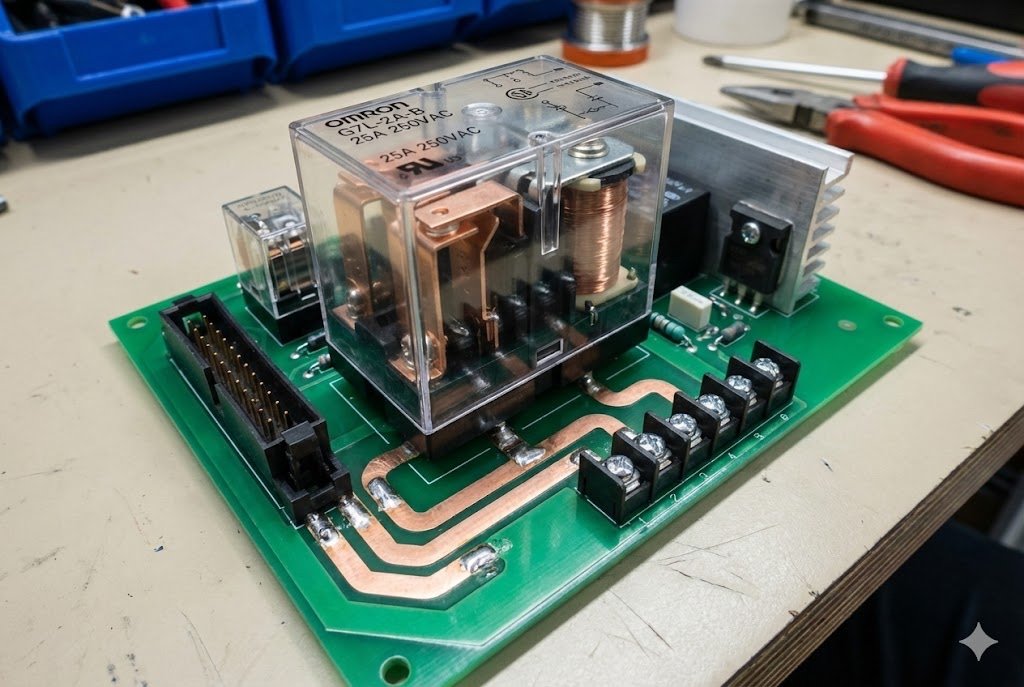
In my twenty years of experience at Nexcir, I have seen many expensive machines fail. The cause is rarely the machine itself. The problem usually comes from a cheap relay circuit. Engineers focus on the big processor but forget the simple switch. This leads to noise, sparks, and melted plastic. I want to help you avoid this. I will explain exactly how to choose the right parts. We will look at the relay, the protection, and the drive circuit. These steps will keep your hardware safe.
What are the critical factors for high-power relay selection?
Choosing the wrong relay rating leads to rapid overheating and welded contacts. This creates a fire hazard.
You must analyze the load type, specifically looking at inrush current7 for motors or capacitive loads8. Select a relay with contact materials like Silver Tin Oxide9 designed to handle these surges.
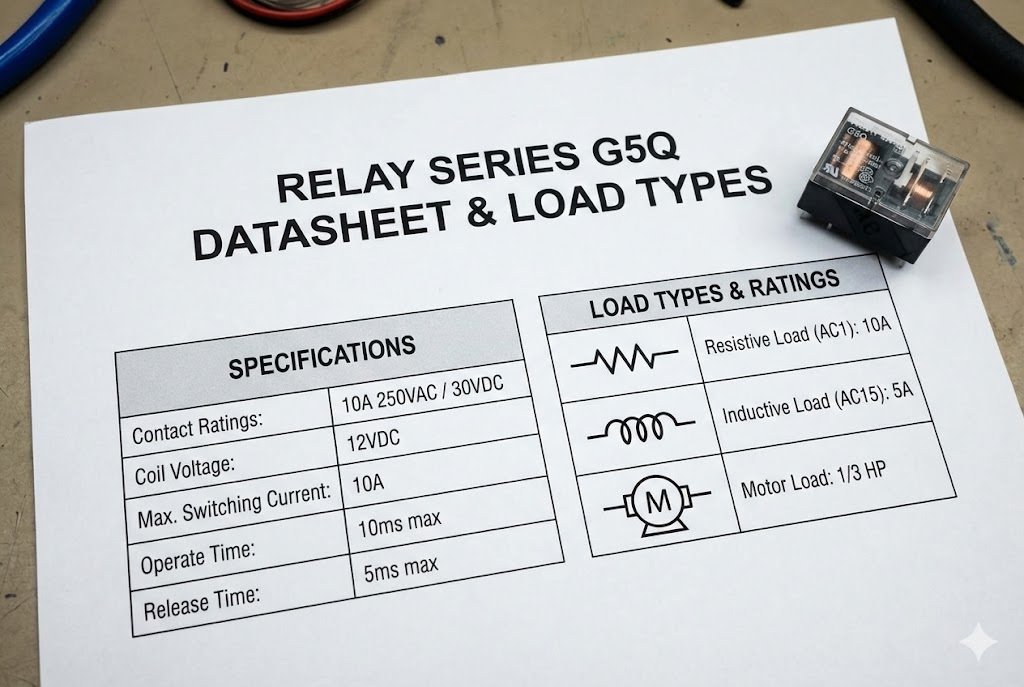
When I help a customer with a new design, I always ask about the load first. A simple resistor is easy to drive. But a motor or a power supply is very different. These are called inductive and capacitive loads8. They act differently when you turn them on.
For example, a motor might need 10 Amps to run. But when it starts, it might pull 60 Amps for a short time. If you pick a standard 10 Amp relay, the contacts will stick together. This is a common failure. You need to look at the "Inrush Current" rating in the datasheet.
Also, the material of the contact points matters. Standard relays use Silver Nickel. This is fine for lights. But for high power, I recommend Silver Tin Oxide9 (AgSnO2). It resists welding much better. At Nexcir, we source these specific types from original manufacturers. We ensure you get the right part for the heavy work.
Here is a simple breakdown of load types I use to guide my clients:
| Load Type | Characteristics | Key Risk | Recommended Contact Material |
|---|---|---|---|
| Resistive | Heater, Incandescent Lamp | Steady current flow | Standard AgNi (Silver Nickel) |
| Inductive | Motors, Solenoids | High voltage spike at turn-off | AgSnO2 (Silver Tin Oxide9) |
| Capacitive | Power Supplies, LED Drivers | High inrush current7 at turn-on | AgSnO2 (Silver Tin Oxide9) |
Why is a contact protection circuit necessary for longevity?
Electrical arcs burn through relay contacts and destroy the device in weeks. You lose money on replacements.
Protection circuits, such as a flyback diode5 for DC loads or an RC snubber6 for AC loads, absorb the energy released when contacts open. This prevents arcing and extends relay life.
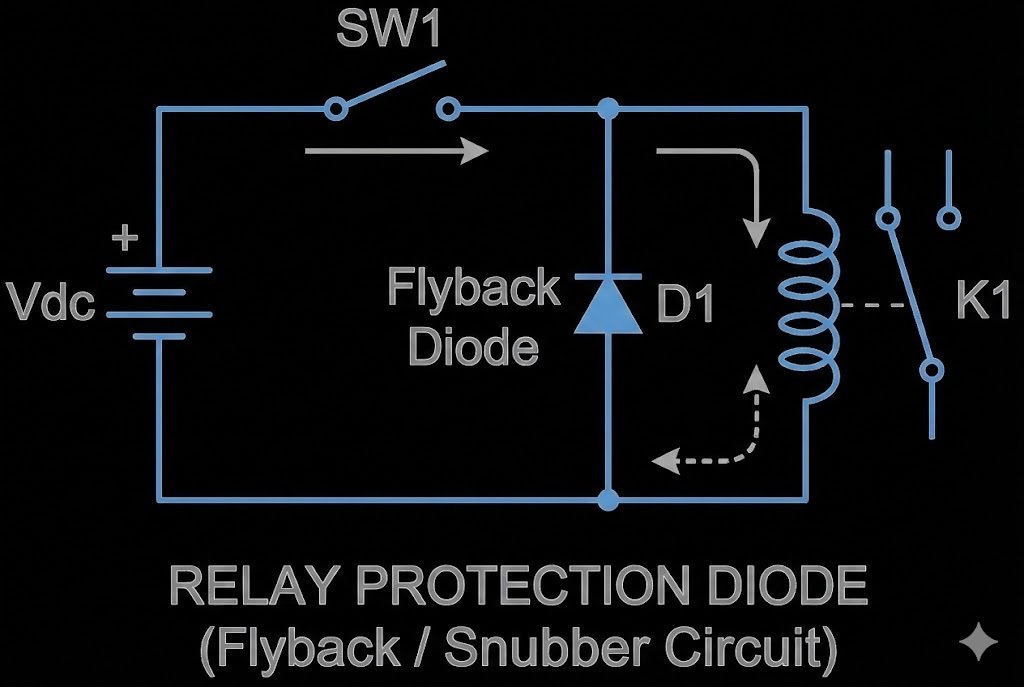
I often explain to junior engineers that a relay coil is like a compressed spring. When you push electricity through a coil, it builds up a magnetic field. This is potential energy. When you turn the switch off, that field collapses. The energy has to go somewhere.
If you do not provide a path, the energy becomes a high-voltage spike. This spike can reach hundreds of volts. It jumps across the open contacts. We call this arcing. It looks like a tiny lightning bolt inside the relay. This heat creates carbon deposits. Eventually, the relay stops conducting electricity.
For DC circuits, the solution is simple. We add a diode across the coil. This is often called a "flyback diode5." It allows the current to loop back and fade away slowly. It stops the voltage spike. For AC circuits, we use a resistor and a capacitor together. This is an RC Snubber. It absorbs the energy.
I have seen projects where they skipped these cheap parts to save pennies. The result was field failures after three months. It is not worth the risk. A simple diode costs almost nothing but doubles the life of the relay.
How does optocoupler isolation prevent microcontroller damage10?
High voltage noise from motors can travel back and kill sensitive microcontrollers. This creates random bugs.
Optocouplers like the PC817 use light to transmit signals, electrically separating the high-voltage relay side from the low-voltage logic side. This stops noise interference completely.
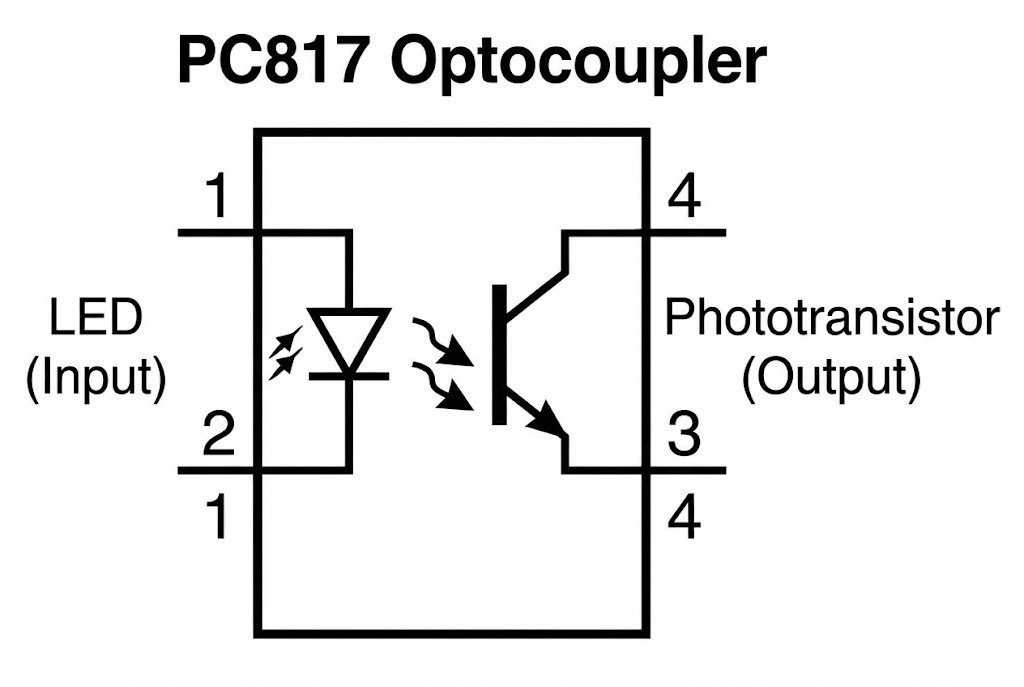
This is the most critical safety feature in your design. You have a microcontroller (MCU). It runs on 3.3V or 5V. It is very sensitive. On the other side, you have a relay switching 220V or even higher. If the relay fails internally, that high voltage can rush back into your MCU. If that happens, your entire control board is dead.
The solution is "Galvanic Isolation." We use a component called an optocoupler. The most popular one in the industry is the PC817. I sell thousands of these because they are the industry standard.
Inside the PC817, there is an LED and a light sensor. When your MCU sends a signal, the LED lights up. The sensor sees the light and turns on the other side. There is no wire connecting the two sides. Only light crosses the gap. This means 220V cannot cross over to kill your processor.
Also, relays create "noise" or interference. This noise confuses the MCU. It causes the system to reset randomly. The PC817 blocks this noise. At Nexcir, we consider the PC817 an essential part of the Bill of Materials (BOM) for any relay board. It is cheap insurance for your expensive electronics.
Why do you need an NPN transistor4 to drive the relay coil?
Microcontrollers cannot provide enough current to move the relay switch. The pin will burn out.
Microcontroller pins typically output only 20mA, but relay coils often need 70mA or more. An NPN transistor4 acts as a current amplifier11 to switch this load safely.
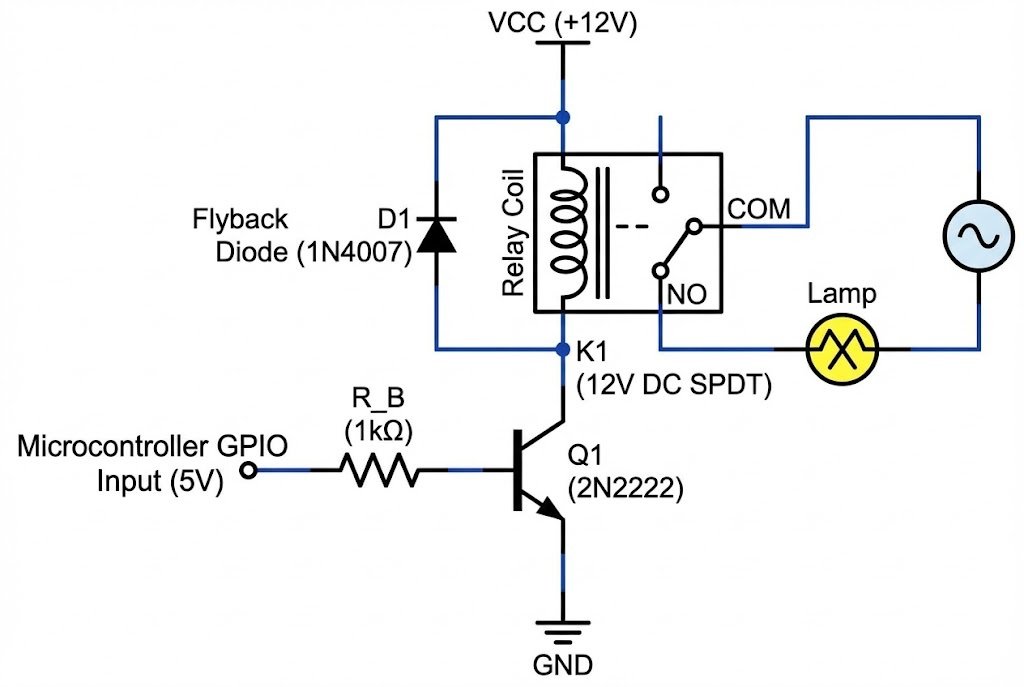
I see this mistake in student projects and even some professional prototypes. An engineer connects the relay coil directly to the MCU pin. It might work once or twice. Then, the MCU gets hot and fails.
The reason is current. A standard relay coil needs between 50mA and 100mA to activate the magnet. A typical MCU pin can only give about 20mA. You are asking a child to lift a heavy weight. The child will get hurt.
You need a driver. The most common solution is an NPN transistor4. Common part numbers are 2N2222, BC547, or S8050. These are staple items in our inventory at Nexcir.
The transistor works like a valve. The MCU sends a tiny current to the "Base" of the transistor. This opens the valve. Then, a large current flows from the "Collector" to the "Emitter." This large current powers the relay coil. The MCU does not feel the heavy load.
When we supply kits to our OEM customers, we always bundle the Relay, the PC817 Optocoupler, and the NPN Transistor together. They are a team. You cannot have a reliable circuit without all three working together. It ensures your product works every time, for years.
Conclusion
Proper relay selection, combined with PC817 isolation and NPN drivers, ensures system safety. Trust Nexcir for these essential, authentic components to secure your supply chain.
Learn how to analyze relay load types for optimal performance and safety. ↩
Learn about optical isolation to enhance your circuit designs and protect sensitive components. ↩
Discover the versatility of the PC817 optocoupler and how it can improve your designs. ↩
Learn about NPN transistors to effectively drive relay coils and protect your MCU. ↩
Understand the importance of flyback diodes in protecting circuits from voltage spikes. ↩
Find out how RC snubbers can extend the life of your relays and prevent damage. ↩
Learn about inrush current to make informed decisions when selecting relays for your applications. ↩
Understand capacitive loads to enhance your relay circuit designs and prevent issues. ↩
Explore the advantages of Silver Tin Oxide for high-power applications and reliability. ↩
Discover strategies to protect microcontrollers from damage in relay applications. ↩
Explore the role of current amplifiers in electronic circuits for better performance. ↩