You are building a high-power battery pack or a heavy-duty industrial device. The wires feel hot to the touch during testing. You worry about melting insulation or starting a fire. You need the right wire thickness and connector immediately to ensure safety.
To handle 50A+ currents safely, use 8 AWG1 or 10 AWG2 silicone wires with high temperature ratings3. For connectors, choose XT604 for compact, vibration-heavy applications like drones, or Anderson Powerpoles5 for modular, frequent-disconnect industrial use. Always verify your selection against a standard AWG Ampacity Chart6 to prevent voltage drop and dangerous overheating.
I have seen many engineers fail because they guessed the wire size or picked a cheap connector. They ruin expensive batteries and prototypes. Do not let this happen to your project. I will guide you through the charts and the connector choices to make your system safe and efficient.
Which AWG Size Is Best for 50A to 60A Currents?
A thin wire acts like a bottleneck in a water pipe. It restricts the flow of electricity. This resistance creates dangerous heat in your system that can melt insulation.
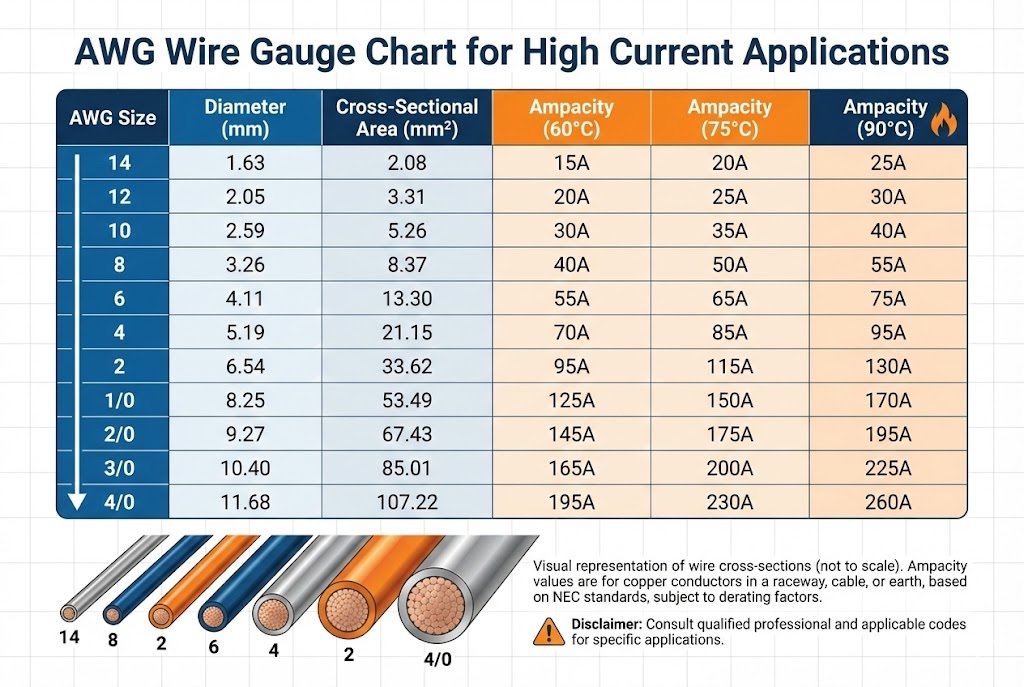
For 50A to 60A loads, 8 AWG1 is the safest choice for continuous use because of its thick copper core. 10 AWG2 works for short bursts or intermittent loads. 12 AWG is generally too thin for this current and will overheat. Lower AWG numbers mean thicker copper and better safety margins.
I often see clients ask for "thick wire" without knowing the specific number they need. This is dangerous. In the American Wire Gauge (AWG) system, the rule is simple but confusing: the lower the number, the thicker the wire. At Nexcir, we supply many OEMs who build power supplies. They often try to save money by using 12 AWG wire for 50A loads. I always tell them to stop.
When you push 50 amps through a 12 AWG wire, the resistance is too high. The energy that does not reach your motor turns into heat. This heat builds up. If you use PVC insulation, it melts at around 105°C. If you use Silicone insulation, it can handle up to 200°C, but the wire will still be extremely hot. It wastes power.
Here is a simple breakdown I use for my customers:
| AWG Size | Diameter (mm) | Recommended Current (Continuous) | Typical Application |
|---|---|---|---|
| 8 AWG1 | 3.26 mm | 40A - 55A | High Power Battery Packs, Solar Inverters |
| 10 AWG2 | 2.59 mm | 30A - 40A | Medium Motors, Heavy Drones |
| 12 AWG | 2.05 mm | 20A - 25A | General Wiring, 3D Printers |
For a 60A peak load, 8 AWG1 is the standard. It is heavy and harder to solder, but it keeps your system cool. We always source high-quality copper cables for our clients. Cheap cables use aluminum coated in copper (CCA). CCA has higher resistance. It gets hotter than pure copper. Always check that your 8 AWG1 wire is pure copper. This ensures your voltage stays stable and your machine runs efficiently.
Is Anderson Powerpole Better Than XT604 for Your Project?
You have the right wire. Now you need to plug it in. Picking the wrong plug causes dangerous sparks, loose connections, and system shutdowns.
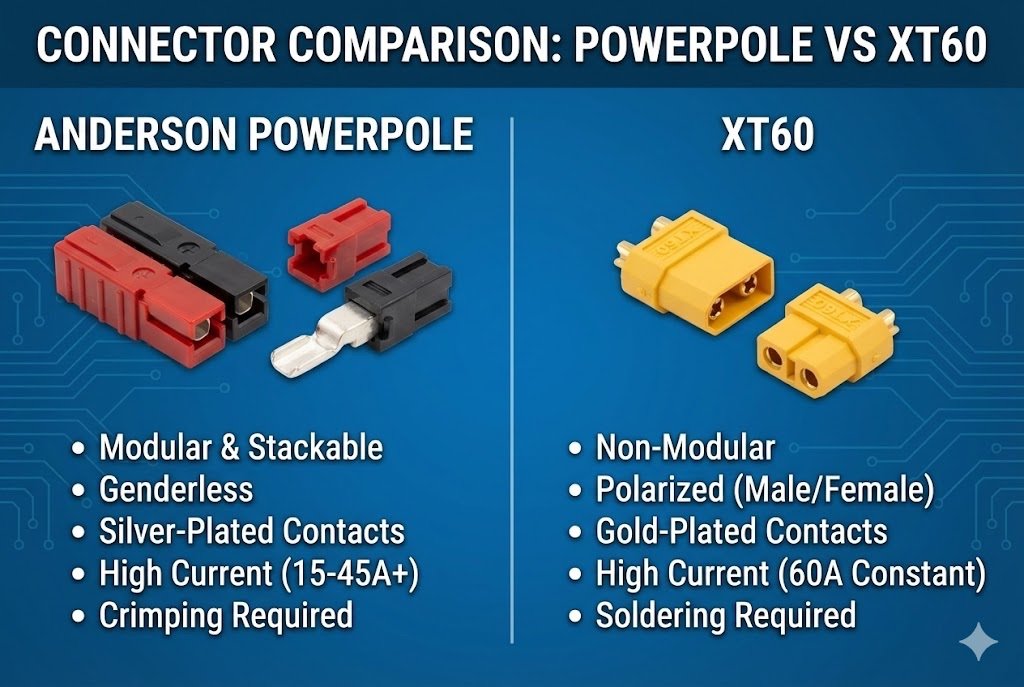
XT604 connectors are excellent for fixed, compact setups like drones because they hold very tight. Anderson Powerpoles5 are superior for modular systems7 requiring frequent unplugging and configuration changes. Anderson plugs handle higher voltages well, while XT604 offers a vibration-resistant fit for mobile devices.
I remember a project where a client used XT604s for a rack server system. It was a mistake. The technicians struggled to unplug the batteries for maintenance. XT604 is designed to be very tight. It relies on friction. This is great for a racing drone that flips in the air. You do not want the battery to fall out. But for industrial racks, it is a pain.
We suggested they switch to Anderson Powerpoles5. Here is why Anderson is different. It is "genderless." There is no male or female plug. You can flip them and connect them. You can also stack them side-by-side like Lego blocks. This allows you to build custom connectors with 4, 6, or 8 poles. This is called "modularity."
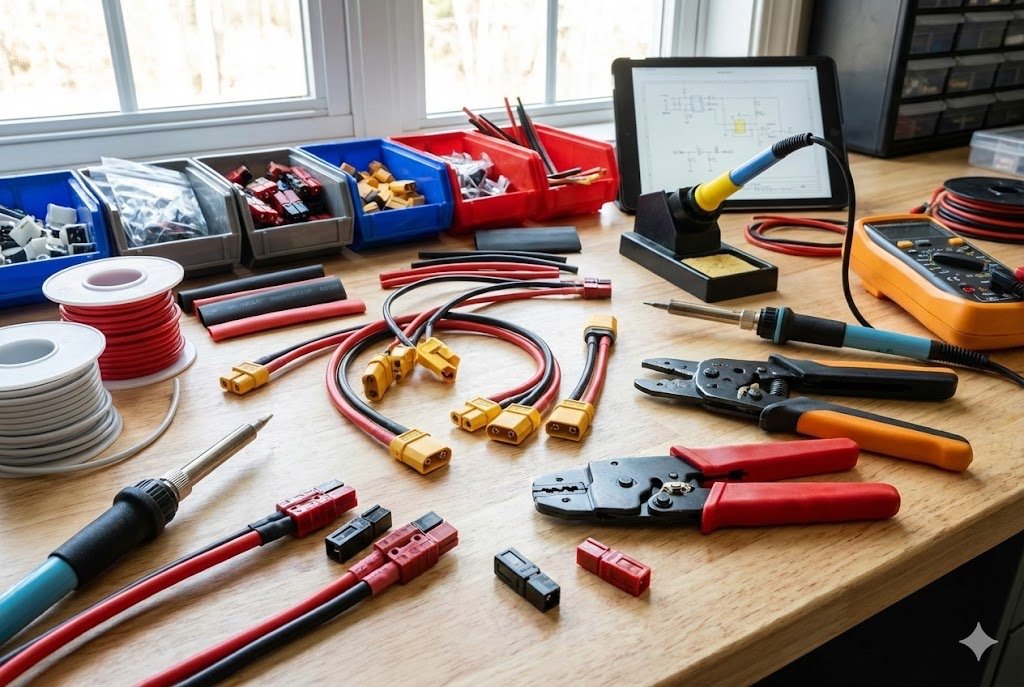
However, Anderson connectors require a specific crimping tool8. If you try to use pliers, the connection will be bad. It will heat up. XT604 is usually soldered. If you are good at soldering9, XT604 is easy. If you prefer crimping, Anderson is better.
There is another factor: Authenticity. At Nexcir, we see a lot of fake connectors. A fake XT604 uses cheap plastic. It melts when you solder it. A fake Anderson connector has weak springs. The contact creates resistance. For critical industrial jobs, we sometimes look beyond these two hobbyist standards. We recommend TE Connectivity or Molex industrial connectors.
TE Connectivity and Molex Alternatives
If you are building a medical device or an automotive part, you need certification. TE and Molex provide detailed datasheets.
- Molex Mega-Fit10: These are great for high current. They have a locking clip. They will not vibrate loose.
- TE Connectivity AMP series11: These are rugged. They handle dust and moisture better than an open Anderson plug.
We help our clients source these original parts. We ensure the supply chain is clean. Using a genuine connector means the metal pins are the right alloy. They handle the full 60A without failing.
Why Are Current Sense Resistors Crucial for High-Power Circuits?
You trust your wires and connectors. But accidents happen. A short circuit or a stalled motor can pull 100A through a 50A cable instantly.
A current sense resistor12, or shunt, measures the electricity flowing through your circuit in real-time. It sends data to your controller to cut power if the current exceeds the limit of your 8 AWG1 wire. This component is essential for preventing catastrophic failure in high-power systems.
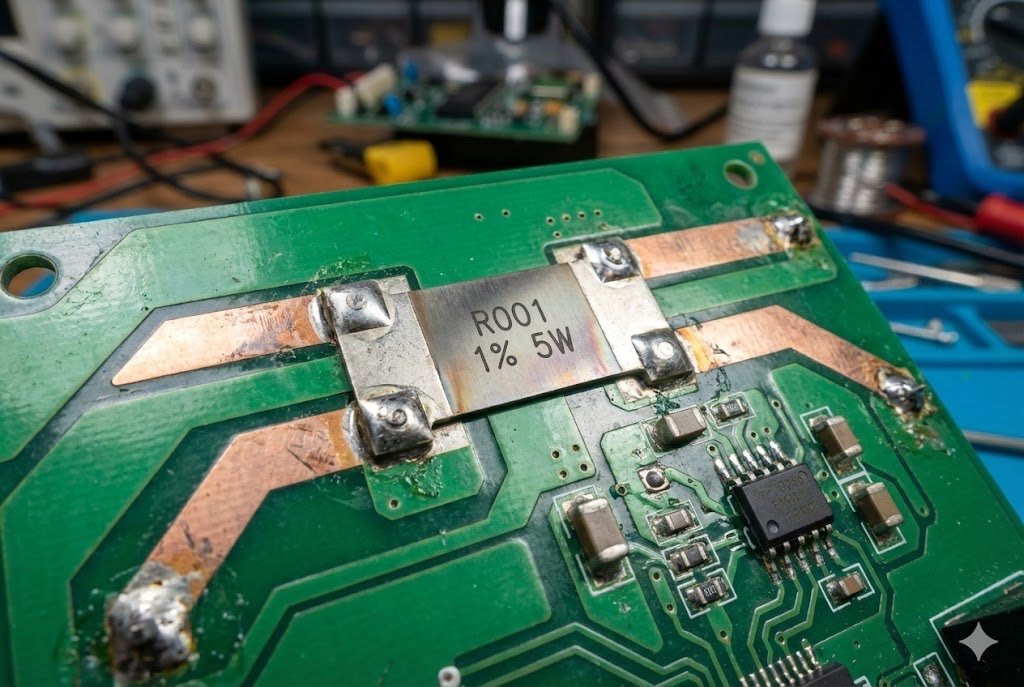
Using thick 8 AWG1 wire is passive safety. It handles the heat. Using a shunt resistor13 is active safety. It stops the heat before it starts. This is a critical distinction that I try to teach every new hardware engineer I work with.
A shunt resistor13 is a very special component. It sits in the path of the current. It has a very low resistance value, like 0.001 Ohms. Because the resistance is so low, it does not waste much power. However, it creates a tiny voltage drop. Your Battery Management System (BMS) or microcontroller reads this voltage drop. Using Ohm's Law, the chip calculates exactly how many Amps are flowing.
If the motor stalls, the current spikes. The shunt detects this in milliseconds. The system shuts down before the wire melts.
Selecting the Right Shunt
You cannot just pick any resistor. Standard resistors change their value when they get hot. This is bad. You need a resistor with a low TCR (Temperature Coefficient of Resistance14). This means the value stays stable even when hot.
- Metal Element Resistors: These are common for high current. They are robust.
- Precision Shunts: These are used when you need to measure battery life accurately.
At Nexcir, we supply precision shunts to our automotive clients. They need to know the battery state of charge (SOC) with 99% accuracy. If the shunt is cheap and drifts due to temperature, the car might say it has 10% battery when it is actually empty. That is a disaster.
We also help engineers match the shunt to the connector. If you use an Anderson connector rated for 45A, you set your software limit to 40A. The shunt provides the data to enforce this limit. It ties the whole system together. It protects the connector, the wire, and the battery.
Conclusion
Choosing between Anderson and XT604 depends on your need for modularity versus compactness. Always pair them with the correct 8 AWG1 or 10 AWG2 wire and safety shunts to prevent failure.
Explore this link to understand the optimal uses for 8 AWG wire, ensuring safety and efficiency in your projects. ↩
Learn when to use 10 AWG wire to handle specific current loads effectively and safely. ↩
Understanding high temperature ratings is crucial for ensuring wire safety in high-power applications. ↩
Find out why XT60 connectors are ideal for compact setups and their unique advantages in high-vibration environments. ↩
Discover the benefits of using Anderson Powerpoles for modular systems and how they enhance connectivity. ↩
Understanding the AWG Ampacity Chart is crucial for selecting the right wire gauge for your applications. ↩
Learn about the benefits of modular systems and how they enhance flexibility in electrical setups. ↩
Find out how to select the appropriate crimping tool to ensure secure connections for your electrical components. ↩
Explore best practices for soldering to ensure strong, reliable connections in your projects. ↩
Discover why Molex Mega-Fit connectors are preferred for high current applications and their locking features. ↩
Learn about the ruggedness and reliability of TE Connectivity AMP series connectors for demanding environments. ↩
Explore the role of current sense resistors in protecting high-power circuits and preventing failures. ↩
Learn how shunt resistors function to monitor current flow and enhance circuit safety. ↩
Understanding TCR is essential for selecting resistors that maintain accuracy under varying temperatures. ↩