Are you struggling with complex RJ45 pinout definitions or facing unexpected component shortages for your network designs? These issues can halt your network equipment production and cause severe delays in your delivery schedule.
An RJ45 with integrated magnetics1 (ICM) combines the connector and signal transformer into one unit to save board space and reduce noise. To select the right one, you must match the Ethernet speed (10/100/1000Base-T), verify the internal schematic matches your PHY chip, and confirm the mechanical footprint fits your PCB.
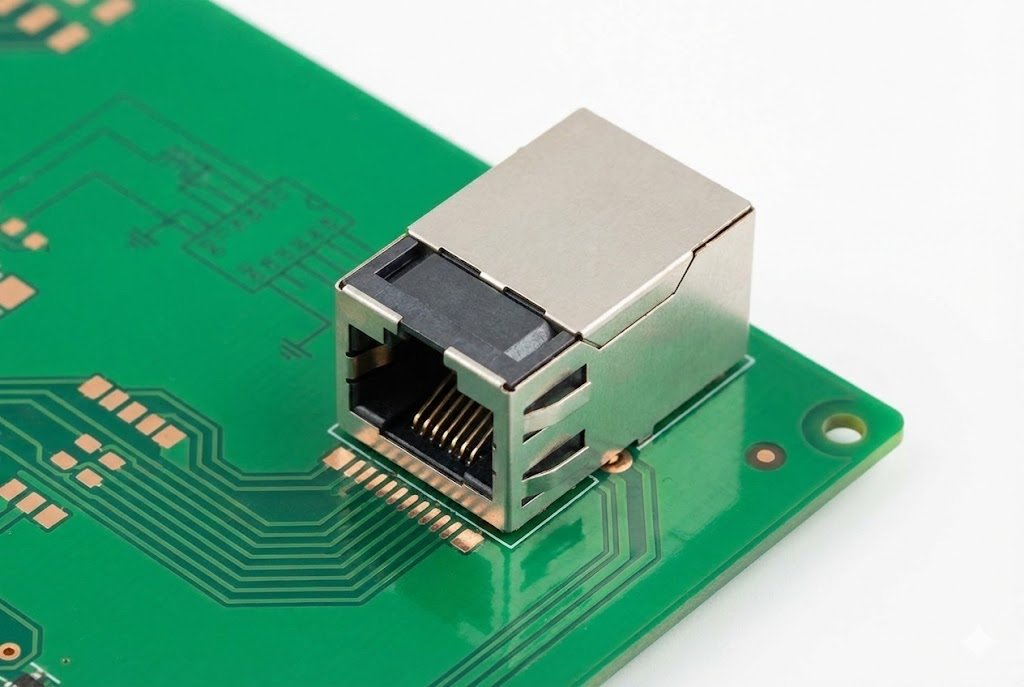
Many engineers underestimate the complexity of these connectors until a specific part goes End-of-Life (EOL) or becomes unavailable. I have seen projects stall simply because the team did not account for the specific internal wiring of the magnetic module. In this post, I will share my experience in sourcing these critical components and understanding their technical specifications to help you avoid common pitfalls.
What are the critical RJ45 pinout definitions2 you need to know?
Wrong pinout interpretations often lead to failed network connections and wasted prototype boards during testing. You cannot afford these costly mistakes when you are close to mass production.
Standard RJ45 connectors usually follow T568A or T568B wiring standards for cables, but for component selection, you must focus on the internal schematic. You need to know how the PHY chip connects to the magnetics, specifically checking the transmit (TX) and receive (RX) pairs.
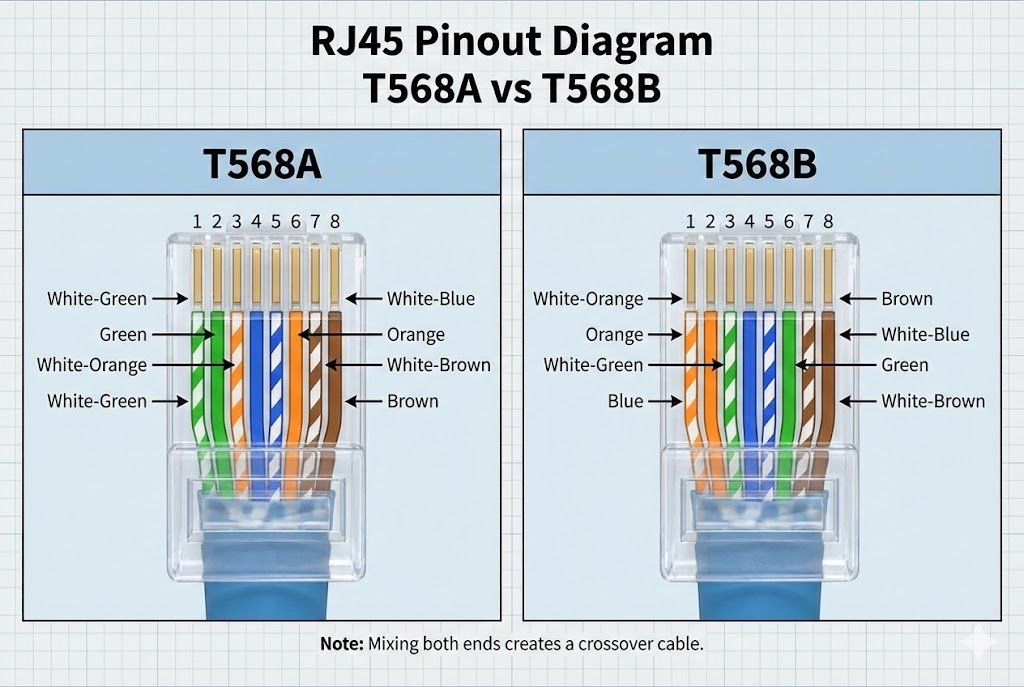
When we look at the pinout of an RJ45 connector, we need to separate the "interface" side (where the cable plugs in) from the "PCB" side (where you solder it). For the cable side, the industry uses standard definitions. However, the PCB side is where things get tricky. I often see datasheets that look similar but have completely different internal wirings.
You must pay attention to the pin definition based on the speed of your application. The pin functions change as you move from 10/100 Base-T to Gigabit Ethernet. Here is a breakdown of how the pins usually function on the PCB side for an ICM:
| Pin Number | 10/100 Base-T Function | 1000 Base-T (Gigabit) Function | Note |
|---|---|---|---|
| 1 | Transmit + (TX+) | Bi-directional Pair A+ | Critical for signal polarity |
| 2 | Transmit - (TX-) | Bi-directional Pair A- | Must match PHY differential pair |
| 3 | Receive + (RX+) | Bi-directional Pair B+ | |
| 4 | Not Used / Common Mode Term | Bi-directional Pair C+ | Gigabit uses all 4 pairs |
| 5 | Not Used / Common Mode Term | Bi-directional Pair C- | |
| 6 | Receive - (RX-) | Bi-directional Pair B- | |
| 7 | Not Used / Common Mode Term | Bi-directional Pair D+ | |
| 8 | Not Used / Common Mode Term | Bi-directional Pair D- |
Another critical aspect I look for is the LED pinout. Many RJ45 connectors have built-in LEDs for Link and Activity status. The polarity of these LEDs is not standard. Some are common cathode, and some are common anode. If you choose the wrong one, your status lights will not work, or they might damage your PHY driver. At NexCir, we always double-check these schematic details against your BOM requirements to ensure the part we source is electrically identical to your design intent.
How do you choose the best Integrated Connector Module (ICM)?
Choosing the wrong ICM causes electromagnetic interference (EMI) issues and compliance failures during certification. This forces you to redesign your board and delays your product launch significantly.
Select your ICM based on transmission speed, EMI shielding performance, and industrial temperature requirements. You must ensure the magnetics inside match your PHY controller’s current or voltage drive mode to ensure data integrity and proper signal isolation.
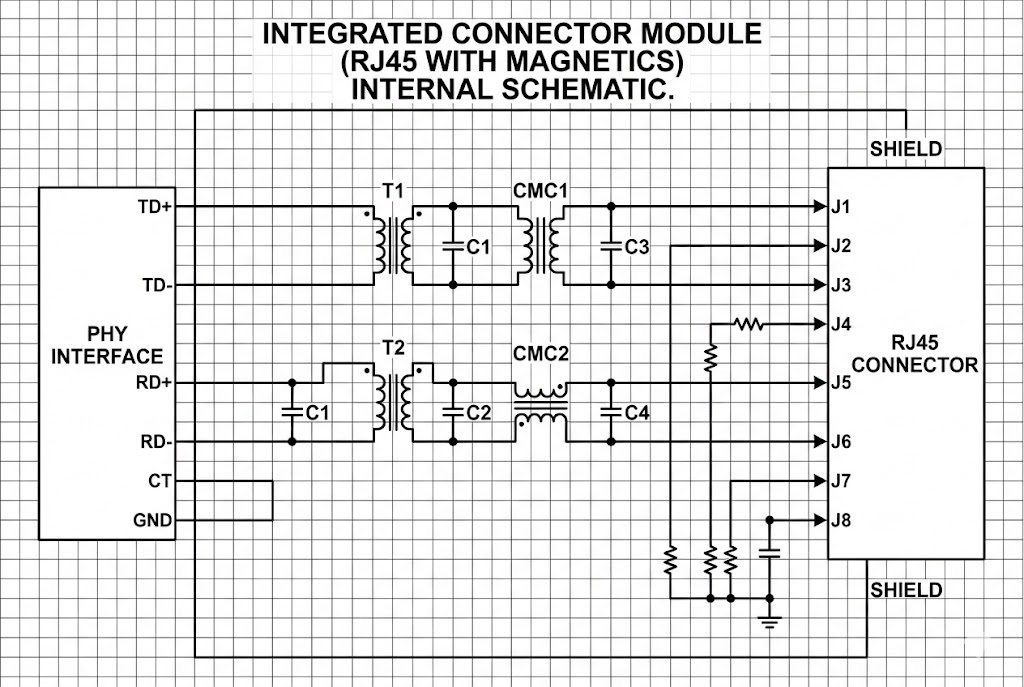
When I help OEM customers select an RJ45 with integrated magnetics1, I treat it as a high-value electromechanical component, not just a simple plug. The "Magnetics" part is a transformer. It provides isolation and signal conditioning. If this internal transformer does not match your main chip (the PHY), the system will not work.
You need to evaluate the component based on three main pillars: Electrical, Mechanical, and Environmental. I use a specific framework to break this down. This helps us find the exact part or a better alternative if the primary choice is out of stock.
1. Electrical Compatibility
The "Turns Ratio" is the most important spec here. This is the ratio of wire turns in the primary winding to the secondary winding of the transformer. Common ratios are 1:1 or 1:1.414. If you use a PHY that expects a 1:1 ratio but use a connector with 1:1.414, the signal voltage will be wrong. You also need to check if the PHY is "Current Mode" or "Voltage Mode," as this changes how the center taps of the transformer are connected.
2. Power Over Ethernet (PoE)3
Is your device powering a camera or a sensor? If yes, you need a PoE-capable connector. Standard connectors cannot handle the DC current. You must check if you need PoE (15W), PoE+ (30W), or PoE++ (60W-90W). Using a non-PoE connector in a PoE circuit will burn out the internal coils.
3. Mechanical and Shielding
Does the connector have EMI fingers (spring tabs) on the metal shield? These tabs help ground the connector to the panel, reducing noise. I also check the physical orientation: Tab-Up or Tab-Down. This affects how the user plugs in the cable.
| Feature Category | Key Parameters to Check | Why it Matters? |
|---|---|---|
| Speed | 10/100, 1G, 2.5G, 10G | Determines bandwidth and internal pairs used. |
| Schematic | Turns Ratio, Center Taps | Must match the PHY chip datasheet exactly. |
| PoE Capability | Non-PoE, PoE, PoE+, 4-pair PoE | Prevents overheating and failure under load. |
| Shielding | EMI Fingers, Shield Grounding | Critical for passing FCC/CE emission tests. |
| Temp Range | 0°C to 70°C vs -40°C to 85°C | Industrial environments need wider ranges. |
What should you do when your primary RJ45 part is out of stock?
Supply chain disruptions can leave your production line empty if your specified connector is unavailable. Relying on a single brand without approved alternatives is a dangerous strategy for any manufacturer.
You need a reliable list of cross-reference alternatives4 that are pin-to-pin compatible. Brands like Pulse, Bel Fuse, Halo, and Wurth often have equivalents, and we help you identify these drop-in replacements to keep your manufacturing running without redesigning the PCB.
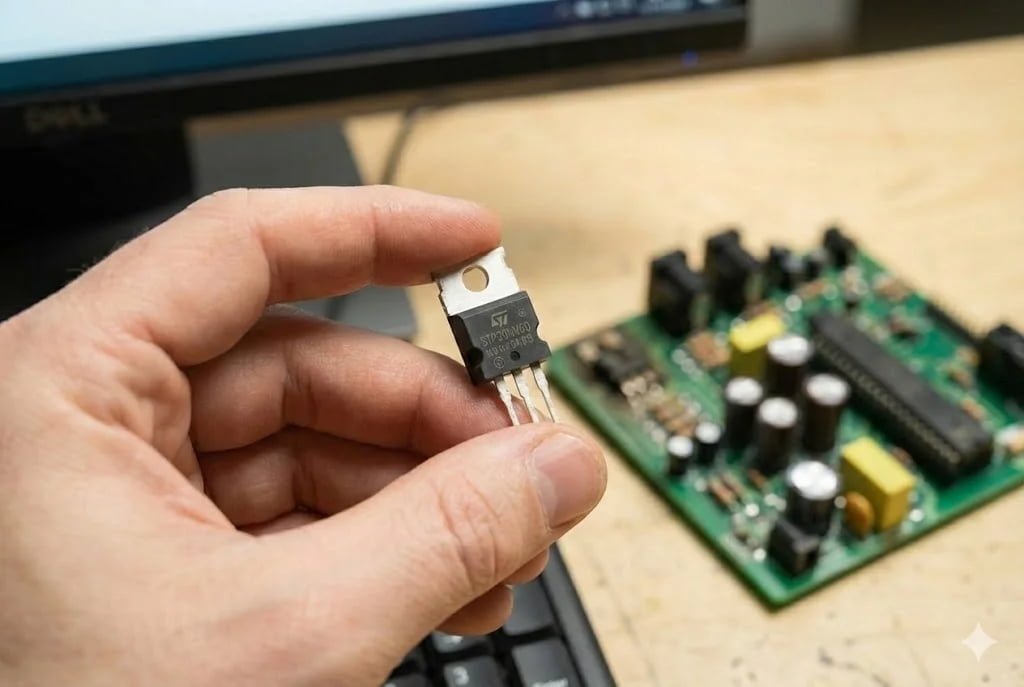
This is where NexCir delivers the most value to our customers. We are not just moving boxes; we are engineering partners. In the world of RJ45 connectors, "Out of Stock" is a very common phrase. Major manufacturers like TE Connectivity, Amphenol, or Molex might have lead times of 20 to 50 weeks. You cannot wait that long.
However, the good news is that the RJ45 market is highly standardized. For almost every premium part, there is a high-quality alternative from another reputable brand. The challenge is verifying that it is a true "Drop-in Replacement."
When I look for an equivalent, I perform a three-step validation process:
- Footprint Overlay: I compare the PCB landing pattern. The pins must be in the exact same coordinates. The plastic pegs and shield tabs must align perfectly.
- Schematic Match: This is where most errors happen. I verify the internal magnetic circuit. The choke location (transmit vs. receive side) and the center tap connections must be identical.
- Performance Check: We ensure the isolation voltage (usually 1500Vrms) and insertion loss specs meet the original standard.
Here is a simplified example of how we might map alternatives for a typical Gigabit Jack. Note that this is for illustration; you must always check the specific datasheet.
| Primary Brand | Series / Model | Potential Alternative Brands | Key Consideration for Substitution |
|---|---|---|---|
| Pulse Electronics | J00-00XX Series | Bel Fuse, Halo, Wurth | Check LED polarity (Common Anode/Cathode). |
| Bel Fuse | 0826 Series | Pulse, Abracon, Trxcom | Verify EMI finger tabs on the shield. |
| Halo Electronics | HFJ11 Series | Pulse, Bel, Amphenol | Confirm body height and latch orientation. |
| Wurth Elektronik | WE-RJ45 | Bourns, TDK, Pulse | Check operating temperature range. |
At NexCir, we do not guess. We use our global sourcing network to find these alternatives. We focus on original components. If a specific Pulse part is gone, we might find the exact functional equivalent from Bel Fuse or Halo that is available in stock. We help you update your BOM (Bill of Materials) with these valid alternatives so you are never held hostage by one single part number.
How does the application circuit affect your RJ45 choice?
Poor circuit layout destroys signal quality even if you select the highest quality components. Your device will fail certification tests if the application circuit does not support the connector properly.
The application circuit requires careful decoupling capacitor placement and proper ground plane separation. You must connect the chassis ground of the RJ45 shield separately from the digital ground to minimize noise interference and protect against electrostatic discharge (ESD).
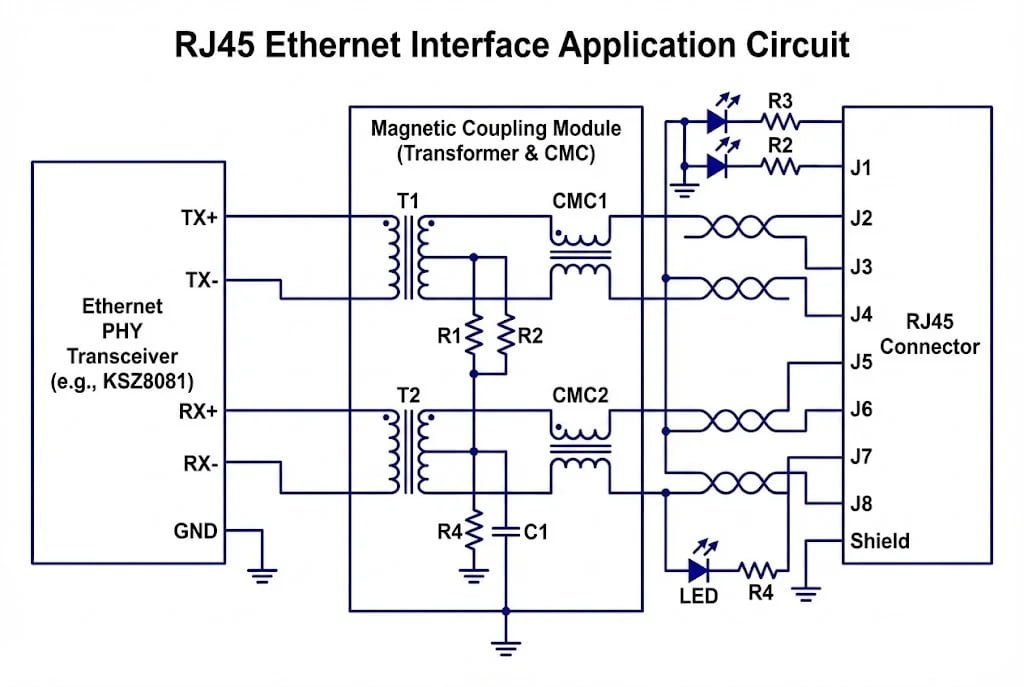
The best RJ45 connector cannot fix a bad circuit design. When we support our customers, we often look at how they intend to use the component. For Ethernet interfaces, the connection between the PHY chip and the RJ45 ICM is sensitive.
One key concept is the "Bob Smith Termination." This is a circuit technique used to reduce common-mode noise. It involves connecting the spare pairs (in 10/100 systems) or center taps to ground through 75-ohm resistors and a high-voltage capacitor. Most modern ICMs have some of this circuitry built-in, but you must know what is inside the jack versus what you need to put on your PCB.
If you choose an ICM that already has the termination resistors inside, but you add them again on your PCB, you will create a double-termination issue. This will ruin your signal impedance.
Here are the critical design rules I recommend following:
- Keep Traces Short: The distance between the PHY and the RJ45 should be as short as possible, ideally less than 1 inch (2.54 cm).
- Impedance Control: The differential pairs (TX+ and TX-, RX+ and RX-) must be routed with 100-ohm differential impedance.
- Ground Separation: You should have a "Chassis Ground" region near the connector for the metal shield. This should be connected to the digital ground only at one point or through a high-voltage capacitor/resistor network. This prevents high-frequency noise from entering your system ground.
- Power Supply Filtering: The center taps of the transformer often connect to the power supply (VCC). This line needs a ferrite bead and capacitors to filter out noise.
By understanding these application details, NexCir ensures that the parts we source for you will actually work in your specific production environment. We look at the whole picture, not just the part number.
Conclusion
Selecting the correct RJ45 ICM requires matching pinouts, electrical schematics, and mechanical fit, while having a robust list of alternatives is vital for supply stability. NexCir provides global sourcing for original components and expert cross-reference support.
Understanding the advantages of RJ45 with integrated magnetics can help optimize your network design for space and noise reduction. ↩
Knowing the critical RJ45 pinout definitions can prevent costly mistakes in network equipment production and testing. ↩
Exploring PoE can help you understand how to power devices like cameras and sensors efficiently through network cables. ↩
Learning about cross-reference alternatives ensures you can maintain production even when specific RJ45 parts are out of stock. ↩