Your project needs a huge current gain, but a single transistor isn't enough. This forces you to design complex driver circuits, wasting time and board space.
A Darlington pair transistor1 connects two BJT transistors2 together to function as one. The first transistor amplifies the input signal, and its output is then amplified again by the second. This multiplies their gains, creating a single component with extremely high current amplification3n](https://arxiv.org/abs/cond-mat/0211639)%%%FOOTNOTE_REF_4%%%.
That's the basic idea, but it's just the start. To really use this component effectively in your designs, you need to understand how this connection multiplies gain and what trade-offs come with it. As a component sourcing5 partner, I've seen engineers use them to solve big problems, but I've also seen the issues that arise when their unique characteristics aren't considered. Let's break down exactly how it works and where it shines.
How Do Two Transistors Create Such High Gain?
Struggling to get enough current from your microcontroller pin? This makes driving motors or relays seem impossible without a complicated driver IC. A Darlington pair makes it simple.
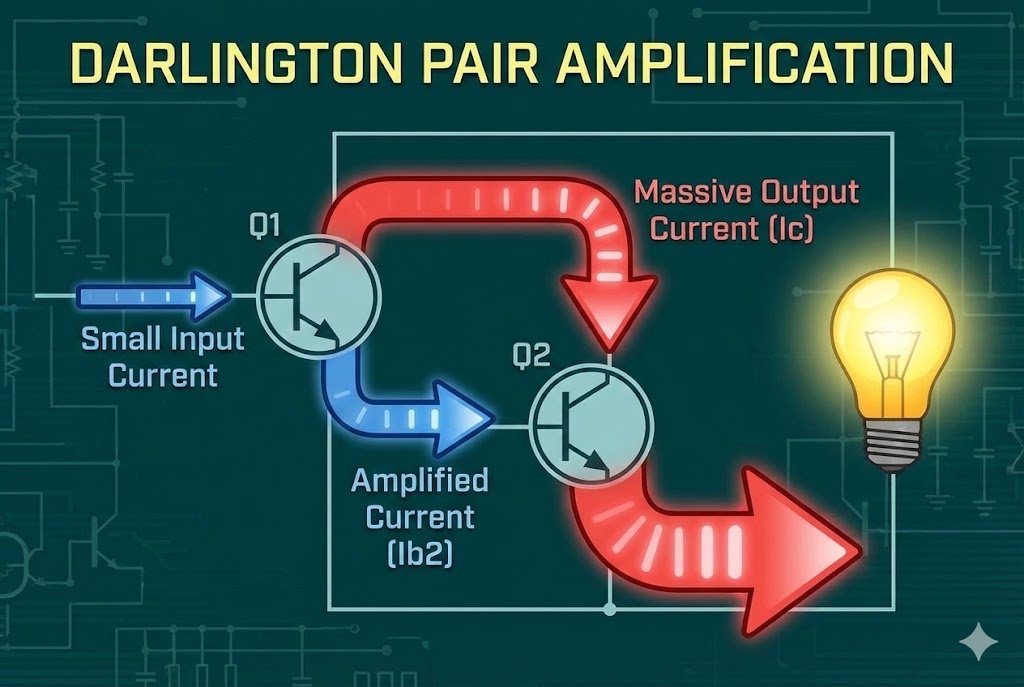
It works by using the small, amplified emitter current from the first transistor as the base current for the second. The total current gain6 (β) is approximately the product of the individual gains (β_total ≈ β1 × β2), resulting in massive amplification from a tiny input signal.
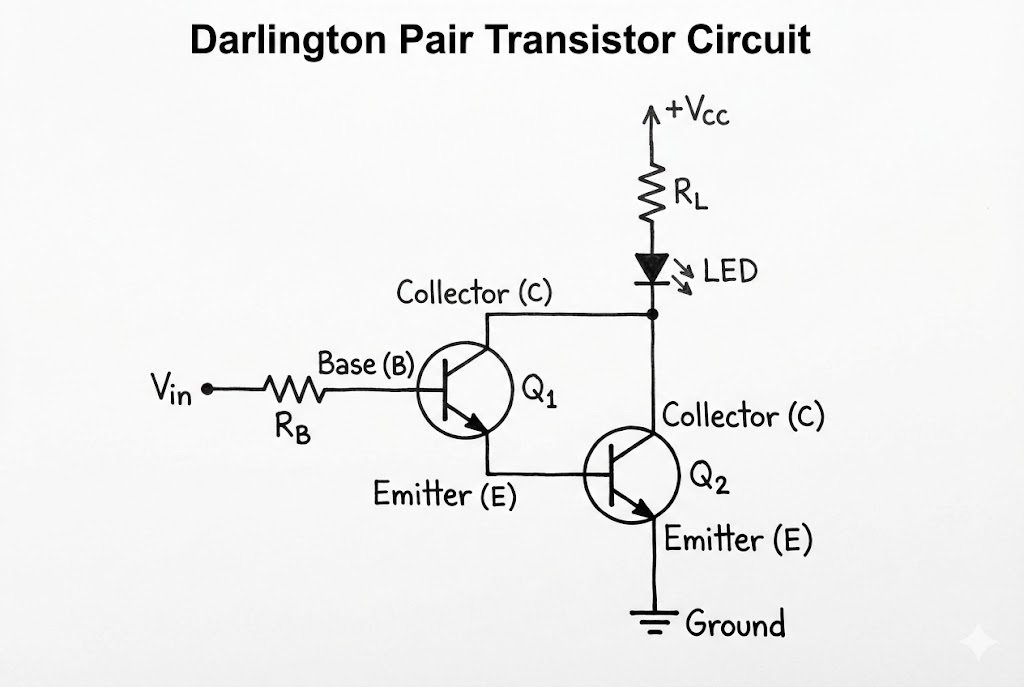
Let's look at the circuit more closely. The Darlington configuration connects the emitter of the first transistor (Q1) directly to the base of the second transistor (Q2). The collectors of both transistors are tied together. This simple arrangement is what creates the "super beta" effect.
Imagine a small input current, Ib1, goes into the base of Q1. Q1 amplifies this current by its own gain, β1. The resulting emitter current, Ie1, is roughly β1 times larger than the input current. This Ie1 then becomes the base current, Ib2, for the second transistor, Q2. Q2 takes this already amplified current and multiplies it again by its own gain, β2.
I remember a project where a team needed to drive a small DC motor directly from a low-power MCU pin that could only supply a few milliamps. A standard BJT couldn't provide enough current to get the motor spinning. Instead of adding a dedicated motor driver IC, we suggested a single Darlington pair transistor1. It solved the problem instantly, simplifying the design and saving board space.
Understanding the Gain Calculation
The magic is in the math. The total gain isn't just added; it's multiplied.
| Parameter | Description | Example Calculation |
|---|---|---|
| Q1 Gain (β1) | The current gain of the first transistor. | 100 |
| Q2 Gain (β2) | The current gain of the second transistor. | 80 |
| Total Gain (β_total) | The combined gain of the pair. | β1 × β2 = 100 × 80 = 8,000 |
As you can see, two average transistors combine to create a component with a current gain in the thousands. This allows a tiny input signal, often from a microcontroller, to control a much larger load current, making it a powerful tool for switching and amplification.
What Are the Downsides of Using a Darlington Pair?
You found the perfect high-gain solution for your circuit. But now you notice a significant voltage drop and slower performance than you expected. What's causing these issues?
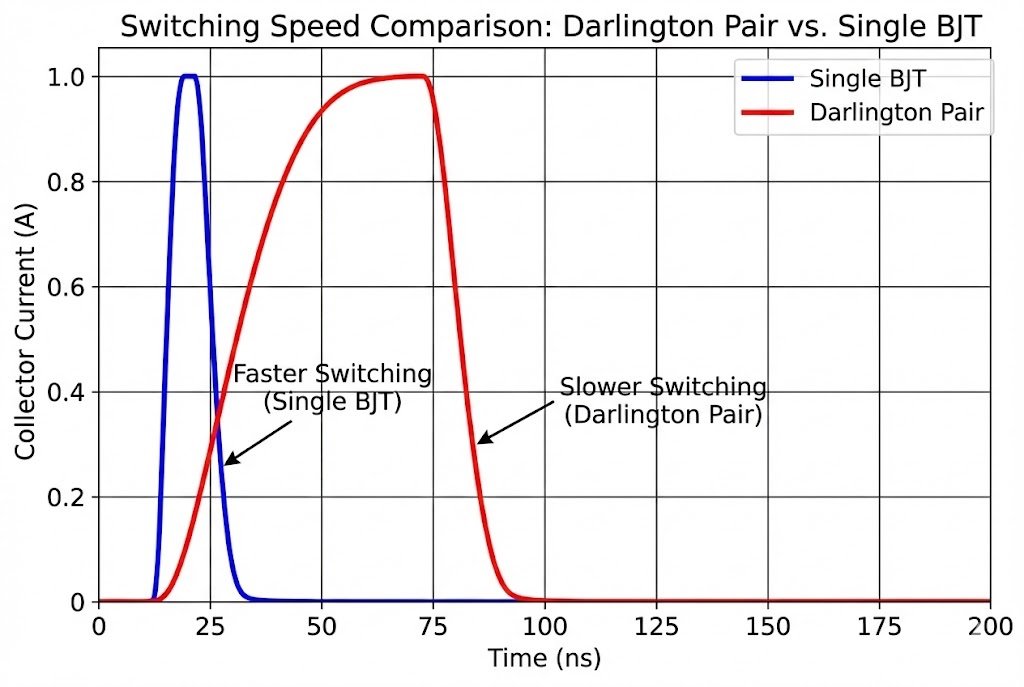
The main drawbacks are a higher base-emitter voltage drop7 (typically 1.2V–1.4V) and a higher saturation voltage8, which creates more heat. They also have slower switching speeds9, making them a poor choice for high-frequency applications10 where fast on/off times are critical.
While the high gain is impressive, it comes with important trade-offs that you must account for in your design. Ignoring them can lead to inefficiency, heat problems, and poor performance. In my experience sourcing components, helping engineers understand these trade-offs is just as important as finding the part itself. They are not a drop-in replacement for every single transistor.
The Higher Voltage Drop
A standard BJT has a base-emitter turn-on voltage (V_BE) of about 0.7V. In a Darlington pair, the total V_BE is the sum of the V_BE of the first transistor (Q1) and the V_BE of the second transistor (Q2). This means you need at least 1.4V to turn it on. More importantly, the collector-emitter saturation voltage8 (V_CE(sat)) is also higher. A single transistor might have a V_CE(sat) of 0.2V, but a Darlington pair's V_CE(sat) is closer to 0.9V or 1V because Q2 can never be fully saturated. This higher voltage drop leads to more power being wasted as heat (Power Loss = V_CE(sat) × I_C).
The Slower Switching Speed
The second major issue is speed. Darlington pairs are notoriously slow to turn off. When Q1 turns off, the stored charge in the base of Q2 has no low-resistance path to discharge. It has to leak away slowly, which keeps Q2 conducting for a short time after the input signal is removed. This "storage time" delay makes them unsuitable for applications like high-frequency switch-mode power supplies (SMPS) or fast data communication lines. I once saw a design where a Darlington was used in a PWM motor control11 circuit running at a high frequency. The slow turn-off time caused significant power loss12 and overheating because the transistor never fully turned off before the next cycle began.
Where Should You Use a Darlington Pair Transistor?
You need to control a high-power device from a low-power source. Your MCU pin can't drive a motor or a big LED array directly. How do you bridge that gap simply?
Darlington pairs are perfect for high-gain, low-to-medium-frequency applications. Common uses include driving DC motors, relays, and solenoids, or switching high-power LEDs. They excel in any circuit where you need to control a large current with a very small one.
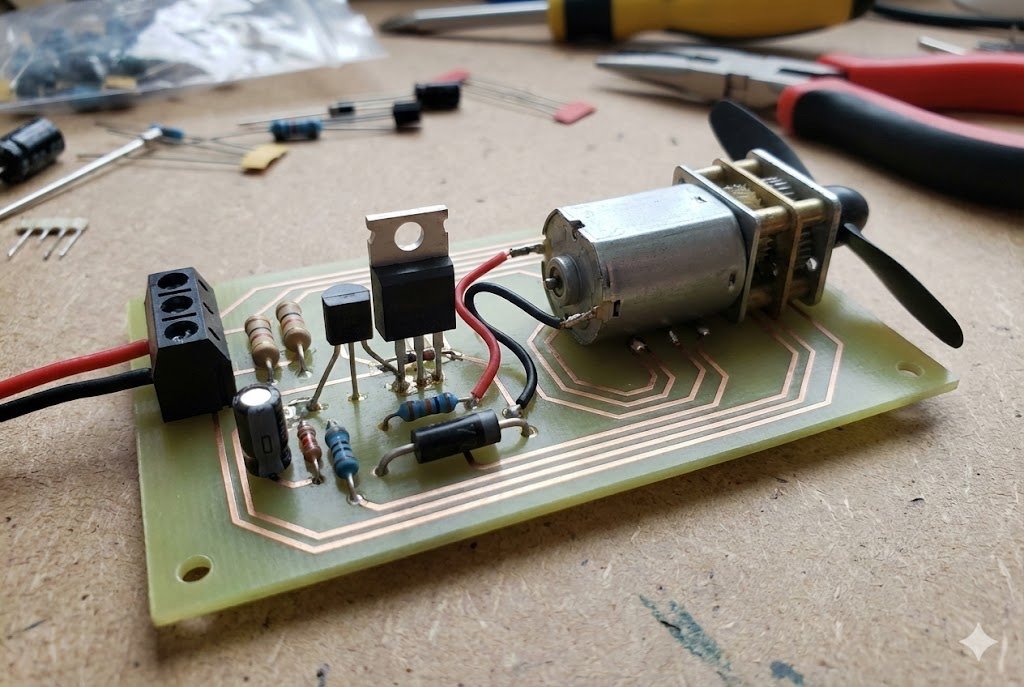
The key is to use the Darlington pair where its strengths—massive current gain and simplicity—outweigh its weaknesses of high voltage drop and slow speed. When we help our OEM customers with component selection, we always focus on the application first. Is it a DC application? Is it switching at a low frequency? If so, a Darlington pair is often the most cost-effective and straightforward solution. It saves you from needing more complex driver stages.
Common Darlington Pair Applications
Let's break down the most common places you'll find these components.
- Motor Drivers: A small DC motor might need 500mA to run, but your microcontroller can only output 20mA. A Darlington pair can easily amplify that 20mA signal to provide the 500mA the motor needs. This is a classic use case.
- Relay and Solenoid Drivers: Similar to motors, the coils inside relays and solenoids require a significant amount of current to energize. A Darlington transistor can act as a simple, effective switch to control them from a logic-level signal. Just remember to add a flyback diode13 across the coil to protect the transistor from voltage spikes when it turns off.
- Audio Amplifiers: In the output stages of audio amplifiers14, Darlington pairs (or a similar configuration called the Sziklai pair) are often used. They provide the high current gain needed to drive the low impedance of a speaker, delivering power efficiently.
- High-Power LED Arrays: Driving a string of powerful LEDs can require more current than a standard logic pin or small transistor can handle. A Darlington pair can switch the high current needed for bright illumination.
Here is a quick summary of these applications:
| Application | Key Requirement | Why Darlington Works Well |
|---|---|---|
| DC Motor Driver | High current gain | Amplifies low-power MCU signal to drive the motor. |
| Relay/Solenoid Switch | High current switching | Easily handles the coil's current demand. |
| Audio Amplifier | High current gain | Drives low-impedance speakers effectively. |
| LED Array Driver | High current capability | Switches large currents needed for bright LEDs. |
In all these cases, the switching speed is not the most critical factor, but the ability to control a large load with a tiny signal is.
Conclusion
A Darlington pair offers massive current gain in a simple package. While it has drawbacks like a higher voltage drop and slow speed, it's perfect for driving high-power loads.
Explore this resource to understand the fundamentals of Darlington pair transistors and their applications. ↩
Gain insights into BJT transistors, their operation, and their role in electronic circuits. ↩
Discover the advantages of high current amplification for efficient circuit design. ↩
Learn about current amplification to grasp how transistors can enhance signals effectively. ↩
Learn about component sourcing to improve your procurement strategies in electronics. ↩
Understand the calculation of total current gain to optimize your circuit designs. ↩
Explore the concept of base-emitter voltage drop to improve your understanding of transistor behavior. ↩
Learn about saturation voltage to better manage power loss in your circuits. ↩
Discover how switching speeds impact performance in various applications. ↩
Understand the challenges in high-frequency applications to make informed design choices. ↩
Explore PWM motor control to enhance your knowledge of efficient motor driving techniques. ↩
Understand the causes of power loss to enhance the efficiency of your electronic designs. ↩
Learn about flyback diodes to protect your circuits from voltage spikes. ↩
Gain insights into audio amplifiers to enhance your audio circuit designs. ↩