Running out of pins on your microcontroller can stop a project instantly. You want to add a display and buttons, but you have no connections left for them.
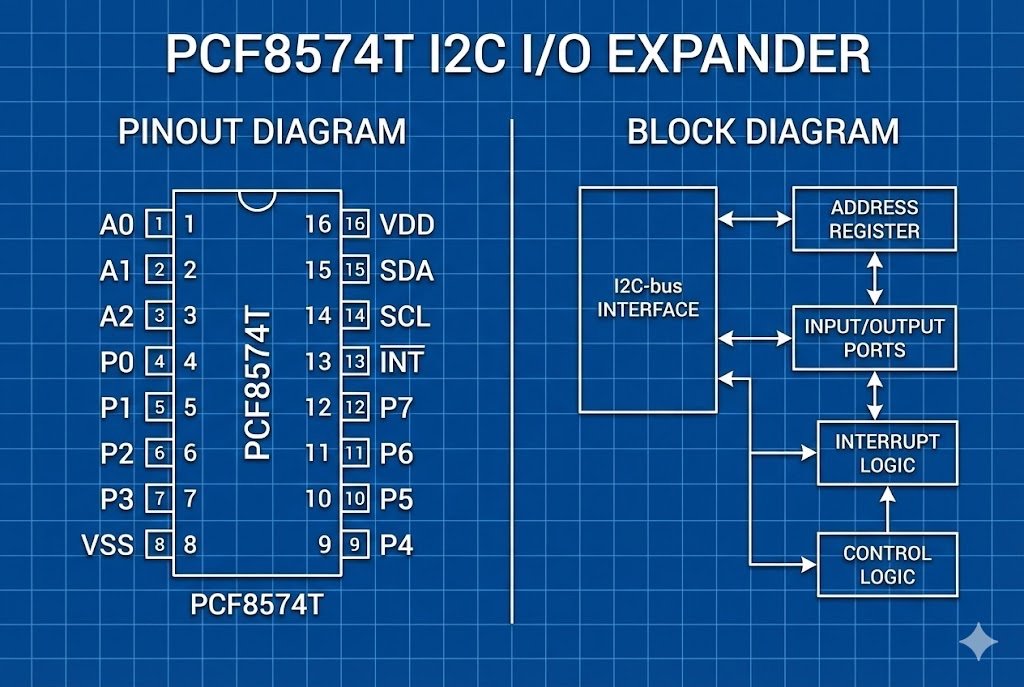
The PCF8574T1 is an 8-bit I/O expander that uses the I2C protocol2. It converts two SDA/SCL lines into eight parallel ports. This chip is perfect for driving LCD1602 displays3 and scanning matrix keypads4, saving valuable microcontroller pins5 for sensors and other logic.
I remember a project where we had to add a user interface to a finished board design. We had zero spare pins. The panic was real until we looked at the I2C bus6. Using the PCF8574T1 allowed us to add a full screen and keypad without changing the main processor. It is a simple tool, but it saves designs. Let's look at how it works.
Why is the PCF8574T1 the best solution when your MCU pins are not enough?
You have a powerful processor, but you used all the pins for sensors. Now you cannot add a screen or buttons. It is a frustrating and common problem for engineers.
The PCF8574T1 solves pin scarcity by using the I2C bus6. It requires only two pins (SDA and SCL) to control up to eight input/output lines. You can even chain multiple chips together to get up to 64 remote I/O ports from just two wires.
At Nexcir7, we often see engineers trying to upgrade older designs. They want to add new features but cannot change the main chip. This is where the PCF8574T1 shines. It acts like a remote control for pins. You send a message over two wires, and the chip turns eight pins on or off.
The magic lies in the addressing8. The chip has three pins named A0, A1, and A2. By connecting these to either power or ground, you give the chip a unique name or "address." Since there are three pins, you can have eight different addresses. This means you can put eight of these chips on the same two wires. If each chip gives you 8 pins, that is 64 extra pins total.
Here is a simple breakdown of how the pin count changes:
| Method | Wires Used on MCU | I/O Pins Gained | Net Gain |
|---|---|---|---|
| Direct Connection | 8 | 8 | 0 (Break even) |
| PCF8574T1 (1 Chip) | 2 | 8 | +6 Pins |
| PCF8574T1 (8 Chips) | 2 | 64 | +62 Pins |
Another key feature is that these ports are "quasi-bidirectional." This is a fancy way of saying they can be inputs or outputs without a complex setup command. You just write a "1" to the port, and it becomes an input weakly pulled high. If you write a "0", it drives the line low strongly. This simple structure makes it very robust for basic tasks. When we help clients at Nexcir7 select components, we recommend this for its reliability. It does not have complex registers to configure. You just plug it in, address it, and send data. It is the most efficient way to expand your system without redesigning the brain of your device.
How do you connect an LCD1602 display using only two wires?
Wiring a standard LCD screen usually takes at least six data pins plus power. That is too many wires for small projects or messy breadboards. There is a much cleaner way.
By soldering a PCF8574T1 backpack module to the LCD1602, you reduce the wiring to VCC, GND, SDA, and SCL. The chip handles the parallel data transfer to the screen controller, allowing simple software libraries to send text and commands over the I2C bus6.
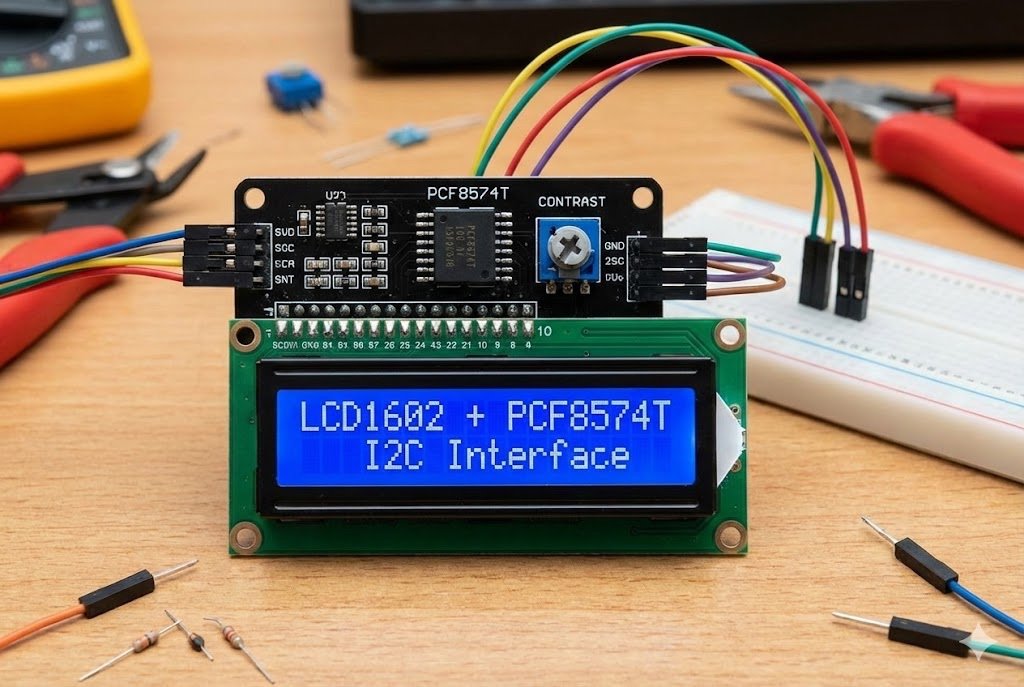
I have built many prototypes where the wiring for the LCD screen was a nightmare. Loose wires cause the screen to show garbage characters. The PCF8574T1 module fixes this. It sits right on the back of the screen.
The standard LCD1602 interface is parallel. It needs pins for Data (D0-D7), Register Select (RS), Read/Write (RW), and Enable (E). That is a lot of connections. The PCF8574T1 takes the serial data from your MCU and turns it into these parallel signals.
However, the PCF8574T1 only has 8 pins. A full LCD connection needs more than that if you use 8-bit mode. To solve this, we use the LCD in "4-bit mode9." We send the data in two halves. First, we send the top 4 bits, then the bottom 4 bits.
Here is how the mapping typically works on those black backpack modules:
- P0 -> RS (Register Select): Tells the LCD if we are sending a command or text.
- P1 -> RW (Read/Write): Usually held low to write data.
- P2 -> E (Enable): This is the trigger that tells the LCD to read the data.
- P3 -> Backlight: Controls the transistor that turns the light on.
- P4 to P7 -> D4 to D7: These are the data lines.
When you use a library like LiquidCrystal_I2C, the code handles all the bit shifting for you. You just type lcd.print("Hello"). Behind the scenes, the MCU sends I2C packets to the PCF8574T1. The PCF8574T1 toggles the P0-P7 pins rapidly to mimic a parallel connection.
At Nexcir7, we supply these chips to factories that make these LCD modules. We ensure the chips are genuine because timing is critical. If the chip is slow or has jitter, the LCD will display random symbols. A genuine PCF8574T1 ensures that the "Enable" pulse is clean and the data is stable. This simple reduction from 10+ wires down to 4 wires (including power) reduces assembly costs and failure points significantly.
Can the PCF8574T1 handle matrix keypad scanning efficiently?
Reading a 4x4 keypad usually needs eight pins from your microcontroller. If you are building a security system or a control panel, losing eight pins is a very high cost.
Yes, the PCF8574T1 is excellent for keypad scanning. Its interrupt output (INT)10 alerts the MCU when a key is pressed. This means the processor does not need to constantly poll the bus, saving processing power and reducing I2C traffic until an actual event occurs.
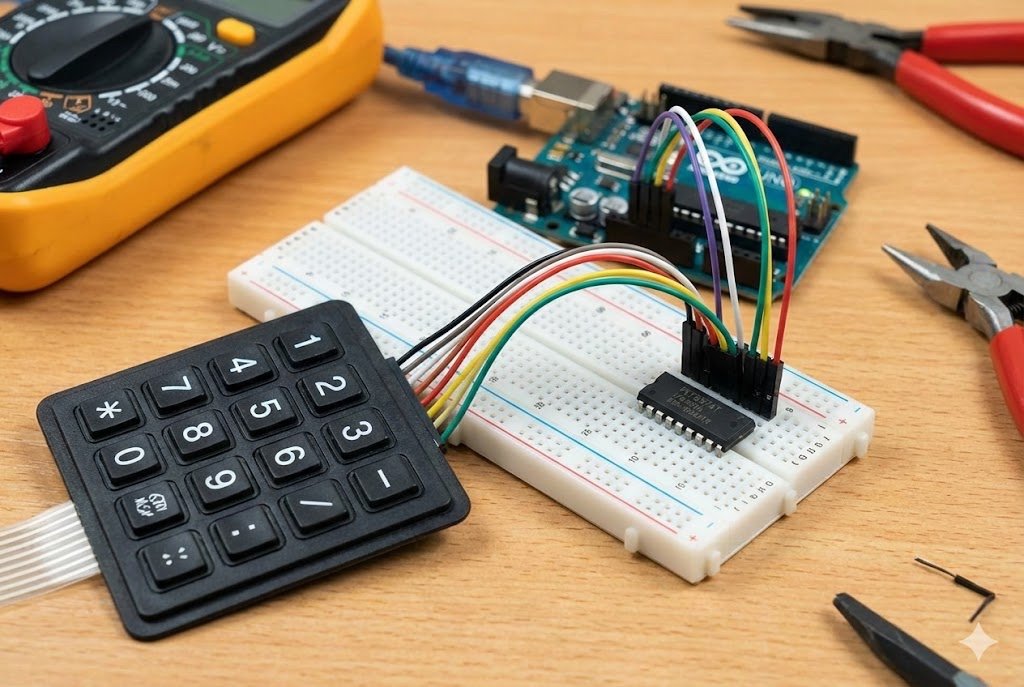
One of the best features of the PCF8574T1 that people often ignore is the Interrupt (INT) pin. This pin is an open-drain output. It stays high normally. But if any of the input pins change state, the INT pin goes low.
Why is this important? Imagine you are the main processor. Without an interrupt, you have to ask the keypad, "Is a button pressed?" thousands of times per second. This wastes energy and time. With the PCF8574T1, the processor can do other work or even sleep. When a user presses a button, the PCF8574T1 pulls the INT line low. The processor wakes up and says, "Okay, let me check what happened."
The scanning logic works like this:
- Setup: We connect the 4 rows of the keypad to P0-P3 and the 4 columns to P4-P7.
- Wait State: We set all outputs to High. We wait for the INT pin to go low.
- Detection: When a button is pressed, it connects a row to a column.
- Scanning: The MCU asks the PCF8574T1 to pull one row low at a time. Then it reads the columns. If a column reads low, we know which button connects that row and column.
This table shows the state logic:
| Step | Action | Logic Level | Goal |
|---|---|---|---|
| Idle | Set all Inputs High | Logic 1 | Wait for change |
| Press | User pushes button | Logic 0 (on INT) | Wake up MCU |
| Scan 1 | Drive Row 1 Low | Logic 0 | Check Columns |
| Scan 2 | Drive Row 2 Low | Logic 0 | Check Columns |
We have clients in the industrial control sector who use this for control panels. They love it because they can run the keypad over a long cable using I2C buffers, keeping the main high-voltage electronics far away from the user's fingers. The PCF8574T1 acts as a buffer. If there is a static shock on the keypad, it might kill the cheap expansion chip, but it saves the expensive main controller. At Nexcir7, we advise using this chip not just for pin saving, but for system isolation11 and modularity12.
Why is the PCF8574T1 a perfect component for cost-effective manufacturing?
Engineers love specs, but procurement managers love price and availability. This chip hits the sweet spot for both groups in mass production scenarios.
The PCF8574T1 is a high-volume "lead magnet" component. It is inexpensive, widely available, and used in thousands of products. For OEMs13, buying this general part in bulk reduces BOM costs14 while ensuring supply chain stability15 through distributors like Nexcir7.

I want to talk about the business side of this chip. In the electronics market, we call parts like the PCF8574T1 "general parts" or "commodities." They are like the rice or bread of the industry. Everyone uses them.
Because the volume is so high, the price is very sensitive. A fraction of a cent difference matters when you buy 100,000 units. At Nexcir7, we position this part as a "lead magnet." We know that if a customer trusts us to supply their PCF8574T1s at a good price, they will also trust us with their expensive FPGAs and processors.
However, being a cheap part does not mean quality does not matter. There are many generic clones of this chip. Some of them do not strictly follow the I2C timing standards. I have seen production lines stop because a batch of cheap clones would lock up the I2C bus6, crashing the whole system. This is where Nexcir7’s 20 years of experience comes in.
We only source from authorized channels and proven manufacturers. Even for a low-cost item, we ensure:
- Authenticity: No fake dies inside the package.
- Soldering Quality: The pins must be plated correctly to avoid "cold joints16" during reflow soldering.
- Consistency: Every reel must be from the same batch to ensure consistent electrical characteristics.
For our customers, the value expectation is simple: "Don't stop my line." They want low prices, but they fear counterfeit risks more. By offering the PCF8574T1 at competitive prices but with a guarantee of origin, we solve their pain point. We help them lower procurement costs without introducing the risk of bad parts. It is about building a long-term partnership. We want to be the partner that helps them grow, supplying the simple parts and the complex ones with the same level of care.
Conclusion
The PCF8574T1 is the ultimate tool for expanding MCU I/O cheaply and effectively. Whether for LCDs or keypads, it saves pins and simplifies design, while Nexcir7 ensures reliable, authentic supply.
Explore this link to understand the PCF8574T's functionality and how it can expand your microcontroller's I/O capabilities. ↩
Learn about the I2C protocol, a key feature of the PCF8574T, to understand its role in communication between devices. ↩
Discover how to efficiently connect an LCD1602 display using the I2C protocol, saving valuable microcontroller pins. ↩
Find out how to use the PCF8574T for scanning matrix keypads, optimizing your microcontroller's pin usage. ↩
Learn techniques to expand your microcontroller's pins using I2C, crucial for adding more components to your project. ↩
Understand the I2C bus, a critical component in modern electronics, to improve your design's communication capabilities. ↩
Explore Nexcir's offerings to see how they can support your electronic component needs with quality and reliability. ↩
Learn about addressing in I2C devices to effectively manage multiple components on the same bus. ↩
Explore the 4-bit mode in LCD displays to understand how it reduces pin usage while maintaining functionality. ↩
Discover how the INT pin in PCF8574T can optimize your system's efficiency by reducing unnecessary polling. ↩
Learn how the PCF8574T can enhance system isolation, protecting your main controller from potential damage. ↩
Explore the concept of modularity in electronic design to create flexible and scalable systems. ↩
Find out how OEMs can benefit from using the PCF8574T in their products, focusing on cost-effectiveness and efficiency. ↩
Explore how the PCF8574T can help reduce BOM costs, making your manufacturing process more cost-effective. ↩
Discover how using the PCF8574T can enhance supply chain stability, crucial for consistent production. ↩
Understand the issue of cold joints in soldering and how to prevent them for better electronic assembly quality. ↩