Car batteries drain quickly if electronics stay on. This is a huge problem for design engineers. You must choose the right transceiver1 to stop this power loss.
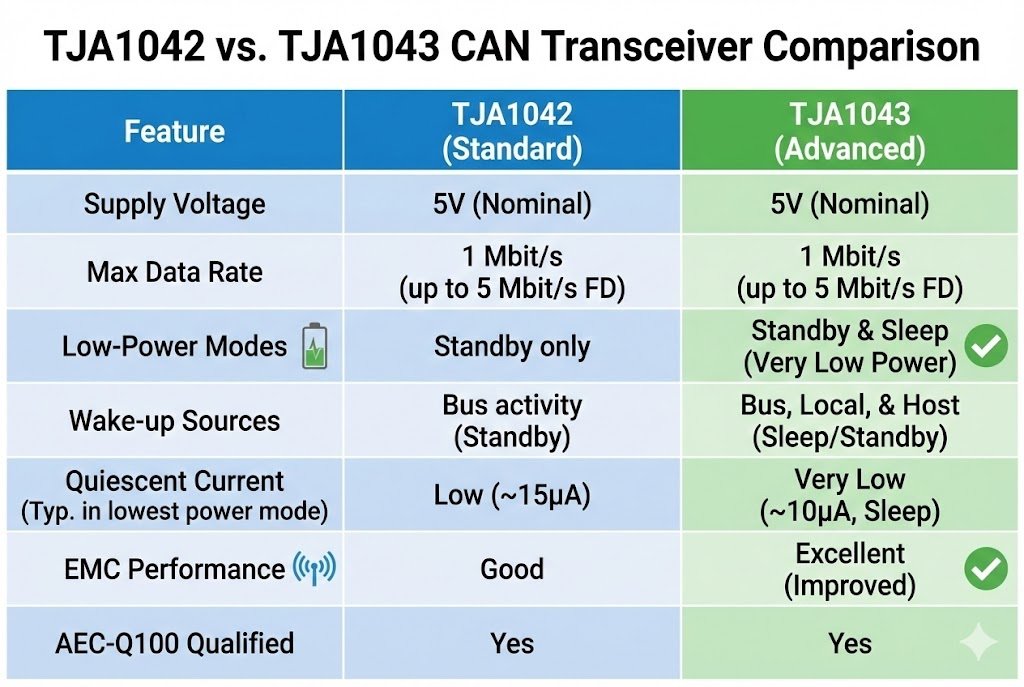
The TJA10432 is the correct choice for "always-on" components like Body Control Modules (BCM)3 because it supports sleep and wake-up function4s to save power. The TJA10425 is ideal for diagnostic tools like OBD scanners, which only operate when the engine runs, offering a lower cost without complex wake-up logic.
I have worked with many procurement managers and engineers at Nexcir. We see a common mistake in the industry. People often pick a chip based only on price or availability. They ignore the specific power requirements of their application. This leads to dead batteries or wasted budget. I want to share my experience to help you avoid these issues.
Why is the sleep and wake-up function4 critical in automotive electronics?
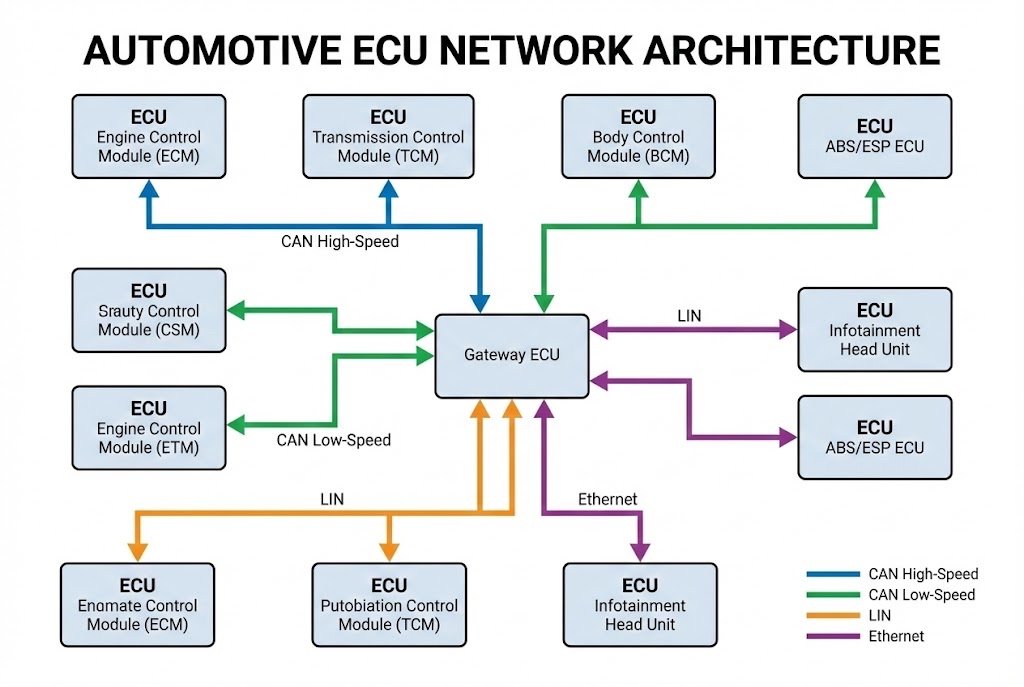
Modern cars have over 70 electronic control units (ECUs). If they all stay on, the battery dies in hours. We need a way to turn them off safely.
The sleep and wake-up function4 allows an ECU to enter a low-power mode, consuming micro-amps instead of milli-amps, while still listening for a specific signal to turn back on. This is the only way to meet strict OEM standby current requirements.
Understanding the Power Drain
I remember a project with a client developing a new door control module. They were failing their quiescent current tests6. The limit was 100µA (micro-amps), but their board was drawing 5mA (milli-amps). That is 50 times too high. The problem was simple. They used a standard transceiver7 that could not put the rest of the board to sleep.
In automotive design, we look at "Key-Off" loads. When you park your car and walk away, the car looks like it is off. But the alarm, the door locks, and the remote receiver are still alive. They are "sleeping." They need to wake up instantly if you press your key fob.
If you use a standard transceiver7 without sleep capability, the microcontroller (MCU) must stay awake to check the bus. An active MCU uses a lot of power. However, if you use a transceiver with wake-up capability8, the MCU can turn off completely. The transceiver stays in a very low power state. It watches the bus. When it sees a wake-up pattern, it triggers the MCU to start.
Here is a simple breakdown of the current consumption differences9 we see in the lab:
| Mode | Standard Transceiver (e.g., TJA10425) | Wake-up Transceiver (e.g., TJA10432) |
|---|---|---|
| Active Mode | 40mA - 70mA | 40mA - 70mA |
| Standby/Sleep | 10mA - 15mA (MCU must stay on) | 10µA - 20µA (MCU is off) |
| Impact | Drains battery quickly | Battery lasts for weeks |
At Nexcir, we emphasize this difference. If your device connects directly to the battery (KL30), you cannot ignore the sleep function. It is not just a feature; it is a requirement for the car to function reliably.
When is the TJA10432 the absolute best choice for your design?
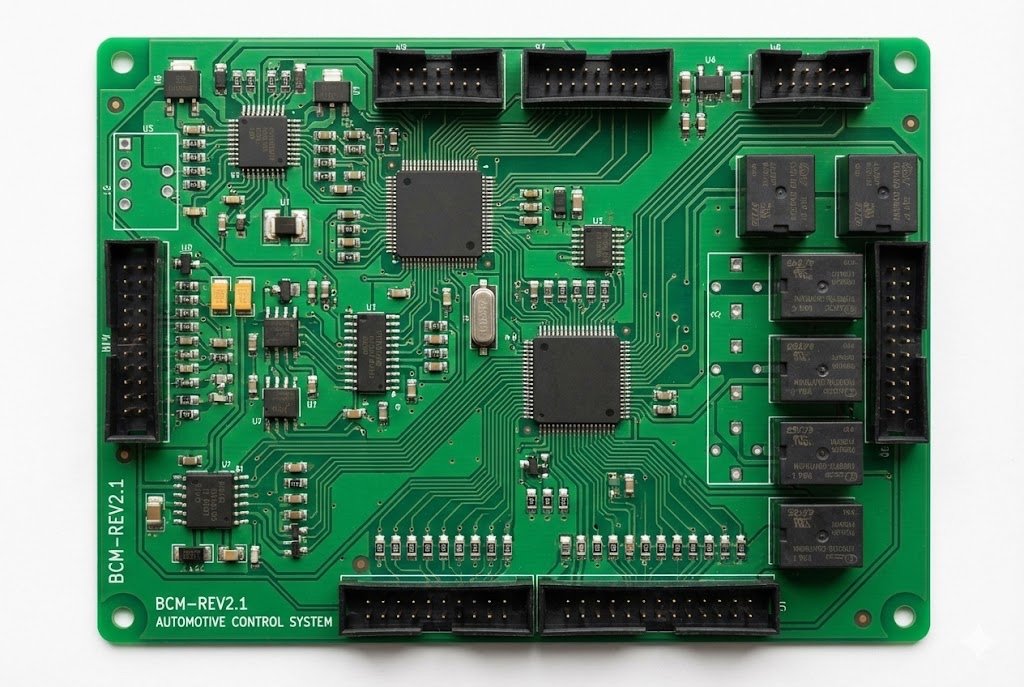
You are designing a Body Control Module (BCM) or a gateway. These devices must never fully disconnect from power. They manage the car's security and access.
The TJA10432 is the industry standard for these applications because it features an INH (Inhibit) pin that controls external voltage regulators, allowing the entire board to power down and wake up only when necessary.
The Power of the INH Pin
The TJA10432 is not just a radio for data. It is a power manager. The most critical feature of the TJA10432 is the INH pin10. I often explain this to hardware engineers who are new to automotive CAN.
Here is how it works. The TJA10432 connects to the battery supply. The INH pin10 connects to the Enable pin of your main voltage regulator (LDO or DC-DC converter). When the car is running, the INH pin10 is High. The regulator works, and the MCU has power.
When the car turns off, the MCU tells the TJA10432 to go to "Sleep Mode." The TJA10432 then pulls the INH pin10 Low. This turns off the regulator. The MCU loses power and turns off. The whole board is dead, except for a tiny part of the TJA10432. This state consumes almost no energy.
Then, two things can happen:
- Local Wake-up11: A switch connected to the TJA10432 changes state (like a door handle pull).
- Remote Wake-up12: A specific pattern of data appears on the CAN bus wires.
If either happens, the TJA10432 pulls the INH pin10 High. The regulator turns on. The MCU boots up. The car reacts.
This capability makes the TJA10432 essential for:
- Body Control Modules (BCM)3: Controlling lights, locks, and windows.
- Gateways: Managing data between different networks.
- Keyless Entry Systems13: Waiting for a signal.
I always tell my customers: if your module needs to wake up the car, or if the car needs to wake up your module, you must use the TJA10432. There is no cheaper workaround that is safe.
Key Features of TJA10432
| Feature | Benefit |
|---|---|
| Sleep Mode | Ultra-low current consumption (< 20µA). |
| INH Output | Controls external power supplies to shut down the MCU. |
| Wake-up Source Recognition | Tells the MCU why it woke up (Local vs. Remote). |
| VIO Pin14 | Allows direct interfacing with 3.3V or 5V microcontrollers. |
Why should you choose the TJA10425 for diagnostic tools?
Not every device needs to sleep. Some devices only work when the mechanic is fixing the car. In these cases, simplicity and cost are more important.
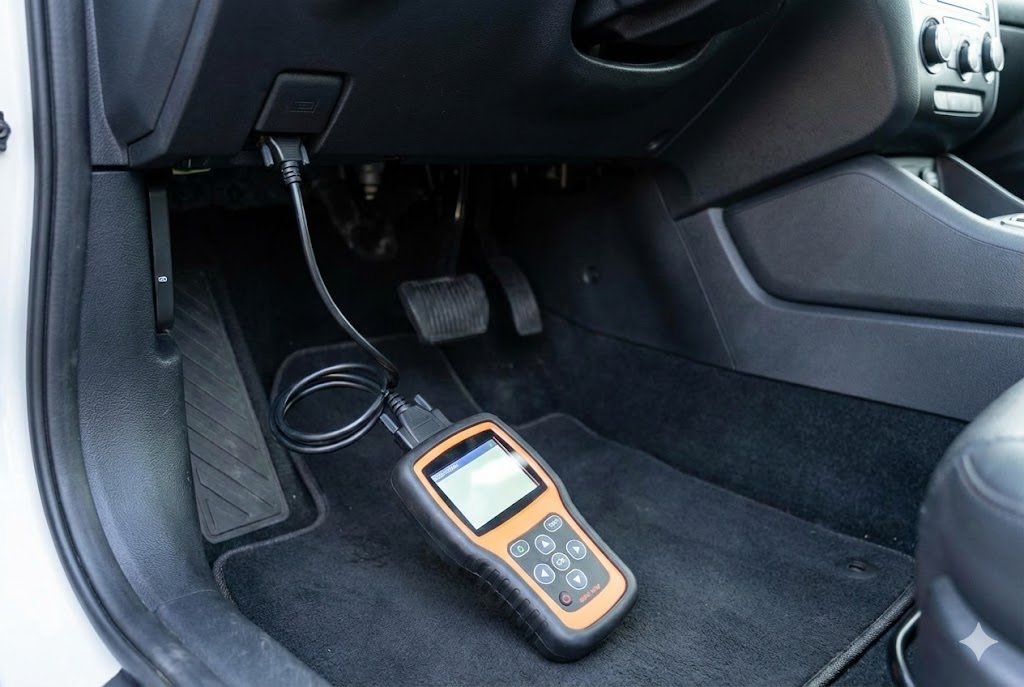
The TJA10425 is the perfect choice for On-Board Diagnostics (OBD) tools15 because these devices typically receive power only when the ignition is on, making the complex sleep and wake-up circuitry unnecessary and overpriced.
Simplicity Wins for Diagnostic Tools
I frequently work with customers who manufacture aftermarket tools. These are the OBD scanners, emissions testers, and data loggers you see in repair shops. A common question arises: "Should we use the TJA10432 to be safe?"
My answer is usually "No." Here is why.
An OBD tool usually gets power from the OBDII port. In many cars, this port has power all the time. However, the tool is not a permanent part of the car. A mechanic plugs it in, does the work, and unplugs it. Or, if it is a consumer dongle (like an insurance tracker), it might stay plugged in.
But here is the key difference: The TJA10425 is a basic transceiver. It sends and receives. It has a "Standby" mode, but it does not have the INH pin10 to control power regulators. It assumes the system power is managed elsewhere or is simply switched on by the ignition key (KL15).
If you use a TJA10432 in a simple OBD tool, you are paying for silicon you do not use. The TJA10432 is more expensive than the TJA10425. It also has more pins and requires a slightly more complex PCB layout.
For an OBD tool, the logic is simple:
- Ignition On16: The tool gets power. The TJA10425 starts transmitting.
- Ignition Off: The tool loses power (or goes into a simple idle). The TJA10425 turns off.
There is no need for the transceiver to wake up the MCU because the user controls the usage.
We also recommend the TJA10425 for:
- Engine Sensors: They only run when the engine runs.
- Infotainment Add-ons: They turn on with the dashboard.
- Industrial CAN systems: Where power is supplied by a main switch.
By choosing the TJA10425, you save money on the Bill of Materials (BOM). You also reduce supply chain risk because the TJA10425 is one of the most common chips in the world. It is easier to source in high volumes.
How do we determine the final selection strategy for your project?
We have looked at the technical details. Now we need a simple rule to make decisions fast. This helps procurement teams and engineers align their goals.
Your selection strategy should follow this rule: Use the TJA10432 for any node connected to "Battery Constant" (KL30), and use the TJA10425 for any node connected to "Ignition Switched" (KL15).
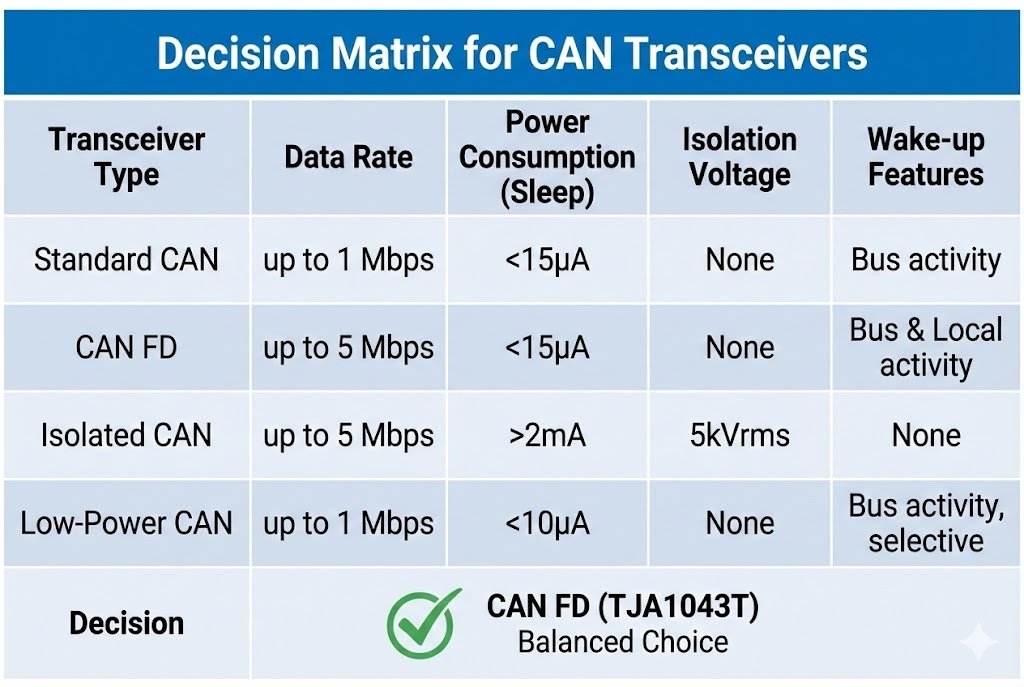
The Decision Matrix17
At Nexcir, we help clients optimize their supply chain. Part of that is reducing the number of different parts they buy. However, you cannot merge these two chips into one without losing money or performance.
I encourage you to use critical thinking when you review your design. Ask these three questions:
-
Where does the power come from?
-
Does the device need to "listen" while off?
-
What is the budget pressure?
Here is a summary table to help you finalize your decision:
| Scenario | Recommended Part | Reason |
|---|---|---|
| Body Control Module (BCM) | TJA10432 | Must sleep and wake up to save battery. |
| Gateway / Hub | TJA10432 | Needs to manage network traffic 24/7. |
| OBDII Scanner | TJA10425 | Only used when the car is active. |
| Dashboard Display | TJA10425 | Powered by ignition (usually). |
| Engine Control Unit (ECU) | TJA10425 | Usually powered by a main relay. |
We hold stock of both at Nexcir. We source them from authorized distributors to ensure you never get counterfeit parts. Supply chain stability is just as important as the technical specs. If you design in a TJA10432, make sure you have a partner who can deliver it long-term.
Conclusion
To summarize: choose the TJA10432 for always-on nodes like BCMs that require sleep modes, and choose the TJA10425 for ignition-switched tools like OBD scanners to save costs.
Selecting the right transceiver is crucial to prevent battery drain and ensure efficient power management in automotive systems. ↩
The TJA1043 is ideal for always-on components, offering sleep and wake-up functions to save power and enhance vehicle performance. ↩
BCMs manage critical functions like security and access, making them essential for vehicle operation and safety. ↩
This function helps meet OEM standby current requirements, preventing battery drain and ensuring reliable vehicle operation. ↩
The TJA1042 is cost-effective for tools that operate only when the engine runs, avoiding unnecessary complexity. ↩
Quiescent current tests ensure that electronic components consume minimal power when inactive, preventing battery drain. ↩
Standard transceivers lack sleep capability, leading to higher power consumption and potential battery drain. ↩
Wake-up capability allows the MCU to turn off completely, reducing power consumption and extending battery life. ↩
Understanding these differences helps in selecting the right transceiver to optimize power usage and prevent battery drain. ↩
The INH pin controls external voltage regulators, allowing the board to power down and wake up efficiently, saving energy. ↩
Local Wake-up allows devices to respond to physical changes, ensuring immediate functionality when needed. ↩
Remote Wake-up enables devices to react to specific data patterns, ensuring timely responses without draining power. ↩
Keyless Entry Systems enhance convenience and security, making them a vital feature in automotive design. ↩
The VIO Pin allows direct interfacing with microcontrollers, ensuring compatibility and efficient power management. ↩
OBD tools provide critical data for vehicle diagnostics, helping in timely maintenance and repair. ↩
Understanding the ignition process helps in designing systems that efficiently manage power and functionality. ↩
The Decision Matrix simplifies the selection process, ensuring the right transceiver is chosen for specific applications. ↩