Industrial environments are full of noise and electrical interference. If your communication lines fail, your entire production line stops, and you lose money. We understand the pressure to build stable systems that resist these harsh conditions.
RS485 is the standard for robust serial communication1 in industrial automation. To make it work reliably, you need a high-quality transceiver like the MAX485 and a well-designed protection circuit. This guide explains how to select the right chip, design anti-interference circuits with TVS diodes, and find alternatives when stock is low.
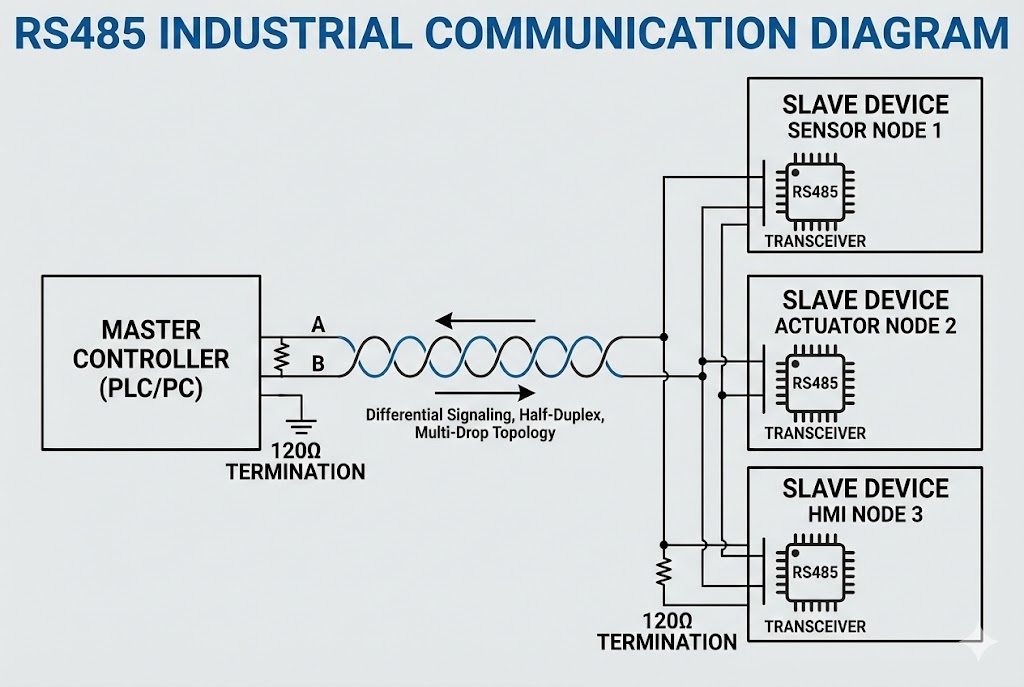
We see many engineers struggle with signal integrity issues in the field. It is often not the fault of the code, but the hardware design. Let’s look at the specific solutions below to fix this.
Why is RS485 Design Challenging in Industrial Automation?
You face unexpected signal drops and data errors on the factory floor. This is frustrating for your team and your customers.
The main challenges are electromagnetic interference (EMI) from heavy machinery and supply chain shortages for legacy parts. You need a design that handles noise and a sourcing partner who can find the parts.

Understanding the Industrial Environment
We work with many OEM manufacturers. They tell us that the factory floor is a battlefield for electronics. You have large motors, variable frequency drives (VFDs), and welding equipment. These devices create massive amounts of electromagnetic noise. This noise induces voltage spikes on your long RS485 cables. If your design is weak, these spikes will destroy your interface ICs.
Another major pain point we see at NexCir is the supply chain. The MAX485 is a classic chip. Sometimes, it goes on allocation or becomes hard to find. When you design a product, you need to know it will be manufacturable for years. We see projects stall because a 50-cent chip is missing.
We focus on helping you solve both problems. We help you source the original components. We also help you choose the right protection parts, like TVS diodes and connectors. A good design is not just the transceiver. It is the whole ecosystem around it. You must think about the complete Bill of Materials (BOM) from day one.
| Challenge | Impact on Production | Solution |
|---|---|---|
| EMI / RFI Noise | Data corruption, system resets | Proper grounding, TVS diodes, shielded cables |
| Ground Loops | Burnt transceivers | Isolated RS485 transceivers, optocouplers |
| Component Shortage | Production line stoppage | Validated cross-reference alternatives |
| Long Cable Runs | Signal attenuation | Termination resistors, lower baud rates |
What Are the Key Technical Specifications of the MAX485?
You need to read the datasheet carefully to ensure compatibility. Missing a small detail can lead to system failure.
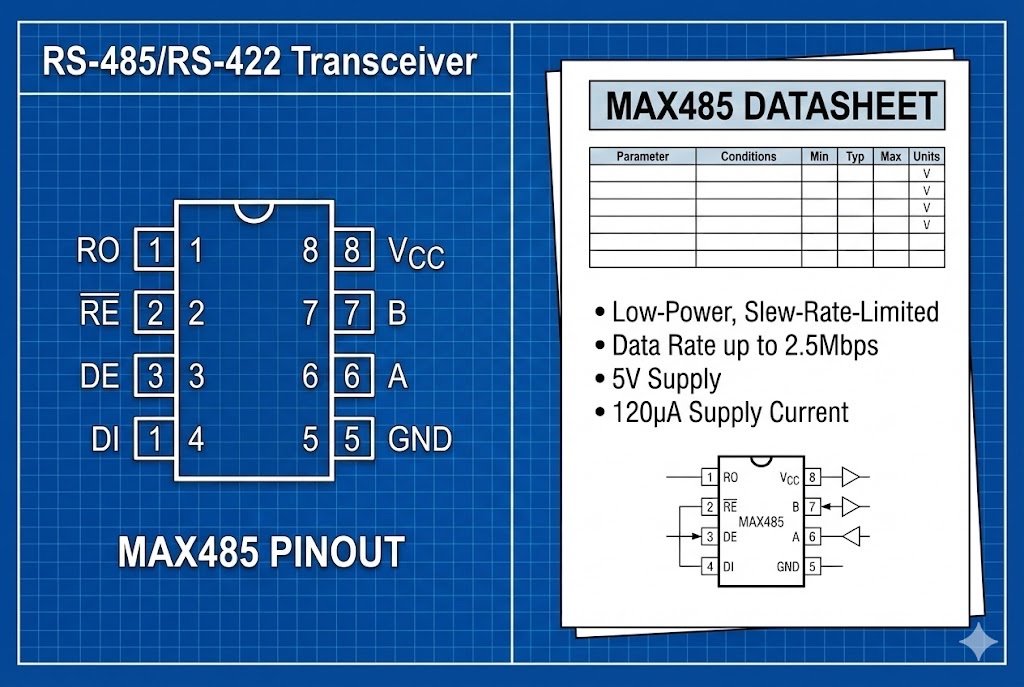
The MAX485 is a low-power transceiver2 for RS-485 and RS-422 communication. It operates on a single +5V supply and supports data rates up to 2.5Mbps, making it ideal for industrial control applications.
breaking Down the Datasheet
We always advise our clients to look beyond the basic voltage. The MAX485 is popular because it is robust, but you must understand its limits. Here are the critical parameters we check when helping customers source this part.
First, look at the Unit Load. The standard RS485 bus supports 32 unit loads. The MAX485 meets this standard. If you need to connect more devices, say 128 nodes, you might need a different chip with a 1/4 unit load rating. But for most standard applications, the MAX485 is the benchmark.
Second, consider the Data Rate. The MAX485 runs up to 2.5Mbps. This is plenty for Modbus RTU or standard sensor data. If you are running high-speed video or massive data streams, this is not the right chip. But for industrial control, stability is more important than raw speed. The slew-rate limiting in some versions helps reduce EMI, which is a huge plus.
Third, look at the Quiescent Current. In battery-powered or remote applications, power matters. The MAX485 draws about 300µA to 500µA. This is low enough for most wired systems.
Below is a summary of the specs we see most often in demand:
- Supply Voltage: 5V DC
- Number of Transceivers: 1 (Half-Duplex)
- Max Data Rate: 2.5 Mbps
- Common Mode Voltage Range: -7V to +12V
- ESD Protection: +/- 2kV (Human Body Model)
We supply these chips in various packages, usually SOIC-8 or DIP-8. The SOIC-8 is what most modern surface-mount designs use.
How Do You Design an Anti-interference Circuit for RS485?
The chip alone is not enough to survive a lightning strike or a power surge. You must add external protection layers.
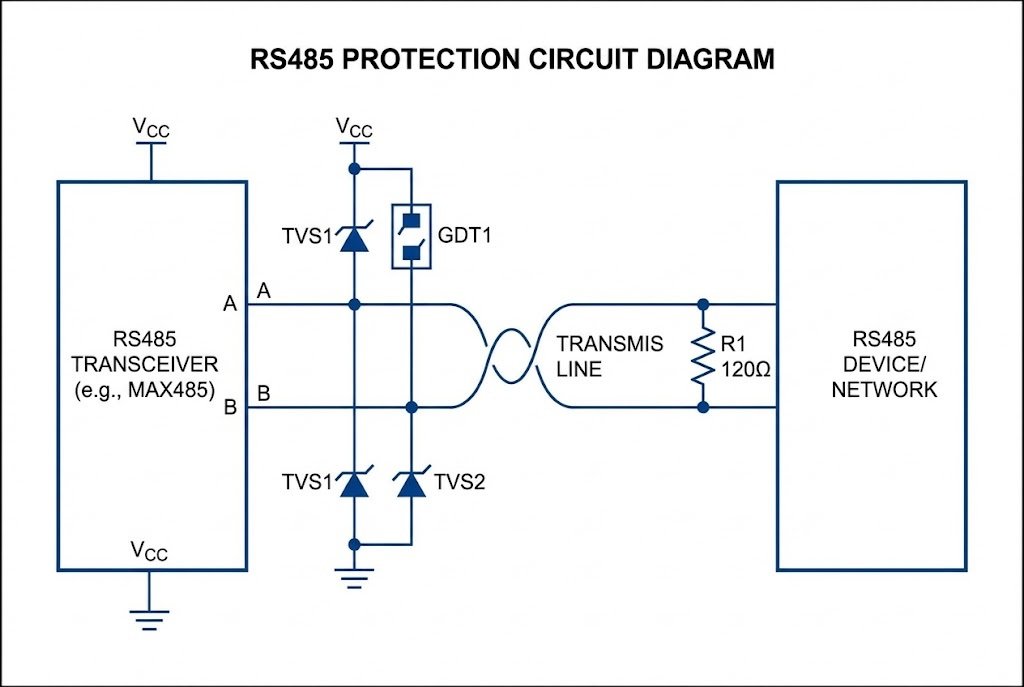
A complete anti-interference circuit includes TVS diodes3, PTC thermistors, and Gas Discharge Tubes (GDT). These components work together to clamp high voltage spikes and protect the MAX485 from permanent damage.
Building the Protection Barrier
We strongly recommend bundling your interface IC purchase with protection components. It saves you time and ensures compatibility. Here is how a robust design works.
1. The First Line of Defense: GDT (Gas Discharge Tube) The GDT sits closest to the connector. It handles the huge energy surges, like those from nearby lightning strikes. It acts like an open switch until the voltage gets too high, then it shorts the energy to the ground.
2. The Current Limiter: PTC Thermistor Between the GDT and the transceiver, you place a PTC (Positive Temperature Coefficient) resistor. When a fault current flows, the PTC heats up and increases its resistance. This blocks the current. It resets automatically when the fault is gone. This is much better than a fuse that you have to replace.
3. The Fast Clamp: TVS Diode (Transient Voltage Suppressor) This is critical. The GDT is strong but slow. The TVS is fast but cannot handle as much energy. The TVS sits right next to the MAX485 pins (A and B). It clamps the voltage to a safe level (usually around 6V to 8V) before it hits the chip.
4. Bias and Termination You also need resistors. A Termination Resistor (usually 120 ohms) goes at both ends of the cable to stop signal reflections. Bias Resistors pull the lines to a known voltage when no one is talking. This stops the bus from floating and picking up noise.
At NexCir, we source all these parts. We can kit the MAX485 with the correct Semtech or Littelfuse TVS diodes and the right Yageo resistors. This makes your procurement easier.
What Are the Best Alternatives to MAX485 During Shortages?
Sometimes the part you want is simply not available. You cannot stop your factory because of one missing chip.
When the MAX485 is out of stock, you can use pin-compatible alternatives from Texas Instruments, Analog Devices, or Renesas. We help you verify the datasheet to ensure the replacement works without redesigning your board.
Managing Lifecycle and Cross-References
This is the most important section for our procurement clients. The MAX485 is a standard part, meaning many manufacturers make a version of it. We call these "Second Sources."
If Maxim (now Analog Devices) cannot supply the part, we look at Texas Instruments. Their SN75176B is a legendary chip. It is very similar to the MAX485. It has the same pinout. You can usually drop it right onto the board.
Another great option is the SP485 from MaxLinear (formerly Exar). It is often cheaper and has excellent availability. For harsh environments, we might suggest the ADM485 from Analog Devices.
However, you must be careful. Not all "equivalents" are identical.
- Speed: Some alternatives are faster. This might cause ringing if your termination is not perfect.
- ESD: Some modern chips have much higher ESD protection (up to 15kV) built-in. This is a good upgrade.
- Load: Some are "1/8 unit load," allowing 256 devices. This is compatible, but you should know about it.
We use our global network to check stock for these alternatives. We do not just look at one region. We check Europe, Asia, and North America.
| Brand | Part Number | Key Feature | Compatibility |
|---|---|---|---|
| Maxim (ADI) | MAX485 | The Standard | Original |
| Texas Instruments | SN75176B | Robust, Low Cost | Pin-Compatible |
| MaxLinear | SP485 | High Availability | Pin-Compatible |
| Renesas (Intersil) | ISL8485 | Low Power | Pin-Compatible |
| Analog Devices | ADM485 | High Reliability | Pin-Compatible |
We verify the authenticity of every chip. We know that in times of shortage, fake chips appear in the market. We have strict testing to ensure you get the real datasheet performance.
How Can NexCir Optimize Your Interface IC Sourcing?
Sourcing electronic components should not be a headache. You need a partner who understands your production goals.
NexCir is not just a trader; we are a supply chain partner for OEMs. We provide original parts, manage long-term schedules, and support your product lifecycle from prototype to mass production.

Beyond Transactional Trading
We built NexCir to serve manufacturers, not just to sell stock. We know that when you buy a MAX485, you also need the connectors, the microcontroller (MCU), and the power management ICs (PMIC).
We act as an extension of your purchasing team. If you are an R&D engineer, we help you find samples. If you are a procurement manager, we help you plan your yearly usage.
Our Value Proposition:
- Global Reach: We don't rely on local stock. We find parts where they exist.
- Quality First: We only deal with original parts. We know the risks of the gray market.
- BOM Support: You can send us your whole list. We will match the RS485 chip with the right TVS diodes and capacitors. This saves you from managing ten different suppliers.
We are young, founded in 2025, but our mindset is mature. We focus on long-term value. We want to be supplying your factory five years from now, not just today.
Conclusion
Designing a reliable RS485 system requires the right MAX485 chip and strong protection circuits. NexCir supplies these components globally. Upload your BOM to us today for a quote.
Understanding why RS485 is the standard can help you appreciate its reliability and importance in industrial settings, ensuring you make informed decisions. ↩
Exploring the benefits of the MAX485 can guide you in selecting the right transceiver for your industrial communication needs, optimizing performance and efficiency. ↩
Learning about TVS diodes' role in anti-interference circuits can enhance your design's resilience against voltage spikes, protecting your communication systems. ↩