Are you struggling to design a stable timing circuit? Timing errors can ruin a good prototype. I will show you how the classic NE555 solves this problem easily.
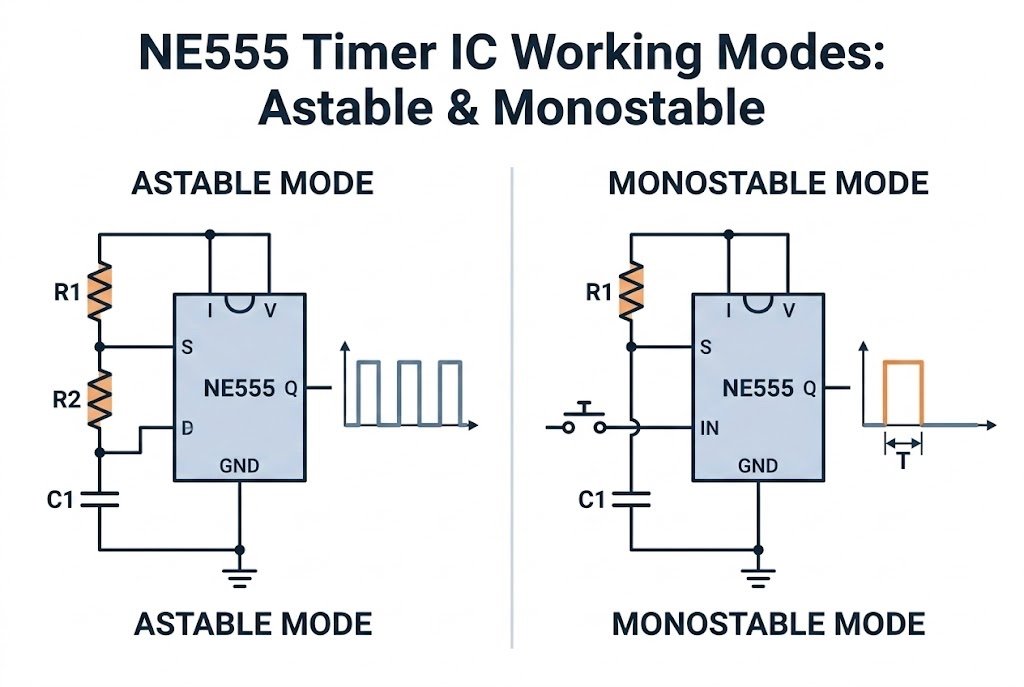
The NE555 timer IC1 operates mainly in astable and monostable mode2s. Astable mode generates continuous square wave3s for pulses. Monostable mode produces a single pulse4 for a set time. Hardware engineers use the NE555P to build reliable clock generators, timers, and PWM dimming circuits5 easily.
You might think an old chip like the NE555 is outdated, but it is still the best tool for simple timing tasks. I remember my first project failed because I used a complex microcontroller instead of a simple timer. Let us look at how you can use this classic chip to make your next design work perfectly.
What are the Astable and Monostable Working Modes of NE555?
Do you get confused by different timer modes? Picking the wrong mode breaks your circuit. I will explain the two main modes so you can choose the right one.
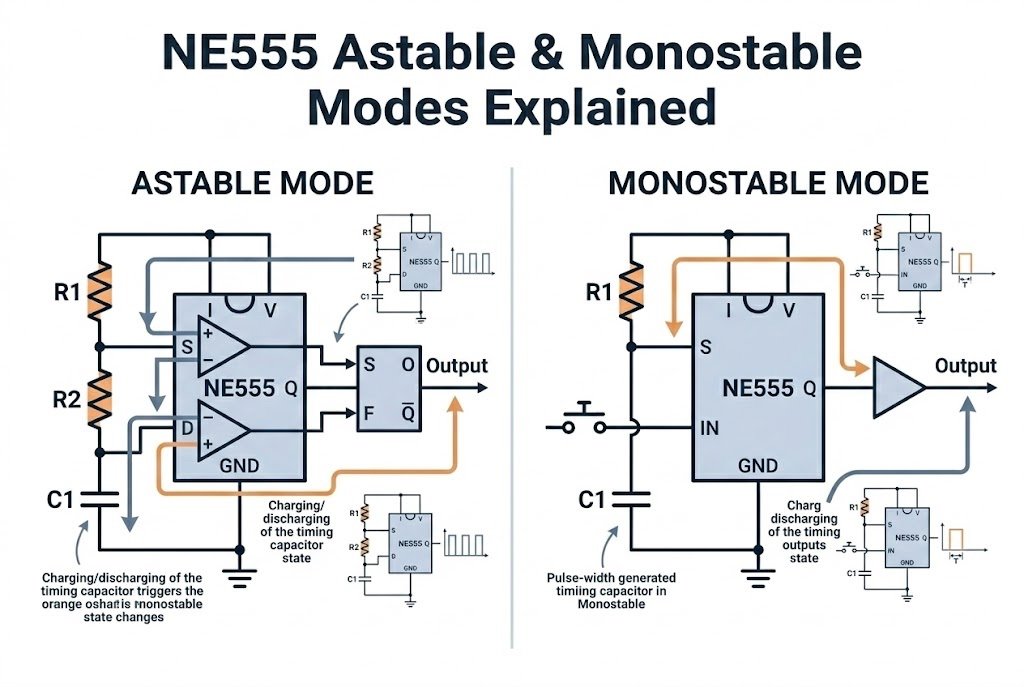
In astable mode6, the NE555 has no stable state. It switches back and forth, creating a continuous square wave3. In monostable mode2, it stays in one stable state until a trigger arrives. Then, it outputs a single pulse4 for a fixed time before returning to normal.
Understanding the Two Main Modes
I talk to many young hardware engineers every week. They often ask me which mode they should use for their early R&D7 designs. You must look at your goal. Do you need a clock signal that never stops? You need the astable mode6. Do you need a delay timer that only works when you press a button? You need the monostable mode2.
Let us break down the differences clearly.
| Feature | Astable Mode | Monostable Mode |
|---|---|---|
| Stable States | None | One (Low state usually) |
| Output Type | Continuous square wave | Single pulse |
| Trigger Input | Self-triggering | External trigger required |
| Main Application | Clock pulse generator | Delay timers |
When I worked on a simple alarm system years ago, I used the astable mode6 to make a buzzer beep. Later, I used the monostable mode2 to keep a light on for ten seconds after a door opened. The NE555P handles both tasks very well. You just need to change the resistors and capacitors8 connected to its pins. You can rely on this chip for many years. It has a very strong output pin. It can drive small relays directly. Nexcir provides 100 percent original NE555 chips. You do not need to worry about fake parts ruining your test circuits. Authentic parts give you exact timing every single time.
How to Calculate the Frequency of an NE555 Timer?
Is your output frequency wrong? Guessing component values wastes your time. I will show you the exact math to get the perfect frequency for your circuit.
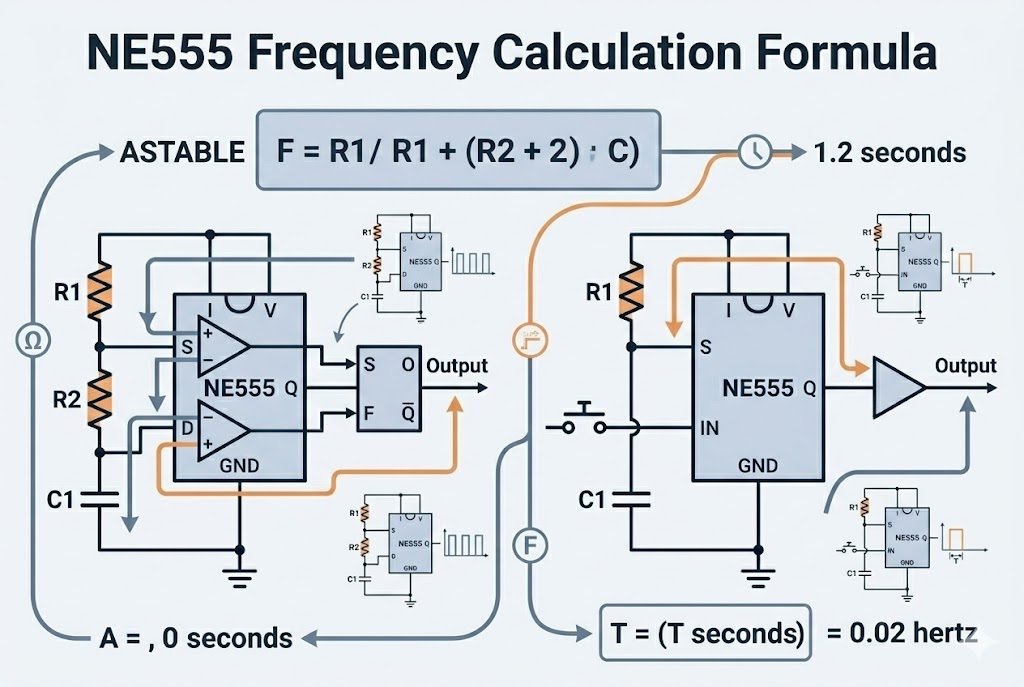
You calculate the NE555 astable frequency using the formula: f = 1.44 / ((R1 + 2R2) C). R1 and R2 are resistor values in Ohms. C is the capacitor value in Farads. This formula helps you find the exact parts to build an accurate pulse generator.
Finding the Right Resistors and Capacitors
Math can be boring, but it is very important in hardware design. I remember spending a whole night changing resistors because I did not use the formula. You must use the formula to save time.
The frequency depends on how fast the capacitor charges and discharges. Resistor R1 and Resistor R2 charge the capacitor. Only Resistor R2 discharges it. This means the high time is always longer than the low time in a basic circuit.
Here is a simple guide to see how part values change the frequency.
| R1 Value | R2 Value | Capacitor (C) | Output Frequency |
|---|---|---|---|
| 1k Ohm | 10k Ohm | 10 uF | Around 6.8 Hz |
| 1k Ohm | 100k Ohm | 1 uF | Around 7.1 Hz |
| 10k Ohm | 10k Ohm | 0.1 uF | Around 480 Hz |
You can see that larger capacitors give lower frequencies. Larger resistors also give lower frequencies. You can find many online calculators for this. But you should know the math yourself. This helps you understand the circuit better. You can fix problems faster when you know how the parts work together. When you design a new board, you should use precise resistors. At Nexcir, we supply high-quality resistors and original NE555P chips. This ensures your real-world frequency matches your math exactly. You do not want a cheap fake chip changing your carefully calculated clock speed.
How to Design a PWM Dimming Circuit with NE555P?
Do your LEDs flicker when you dim them? Bad dimming circuits look cheap and fail quickly. I will teach you how to build a smooth PWM dimmer.
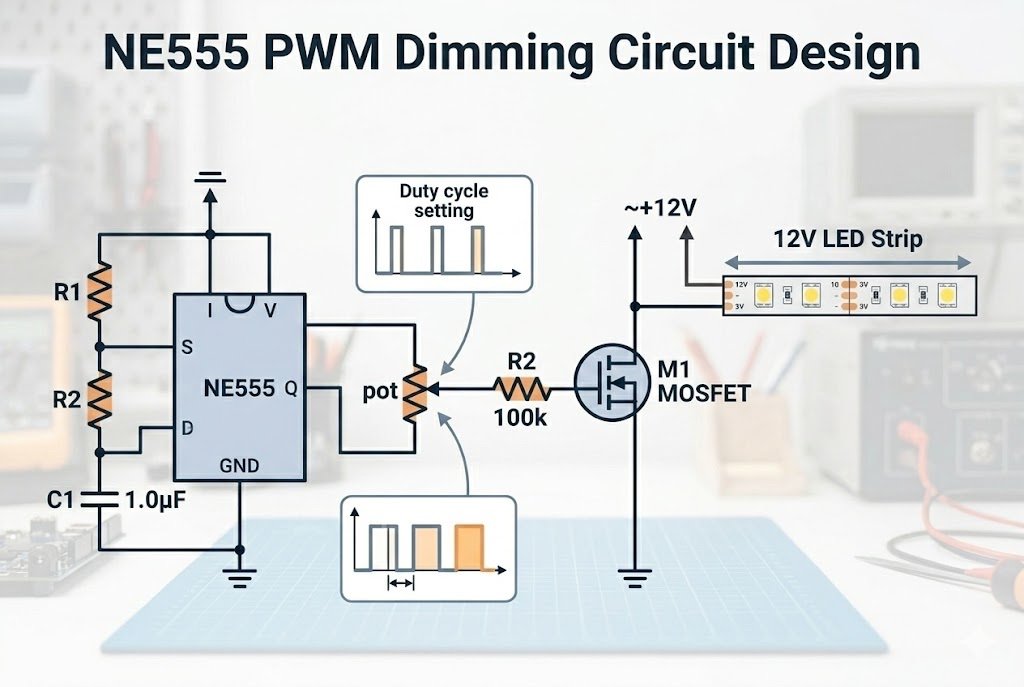
You can build a PWM dimmer by adding a potentiometer and two diodes to the NE555 astable circuit. The diodes force the charge and discharge currents through different sides of the potentiometer. This changes the duty cycle smoothly without changing the main frequency.
Building a Smooth LED Dimmer
Pulse Width Modulation9 is the best way to control LED brightness. If you just lower the voltage, the LED color changes. PWM turns the LED on and off very fast. Your eyes only see the average brightness.
I built a desk lamp a few years ago. I wanted a smooth dimmer. I used an NE555P instead of a costly microcontroller. I connected a 50k Ohm potentiometer to pin 7. I added two 1N4148 diodes. One diode handles the charging path. The other diode handles the discharging path. When I turn the knob, the high time gets longer, and the low time gets shorter. The total time stays the same.
Here are the key parts you need for this design.
| Component | Function in PWM Circuit |
|---|---|
| NE555P IC | Generates the fast pulses |
| Potentiometer | Adjusts the pulse width |
| Two Diodes | Separates charge and discharge paths |
| MOSFET10 | Drives the heavy LED current |
The circuit is very small. You can fit it on a tiny printed circuit board. This helps when you design small products. You must pick a good MOSFET10 if you have many LEDs. The NE555 can only supply about 200mA. A MOSFET10 takes the small signal from the NE555 and switches the big power for the lights. Nexcir can help you source the perfect original NE555P and the right power MOSFET10s. We help early-stage engineers get the best parts so their prototypes work perfectly on the first try.
Why is NE555 Perfect for Early R&D Simple Pulse Generators?
Are you wasting time programming microcontrollers for simple tasks? Writing code for basic pulses is slow. I will show why hardware timers speed up your early R&D7 work.
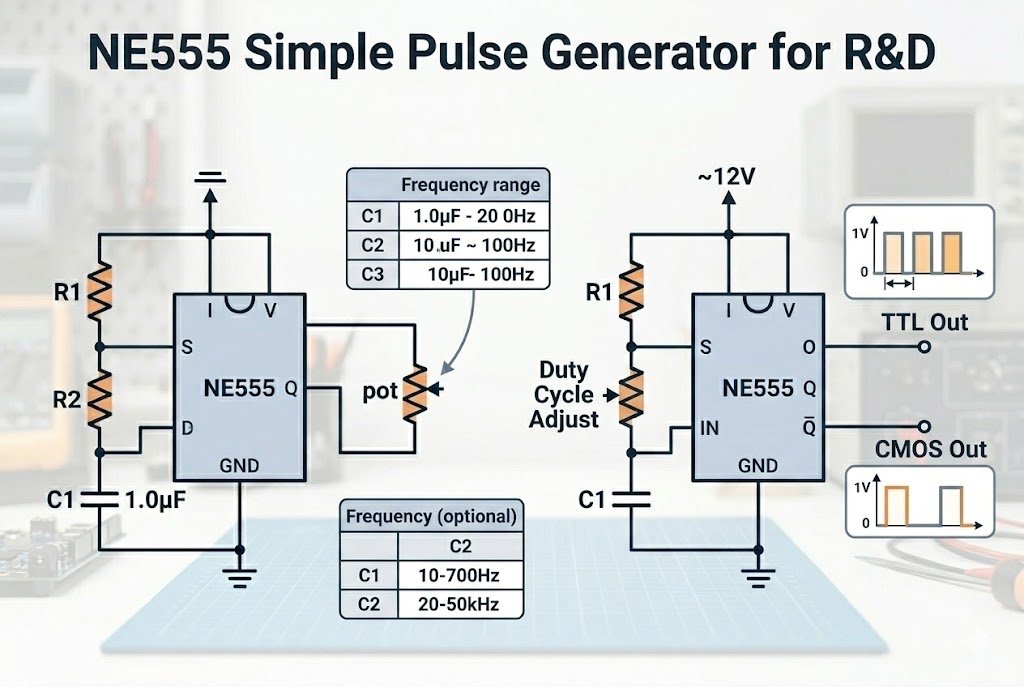
The NE555 is perfect for early R&D7 because it requires no code, boots instantly, and uses very few external parts. Engineers use it to build simple pulse generators11 quickly. This allows them to test other parts of their system without waiting for software development to finish.
Speeding Up Your Prototype Testing
When you start a new project, you want to test your ideas fast. I often see teams stop their hardware tests because the software engineer has not written the clock code yet. This is a big mistake. You can just plug an NE555P into a breadboard. You will have a working pulse generator in five minutes.
The NE555 operates on a wide voltage range. It works from 4.5V up to 15V. You can connect it directly to standard logic chips or higher voltage analog circuits.
Let us look at why hardware timers beat MCUs in early testing.
| Feature | NE555 Timer | Microcontroller |
|---|---|---|
| Setup Time | Minutes | Hours |
| Boot Time | Instant | Needs bootloader time |
| Cost | Very low | Higher |
| Complexity | Very low | High |
You do not need to install complex software on your computer. You just need a power supply and an oscilloscope. This makes your desk much cleaner. I always keep a box of original NE555 chips on my desk. They save me from delays. Many of our OEM customers at Nexcir buy these chips for their test jigs and factory tools. We make sure they get authentic parts12. Fake parts can have unstable voltage levels. You need reliable parts from trusted distributors like Nexcir to make your R&D process smooth and fast.
Conclusion
The NE555 timer is a powerful tool for astable pulses and monostable delays. You can easily build PWM dimmers and pulse generators to speed up your hardware R&D projects.
Explore the versatility of the NE555 timer IC in various electronic applications, from clock generators to PWM dimming circuits. ↩
Understand how the NE555 timer produces a single pulse in monostable mode, perfect for delay timers. ↩
Explore the concept of continuous square waves generated by NE555 in astable mode for timing applications. ↩
Learn about the single pulse output of NE555 in monostable mode, useful for precise timing tasks. ↩
Find out how to create smooth LED dimming circuits with NE555, avoiding flickering and ensuring consistent brightness. ↩
Learn how the NE555 timer generates continuous square waves in astable mode, ideal for clock pulse generation. ↩
Learn how NE555 accelerates early R&D by providing instant pulse generation without complex programming. ↩
Learn how the values of resistors and capacitors influence the frequency output of the NE555 timer. ↩
Explore how Pulse Width Modulation is used in NE555 circuits to control LED brightness effectively. ↩
Understand the importance of MOSFETs in NE555 circuits for driving high current loads like LEDs. ↩
Discover why NE555 is preferred for simple pulse generators, offering quick setup and reliable performance. ↩
Ensure your electronic designs are reliable by using authentic NE555 parts, avoiding issues with fake components. ↩