Are you staring at tiny color bands? A wrong guess can fry your whole circuit board. I will show you exactly how to read a 10k ohm resistor1 quickly.
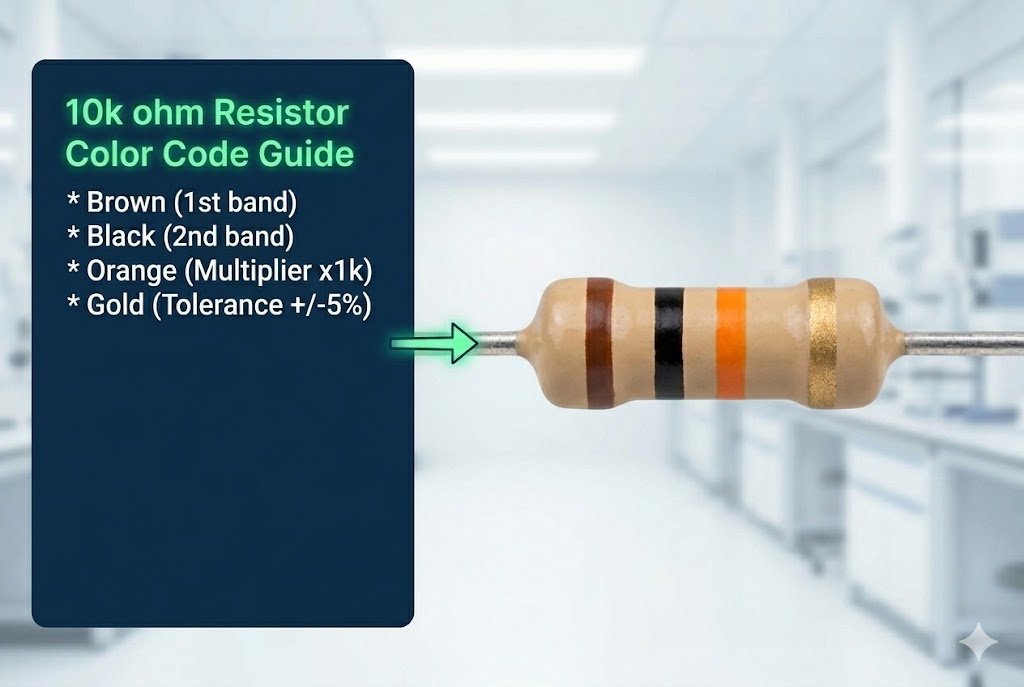
A 10k ohm resistor1 usually has four or five color bands. For a 4-band resistor2, the colors are Brown, Black, Orange, and Gold. Brown is 1. Black is 0. Orange adds three zeros. Gold means a 5% tolerance3. This equals 10,000 ohms or 10k.
You might think reading these small parts is too hard. I know the feeling. But once you learn the basic rules, you will never pick the wrong resistor again.
How to read a 4-band 10k ohm resistor1 color code?
Are 4-band resistor2s confusing you? Using the wrong tolerance ruins your hardware tests. I will break down the 4-band system. You can build your circuits without worry.
Read a 4-band 10k ohm resistor1 from left to right. Band one is Brown (1). Band two is Black (0). Band three is the multiplier, Orange (x1,000). Band four is the tolerance, usually Gold (±5%). You combine them to get exactly 10,000 ohms.
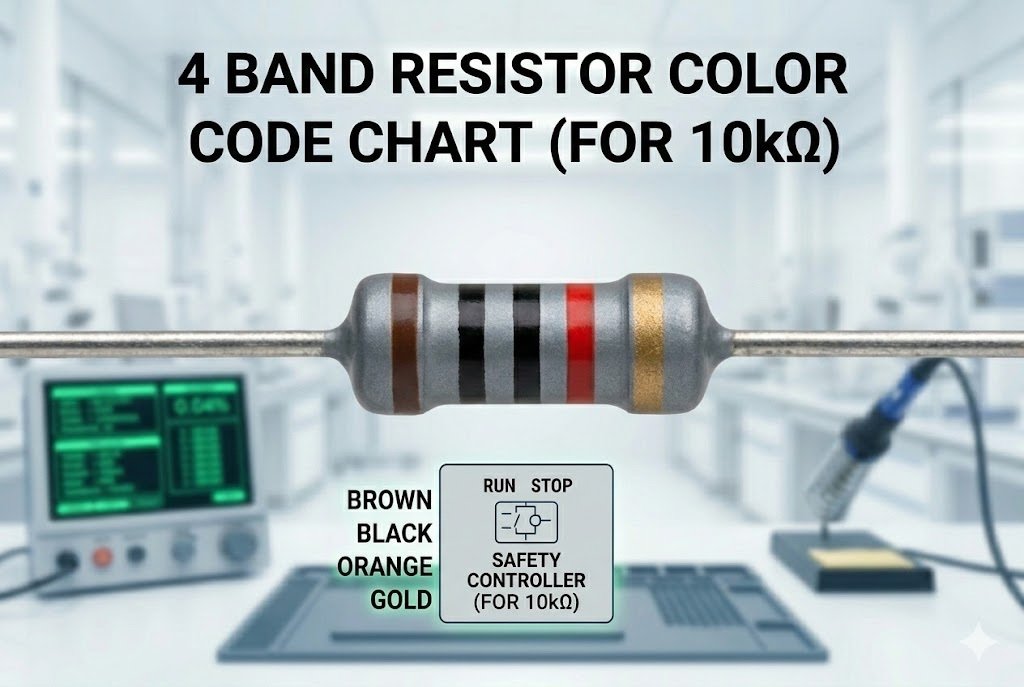
Let us look closer at the 4-band system. This is the most common type of resistor. Hardware engineers use these parts every day in simple circuits. I remember my first project many years ago. I mixed up red and orange bands. The board failed instantly during the first test. You must understand each band clearly to avoid bad designs.
Breaking Down the 4-Band Structure
The first two bands give you the base number4. The third band tells you how many zeros to add. The last band shows the tolerance. Tolerance is the margin of error for the resistor. A 5% tolerance3 means the real value is between 9,500 ohms and 10,500 ohms. If your project needs exact numbers, a 4-band resistor2 might fail. You must choose carefully.
Here is a simple table for the 4-band 10k ohm layout:
| Band Position | Color | Value | Meaning |
|---|---|---|---|
| 1st Band | Brown | 1 | First digit |
| 2nd Band | Black | 0 | Second digit |
| 3rd Band | Orange | x1,000 | Add 3 zeros |
| 4th Band | Gold | ±5% | Tolerance |
I source components for clients at Nexcir5 every day. I always check the tolerance needs first. Many consumer electronics work fine with a 5% margin. Medical or automotive parts need tighter numbers. Knowing this detail helps you buy the right parts from the start. You lower your procurement risks completely. You improve your supply chain efficiency. You stop production delays before they happen.
How to read a 5-band 10k ohm resistor1 color code?
Do your circuits need high precision? A standard 4-band part might fail under strict tests. I will explain the 5-band code for better accuracy in your designs.
A 5-band 10k ohm resistor1 uses Brown, Black, Black, Red, and Brown colors. Band one is Brown (1). Band two is Black (0). Band three is Black (0). Band four is Red (x100). Band five is Brown (±1% tolerance6). This gives you exactly 10,000 ohms.
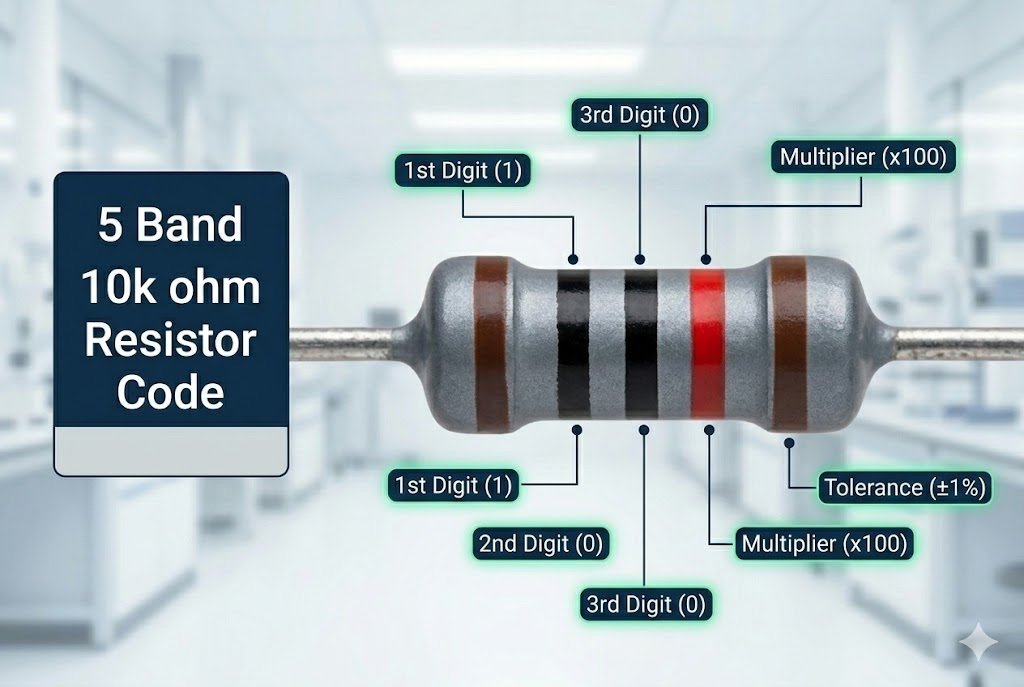
The 5-band resistor7 gives you much more precision. It adds an extra digit band to the code. This extra band allows for tighter tolerances in the manufacturing process. Most 5-band resistor7s have a 1% or 2% tolerance. If you design testing tools or audio gear, you must use 5-band resistor7s. They keep your signals clean and accurate.
Why Choose a 5-Band Resistor?
Let us break down the main difference. A 4-band part has two base number4s. A 5-band part has three base number4s. This means the multiplier shifts one spot. For a 10k ohm value, the base is 100. Then you multiply by 100 with the Red band. This gives you 10,000 ohms.
| Band Position | Color | Value | Meaning |
|---|---|---|---|
| 1st Band | Brown | 1 | First digit |
| 2nd Band | Black | 0 | Second digit |
| 3rd Band | Black | 0 | Third digit |
| 4th Band | Red | x100 | Add 2 zeros |
| 5th Band | Brown | ±1% | Tolerance |
At Nexcir5, we see many OEM managers switch to 5-band resistor7s. They want to lower failure rates in their final products. A 1% tolerance keeps the value between 9,900 and 10,100 ohms. This small change stops big problems in sensitive circuits. I always tell buyers to check their bill of materials carefully. Do not buy 5% parts to save a few cents if you need 1%. We provide stable pricing to help you afford the best parts. You get reliable quality without breaking your budget.
What does the 6th band mean on a 10k ohm resistor1?
Have you ever seen a resistor with six bands? Ignoring that last color can cause heat failures. I will show you how temperature affects your 10k ohm parts.
The sixth band on a 10k ohm resistor1 shows the Temperature Coefficient of Resistance (TCR)8. It tells you how much the resistance changes when the temperature changes. The color indicates parts per million per degree Celsius (ppm/°C9). Brown means 100 ppm/°C9. Red means 50 ppm/°C9.
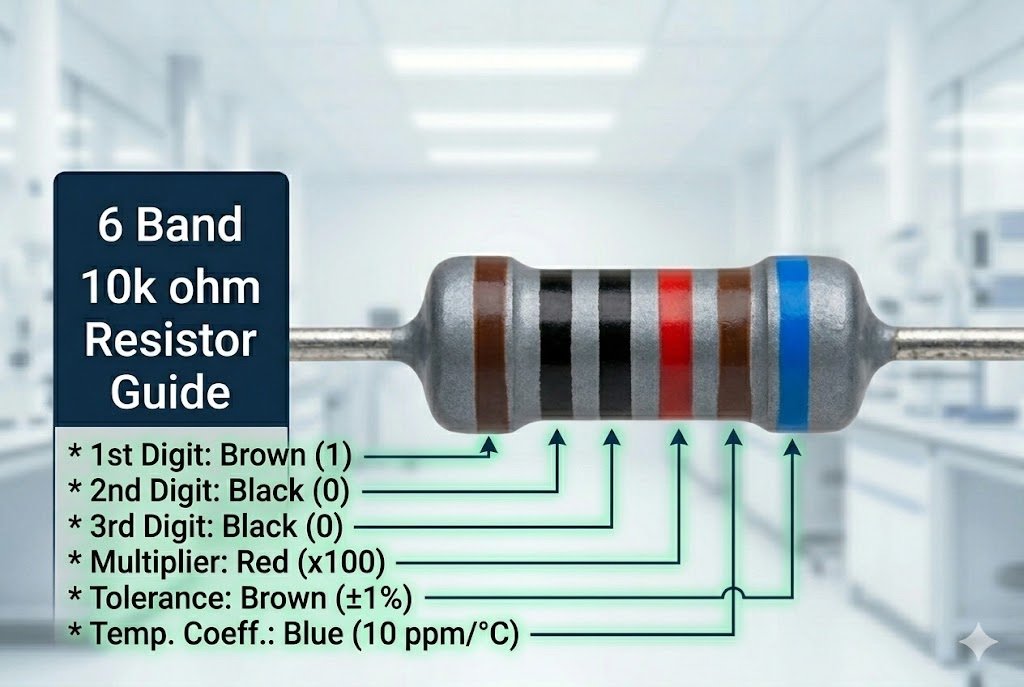
The 6-band resistor10 is for very high-end applications. It looks just like a 5-band part at first glance. It just has one extra stripe at the very end. This stripe is crucial for automotive and industrial electronics. These environments get very hot or very cold. Standard parts fail under these harsh conditions.
Understanding Temperature Coefficient
Heat changes how electricity flows through metal. When a resistor gets hot, its ohm value can drift up or down. If the value drifts too far, your whole system fails. The 6th band tells you exactly how much drift to expect. This helps engineers plan for extreme temperatures safely.
Let us look at common 6th band colors:
| 6th Band Color | TCR Value (ppm/°C9) | Best Use Case |
|---|---|---|
| Brown | 100 | General industrial |
| Red | 50 | Precision tools |
| Yellow | 25 | Lab equipment |
| Blue | 10 | Aerospace parts |
I have worked in the supply chain for over 20 years. I see companies ignore the TCR rating often. They buy standard parts for outdoor devices. When winter comes, the devices stop working. At Nexcir5, we review your exact needs first. If you need parts for extreme weather, we make sure your 10k ohm resistor1s have the correct 6th band. We source these directly from original makers. This stops fake parts11 from entering your factory. Your products will work perfectly in any weather condition.
How do you avoid reading the 10k ohm resistor1 backwards?
Do you read from the left or the right? Reversing the colors gives you a completely wrong value. I will share the simplest trick to find the correct start.
To avoid reading a resistor backwards, look for the gap. The space before the tolerance band is always wider. Start reading from the side opposite the gap. Also, tolerance bands are usually Gold or Silver. These colors never appear in the first band.
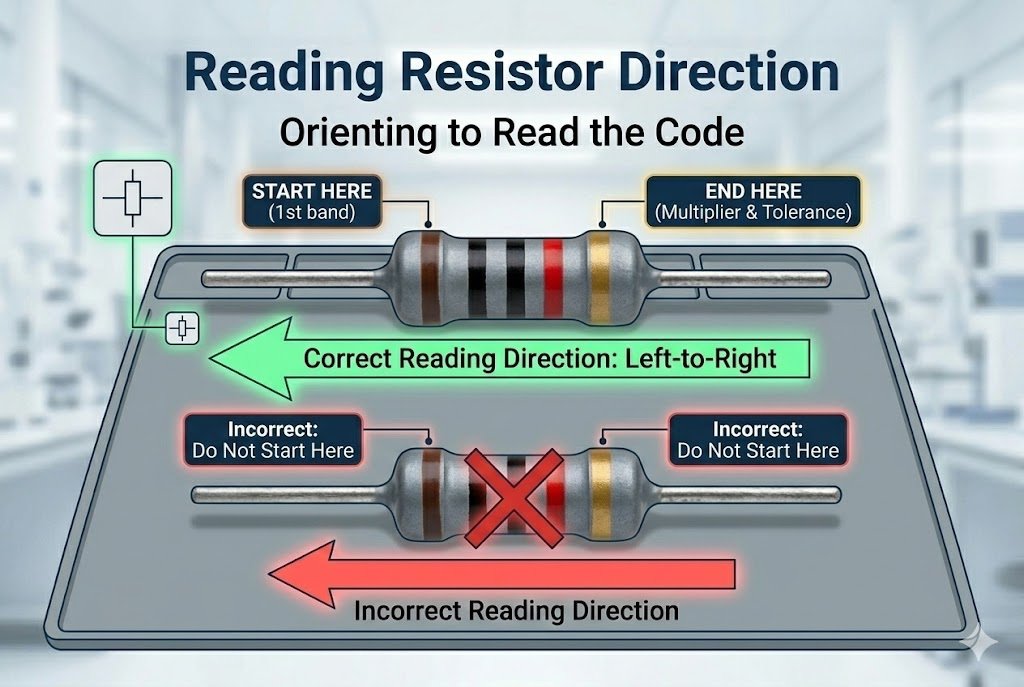
Reading backwards is a very common mistake in our industry. Even expert hardware engineers do it sometimes. They make simple mistakes when they are tired. If you read a 4-band 10k ohm part backwards, you start with Gold. Gold cannot be a first digit ever. You know it is wrong immediately. But what if there is no Gold band to warn you?
Tricks for Finding the First Band
Sometimes, the gap is hard to see on the part. Small parts make it tough for your eyes. Here are a few reliable rules to help you out every time.
| Visual Clue12 | What it Means | Action to Take |
|---|---|---|
| Large Gap | Separates the tolerance band | Start at the other end |
| Gold/Silver Band | This is the tolerance | Put this on the right side |
| Colors Clustered | These are the value bands | Read these first |
You might not solder parts yourself as a procurement manager. You still must inspect incoming stock carefully. If a supplier sends fake parts11, the paint might be sloppy. The gaps might be wrong or missing. This is why Nexcir5 only uses authorized distributors globally. We guarantee 100% original electronic components for every order. We do strict visual checks in our warehouse. Our team ensures the color bands are clear and correct. We make sure they match your order exactly. Stable quality keeps your production lines running on time. You avoid counterfeit products and trust issues completely.
Conclusion
Reading 10k ohm resistor1 color codes is easy once you know the rules. You just match the bands to the right values to keep your circuits safe and reliable.
Understanding the applications of a 10k ohm resistor can help you choose the right component for your electronic projects. ↩
Learning to read a 4-band resistor color code ensures you select the correct resistor for your circuit, preventing costly mistakes. ↩
Understanding tolerance is crucial for ensuring your resistor performs within acceptable limits, affecting circuit reliability. ↩
Identifying the base number is fundamental to calculating the total resistance value, ensuring correct circuit design. ↩
Exploring Nexcir's services can enhance your supply chain efficiency and ensure quality in electronic component sourcing. ↩
A ±1% tolerance provides greater accuracy, essential for sensitive electronic applications where precision is key. ↩
A 5-band resistor offers higher precision, making it vital for applications requiring exact resistance values. ↩
Understanding TCR helps you select resistors that perform reliably under varying temperature conditions. ↩
Knowing ppm/°C values aids in choosing resistors that maintain performance in temperature fluctuations. ↩
A 6-band resistor is crucial for high-end applications, offering insights into temperature stability and precision. ↩
Identifying fake parts is crucial for maintaining circuit integrity and preventing failures in electronic devices. ↩
Using visual clues ensures you read resistor color codes correctly, avoiding errors in component selection. ↩