I used to hate it when my laptop charger got so hot I could barely touch it. Overheating is a massive problem for power designers who want to build smaller, faster adapters. You want high power, but you definitely do not want a fire hazard on your desk.
The INN3677C-H602-TL is a flyback switcher IC from Power Integrations. It combines a primary FET, a primary controller, and a secondary synchronous rectification controller1. It uses PowiGaN technology2 to deliver up to 65W without heatsinks, making it perfect for compact, high-efficiency adapters.
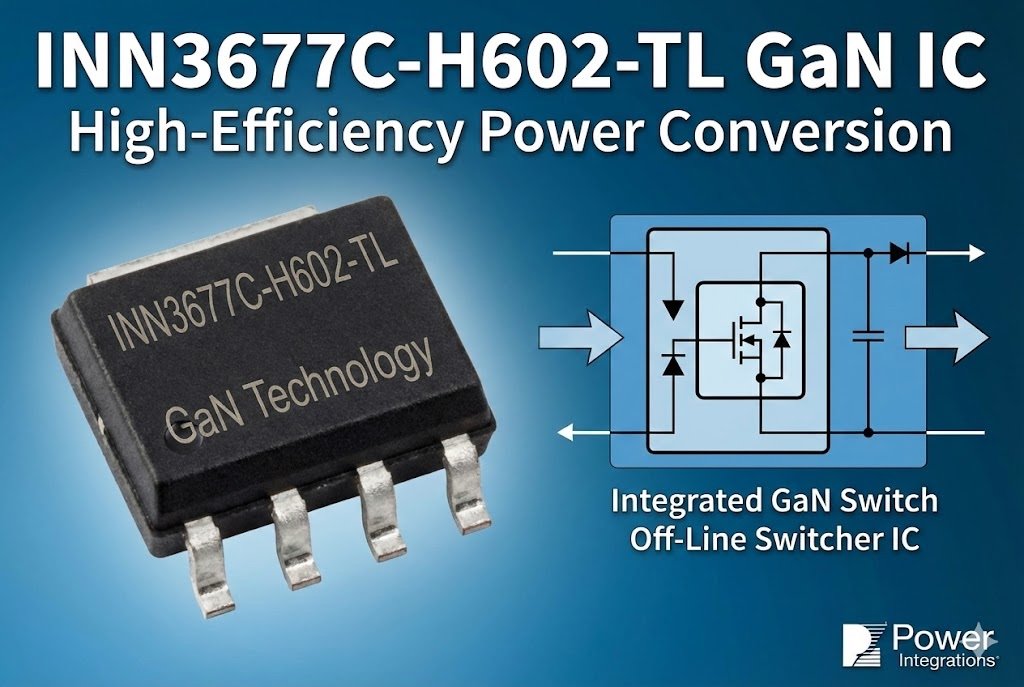
I have seen many chips promise high efficiency on paper. But they often fail when you put them in a real plastic case. This chip is different because of its internal design. It changes how we manage heat and control signals. Let me explain why this matters for your next project.
Why is moving control to the secondary side a revolution?
Traditional power supplies keep the "brain" on the high-voltage side. This is like driving a car from the back seat. It works, but it is slow and hard to control.
The INN3677C shifts control to the secondary side. This allows direct sensing of the output voltage and current. It creates a faster transient response and tighter regulation. You do not need expensive optocouplers3 anymore, which simplifies the board design significantly.
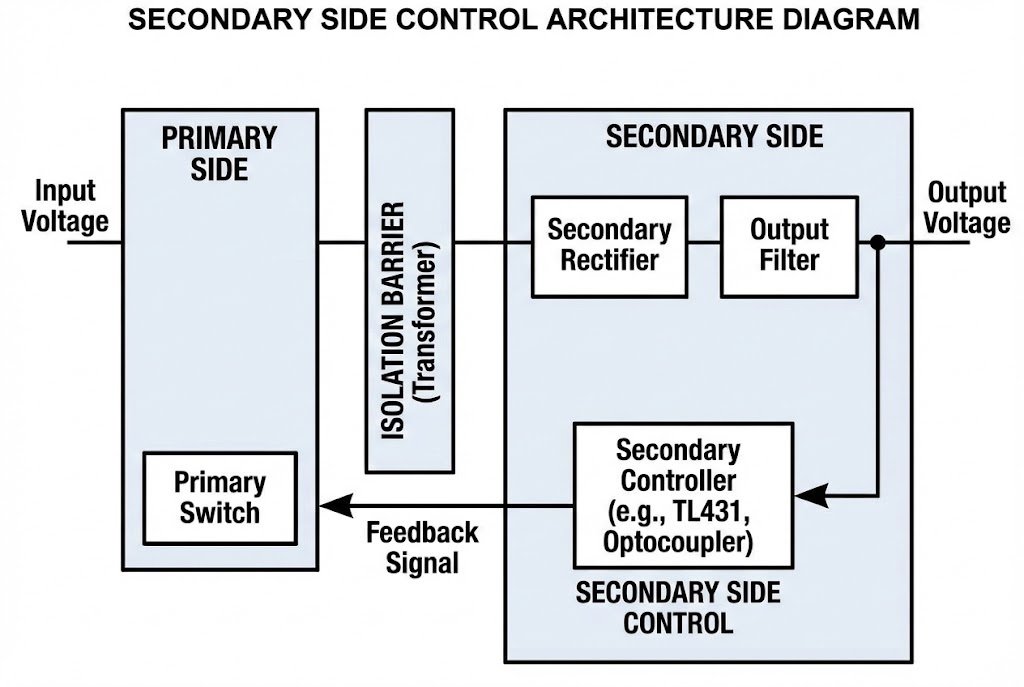
I want to talk about the "brain" of the power supply. In older designs, the main controller sits on the primary side. It has to guess what is happening at the output. It waits for a signal from an optocoupler to tell it to speed up or slow down. This process is slow. It creates a lag. The InnoSwitch3 series, which includes the INN3677C, changes this game completely. It puts the controller on the secondary side. It sees exactly what the load needs right now.
This architecture uses a digital link4 to send commands back to the high-voltage side. This is a big deal for engineers. It means we can react instantly to load changes.
| Feature | Traditional Primary Control | INN3677C Secondary Control |
|---|---|---|
| Sensing Location | Primary Side (Indirect) | Secondary Side (Direct) |
| Response Speed | Slow (Laggy) | Instant (Real-time) |
| Component Count | High (Needs Optocoupler) | Low (Integrated) |
| Regulation Accuracy | +/- 5% | +/- 3% or better |
This matters because modern devices change power needs fast. A smartphone goes from 0% to 100% load in microseconds. Primary control lags behind. This causes voltage drops. Secondary control reacts instantly. At Nexcir, we see clients fail compliance tests because of slow response times. This chip fixes that problem. It is critical for USB-PD applications5 where voltage jumps from 5V to 20V. The chip handles these jumps without sweating. It simplifies the feedback loop. You do not need complex compensation networks. This saves time during the design phase. It also saves space on the PCB.
Does PowiGaN technology2 solve the heat problem for good?
Everyone talks about GaN making things smaller. But I think size is just a bonus. The real enemy of electronics is heat, and small things usually get hot very fast.
PowiGaN is Power Integrations' gallium nitride switch technology6. In the INN3677C, it replaces silicon transistors. It has very low conduction losses7. This means the chip stays cool even at full load. It can deliver 45W to 65W in an enclosed adapter without any metal heatsinks.
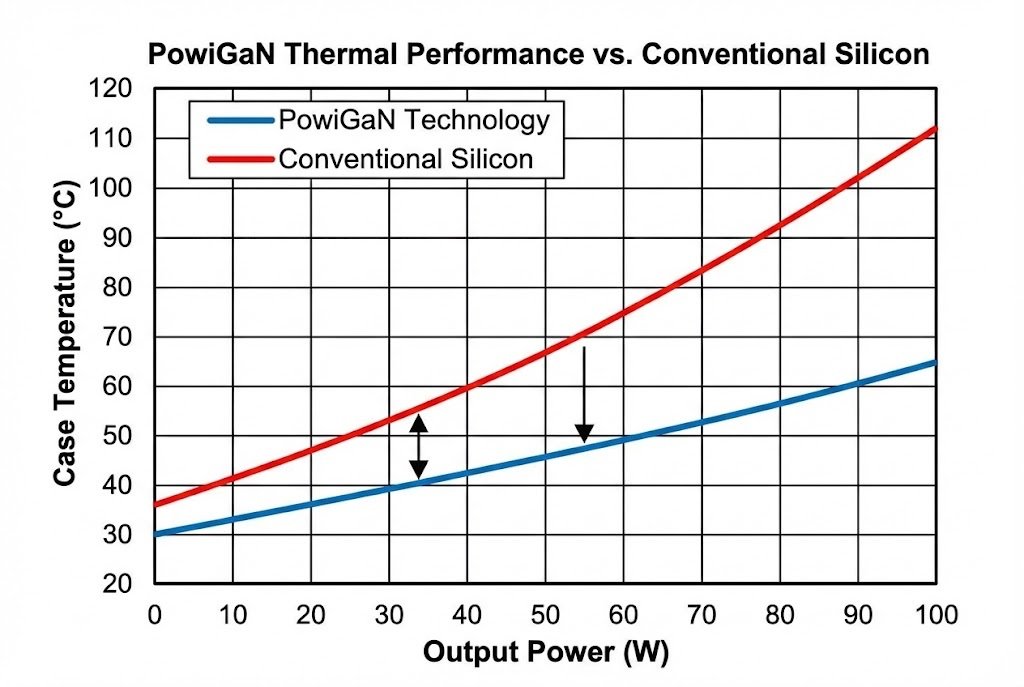
I remember a project where a client wanted a credit-card-sized charger. We used standard silicon chips. It melted the plastic case during testing. That was a bad day for everyone. The INN3677C uses PowiGaN. This is not just marketing hype. It changes the physics of the switch. Silicon has resistance. When you push current through resistance, you get heat. To get 65W out of silicon, you need a big aluminum heatsink. That takes up space.
PowiGaN has very low resistance. It does not get hot. So, you remove the heatsink. Now you have space. You can make the adapter thin.
| Characteristic | Silicon Transistor | PowiGaN Switch |
|---|---|---|
| Heat Generation | High | Very Low |
| Heatsink Requirement | Essential for >30W | None for up to 65W |
| Switching Speed | Moderate | Very Fast |
| Efficiency | 85-90% | up to 95% |
This prevents "throttling." Many chargers slow down charging when they get too hot to protect themselves. This chip keeps running at full speed. It is the standard for high-end fast charging. We supply this part to OEMs who build premium accessories. They cannot afford returns due to overheating8. The INN3677C allows them to seal the case completely. There are no vents needed. This makes the product look sleek and modern. It also protects the insides from dust and moisture. This is the true value of GaN. It is not just about being small. It is about being cool and stable under pressure.
How does FluxLink technology9 replace the optocoupler safely?
If you move the brain to the secondary side, it must talk to the primary side. Usually, we use optocouplers3. But optocouplers3 degrade over time and die.
FluxLink is a proprietary feedback link used in the INN3677C. It uses magnetic induction to send signals across the isolation barrier10. It is much faster than optocouplers3 and does not age or degrade. This ensures the power supply remains safe and reliable for many years.
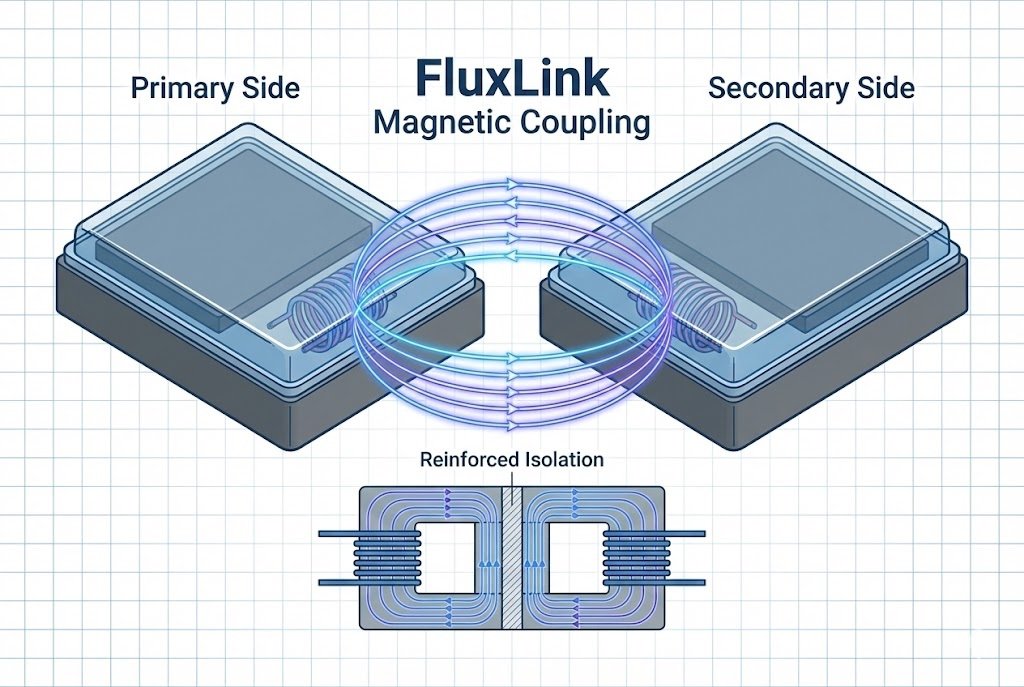
You might wonder how the two sides of the chip talk. They are separated by an isolation barrier10 to prevent electric shock. Old designs use light to cross this gap. We call these components optocouplers3. The problem with optocouplers3 is that they are like lightbulbs. They fade over time. Their current transfer ratio (CTR)11 drops. Eventually, the power supply becomes unstable or fails.
The INN3677C uses FluxLink. Think of it like a tiny transformer inside the chip package. It sends data magnetically. It is digital and extremely fast.
| Reliability Factor | Optocoupler | FluxLink |
|---|---|---|
| Transmission Medium | Light (LED) | Magnetism |
| Aging Effect | Degrades over time | No degradation |
| Bandwidth | Low | High |
| Safety Certification | Varies | UL/TUV Certified12 |
This speed is vital for protection. If a short circuit happens on the charging cable, the secondary side sees it first. It tells the primary side to stop switching. With FluxLink, this happens in one switching cycle. An optocoupler is too slow to catch it that fast. This prevents damage to the expensive device you are charging. At Nexcir, we recommend this for industrial clients who need long life. They cannot afford to change power supplies every two years. FluxLink also helps reduce the Bill of Materials (BOM)13. You remove the optocoupler and the external compensation components. This lowers the cost and increases the reliability of the final product. It is a win-win for the manufacturer and the user.
Conclusion
The INN3677C uses GaN and secondary control to fix heat and speed issues, allowing for small, cool, and safe chargers that define the future of power design.
Learning about this controller can help you understand its role in improving power supply efficiency. ↩
Exploring PowiGaN technology can reveal how it enhances efficiency and reduces heat in electronic devices. ↩
Understanding optocouplers can help you grasp their importance in traditional power supply designs. ↩
Discovering the benefits of digital links can show how they enhance response times in power supplies. ↩
Exploring USB-PD applications can help you understand their role in fast and efficient power delivery. ↩
Learning about GaN technology can reveal its advantages in reducing size and heat in electronic components. ↩
Understanding conduction losses can help you see how they affect the efficiency of electronic devices. ↩
Understanding how to prevent overheating can extend the life of your devices and ensure safety during use. ↩
Discovering FluxLink technology can reveal how it improves communication and reliability in power supplies. ↩
Understanding isolation barriers can help you see their role in ensuring safety and reliability in power supplies. ↩
Learning about CTR can help you understand its impact on the performance of optocouplers over time. ↩
Understanding UL/TUV certification can help you see its importance in ensuring product safety and compliance. ↩
Exploring BOM reduction can show how it lowers costs and increases product reliability. ↩