Finding the exact MOSFET for your power supply or motor driver can be frustrating when stock is low. You cannot afford production delays or system failures caused by a single missing component or an incorrect selection.
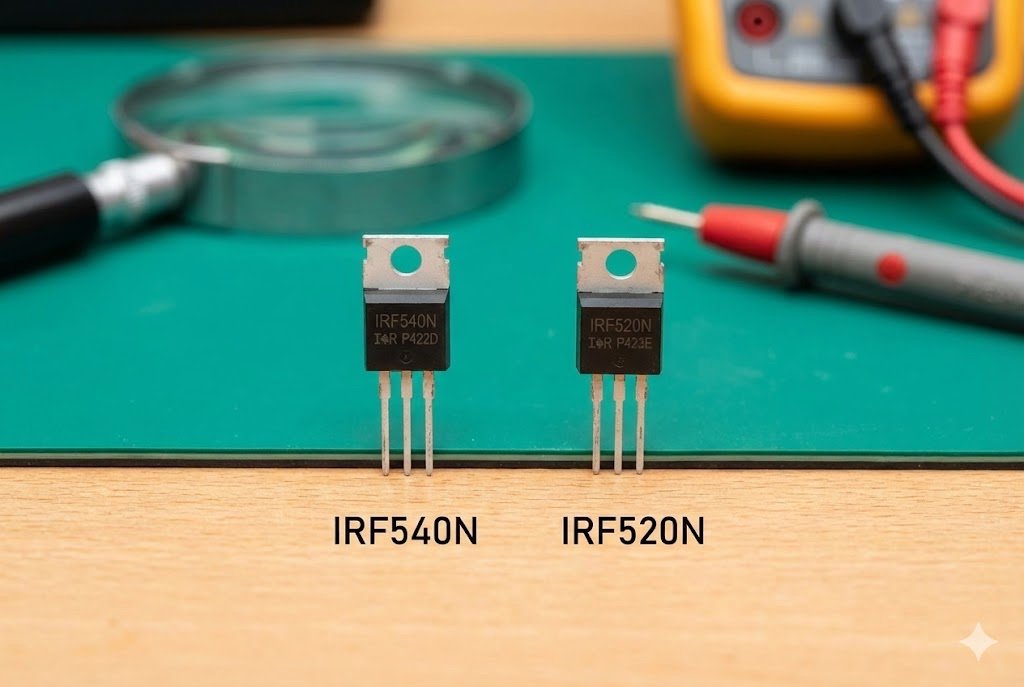
The main difference between IRF540N1 and IRF520N2 is their current handling capability3. The IRF540N1 supports up to 33A, while the IRF520N2 is rated for 9.7A. Both are 100V N-Channel MOSFETs used in switching applications, but the IRF540N1 is better suited for higher-power loads.
In this post, I will break down the technical specs, explain the pinout configurations4, and show you the best alternatives. This guide ensures you pick the right part every time and keeps your supply chain5 moving.
What Are the Key Technical Differences Between IRF540N1 and IRF520N2?
You might think these two parts are interchangeable because they look the same. Using the wrong one can lead to immediate overheating and system failure.
The IRF540N1 has a much lower On-Resistance6 (44mΩ) compared to the IRF520N2 (0.27Ω). This means the IRF540N1 wastes less power and runs cooler. While both share the TO-220 package and 100V breakdown voltage, the IRF540N1 is the stronger choice for high-current circuits7.
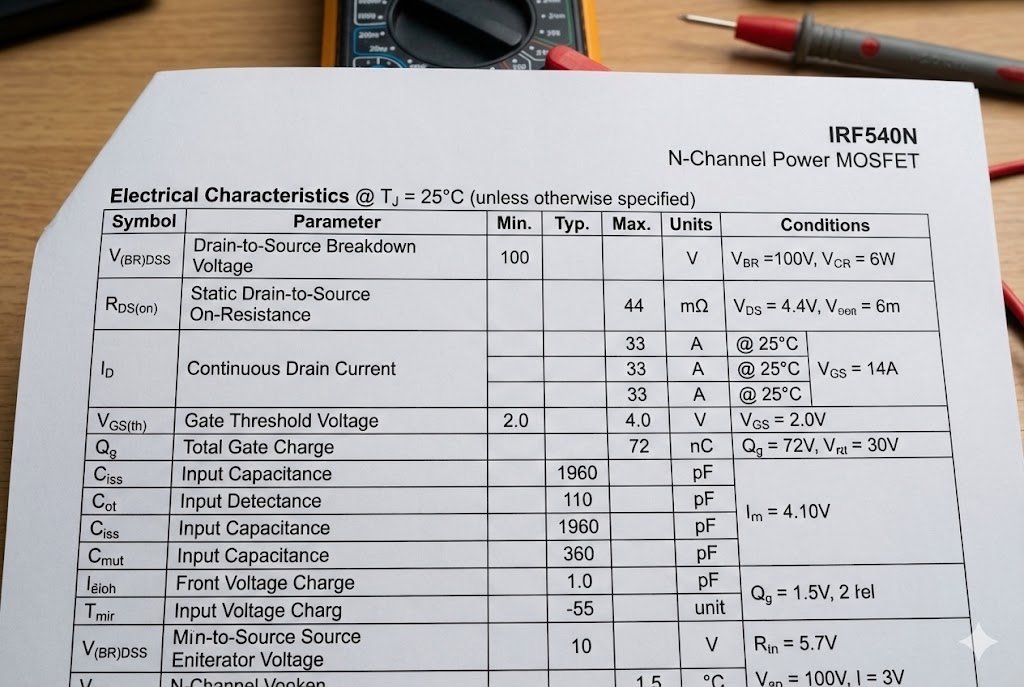
To truly understand which component fits your needs, we must look at the specific parameters found in the datasheets. The table below highlights the critical differences that I analyze when helping OEM clients optimize their Bill of Materials (BOM)8.
Critical Parameter Comparison
| Parameter | Symbol | IRF520N2 | IRF540N1 | Why It Matters? |
|---|---|---|---|---|
| Drain-Source Voltage | $V_{DSS}$ | 100V | 100V | The maximum voltage the switch can block. Both are equal here. |
| Continuous Drain Current | $I_D$ @ 25°C | 9.7A | 33A | The IRF540N1 can handle over 3x the current of the IRF520N2. |
| On-Resistance6 | $R_{DS(on)}$ | 0.27Ω (270mΩ) | 0.044Ω (44mΩ) | Lower resistance means less heat. The IRF540N1 is far more efficient. |
| Power Dissipation | $P_D$ | 48W | 130W | The IRF540N1 can dissipate more heat before failing. |
| Gate Threshold Voltage | $V_{GS(th)}$ | 2.0V - 4.0V | 2.0V - 4.0V | Both require similar voltage levels to start turning on. |
Analysis of Thermal Performance
From my experience sourcing components for industrial clients, the most overlooked spec is the On-Resistance%%%FOOTNOTE_REF6%%% ($R{DS(on)}$). The IRF520N2 has a relatively high resistance. If you push 8 Amps through it, it will generate significant heat ($I^2R$ losses). You would need a large heatsink to keep it stable.
In contrast, the IRF540N1 handling the same 8 Amps will generate very little heat because its resistance is extremely low. This makes the IRF540N1 a more robust choice for modern designs where space for heatsinks is limited. At NexCir, we often advise engineers to upgrade to the IRF540N1 even if the current requirement is low, simply to improve thermal reliability.
How Do the Pinout Configurations Compare?
Wiring a MOSFET incorrectly is the fastest way to destroy your PCB. You need to be absolutely sure about the gate, drain, and source arrangement.
Both the IRF540N1 and IRF520N2 utilize the standard TO-220 package pinout. Looking at the front of the component with the label facing you, pin 1 is the Gate, pin 2 is the Drain, and pin 3 is the Source. This standard layout allows for easy swapping on most circuit boards.
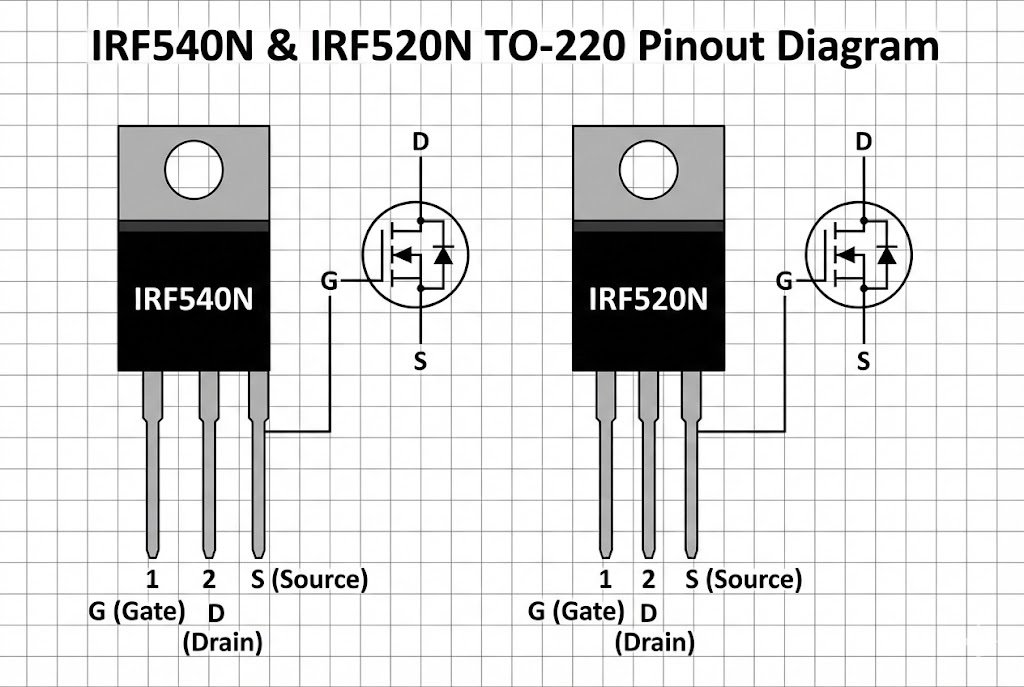
Since both devices use the exact same physical package and pin configuration, they are mechanically interchangeable. This is excellent news for maintenance and repairs, but you must understand the function of each pin to troubleshoot effectively.
Pin Functions Explained
- Gate (G): This is the control pin. By applying a voltage here (relative to the Source), you turn the switch on. It draws almost no current, which makes it easy to drive, although a resistor is often used to prevent ringing.
- Drain (D): This pin connects to the load (like a motor or LED strip). Current flows into the Drain when the MOSFET is on. It is also physically connected to the metal tab on the back of the TO-220 package. This means if you mount it to a metal enclosure, you must use an insulating pad, or you will short the circuit.
- Source (S): This pin connects to the ground (in an N-channel low-side configuration). Current flows out of the Source.
Installation Tips
When I inspect production lines for our customers, a common issue is the "Floating Gate9." If the Gate pin is not connected to a defined voltage (either high or low), the MOSFET can partially turn on, heat up rapidly, and burn out. Always ensure a pull-down resistor is included in your design. Because the IRF540N1 and IRF520N2 have identical pinouts, you can upgrade a board designed for the 520N to the 540N without cutting traces or bending legs, provided the driver circuit can handle the slightly higher gate capacitance of the 540N.
What Are the Best Alternatives When IR Parts Are Out of Stock?
Sourcing original IR (Infineon) parts is becoming difficult due to global supply chain5 shifts. You need reliable backups to keep your manufacturing lines running smoothly.
If you cannot find the IRF540N1, excellent alternatives include the IRF320510 (55V, higher current), STP55NF0611, or the 2N700012 for low-power signal switching. At NexCir, we recommend cross-referencing based on specific voltage and current needs rather than just part numbers.
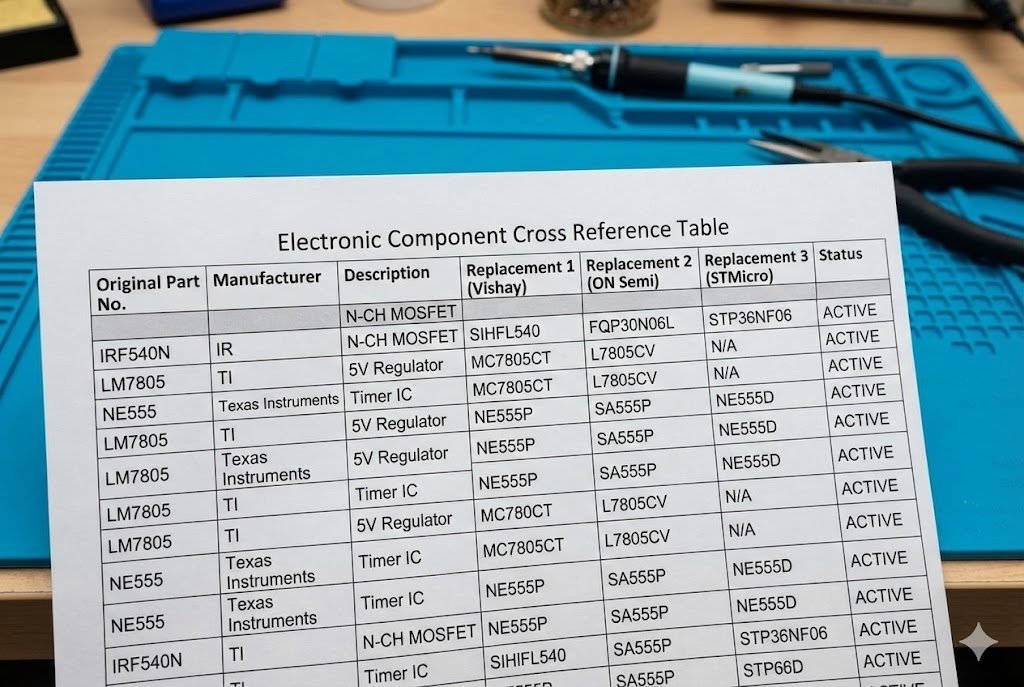
Supply stability is the core of our business at NexCir. We often see customers stuck because they are fixated on a single part number like the IRF540N1. By building a "Cross Reference" database, we help you find components that are functionally equivalent or even better.
Recommended Alternatives and Upgrades
Here is a breakdown of common substitutes we source for our clients when the standard IRF series is allocated or obsolete:
| Model | $V_{DSS}$ | $I_D$ | $R_{DS(on)}$ | Best Use Case |
|---|---|---|---|---|
| IRF320510 | 55V | 110A | 8mΩ | Best Upgrade. If your voltage is under 50V, this runs much cooler and handles massive current. |
| IRFZ44N | 55V | 49A | 17.5mΩ | Common Alternative. Very popular, cheap, and handles more current than the 540N, but lower voltage rating. |
| STP55NF0611 | 60V | 50A | 18mΩ | Modern Replacement. Often easier to source than older IR parts. Great for 12V/24V systems. |
| 2N700012 | 60V | 0.2A | 5Ω | Signal Only. Do not use this for power. Use this only if you are switching small signals and don't need the power of a TO-220 package. |
Strategic Sourcing Advice
When we support OEM manufacturers, we do not just look for the cheapest part. We look for lifecycle status. The IRF540N1 is a very old design. While still available, modern MOSFETs from brands like STMicroelectronics, ON Semiconductor, or high-quality domestic Chinese brands often offer better performance (lower resistance) at a lower cost.
If your application operates at 24V (common in industrial automation), you do not strictly need the 100V rating of the IRF540N1. Switching to a 55V or 60V part like the IRFZ44N or IRF320510 can drastically improve efficiency. However, if you are running near 80V or 90V, you must stick to the IRF540N1 or look for 100V alternatives like the IPP023N10N5 from Infineon.
Where Are These MOSFETs Typically Used in Circuit Designs?
Understanding the ideal application helps you avoid over-engineering or under-powering your device. Choosing the wrong component for the specific load type is a common mistake.
The IRF540N1 is widely used in motor controllers, relay drivers, and DC-DC converters where high efficiency is required. The IRF520N2 is often found in simpler logic-level switching, LED dimmers, and Arduino starter kits where the current load is under 10 Amps.
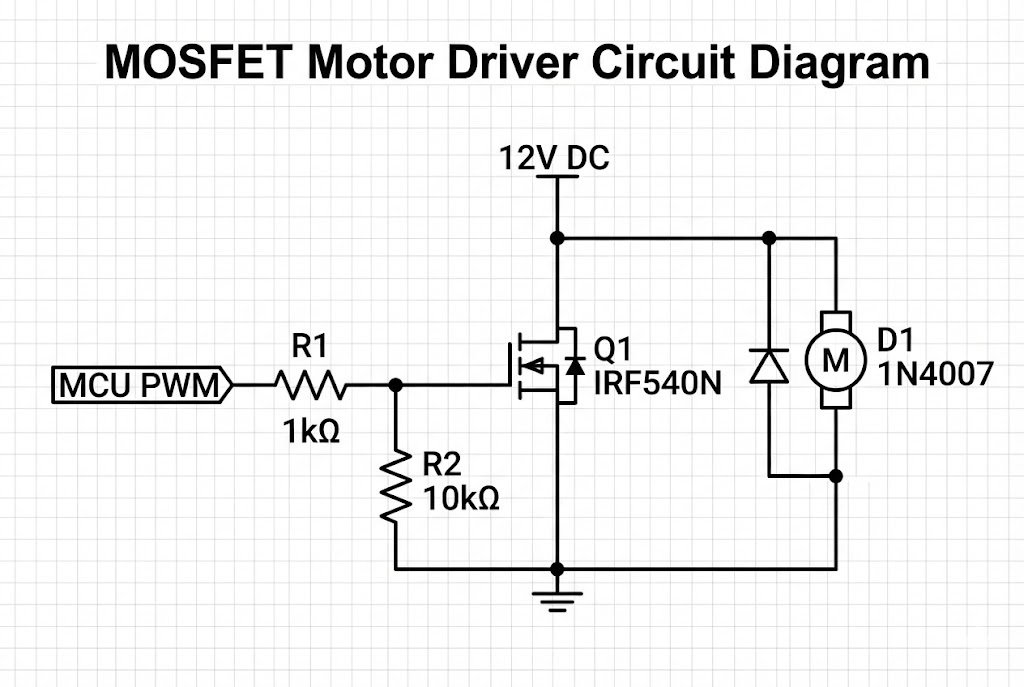
The application determines the component. I have seen many engineers try to use an IRF520N2 to drive a large DC motor, only to have the component fail immediately upon stalling. Understanding the load is key.
Typical Application Scenarios
-
H-Bridge Motor Drivers13: In robotics, you need to control the direction of a motor. The IRF540N1 is a staple here because motors draw high in-rush current when starting. The high current rating (33A) provides a safety margin that the IRF520N2 (9.7A) lacks. If the motor stalls, the 520N might burn out instantly.
-
Solenoid and Relay Drivers: For industrial automation, driving a large solenoid requires a robust switch. The IRF540N1 is preferred because inductive loads14 (coils) store energy. When you turn the switch off, that energy spikes back. While you should always use a flyback diode, the ruggedness of the IRF540N1 helps survive accidental spikes better than the 520N.
-
LED Lighting Dimming15 (PWM): For controlling LED strips, the IRF520N2 is often sufficient if the strip is short (under 5 meters). However, for long architectural lighting runs, the resistance of the 520N causes voltage drop, making the LEDs dimmer at full power. The IRF540N1 ensures the LEDs get the full voltage they need.
Gate Drive Considerations
A critical detail often missed is the "Logic Level" requirement. Neither the IRF540N1 nor the IRF520N%%%FOOTNOTE_REF2%%% are true logic-level MOSFETs. They need about 10V at the Gate to fully open ($R{DS(on)}$ is rated at 10V). If you drive them directly from a 3.3V or 5V microcontroller (like an Arduino or ESP32), they will not turn on completely. They will act like a resistor, get very hot, and likely fail. In these cases, we recommend using a gate driver circuit16 or switching to a true logic-level MOSFET like the IRL540N (note the 'L' instead of 'F').
Conclusion
Choosing between the IRF540N1 and IRF520N2 depends on your current requirements, but knowing their alternatives ensures your production never stops. Contact NexCir today to upload your BOM for global sourcing.
Explore detailed specifications of the IRF540N to understand its capabilities and applications. ↩
Learn about the IRF520N's specifications to see if it fits your project needs. ↩
Understanding current handling capability is crucial for selecting the right MOSFET for your application. ↩
Understanding pinout configurations is essential for correct MOSFET installation and operation. ↩
Explore the impact of supply chain dynamics on sourcing electronic components effectively. ↩
Discover how On-Resistance impacts efficiency and heat generation in MOSFETs. ↩
Understand the requirements for high-current circuits to ensure safe and efficient designs. ↩
Learn about the importance of a BOM in electronics manufacturing and sourcing. ↩
Learn about the risks of a Floating Gate and how to prevent it in your designs. ↩
Explore the IRF3205 specifications to see if it can serve as a suitable alternative. ↩
Learn about the STP55NF06 to evaluate its potential as a replacement for your application. ↩
Understand the 2N7000 specifications to determine its suitability for low-power applications. ↩
Explore the workings of H-Bridge Motor Drivers to understand their application in robotics. ↩
Learn about inductive loads to better manage energy spikes in your circuits. ↩
Discover how MOSFETs are used in LED lighting dimming applications for better control. ↩
Discover the role of gate driver circuits in ensuring proper MOSFET operation. ↩