You worry about the availability of the TJA1050T1 for your legacy designs. You fear production stops because you cannot find this classic CAN transceiver in the market.
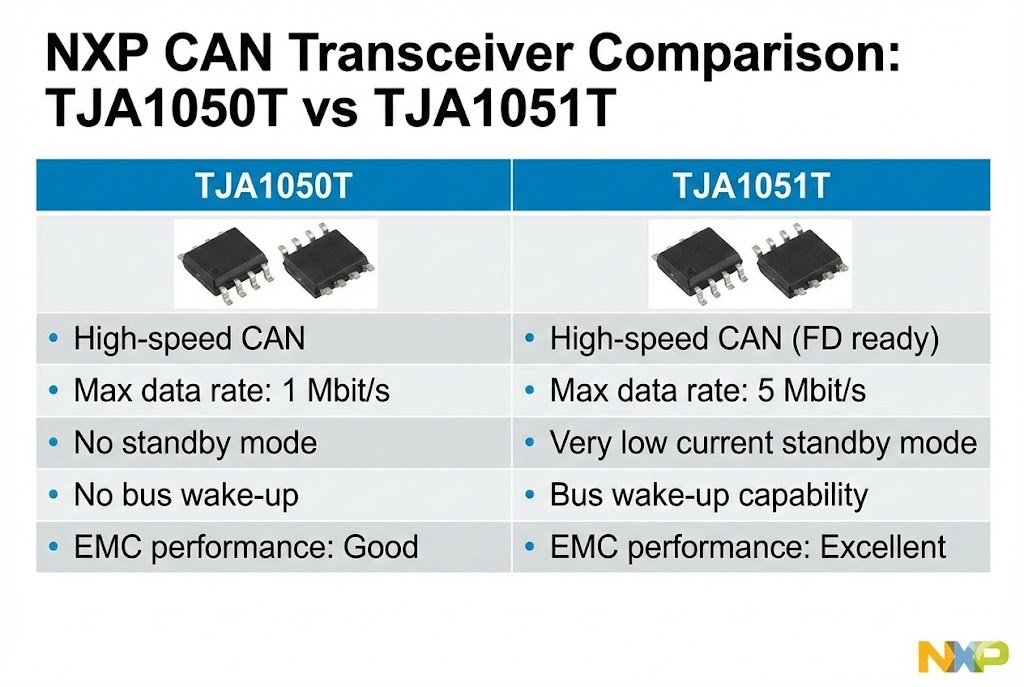
TJA1050T1 is not fully obsolete but is not recommended for new designs. You should migrate to TJA1051T2 or TJA1042T3. These newer chips offer better EMC performance and support 3.3V logic4 without changing your PCB layout.
I see many clients struggling with this specific part. You have used the TJA1050T1 for years. It is a reliable workhorse. However, the industry is moving forward. New microcontrollers use lower voltages. Supply chains are shifting toward newer generation chips. I want to help you understand why this change is good for you. I will explain how you can switch to better parts without a headache.
Why is the TJA1050T1 causing headaches for engineers today?
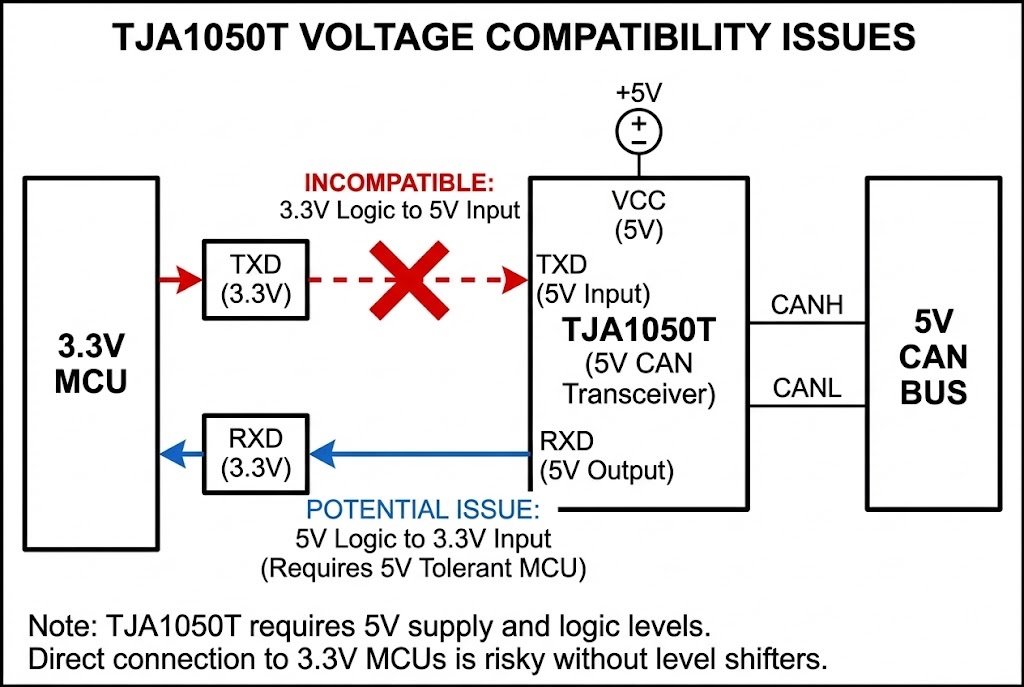
You love the TJA1050T1 because you have used it for years without issues. Now, modern microcontrollers use 3.3V, and this old chip only works with 5V systems.
The main problem is voltage compatibility. TJA1050T1 requires 5V logic to work correctly. Most new MCUs run on 3.3V. Also, TJA1050T1 has lower ESD protection5 compared to modern automotive standards, risking failure in harsh environments.
The Hidden Costs of Keeping the Old TJA1050T1
I talk to engineers every day at Nexcir6. Many of you tell me that you do not want to change the design. I understand that feeling. Change feels risky. But sticking with the TJA1050T1 actually adds more risk and cost to your project than you might think. We need to look at the technical details to see why this is true.
The biggest issue is the logic voltage. The TJA1050T1 is a 5V device. It expects 5V signals on the TXD and RXD pins. Today, you probably use an STM32 or a similar modern microcontroller. These chips run on 3.3V. If you connect them directly, it might not work reliable. You might need to add a level shifter circuit7. This adds extra components to your board. It takes up space. It costs money.
Another issue is Electromagnetic Compatibility (EMC)8. The TJA1050T1 is an older generation chip. It often requires a common-mode choke coil9 to pass strict emission tests. This is another expensive component you have to buy and solder.
Here is a breakdown of the limitations you face with the TJA1050T1:
| Feature | TJA1050T1 (Legacy) | Modern Requirement | Impact on You |
|---|---|---|---|
| Logic Voltage | 5V Only | 3.3V or 5V | Need level shifters for new MCUs. |
| Data Rate | Up to 1 Mbit/s | CAN FD (up to 5 Mbit/s) | Limits system speed. |
| EMC Performance | Standard | High / Very Low Emission | Requires extra choke coils. |
| ESD Protection | 4 kV (HBM) | 8 kV+ (HBM) | Higher risk of field failure. |
You can see that the TJA1050T1 holds your design back. It forces you to add parts to compensate for its age. It is time to look at the upgrades.
Why is TJA1051T2 the perfect upgrade for your system?
You want a replacement that drops right into your existing circuit board. You do not want to redesign your whole circuit board just to change one chip.
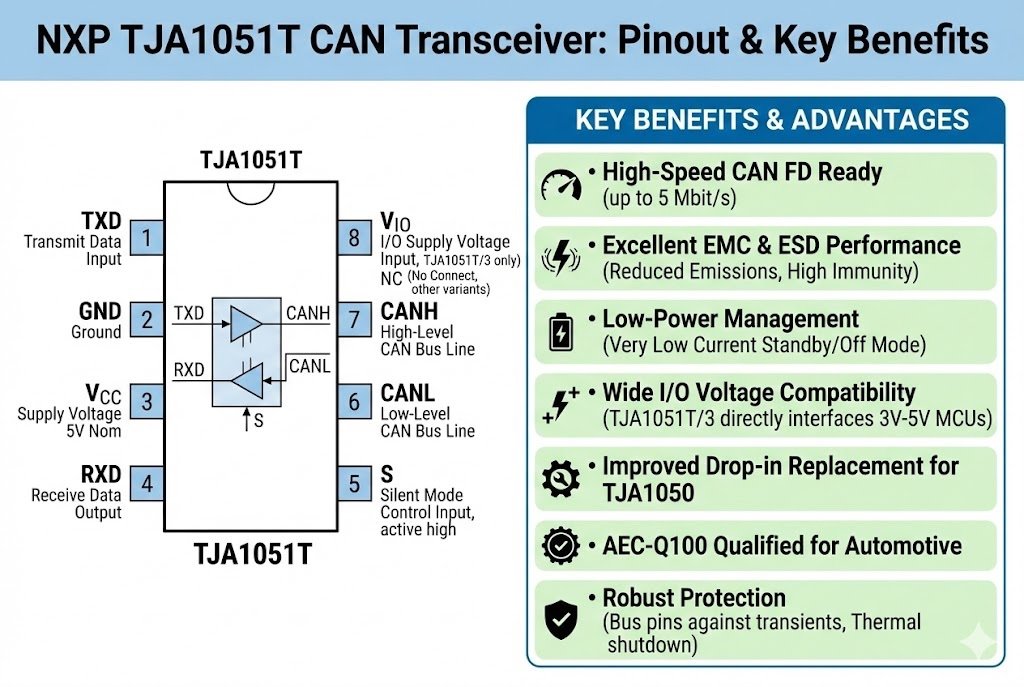
TJA1051T2 is the direct successor. It is pin-compatible with TJA1050T1. It offers much higher ESD protection5 and low electromagnetic emission. Crucially, the TJA1051T2/3 version supports 3.3V microcontrollers directly.
The TJA1051T2 is Built for Modern Electronics
I always recommend the TJA1051T2 as the first option for my clients. It is the third generation of high-speed CAN transceivers from NXP. It solves almost every problem the TJA1050T1 has. The best part is that it fits in the same spot on your board. You usually do not need to change the layout.
Let's talk about the voltage issue again. The TJA1051T2 comes in different versions. The standard TJA1051T2 works like the old one. But the TJA1051T2/3 is special. It has a VIO pin (on pin 5) that allows you to connect it to your microcontroller's supply voltage. This means it can talk to 3.3V microcontrollers perfectly. You can remove those level shifters I mentioned earlier. This saves you money and board space.
Another huge benefit is the signal quality. The TJA1051T2 has excellent EMC performance. In many automotive applications, you can remove the common-mode choke. This is a significant cost reduction. It also supports CAN FD (Flexible Data-rate)10. This means your hardware is ready for faster communication speeds in the future.
Here is how the TJA1051T2 improves upon the TJA1050T1:
| Feature | TJA1050T1 | TJA1051T2 / TJA1051T2/3 | Your Benefit |
|---|---|---|---|
| Pin 5 Function | Vref (Reference Voltage) | VIO (Supply for I/O) | Direct connection to 3.3V MCUs. |
| Pin 8 Function | S (Silent Mode11) | S (Silent Mode11) | Same logic control. |
| CAN FD Support | No | Yes | Future-proof design. |
| Choke Required? | Often Yes | Often No | Lower BOM cost. |
Please note that Pin 5 on TJA1050 is an output (Vref), but on TJA1051T2/3 it is an input (VIO). If you replace it, make sure you connect Pin 5 to your MCU voltage (3.3V or 5V). If you use the basic TJA1051T2 (no /3), Pin 5 is not connected (NC), which is also safe for 5V systems.
How does TJA1042T3 fit into the picture?
You might need standby mode for power saving in your specific application. TJA1051 is great, but sometimes your application requires even lower power consumption when idle.
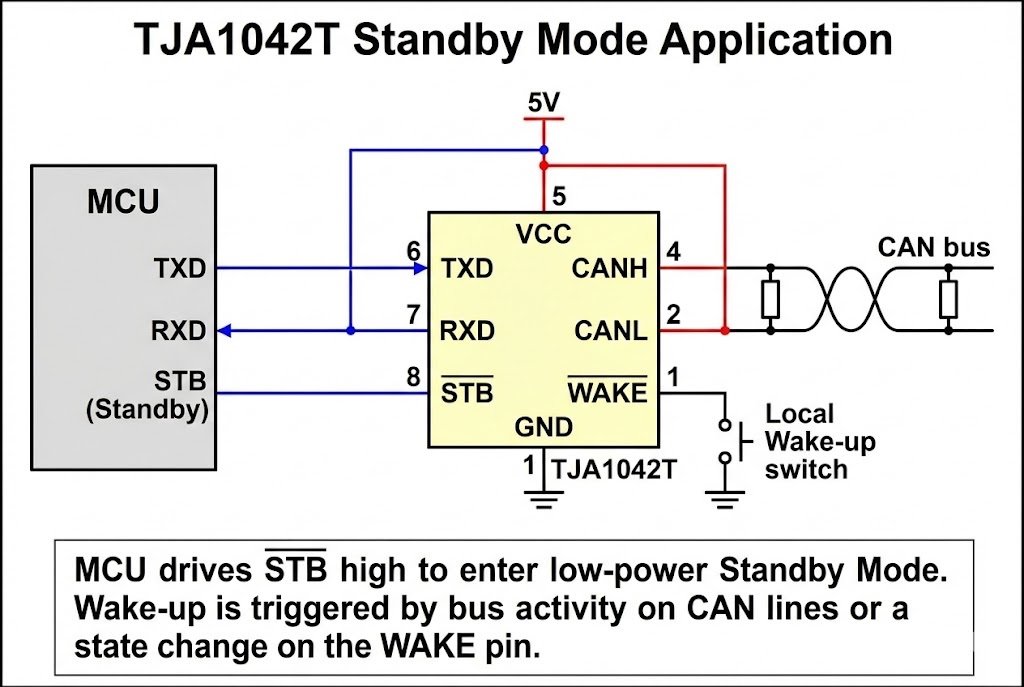
TJA1042T3 is another excellent alternative. It features a Standby mode with bus wake-up capability12. This is perfect for automotive applications where battery drain is a major concern when the engine is off.
Choosing Between TJA1051 and TJA1042
I sometimes see confusion between these two chips. They look the same. They act very similarly. But there is a key difference on Pin 8. This difference changes how your device behaves when it is sleeping.
The TJA1050T1 and TJA1051T2 have a "Silent Mode11" on Pin 8. In Silent Mode11, the transmitter is off, but the receiver is still active. The chip still consumes a moderate amount of current. It listens to everything on the bus.
The TJA1042T3 replaces Silent Mode11 with "Standby Mode13". In Standby Mode13, the chip goes to sleep. It consumes very little power (microamps). The receiver shuts down. However, it has a special "Wake-up" circuit. If it sees activity on the CAN bus lines, it wakes up and signals your microcontroller.
This is vital for battery-powered devices. If you are designing a device that sits in a car, you need TJA1042T3. It prevents the car battery from dying. If your device is always plugged into mains power, TJA1051T2 is usually enough.
Here is a guide to help you decide:
Decision Matrix
-
Do you need to save battery power?
- Yes: Choose TJA1042T3. It has Standby Mode13.
- No: Choose TJA1051T2. Silent Mode11 is fine.
-
What is your MCU Voltage?
-
Do you need Wake-up capability?
At Nexcir6, we see a trend where TJA1042T3 is becoming the standard for automotive clients, while TJA1051T2 is popular for industrial machinery where power consumption is less critical.
How can Nexcir6 help you manage this transition?
You fear fake chips when buying legacy or new parts in the open market. You need a partner who guarantees the parts are real and work perfectly.
At Nexcir6, we source only from authorized channels. We provide a full cross-reference list to help you switch. We stock TJA1051T2 and TJA1042T3 to ensure your production line never stops waiting for parts.

Trust Nexcir6 for Your Component Upgrade
I have been in this industry for a long time. My team has over 20 years of experience. We have seen what happens when companies buy from unreliable sources. I remember a client who bought "cheap" TJA1050T1 chips from a random broker. The chips failed after one week. Their machines stopped working. It cost them ten times the savings to fix the mess.
At Nexcir6, we prevent this. We believe in "Next Circuit, Next Future14." This means we help you move to the next generation of technology safely. We do not just sell parts; we provide solutions.
Here is how we support your migration from TJA1050T1:
- Cross-Reference Support15: We analyze your Bill of Materials (BOM)16. We identify old parts like TJA1050T1. We suggest the exact replacement, like TJA1051T2/3, that fits your specific voltage needs.
- Guaranteed Authenticity: We only source from authorized distributors and original manufacturers. Every chip you get from us is 100% original. We have a strict quality control process.
- Stock Availability: We know these parts are critical. We keep stock of TJA1051T2 and TJA1042T3. We have a global supply network17. We can get parts to you in North America, Europe, or Asia quickly.
- Bundled Solutions: We can kit these transceivers with other components you need, like MCUs or capacitors. This simplifies your purchasing.
We want to be your long-term partner. We help you optimize costs and improve quality.
| Nexcir6 Service | Competitor / Broker | |
|---|---|---|
| Source | Authorized & Traceable18 | Unknown / Grey Market |
| Technical Support | Engineer-led Advice | Just Sales |
| Advice | Proactive Upgrades19 | Passive Order Taking |
| Risk | Zero (Money-back guarantee20) | High (Counterfeit risk) |
Do not let an old part number stop your production. Let us help you upgrade to the TJA1051T2 or TJA1042T3 today.
Conclusion
TJA1050T1 is aging, but you have better options. Switch to TJA1051T2 for 3.3V support and better EMC. Nexcir6 ensures you get authentic, high-quality parts for a smooth migration.
Explore the current market availability and potential alternatives for the TJA1050T to ensure your production line remains uninterrupted. ↩
Discover why TJA1051T is a superior choice for modern designs, offering better compatibility and performance. ↩
Learn how TJA1042T can enhance your automotive applications with its standby mode and power-saving features. ↩
Understand the advantages of 3.3V logic in modern microcontrollers and how it affects your design choices. ↩
Find out the significance of higher ESD protection in preventing component failure and ensuring device longevity. ↩
Discover how Nexcir guarantees authentic components and supports your transition to modern parts. ↩
Learn about the role of level shifter circuits in bridging voltage differences between components. ↩
Explore the benefits of enhanced EMC performance in reducing interference and improving device reliability. ↩
Discover how common-mode choke coils help in meeting EMC standards and reducing emissions. ↩
Understand the benefits of CAN FD in supporting higher data rates and future-proofing your designs. ↩
Explore the functionality of Silent Mode in CAN transceivers and its impact on power consumption. ↩
Understand the mechanism of bus wake-up capability and its importance in power-sensitive applications. ↩
Learn about Standby Mode in CAN transceivers and how it aids in power conservation. ↩
Explore Nexcir's philosophy of advancing technology safely and efficiently through their services. ↩
Learn how Cross-Reference Support helps in identifying suitable replacements for obsolete components. ↩
Learn the importance of BOM analysis in identifying outdated components and planning upgrades. ↩
Discover the advantages of a global supply network in ensuring timely and reliable component delivery. ↩
Find out the importance of sourcing components from authorized channels to avoid counterfeit risks. ↩
Explore how proactive upgrades can enhance your design's performance and future-proof your products. ↩
Understand the security a money-back guarantee provides when purchasing electronic components. ↩