New energy laws are getting much tougher every year. Are you worried that your current home appliance designs will fail to meet the strict European standards coming in 2026?
The TNY287PG1 from the TinySwitch-4 family is the ideal answer. It uses a specialized multi-mode control engine2 to drop standby power below 30mW3. This ensures your power supplies meet the strict 2026 ErP Directive4, acting as a "green passport" for your products to enter the European market.
I have seen many clients struggle with these new regulations. They design a great product, but it fails the final energy test. This costs them time and money. Today, I will explain why the TNY287PG1 is the right choice for your next design and how it solves these problems.
What exactly does the 2026 ErP Directive4 demand from manufacturers?
The rules for exporting electronics are changing very fast. If your power supply consumes too much energy while it is idle, you simply cannot sell your products in Europe.
The latest ErP Directive pushes no-load power consumption limits down to 30mW or even less for many device categories. This regulation aims to reduce wasted energy in standby mode, forcing manufacturers to upgrade their power management ICs immediately to stay compliant.

Understanding the Pressure on OEMs
At Nexcir, we talk to OEM managers every day. The biggest fear I hear is about "Vampire Power5." This is the power a device uses when it is plugged in but turned off. In the past, a standby power of 100mW or even 300mW was acceptable. Those days are gone. The European Union is leading the world in "Eco-design" requirements.
The 2026 update to the Energy-related Products (ErP) directive6 is very strict. It targets external power supplies and built-in converters. The goal is simple. They want to cut carbon emissions. For you, this means your old designs might be illegal soon.
The 30mW Threshold7
Why is 30mW the magic number? Research shows that billions of devices stay plugged in 24/7. Even small amounts of waste add up to huge numbers globally. The new standard requires that when your washing machine, phone charger, or smart meter is doing nothing, it must "sleep" very deeply.
Impact on Procurement and Engineering
This creates a conflict between two teams.
- Engineers: They need high-performance chips.
- Procurement: They need low costs. Usually, high efficiency costs more money. However, failing compliance costs even more because you lose the whole market. You need to analyze the regulations carefully.
Comparison of Standby Power Standards
| Regulation Era | Typical Limit | Allowable Waste | Status |
|---|---|---|---|
| Pre-2010 | > 500mW | High | Obsolete |
| ErP Tier 2 (2016) | < 75mW - 210mW | Moderate | Current Standard |
| ErP Future (2026) | < 30mW | Ultra-Low | Upcoming / Critical |
I believe that preparing now is the only way to survive. If you wait until 2026, supply chains will be choked. Everyone will rush to buy the same efficient chips. You must secure your supply of compliant components like the TNY287PG1 now.
How does TNY287PG1 achieve ultra-low standby power efficiently?
Standard chips waste power even when they are doing nothing. This heat and energy loss ruin your efficiency rating and can cause your product to fail certification.
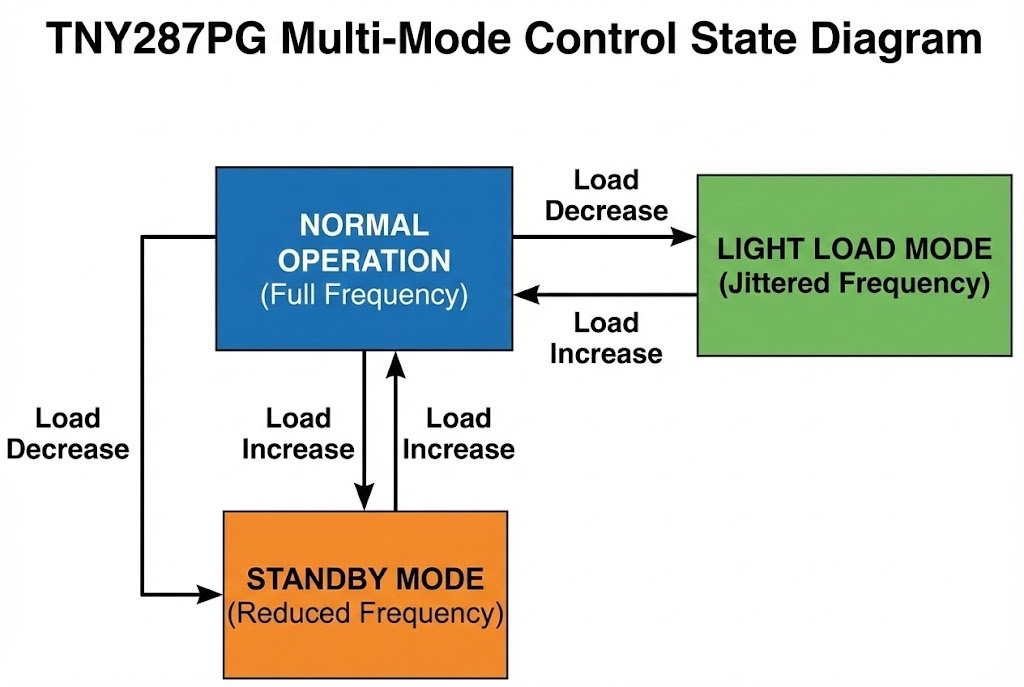
TNY287PG1 utilizes a multi-mode control engine2. It automatically lowers the switching frequency as the load decreases. This drastically reduces switching losses, allowing the system to stay comfortably below the 30mW limit required by new standards.
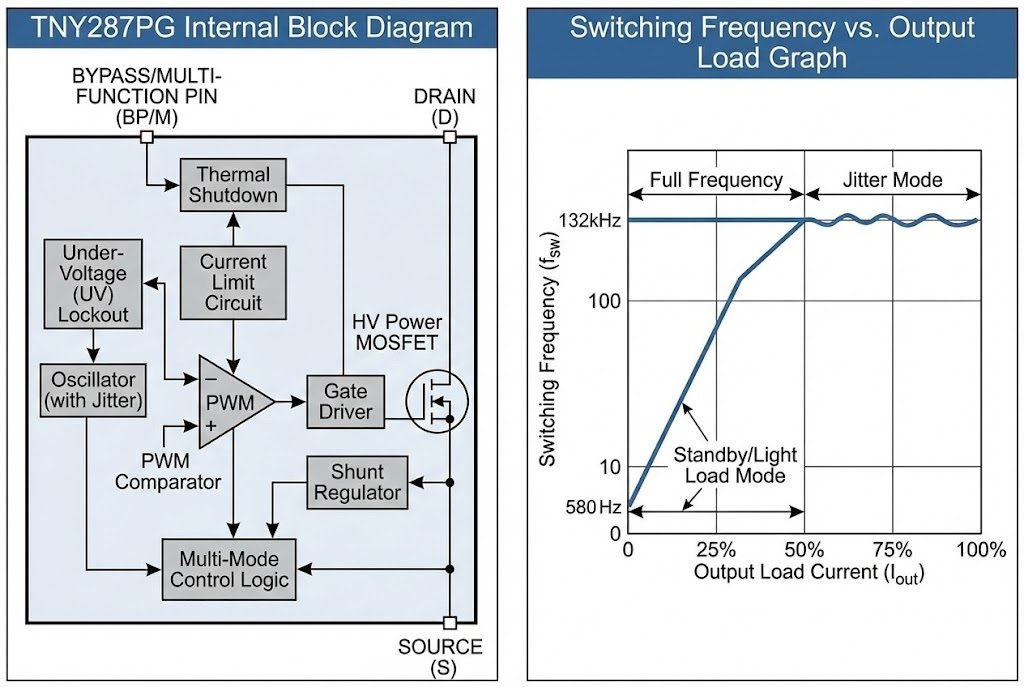
The Magic of the Multi-Mode Control Engine
I want to dive into the technical side of why this chip works so well. The TNY287PG1 is part of the TinySwitch-4 family by Power Integrations. Its secret weapon is how it handles light loads.
Most controllers use Pulse Width Modulation (PWM)8. They switch at a fixed speed. Even if the load is tiny, they keep switching fast. This burns energy. The TNY287PG1 is different. It uses ON/OFF control9.
Breaking Down the Mechanism
When the load drops, the chip does not just make the pulses smaller. It actually skips cycles. It waits. It reduces the effective switching frequency.
- Heavy Load: It switches normally to provide power.
- Light Load: It slows down.
- No Load: It barely switches at all.
This approach minimizes the charging and discharging of the parasitic capacitance in the MOSFET. That is where most "Vampire Power5" comes from. By stopping the switching, you stop the waste.
Line Under-Voltage and Over-Voltage Protection
Another feature I appreciate is the safety integration. You do not need extra components to monitor the input voltage. The TNY287PG1 has this built-in.
- Line Over-Voltage (OV)10: If the grid voltage spikes, the chip stops switching. This protects the device.
- Line Under-Voltage (UV)11: If the voltage is too low, it prevents the power supply from restarting and glitching.
This integration saves board space. It also saves power because you do not need resistor dividers constantly burning current just to measure voltage.
TNY287PG1 Technical Highlights
| Feature | Benefit | Impact on ErP Compliance |
|---|---|---|
| Multi-Mode Control | Adjusts frequency based on load | Critical: Enables <30mW standby |
| 725V MOSFET | Handles high voltage surges | High: Improves reliability/lifespan |
| BP/M Pin | Selectable current limit | Medium: Allows design flexibility |
| Frequency Jittering12 | Spreads EMI spectrum | Medium: Reduces filter cost/power |
At Nexcir, we recommend this chip because it solves the physics problem of power loss. It is not just marketing; it is a smarter way to drive a transformer.
Can switching to TNY287PG1 save your export business to the EU?
Failing compliance checks means stuck shipments and lost revenue. Your goods could sit in customs while competitors take your market share, which is a nightmare scenario.
Adopting the TNY287PG1 acts as an "energy efficiency passport13." It guarantees your products meet the strict eco-design requirements. This removes regulatory barriers, protects your brand reputation, and ensures your supply chain remains uninterrupted.

The Concept of the "Energy Passport"
I like to think of the TNY287PG1 as a passport. Without a passport, you cannot enter a country. Without a high-efficiency IC, your product cannot enter the EU market.
The 2026 ErP directive is a trade barrier. It filters out low-quality manufacturers. If you use cheap, old chips, you are locked out. If you use the TNY287PG1, you pass the border control easily. This gives you a competitive edge. You can tell your customers, "My product is future-proof."
Supply Chain Security and Authenticity
There is a hidden risk here. Fake chips. Because these high-efficiency chips are in demand, the market has counterfeits. A fake TNY287 might look real, but inside, it is an old, inefficient die.
- The Result: You build 10,000 units. You ship them. They get tested. They fail the 30mW limit. You have to recall everything.
This is why Nexcir is strict about sourcing. We only buy from authorized channels. We ensure that the TNY287PG1 you get is the real one from Power Integrations. The specs on the datasheet must match the reality on your circuit board.
Cost Analysis: Redesign vs. Compliance
Some managers argue that the TNY287PG1 costs a few cents more than a generic chip. Let's look at the math.
Option A: Cheap Chip
- Chip cost: $0.10 lower.
- Result: Fails ErP 2026.
- Consequence: Cannot sell in EU. Revenue = $0.
- Chip cost: Slightly higher.
- Result: Meets <30mW.
- Consequence: Access to a market of 450 million people.
Value of Long-Term Partnership
We help our clients see this big picture. We do not just sell parts; we sell market access. By choosing the TNY287PG1 now, you avoid a panic redesign in 2025. You stabilize your production line. You keep your customers happy.
Strategic Advantages for Exporters
| Risk Factor | Solution with TNY287PG1 | Nexcir Support Role |
|---|---|---|
| Regulatory Ban | Meets <30mW standard | Compliance guidance |
| Counterfeit Parts | Guaranteed performance | 100% Original sourcing |
| Supply Shortage | Popular, widely used part | Global inventory management |
| Design Complexity | Simple peripheral circuit | Technical insights |
Transitioning to this chip is a strategic business decision14. It protects your future revenue streams.
Conclusion
The 2026 ErP directive makes low standby power mandatory. By switching to the TNY287PG1, you ensure compliance, protect your export business, and improve product quality with Nexcir's authentic supply chain support.
Explore how the TNY287PG chip can help your products comply with upcoming energy regulations and improve efficiency. ↩
Learn about the technology behind reducing standby power consumption with multi-mode control engines. ↩
Discover the significance of achieving standby power below 30mW for compliance and energy savings. ↩
Understand the new energy efficiency standards set by the 2026 ErP Directive and how they impact product design. ↩
Find out how Vampire Power contributes to energy waste and how to mitigate it in electronic devices. ↩
Gain insights into the ErP directive and its role in shaping energy efficiency standards for products. ↩
Learn why the 30mW threshold is a key target for reducing energy waste in electronic devices. ↩
Understand the role of PWM in power management and its impact on energy efficiency. ↩
Explore how ON/OFF control differs from PWM and its benefits in reducing energy consumption. ↩
Learn about the importance of Line Over-Voltage protection in safeguarding electronic devices. ↩
Discover how Line Under-Voltage protection prevents power supply issues and enhances reliability. ↩
Find out how Frequency Jittering helps in reducing electromagnetic interference in electronic circuits. ↩
Understand the concept of an energy efficiency passport and its role in market access and compliance. ↩
Discover how selecting the right chip can influence market access, compliance, and long-term success. ↩