Your high-power LED lights overheat and fail unexpectedly. This costs you money and risks public safety. You need a driver solution that handles heat intelligently without causing sudden blackouts.
The LNK413EG-LNK420EG series uses a hysteretic thermal shutdown mechanism1. Instead of turning off completely when overheated, it restarts automatically once cool or regulates power. This prevents thermal runaway2 in streetlights and high-bay lamps, ensuring continuous, safe operation even under harsh conditions.
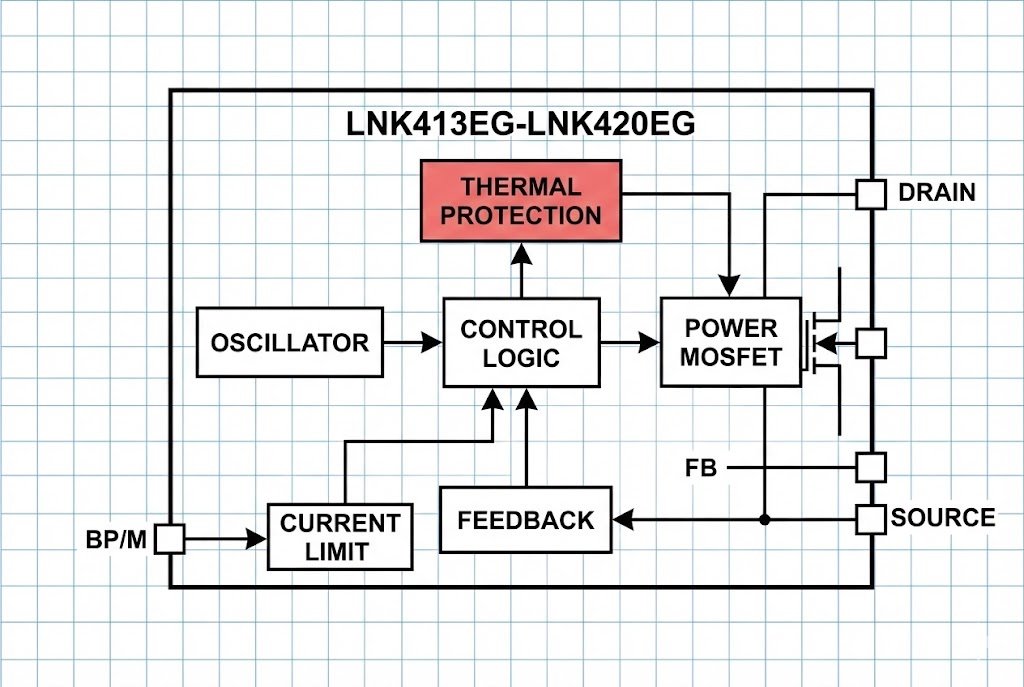
I have seen many engineers struggle with heat management. They design a great light, but it fails in the field. Let me explain how this specific chip family solves that problem.
Why is thermal runaway2 a big risk for LED lighting?
LEDs generate a lot of heat during operation. If that heat stays inside the system, the light fails early. This is a huge pain for maintenance teams and budgets.
Thermal runaway happens when temperature increases cause current to rise, creating even more heat. This cycle destroys components quickly. In outdoor lighting like streetlamps, accumulated dust blocks heat sinks, making this problem inevitable without smart protection.
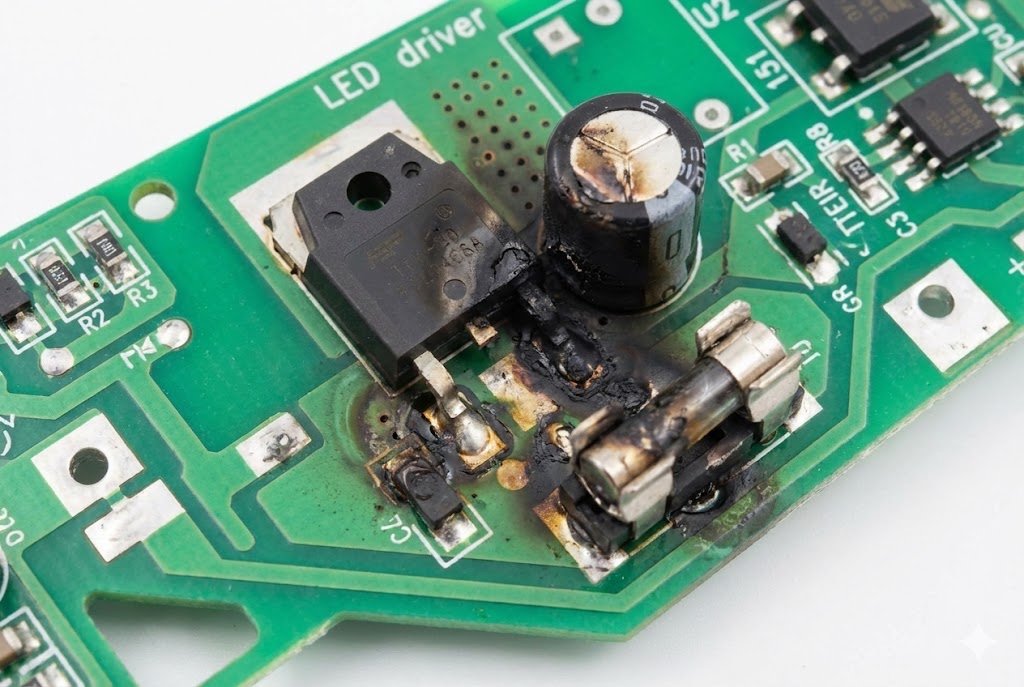
I have worked with clients at Nexcir3 who come to us after their streetlights failed. They used cheap drivers. The result was thermal runaway2. When an LED gets hot, its forward voltage drops. If the driver is not smart, it pushes more current. More current means more heat. It is a circle of destruction.
In outdoor environments, this is worse. Imagine a highway light. Over time, dirt and bird droppings cover the cooling fins. The heat cannot escape. The internal temperature rises. If you use a basic driver, it keeps pushing power until something burns. This is not just about the light breaking. It is about the cost of sending a truck and a crew to fix it.
Here is a simple breakdown of the risk:
| Factor | Result without Protection | Result with Smart Protection |
|---|---|---|
| Dust Buildup | Heat gets trapped inside. | Driver senses heat and adjusts. |
| High Ambient Temp | Components exceed limits. | Driver pauses or lowers power. |
| Component Life | Drastically reduced (months). | Maintained (years). |
| Maintenance Cost | Very High (Emergency repairs). | Low (Scheduled cleaning). |
At Nexcir3, we see this often. Engineers focus on the light output but forget the heat. We advise them to look at the worst-case scenario. Thermal runaway is that worst case. You must plan for it.
How does the LNK413EG-LNK420EG mechanism function?
You want protection that acts fast when danger is near. But you do not want it to be permanent. The chip needs to know when it is safe to reset.
These chips feature hysteretic thermal shutdown. When the junction temperature hits 142°C, the chip disables switching. It only restarts when the temperature drops by 75°C. This large hysteresis4 prevents rapid on-off flickering that damages the LED load.
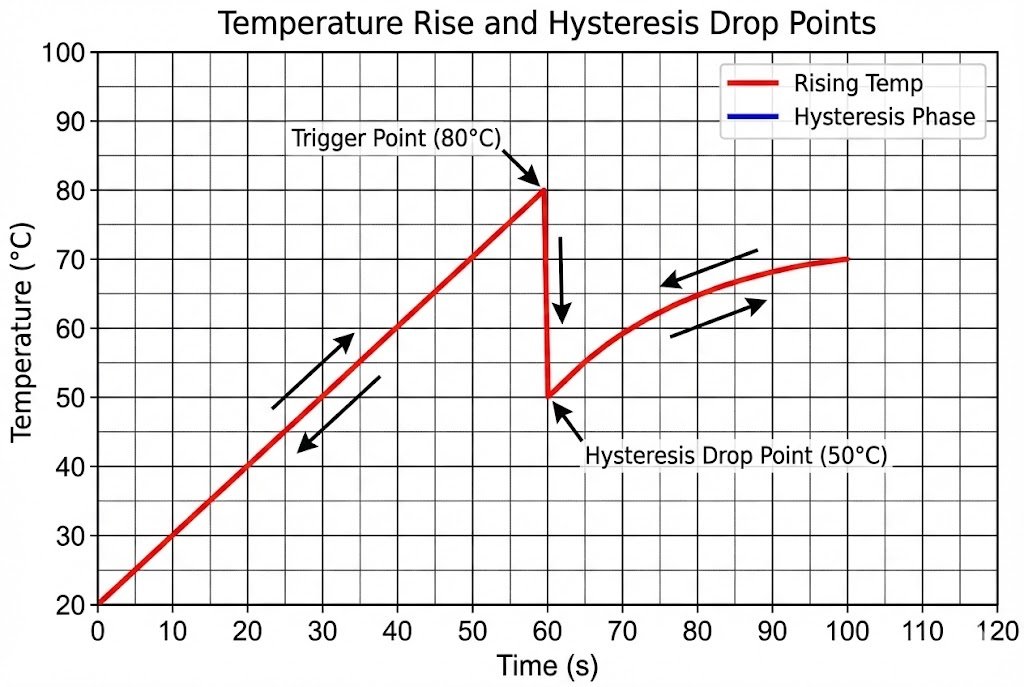
Let's look at the numbers because they matter. The Power Integrations (PI) LinkSwitch-PH family5, which includes the LNK413EG through LNK420EG, is very specific. The logic is built into the silicon. I like this because it does not rely on external parts that can fail.
The trigger point is 142°C. This is the temperature of the silicon die inside the package. When it hits this point, the MOSFET stops switching. The light goes off. But here is the clever part. It does not turn back on immediately. If it turned back on at 140°C, it would just overheat again in one second. That causes "strobing" or flickering. That is bad for the eyes and bad for the electronics.
Instead, it waits. It waits for the temperature to drop by 75°C. This is the "hysteresis4." The chip must cool down to roughly 67°C before it wakes up. This gives the heat sink time to dissipate the energy.
The Cycle of Protection
- Normal Run: Temperature rises slowly due to a blocked vent.
- Trip Point: Temp hits 142°C. Switching stops.
- Cooling Phase: The system rests. No power is generated.
- Reset Point: Temp drops to 67°C.
- Restart: The system tries to run again.
This "hiccup" mode saves the driver. It tells you something is wrong without destroying the hardware.
Why is smooth power reduction critical for safety lighting?
Imagine driving on a highway at night. Suddenly, the streetlights turn off because they got too hot. This is dangerous and unacceptable for municipal projects.
For safety lighting, total darkness is not an option. The LNK series allows for a protection mode that avoids permanent latch-off. While it stops switching to cool down, the recovery is automatic, ensuring the light returns without manual intervention.

I want to share a specific insight regarding this. Many cheap drivers use a "latch-off" thermal protection. This means if it gets too hot, the fuse blows or the circuit locks in the "off" position. To fix it, you have to cut the main power and turn it back on. For a street lamp, that is impossible. You cannot have a technician climb every pole just to reset a breaker.
The LNK413EG-LNK420EG series solves this. It uses auto-recovery6. But there is a deeper benefit. In some advanced designs using these chips, the thermal feedback7 can be used to reduce current before shutdown. However, even with the standard thermal shutdown I described above, the behavior is predictable.
Consider a tunnel light. If the ventilation fans fail, the tunnel gets hot. If the lights burn out, accidents happen. With the EG series, the lights might cycle (turn off, cool, turn on). While blinking is not perfect, it is better than permanent failure. It provides intermittent light and signals a problem.
Furthermore, this mechanism protects the electrolytic capacitors8. Capacitors hate heat. By stopping the switching at 142°C, the chip saves the capacitors from drying out. This extends the total life of the fixture. At Nexcir3, we tell our clients: "You are not just buying a chip; you are buying an insurance policy for your warranty." If your lights fail in 6 months, your brand is ruined. This protection keeps your brand safe.
How does the eSIP package improve heat dissipation?
The chip inside matters a lot. But the plastic case outside matters too. A bad package traps heat like a heavy winter coat in summer.
The eSIP-7C and eSIP-7F packages9 used in the EG series have a low thermal impedance10. They are designed to clip directly onto heat sinks. This physical connection pulls heat away from the silicon much faster than standard DIP or SOIC packages.
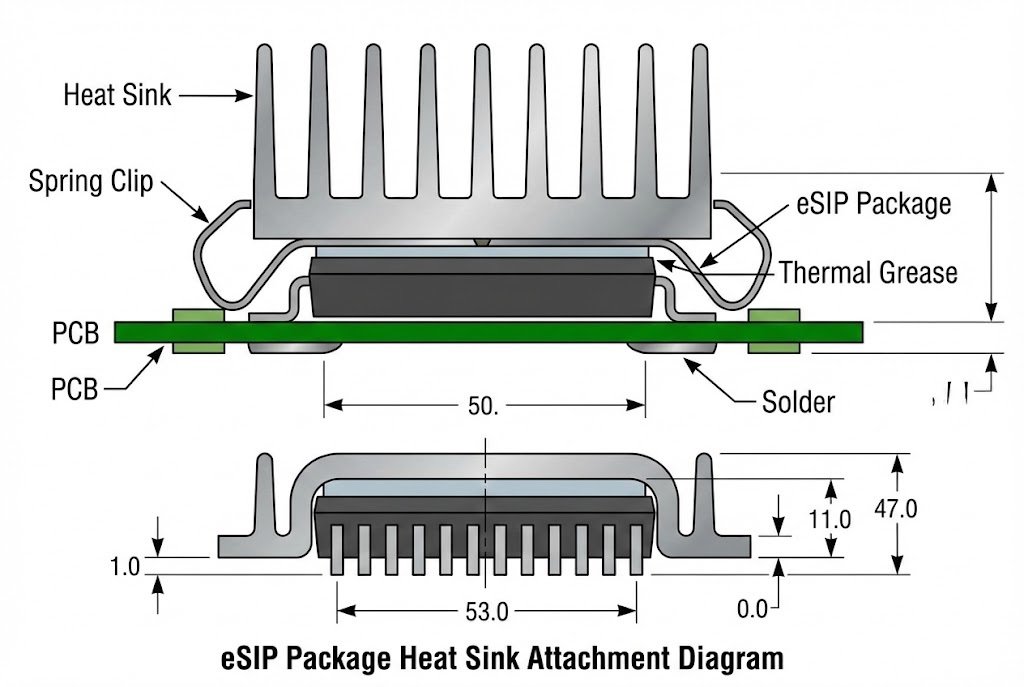
I often see engineers overlook the physical package. They look at the voltage and current ratings, but they ignore the "Rth" (Thermal Resistance). The LNK413EG to LNK420EG come in the eSIP package. This stands for "e-SIP" (Single Inline Package).
Why is this important? Because it is thin and has a metal interface. You can screw or clip this package tightly against a large metal heat sink.
The Thermal Path
- Source: The heat starts in the silicon junction.
- Path: It travels through the lead frame of the eSIP package.
- Exit: It moves into the external aluminum heat sink.
- Air: The heat sink dumps heat into the air.
Standard plastic packages (like DIP-8) rely mostly on the copper traces on the PCB to cool down. That is often not enough for high power. The eSIP package allows for a "low impedance" path. This means heat flows like water through a wide pipe, not a narrow straw.
At Nexcir3, we supply the mounting clips and thermal pads for these packages too. We know that if the physical connection is loose, the chip will overheat even if the design is good. The eSIP design makes it easy for assembly workers to get this right. It is robust. It handles vibration well. For industrial high-bay lights that sit near vibrating machinery, this physical stability is key.
Why choose the EG series over domestic discrete solutions11?
You can buy cheaper parts from local brands. But cheap parts often lack smart features. Is saving a few cents worth the risk of product recall?
Discrete solutions often require external temperature sensors and complex circuits to achieve similar protection. The LNK413EG-LNK420EG integrates this onto one chip. This reduces component count, increases reliability, and eliminates the variance found in cheaper, multi-part discrete designs.
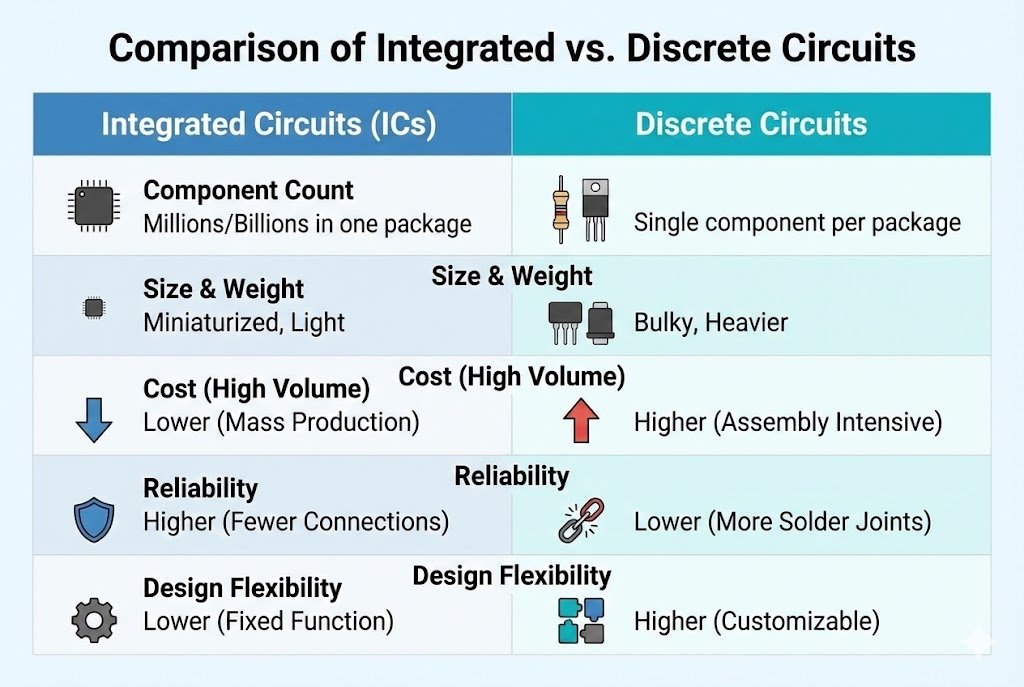
This is where my team and I spend a lot of time consulting. A customer will say, "I can build this driver using a cheap MOSFET and a controller for $0.50 less."
I tell them: "Yes, you can. But can you guarantee the thermal protection?"
To build the same level of safety with discrete parts (separate components), you need:
- A thermal resistor (NTC)12.
- A comparator circuit13.
- Extra resistors and capacitors to tune the hysteresis4.
Every extra part is a point of failure. If the NTC glue fails, protection is gone. If the soldering is bad, protection is gone. With the PI LNK series, the sensor is inside the silicon. It cannot fall off. It cannot be glued badly. It is calibrated at the factory.
The "Hidden" Cost of Discrete Solutions
Many domestic discrete solutions11 have wide tolerances. One batch might shut down at 130°C, the next at 150°C. This inconsistency is a nightmare for mass production. You want every streetlight to behave the same way.
Also, supply chain stability14 matters. Nexcir3 sources these PI parts globally. We ensure they are original. Fake chips often strip out the thermal protection to save die size. You might think you bought a protected chip, but you bought a time bomb. Using the genuine EG series from a trusted distributor like us ensures that the safety features described in the datasheet are actually present in the device.
In the long run, the integrated solution15 is cheaper. You save on PCB space. You save on assembly time. And most importantly, you save on warranty claims16.
Conclusion
The LNK413EG-LNK420EG prevents thermal runaway2 through hysteretic shutdown17. It ensures safety in outdoor lighting, outperforms discrete options, and simplifies thermal management for engineers.
Understanding this mechanism helps in choosing LED drivers that prevent overheating and ensure continuous operation. ↩
Learn about the dangers of thermal runaway and how it can lead to early failure of LED systems. ↩
Nexcir provides expertise and reliable components for effective LED driver thermal management. ↩
Hysteresis is crucial for preventing rapid on-off cycles that can damage LEDs. ↩
Explore the features of this chip family to understand its role in preventing LED overheating. ↩
Auto-recovery allows LED drivers to resume operation after cooling, avoiding manual resets. ↩
Thermal feedback can reduce current before shutdown, preventing overheating in LED systems. ↩
Proper thermal management prevents capacitor overheating, extending their lifespan. ↩
These packages enhance heat dissipation, crucial for maintaining LED driver performance. ↩
Low thermal impedance ensures efficient heat transfer, preventing overheating in LED drivers. ↩
Discrete solutions can be inconsistent and unreliable, leading to potential failures. ↩
NTCs are used in discrete solutions for temperature sensing, but they can be unreliable. ↩
Comparator circuits are part of discrete solutions, but they add complexity and potential failure points. ↩
Stable supply chains ensure the availability of genuine components, preventing counterfeit risks. ↩
Integrated solutions offer reliability and consistency, reducing the risk of thermal failure. ↩
Effective thermal management prevents failures, reducing the need for costly warranty claims. ↩
This shutdown method prevents overheating by allowing the system to cool before restarting. ↩