Do you struggle to choose between a potentiometer and a variable resistor1? The wrong choice can ruin your circuit. I will help you understand the exact differences today.
A potentiometer is a three-terminal device2. It divides voltage3. It controls signal levels. A variable resistor1 uses only two terminals. It adjusts current flow4 in a circuit. Your choice depends on your goal. You must decide to manage voltage or limit current.
I remember a specific project from a few years ago. A hardware engineer came to my office at Nexcir. He was very upset. His team was building a new industrial control panel5. They needed to control the speed of a heavy motor6. The engineer picked a standard component from a catalog. He thought all adjustable resistors were the same. He wired it up. He turned on the power. The component caught fire in three seconds. He almost ruined the whole prototype board. He asked me about his mistake. I looked at his schematic. He used a tiny potentiometer. He needed a heavy variable resistor1. He did not know the difference between the two parts. That simple mistake cost him a week of work. It also cost him money in burnt parts7. I have worked in the electronic components industry for over twenty years. I see this exact mistake all the time. Buyers want to save money. They buy cheap potentiometers for power circuits. This always ends badly. Counterfeit parts make the problem worse. A fake part will burn even faster. At Nexcir, we only supply authentic parts. We want to protect your projects. We want to protect your budget. I sat down with the engineer. We looked at the datasheets8 together. We found the right original component from our trusted supply chain9. I want to share this lesson with you. We will look closely at these two components. You will never burn your boards again.
What are the core differences between a potentiometer and a variable resistor1?
Do you get confused by the names? Misunderstanding these parts causes big design flaws. I will show you the basic physical differences and functional differences right now.
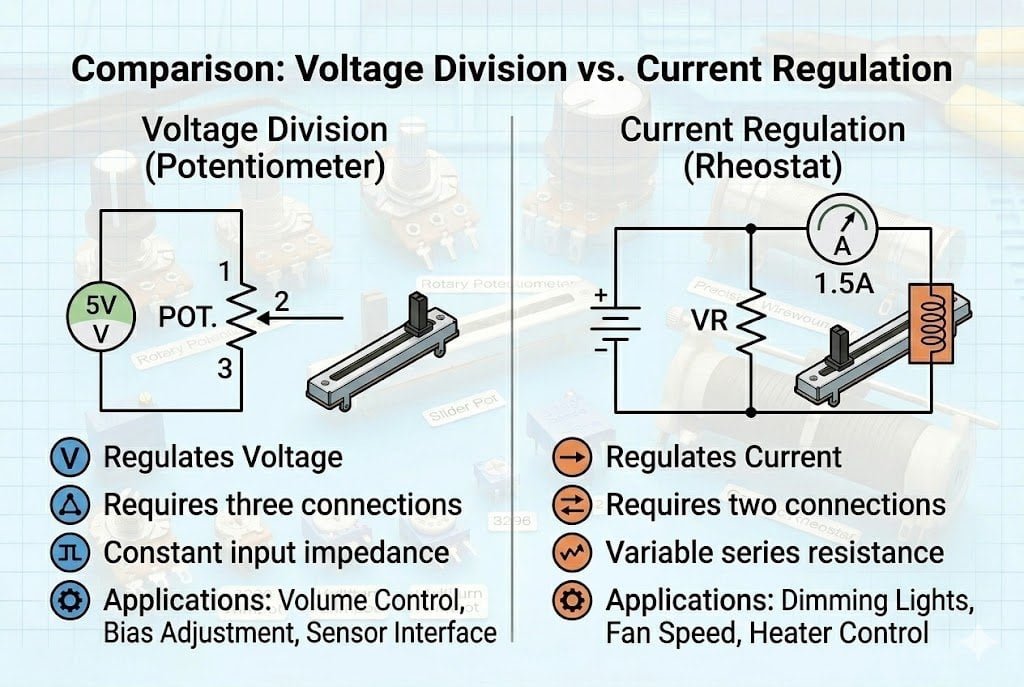
The main difference is the terminal count10. Potentiometers have three terminals. They act as voltage dividers11. Variable resistors use two terminals. They act as current limiters12. Potentiometers handle low power. Variable resistors handle high power and heavy currents.
Physical Build Differences
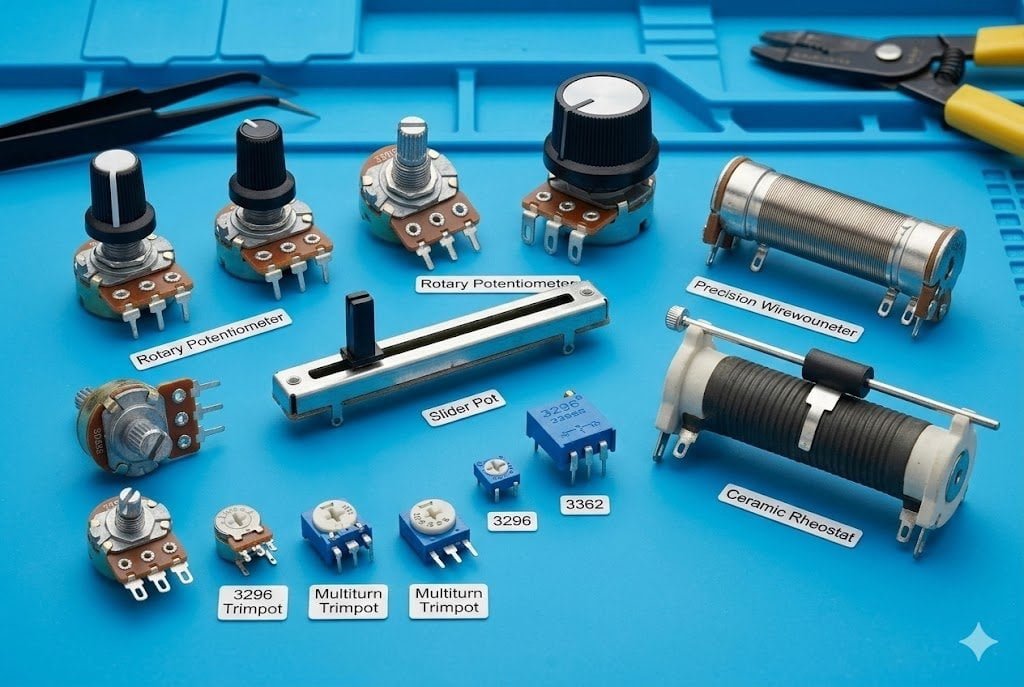
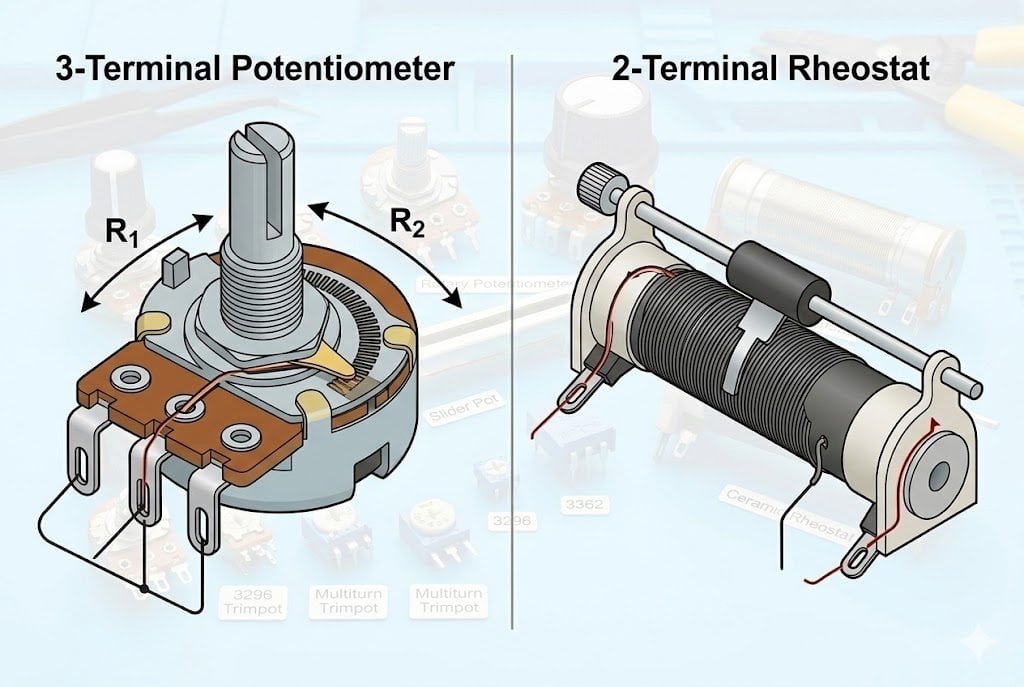
Potentiometers and variable resistor1s look very similar on the outside. But they have very different parts inside. A potentiometer has a thin resistive track. It uses carbon or conductive plastic. It has two fixed ends. A moving wiper slides across this track. This design gives you three connection points. A variable resistor1 is much simpler. People also call it a rheostat. It uses thick wire. The wire wraps around a ceramic core. It usually has only two connections. One connection goes to a fixed end. The other connection goes to the moving wiper.
Power Rating Differences
The internal materials dictate the power rating13. Potentiometers handle very small amounts of power. They usually handle less than one watt. Their thin tracks will melt under heavy loads. Variable resistors handle high power. They can handle tens of watts. They can even handle hundreds of watts. Their thick wires and ceramic bodies absorb a lot of heat safely. Engineers must check the datasheet before buying. The datasheet shows the exact physical limits. It shows the maximum voltage. It shows the maximum current. You must read these numbers. You must trust the numbers from authorized distributors. We provide these datasheets8 to all our clients. We want you to succeed.
Common Use Cases
I see customers use these parts for different jobs. Customers buy potentiometers for user interfaces14. They use them for volume knobs on radios. They use them for joystick controls. These jobs need fine control of small signals. Customers buy variable resistor1s for power control. They use them to dim bright room lights. They use them to change motor speeds15. These jobs need tough parts. The parts must handle big currents.
| Feature | Potentiometer | Variable Resistor |
|---|---|---|
| Terminals | Three | Two |
| Main Function | Divides voltage | Limits current |
| Power Rating | Very low | Very high |
| Internal Material | Carbon or plastic | Thick wire and ceramic |
| Common Use | Audio knobs and sensors | Motor speeds and light dimmers |
How do three-terminal and two-terminal connection16s change circuit logic?
Bad wiring leads to failed tests. It wastes your time and money. I will explain the exact logic behind these terminal connections. You can fix this problem today.
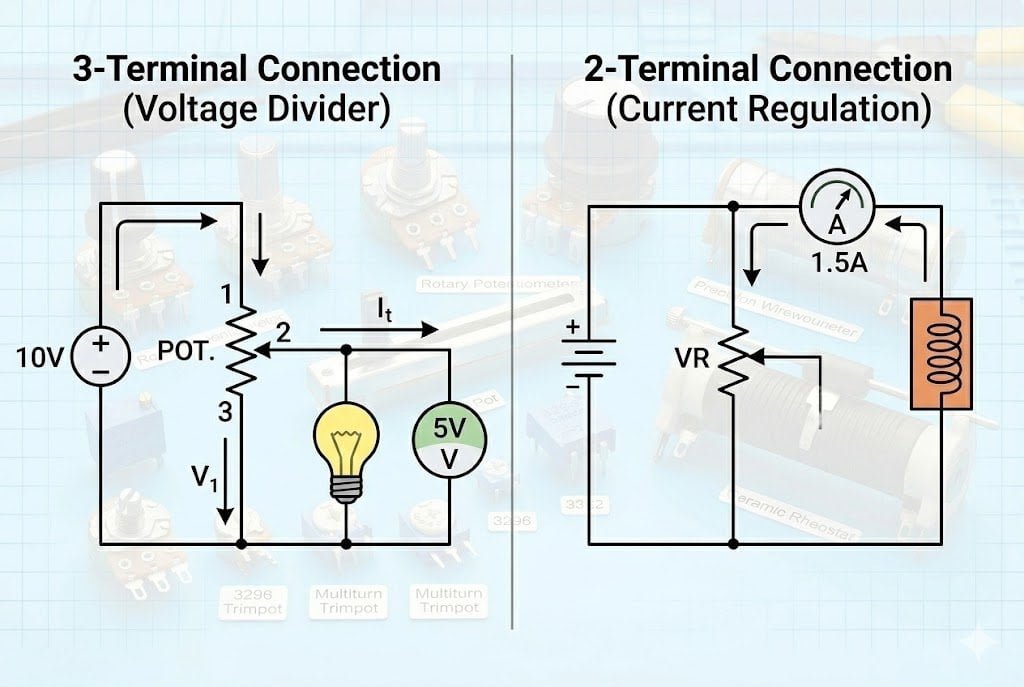
A three-terminal connection17 acts as a voltage divider. It outputs a fraction of the input voltage. A two-terminal connection16 sits in series with the load. It restricts electron flow. One connection changes the potential difference. The other connection changes the current volume.
The Logic of Three Terminals
A three-terminal setup is a voltage divider. You connect the two fixed ends across your power source. The full voltage drops across the whole track. The wiper acts like a tap. It picks off a fraction of that voltage. You move the wiper up. The output voltage goes up. You move the wiper down. The output voltage goes down. The logic here is simple. The total resistance of the component stays exactly the same. The power source always sees a steady load. Only the output signal changes. I always tell my customers to use this logic for microcontrollers. Microcontrollers need steady reference voltages. They use these voltages to read sensors correctly.
The Logic of Two Terminals
A two-terminal setup is a current limiter. You connect it in series with your main load. The electricity must flow into the wiper. The electricity flows out of one fixed end. You move the wiper. You change the length of the track in the circuit. This changes the total resistance of the whole circuit. More resistance means less current flows. Less resistance means more current flows. The logic here is about blocking flow. The power source sees a changing load. The voltage across your load will also change as a result.
Comparing the Circuit Impact
These two logics impact your circuit differently. A three-terminal connection17 protects your power supply from sudden changes. A two-terminal connection16 directly forces the power supply to push harder. It forces the power supply to push softer. You must understand this logic for good design. Good design saves money. Good design prevents failures in the field. Your customers want reliable products. They do not want broken devices. You give them reliable products with good logic. We support your good logic with reliable parts.
| Circuit Logic | Three-Terminal Connection | Two-Terminal Connection |
|---|---|---|
| Primary Goal | Change output voltage level | Change total circuit current |
| Total Resistance | Stays constant | Changes constantly |
| Power Supply Load | Stable | Variable |
| Component Placement | Parallel to power source | Series with the load |
| Best Application | Signal processing | Power delivery |
Which component wins in voltage division18 and current regulation19?
Do your circuits suffer from unstable power? Bad component choices cause these drops. I will break down the pros and cons of each part. You will choose correctly.
Potentiometers win at voltage division18. They provide a smooth voltage output without breaking the circuit. Variable resistors win at current regulation19. They handle the heat and stress perfectly. They limit high currents directly in line with your heavy load.
Pros and Cons in Voltage Division
Voltage division circuits need exact outputs. They need steady outputs. Potentiometers are the clear winners here. Their biggest pro is a smooth output. Their output is proportional. You get exactly what you expect. Another pro is cost. They are very cheap to make. But they have a big con. They are fragile. You cannot pull much current from the wiper. Your load might try to draw too much power. The voltage will drop. The wiper might also burn out. I always advise my OEM clients to use a buffer amplifier. They need a buffer amplifier to draw power from a potentiometer.
Pros and Cons in Current Regulation
Current regulation circuits need tough parts. They need durable parts. Variable resistors are the best choice for this job. Their biggest pro is heat tolerance. They survive harsh industrial environments. They handle big power spikes without failing. But they also have cons. Their biggest con is inefficiency. They limit current. They turn electrical energy into heat. This wastes battery life. It also makes your device hot. Another con is size. They are bulky. They take up a lot of space on a circuit board.
Sourcing the Right Component
At Nexcir, we help you avoid these cons. We source original parts. We help you find the exact power rating13. We make sure you get authentic components. These components will not fail under pressure. Counterfeit parts often have fake power rating13s. A fake variable resistor1 will fail. It fails just like a small potentiometer. We protect you from that risk. You must balance these pros and cons. Every project has a budget. Every project has physical limits. You must choose the best compromise. We help you find that compromise. We offer flexible service models. We offer competitive pricing. We deliver the right parts on time.
| Application | Best Component | Major Pros | Major Cons |
|---|---|---|---|
| Voltage Division | Potentiometer | Smooth output and low cost | Fragile and low power limit |
| Current Regulation | Variable Resistor | Tough and handles high heat | Bulky and wastes power |
| Signal Control | Potentiometer | Precise and easy to turn | Cannot drive heavy loads |
| Motor Control | Variable Resistor | Safe under heavy load | Inefficient for batteries |
Conclusion
Potentiometers control voltage with three terminals. Variable resistors control current with two terminals. You must choose wisely. The right choice keeps your circuits safe, stable, and running perfectly.
Discover the applications of variable resistors to optimize current flow in circuits. ↩
Understanding three-terminal devices helps in selecting components for voltage control in circuits. ↩
Learn how voltage division works to ensure precise control in electronic applications. ↩
Explore how current flow adjustment can enhance circuit performance and prevent overloads. ↩
Find out how these components are crucial for controlling machinery in industrial settings. ↩
Learn why variable resistors are essential for managing the power requirements of heavy motors. ↩
Understand the reasons behind component failure to prevent costly damage in circuits. ↩
Learn how datasheets provide critical information for selecting the right components. ↩
Explore how reliable supply chains prevent failures and ensure authentic parts. ↩
Understand how terminal count affects the functionality and application of components. ↩
Learn about voltage dividers to enhance your circuit design and signal processing. ↩
Discover how current limiters protect circuits from excessive current and potential damage. ↩
Understand the importance of power rating to prevent overheating and ensure component longevity. ↩
Explore the role of potentiometers in providing precise control in electronic devices. ↩
Learn how variable resistors are used to adjust motor speeds for optimal performance. ↩
Explore the impact of two-terminal connections on circuit design and current regulation. ↩
Understand the logic of three-terminal connections to improve circuit stability and performance. ↩
Learn the advantages and limitations of potentiometers in voltage division applications. ↩
Discover how variable resistors provide effective current regulation in high-power applications. ↩