Your power supply units might be overheating or losing energy because of a single, small component choice. Are you struggling with low efficiency or thermal issues in your latest circuit designs? This is a common pain point.
Schottky diodes1 (like SS342) provide low forward voltage drops3 for low-voltage efficiency, while Fast Recovery diodes4 (like FR1075) handle high voltages with quick switching speeds. You must choose Schottky for low-voltage output rectification and Fast Recovery for high-voltage input stages6.
I have seen many projects fail simply because the procurement team or the design engineer picked the wrong type of rectifier. We need to look closely at the details to save your project time and money.
What defines the core difference between Schottky and Fast Recovery Diodes?
You cannot swap these two components without risking the safety of your entire power supply unit. I know how confusing the datasheets can look at first glance.
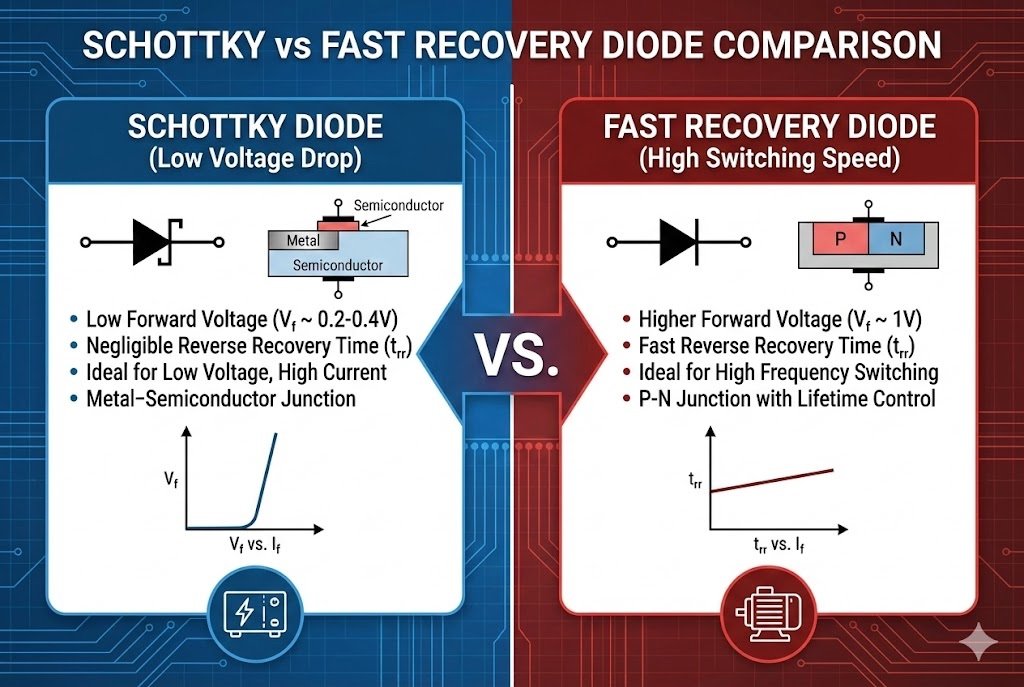
Schottky diodes1 use a metal-semiconductor junction to achieve fast switching and low voltage drop but have higher leakage current7. Fast Recovery diodes4 use a P-N junction, allowing them to block high voltages but creating a larger voltage drop.
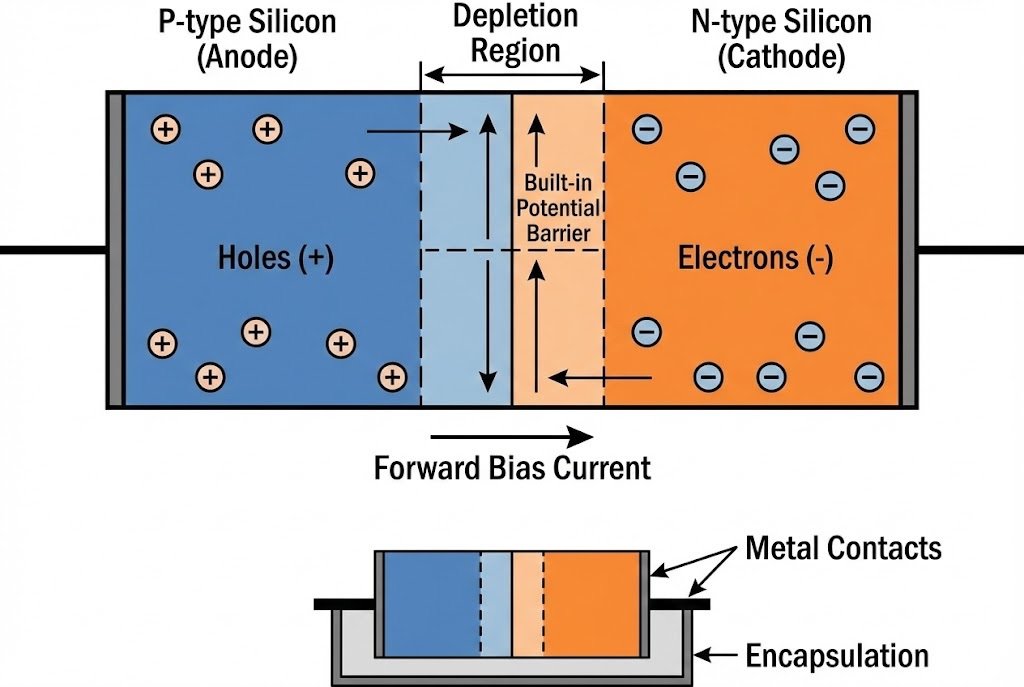
Let me break this down further based on my experience at Nexcir. The fundamental difference lies in the materials used inside the chip. A standard Fast Recovery diode is made like a traditional valve; it is strong but takes a bit of force to push open. This "force" is the Forward Voltage Drop8 ($V_f$).
On the other hand, a Schottky diode is like a lightweight flap. It opens very easily, meaning you lose less energy pushing it open. However, because it is so light, it cannot hold back a huge amount of pressure (Voltage).
Here is a simple breakdown of how these differences look in numbers:
| Feature | Schottky Diode | Fast Recovery Diode |
|---|---|---|
| Junction Type | Metal-Semiconductor | P-N Junction |
| Forward Voltage ($V_f$) | Low (0.2V - 0.5V) | High (0.8V - 1.5V) |
| Reverse Voltage ($V_r$) | Low (usually < 200V) | High (up to 1000V+) |
| Switching Speed ($t_{rr}$) | Extremely Fast (ns) | Fast (hundreds of ns) |
| Main Drawback | High Leakage Current | Higher Heat Generation |
When I help clients source components, I ask them to look at the "Barrier." The Schottky barrier is great for speed and efficiency, but it leaks current when it gets hot. The Fast Recovery P-N junction is robust. It creates more heat when current flows through it, but it effectively stops current from flowing backward, even at high voltages. Understanding this trade-off is the first step to optimizing your supply chain and design.
How do the SS342 and FR1075 compare in practical power supply designs?
We frequently ship these two specific model numbers to our OEM clients for very different purposes. Using the SS342 in the place of an FR1075 will likely cause an immediate explosion.
The SS342 is a 3A/40V Schottky diode ideal for the low-voltage output side of buck converters. The FR1075 is a 1A/1000V Fast Recovery diode designed for high-voltage input rectification or snubber circuits.
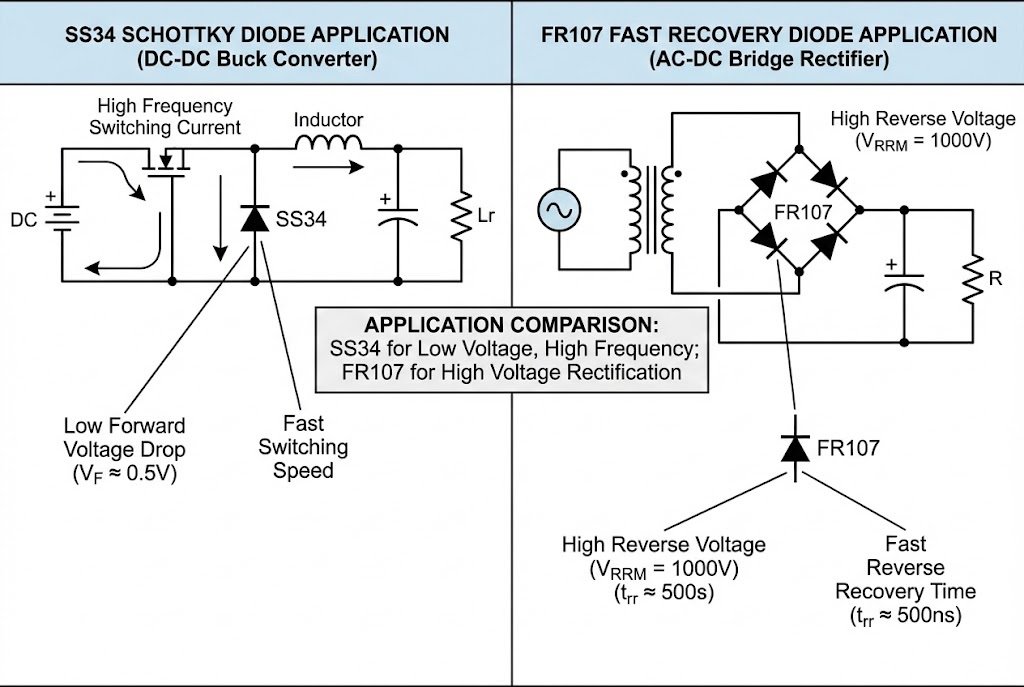
I want to dive deep into these two specific part numbers because they represent the standard choice for many of our customers.
First, look at the SS342. This is an SMD (Surface Mount Device) component.
- Current: 3 Amps.
- Voltage: 40 Volts.
- Use Case: You will find this on the output side of a switching power supply. For example, if you are converting 12V down to 5V for a USB charger, the SS342 is the correct choice. Its low resistance means it does not get too hot even when 3 Amps are flowing through it. It saves battery life in portable devices.
Now, look at the FR1075. This is usually an Axial (leaded) component, though SMD versions exist.
- Current: 1 Amp.
- Voltage: 1000 Volts.
- Use Case: You see this on the input side, right where the AC power comes from the wall, or in "flyback" circuits. The voltage here can spike very high. A Schottky like the SS342 would fail instantly because it cannot handle 1000V.
If you use an FR1075 on the 5V output side, it will work, but it is wasteful. The high voltage drop (around 1.3V) means that if you pull 1 Amp, you are wasting 1.3 Watts of power just as heat. That is huge for a small device. Conversely, if you put an SS342 on the input side, the 220V/110V mains power will destroy it immediately.
At Nexcir, we ensure that when you request an "equivalent" or "alternative," we match these critical parameters. We do not just look at the price; we look at where the part goes on the board.
When should you prioritize Reverse Recovery Time9 over Forward Voltage Drop8?
High-frequency power supplies are shrinking in size, and this makes the timing of your diode critical. Do you know if your switching loss10 is higher than your conduction loss11?
Prioritize Reverse Recovery Time%%%FOOTNOTE_REF9%%% ($t{rr}$) when your switching frequency exceeds 100kHz to reduce switching loss10es. Prioritize Forward Voltage Drop8 ($V_f$) for high-current, low-voltage outputs to minimize conduction loss11es.
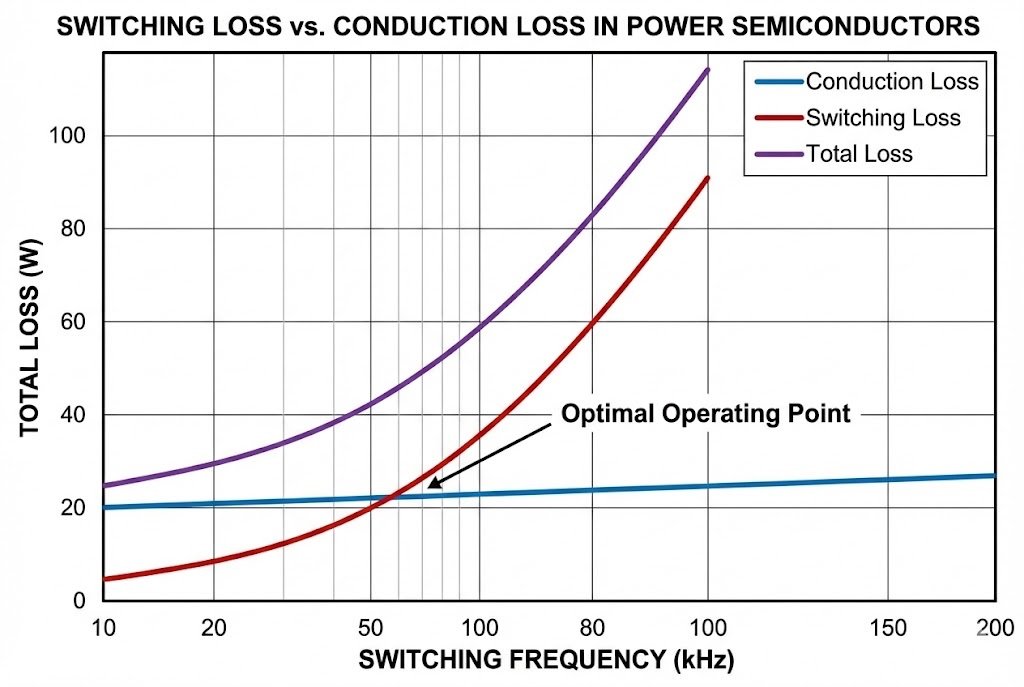
This is where critical thinking applies to component selection12. You have two main enemies in power electronics: Conduction Loss and Switching Loss.
1. Conduction Loss (Related to $V_f$) This happens when the diode is "ON".
- Formula: Power Loss = Current ($I$) × Forward Voltage ($V_f$).
- Scenario: If your device runs at a high current (like 5A or 10A) but a low frequency, the diode stays "ON" for a long time. Here, a low $V_f$ (Schottky) is the king. Even a small drop from 0.7V to 0.4V saves a massive amount of heat.
2. Switching Loss (Related to $t_{rr}$) This happens when the diode turns from "ON" to "OFF".
- Scenario: If your power supply switches ON and OFF 200,000 times per second (200kHz), the time it takes to close the valve matters.
- The Problem: A standard diode does not stop current instantly. It lets a little bit of current flow backward for a split second. This is the Reverse Recovery Time%%%FOOTNOTE_REF9%%% ($t{rr}$).
- The Impact: If $t_{rr}$ is too slow, the diode fights against the rest of the circuit every time it switches. This creates massive heat spikes.
So, here is my rule of thumb for procurement:
- Low Voltage / High Current: Buy Schottky. The $V_f$ is the priority.
- High Voltage / High Frequency: Buy Fast Recovery (or Ultra-Fast Recovery). The $t_{rr}$ is the priority.
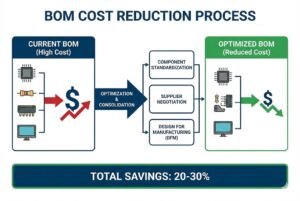
We help our clients analyze their Bill of Materials (BOM)%%%FOOTNOTE_REF13%%%. Sometimes, paying a few cents more for a diode with a better $t{rr}$ specification can save dollars on heat sinks and cooling fans later.
How does diode selection impact thermal management14 and total system cost?
Heat sinks are expensive, heavy, and take up valuable space in your product enclosure. What if the right diode choice could eliminate the need for extra cooling?
Lower forward voltage reduces heat generation, allowing for smaller PCBs and removing heat sinks. This lowers the Bill of Materials (BOM)13 cost and increases the lifespan of the power supply unit.
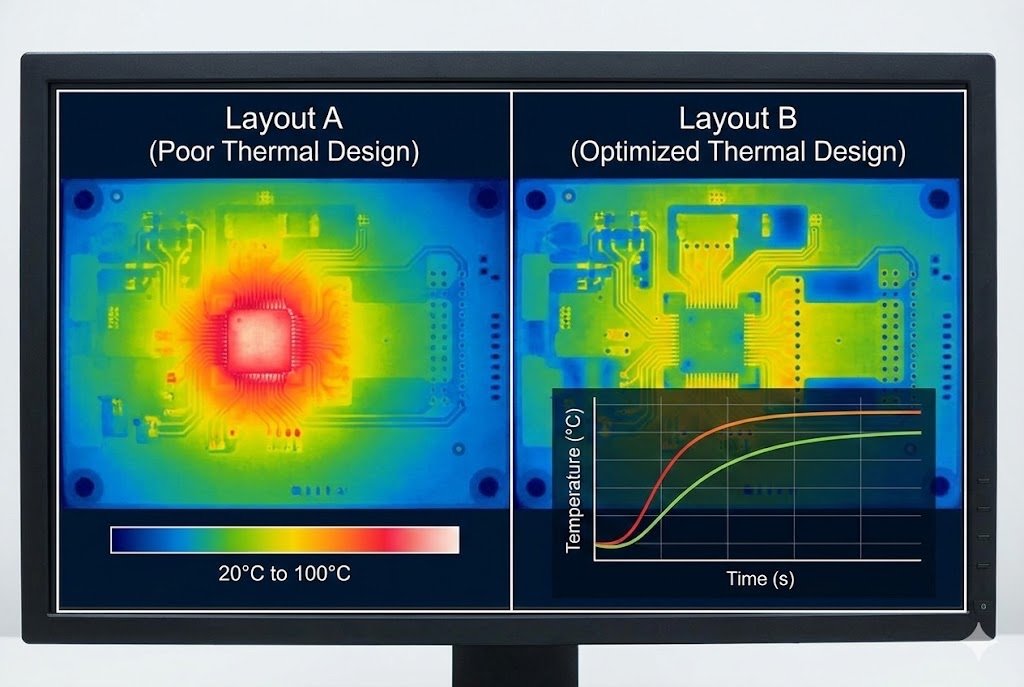
Thermal management is often an afterthought, but it should be a primary concern during component sourcing. I want to explain the "hidden costs" of choosing the wrong diode.
If you choose a cheap Fast Recovery diode with a high voltage drop for a high-current application, you generate excess heat.
- Result 1: You need a larger heat sink. This adds weight and cost.
- Result 2: You need a fan. Fans have moving parts and are the first thing to break.
- Result 3: The PCB material degrades faster over time due to thermal stress.
The Risk of Thermal Runaway There is a specific risk with Schottky diodes1 that you must know. As a Schottky diode gets hot, its leakage current7 increases. This increased leakage creates more heat. This loop continues until the component fails. This is called "Thermal Runaway."
To prevent this, you need high-quality components.
- Authenticity Matters: Cheap, counterfeit Schottky diodes1 often have poor thermal resistance. They might look like an SS342, but the die inside is smaller and cannot handle the heat.
- Nexcir's Approach: We only source from authorized distributors and original manufacturers. We ensure the datasheet thermal ratings are real.
When we supply components, we look at the Total Cost of Ownership15. A slightly more expensive, high-efficiency diode16 from a reputable brand like Onsemi, Vishay, or Diodes Inc. is cheaper than recalling a product because it overheated. We help you balance the electrical efficiency with the thermal reality of your product design.
Conclusion
Choosing between Schottky (SS342) and Fast Recovery (FR1075) diodes depends on your voltage requirements and switching frequency. Correct selection improves efficiency, reduces heat, and ensures your power supply lasts longer.
Explore the benefits of Schottky diodes for low-voltage applications and their efficiency in circuit designs. ↩
Get detailed information on the SS34 diode and its ideal use cases in power supply designs. ↩
Understand how low forward voltage drops can enhance efficiency in power supply units. ↩
Learn about Fast Recovery diodes and their role in handling high voltages with quick switching speeds. ↩
Explore the specifications of the FR107 diode and its applications in high-voltage circuits. ↩
Discover effective strategies for managing high-voltage input stages in power supply designs. ↩
Investigate the factors contributing to leakage current and its impact on diode performance. ↩
Gain insights into the significance of Forward Voltage Drop in optimizing diode efficiency. ↩
Learn about Reverse Recovery Time and its critical role in high-frequency power supply applications. ↩
Find out effective methods to reduce switching loss in power electronics for better efficiency. ↩
Understand conduction loss and its implications for the efficiency of power supply units. ↩
Learn about the critical factors in selecting components that optimize power supply performance. ↩
Understand the importance of BOM in selecting components that optimize cost and performance. ↩
Explore thermal management techniques to enhance the reliability and efficiency of power supply units. ↩
Discover how Total Cost of Ownership can influence component selection and overall project success. ↩
Discover the advantages of high-efficiency diodes and their impact on overall system performance. ↩