leading paragraph: You buy TNY287 chips, but your production line still reports failures. You check the specs, and everything looks fine. Why are your boards failing in the field?
snippet paragraph: The "PG" suffix in TNY287PG1 represents a DIP-8C package2 with a specifically missing pin. This design increases the creepage distance3 for the high-voltage Drain pin4. It prevents electrical arcing5 in humid environments, significantly improving production yield and long-term reliability compared to standard packages.
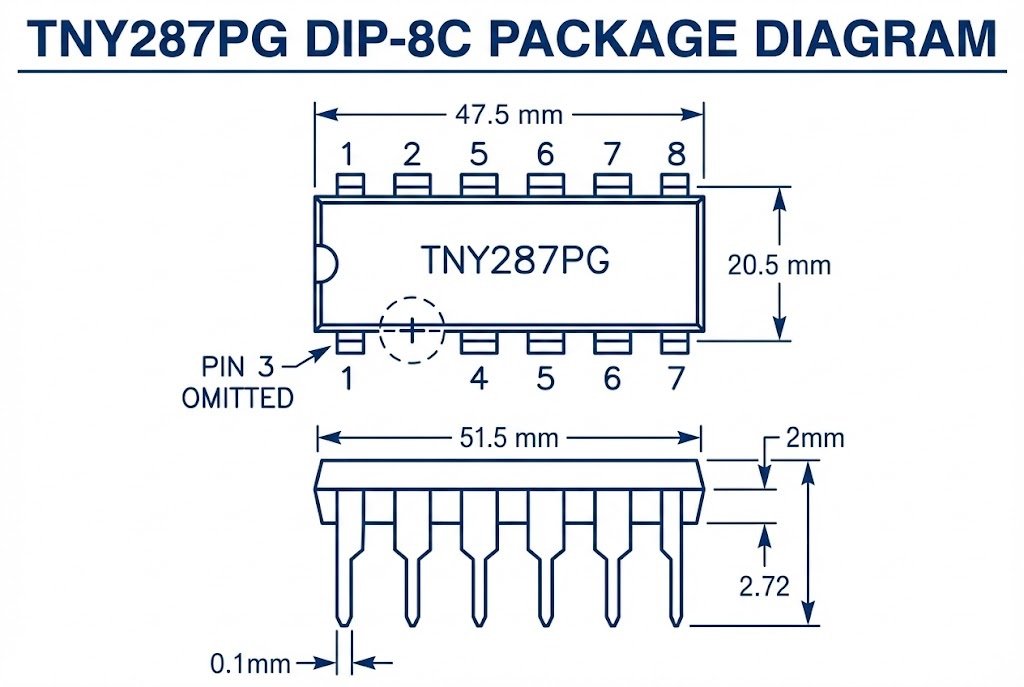
Transition Paragraph: I often see clients confused by this small detail. They think all DIP-8 chips look the same and act the same. This is a dangerous mistake. I have seen production lines stop because of this misunderstanding. I will explain why this small suffix matters so much for your business.
leading paragraph: You see a gap where a pin should be on the chip. Is it a defect? No, it is a crucial safety feature that protects your circuit.
snippet paragraph: The TNY287PG1 uses the DIP-8C package2. It intentionally omits pin 3. This increases the physical distance between the high-voltage pin and low-voltage pins. This extra space prevents high-voltage sparks from jumping across the gap on the PCB.
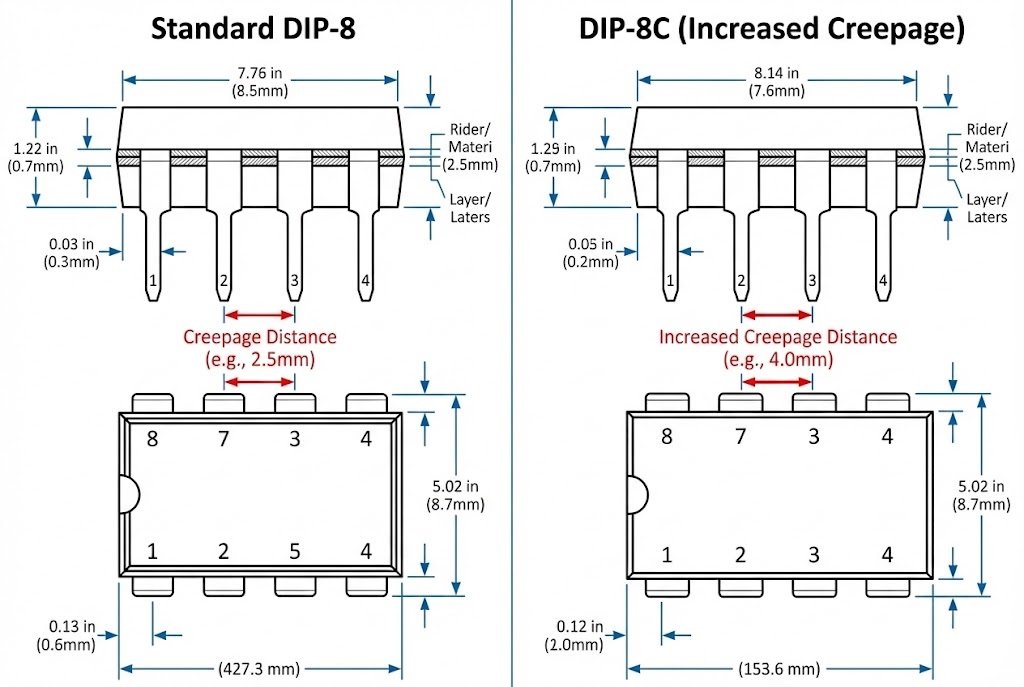
Dive deeper Paragraph: I want to look closely at the physics here. The TNY287PG1 contains a 700V power MOSFET6. This is a very high voltage. In a standard DIP-8 package, the pins are very close together. The standard distance is often 2.54mm between pin centers. This is usually fine for low voltage. But for 700V, this space is dangerous. If the voltage jumps across the gap, your board burns.
The engineers at Power Integrations created the DIP-8C package2 to solve this. They removed Pin 3. This is the pin between the Source and the Drain. By taking this pin out, they doubled the distance across the package surface. This distance is called "creepage."
I always tell my engineering clients to measure this. You cannot cheat physics. If you use a standard package for high voltage, you risk failure. The TNY287PG1 guarantees a creepage distance3 that meets strict safety standards. This is not just about fitting the chip on the board. It is about keeping the high voltage inside the chip where it belongs.
Key Differences in Package Types
| Feature | Standard DIP-8 | TNY287PG1 (DIP-8C) |
|---|---|---|
| Pin Count | 8 Pins | 7 Pins (Pin 3 removed7) |
| Pin Spacing | Standard 2.54mm | Increased at High Voltage Node |
| Creepage Distance | Small | Large (> 3mm effective) |
| High Voltage Safety | Moderate | Excellent |
How does humidity kill your control boards without the right package?
leading paragraph: Your product works in the lab but fails in real homes. High humidity is often the silent killer of sensitive electronic components.
snippet paragraph: In applications like air conditioner control boards, moisture and dust build-up create conductive paths8. The TNY287PG1's wider pin spacing breaks these paths. This specific packaging prevents arcing, which causes short circuits and permanent board damage in the field.
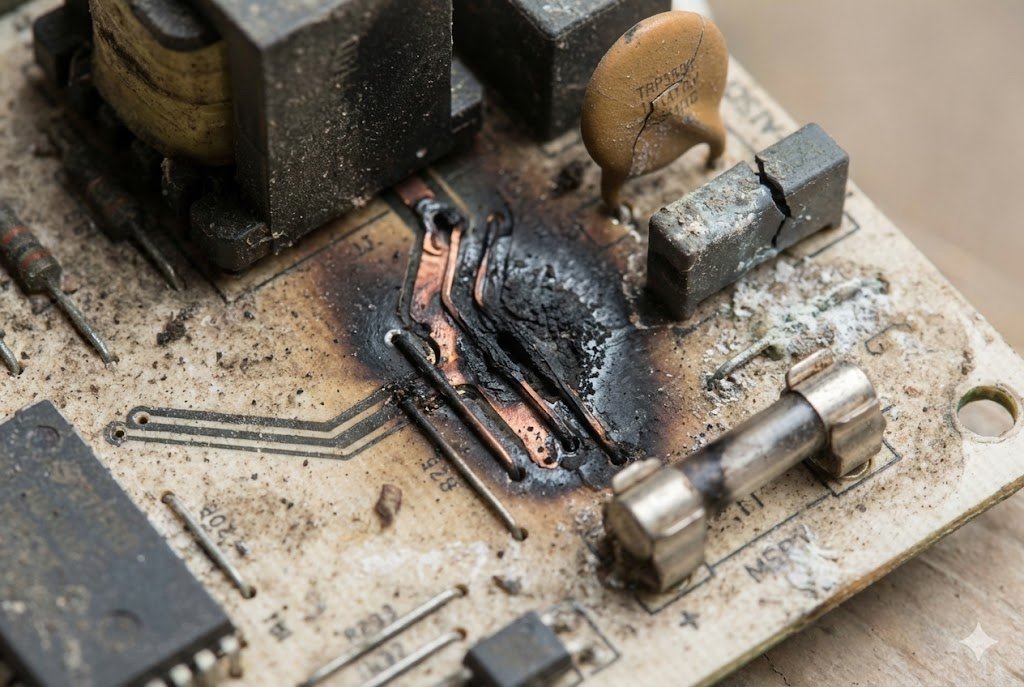
Dive deeper Paragraph: I remember a client who made air conditioners. They had a huge problem. Their units worked fine in the factory. But after six months in a customer's home, the power supply would explode. They blamed the chip manufacturer. I looked at their design. They were using a generic controller9 with standard spacing.
Here is what happens in the real world. Air conditioners create moisture. Dust also settles on the PCB. When you mix dust and water, you get a conductive layer. This is not a perfect wire, but it can carry electricity. This layer sits on the surface of the chip package.
If you use the TNY287PG1, the distance between the high-voltage Drain and the other pins is large. The conductive path of dust and water has to be very long to cause a short. But with a standard package, that path is short. The 700V inside the chip easily jumps across the wet dust. This is called "tracking" or "arcing." It creates a carbon path. Once carbon forms, the chip is dead. The TNY287PG1 is specifically designed to stop this. It breaks the path. This is why the "PG" suffix is mandatory for appliances like washing machines and AC units.
Environmental Impact on Component Choice
- Dry Environment: Standard spacing might work, but safety margin is low.
- Humid Environment: Moisture lowers the resistance of the PCB surface.
- Dusty Environment: Dust absorbs moisture and becomes conductive.
- The Solution: Increased physical distance (DIP-8C) is the only passive defense against these environmental factors.
Is saving money on generic packages actually costing you more?
leading paragraph: You find a cheaper alternative without the "PG" suffix. It saves a few cents now, but it creates a financial disaster later.
snippet paragraph: Buying the wrong package increases the defect rate. Returns, repairs, and lost reputation cost far more than the price difference of the chip. True cost efficiency10 comes from selecting the correct, application-specific package like the TNY287PG1 from the start.
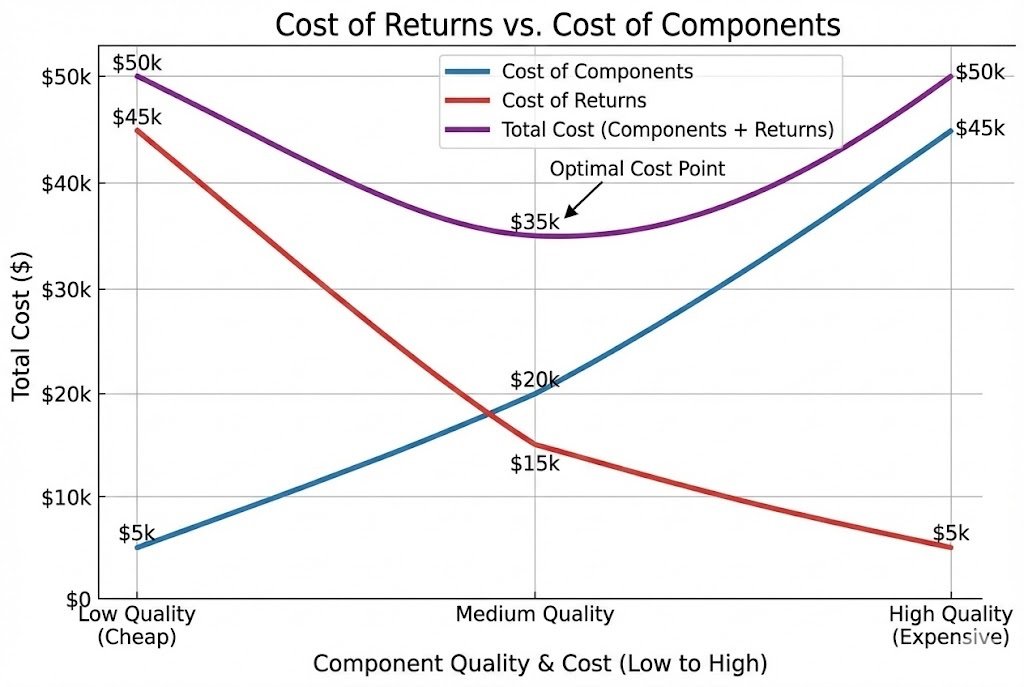
Dive deeper Paragraph: I know procurement managers are under pressure. You need to cut costs. You might see a supplier offering a "compatible" chip that is cheaper. It might look the same. It might even function when you plug it in. But if it lacks the proper creepage distance3 of the TNY287PG1, you are buying a time bomb.
Let's look at the numbers. You save $0.05 on a chip. You make 10,000 boards. You save $500. That sounds good. But because you chose the wrong package, your failure rate in humid areas goes up by 2%. That is 200 failed units.
Each return costs you shipping, labor, and a new board. That might be $100 per unit. 200 units times $100 is $20,000. You saved $500 to lose $20,000. This is bad math.
At Nexcir11, we help you avoid this. We check the part numbers. We make sure you get the TNY287PG1 with the correct DIP-8C package2. We source only from authorized channels. We ensure the lead frame inside matches the spec. We do not just sell parts; we sell the assurance that your product will last. Do not let a small price difference on a BOM destroy your profit margin.
The Real Cost of "Cheap" Alternatives
- Procurement Phase: Generic parts look cheaper on the invoice.
- Production Phase: Yield drops due to testing failures (Spark gaps).
- Field Phase: High returns due to environmental stress12 (Humidity).
- Brand Phase: Customers lose trust in your reliability.
Conclusion
The TNY287PG1 is not just a part number; it is a safety solution. Choose the right package to stop arcing, save money, and keep customers happy.
Understanding the specific advantages of the TNY287PG can help ensure your electronic designs are reliable and safe. ↩
Learn about the DIP-8C package to understand its role in preventing electrical failures in high-voltage applications. ↩
Explore why maintaining proper creepage distance is crucial for preventing electrical arcing and ensuring circuit safety. ↩
Discover how the high-voltage Drain pin impacts the design and reliability of electronic circuits. ↩
Understanding the causes of electrical arcing can help in designing circuits that are safe and reliable. ↩
Learn about the applications and benefits of using a 700V power MOSFET in high-voltage electronic designs. ↩
Find out the significance of removing Pin 3 in the TNY287PG package and its impact on circuit safety. ↩
Understanding how conductive paths form can help in designing PCBs that resist environmental damage. ↩
Understand the potential risks and drawbacks of using generic controllers in electronic designs. ↩
Discover how selecting the correct package can lead to long-term cost savings and product reliability. ↩
Find out how Nexcir can assist in sourcing reliable electronic components and ensuring product longevity. ↩
Learn about the effects of environmental stress on electronic components and how to mitigate them. ↩