You are designing a small device, but you feel stuck choosing between two coin batteries that look almost identical. If you pick the wrong one, your product might fail to fit or die too quickly. I will explain the key differences between CR20251 and CR20322 to help you decide.
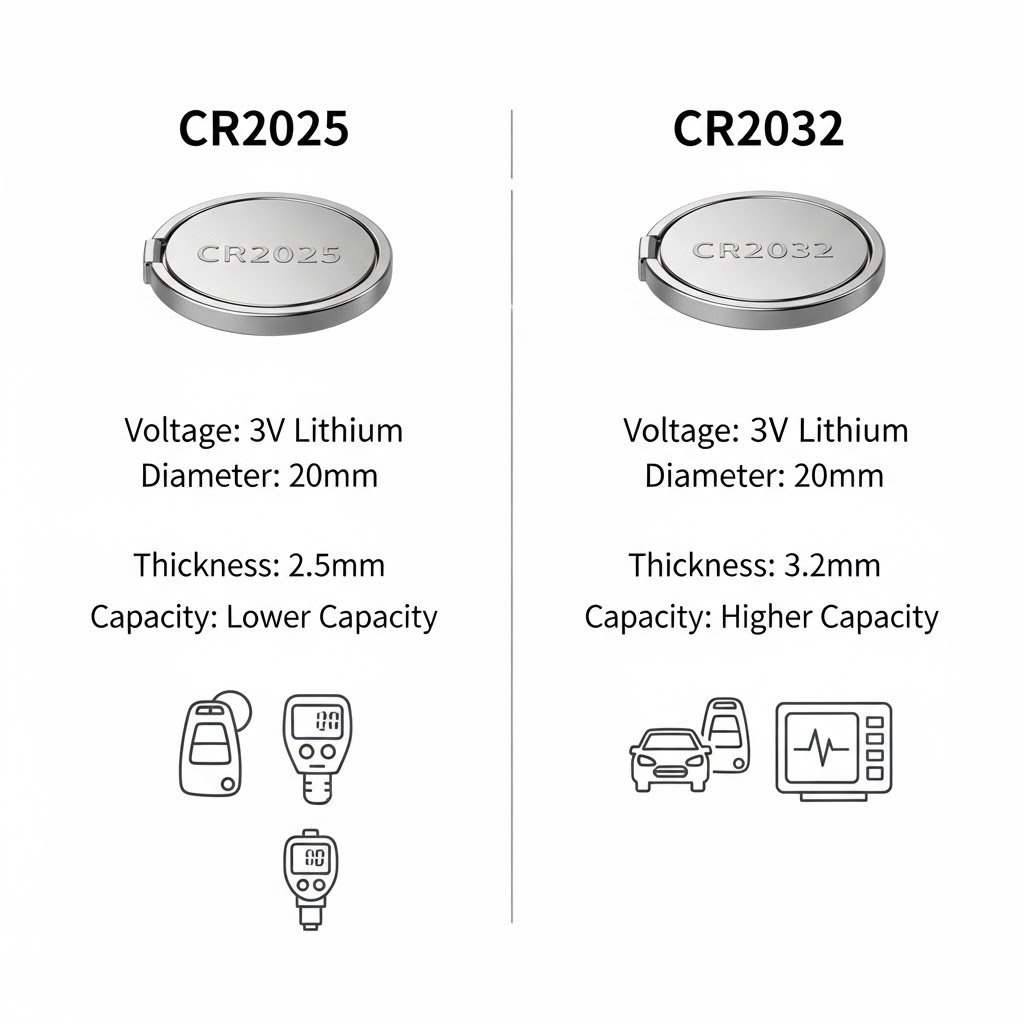
The main difference lies in thickness and battery capacity3. The CR20322 is 3.2mm thick and holds about 220-240mAh, offering a longer lifespan. The CR20251 is thinner at 2.5mm with only 160-170mAh capacity. You should choose the CR20322 for longevity, but use the CR20251 when device design demands a slim profile.
At Nexcir, I often see clients confused by these two specifications. They look the same on a spec sheet until you hold them in your hand. We have helped many hardware engineers adjust their Bill of Materials (BOM) at the last minute because of this small size difference. In the following sections, I will break down exactly how these batteries differ and why that matters for your procurement and design process.
What are the exact physical specifications of CR20251 and CR20322?
Engineers sometimes ignore physical dimensions during the early electronic design phase until the prototype fails its mechanical fitting tests4. This oversight causes delays.
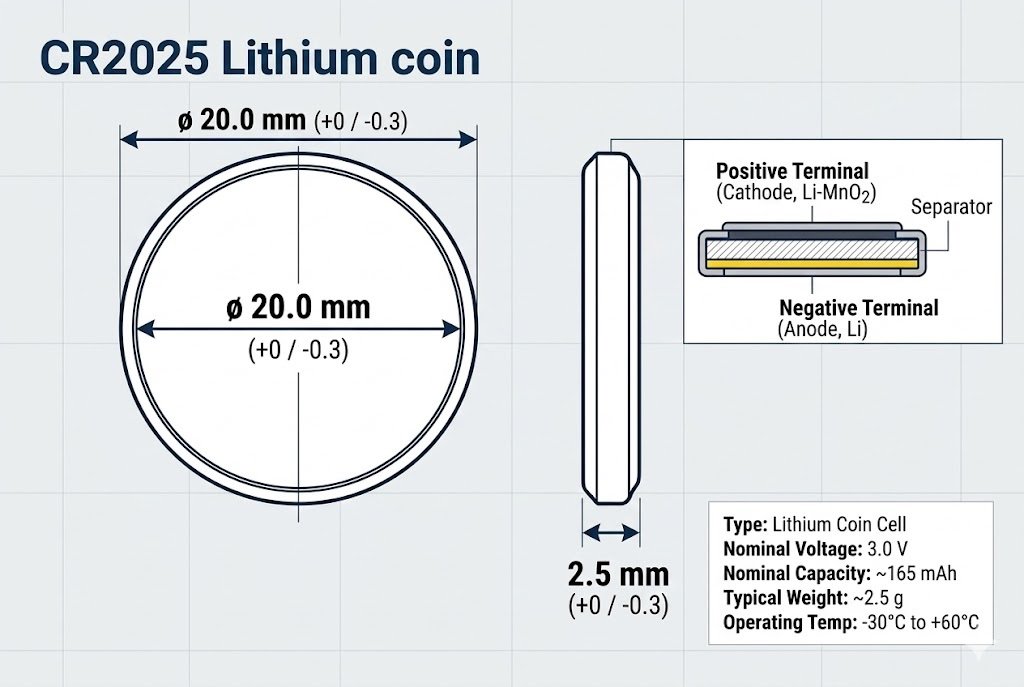
Both batteries share a 20mm diameter and 3-volt output, but their height differs. The "25" in CR20251 indicates a 2.5mm thickness, while the "32" in CR20322 stands for 3.2mm. This 0.7mm gap dictates which battery holder5 you must use.
Understanding the IEC Standards
I want to dive deeper into what these numbers actually mean. The names are not random marketing terms. They follow the International Electrotechnical Commission (IEC) standards6. This is helpful to know because it applies to almost all coin cells you will source through us at Nexcir.
Here is a breakdown of the naming logic:
- C: This letter stands for the chemistry. It means Lithium Manganese Dioxide ($LiMnO_2$)7. This chemistry is very stable and provides a steady 3V output.
- R: This stands for "Round" or cylindrical shape.
- 20: This number represents the diameter in millimeters. Both batteries are exactly 20mm wide.
- 25 or 32: This represents the height or thickness in tenths of a millimeter.
I have created a table below to help you visualize the strict physical data we use when sourcing these for OEM clients8:
| Feature | CR20251 | CR20322 |
|---|---|---|
| Diameter | 20.0 mm | 20.0 mm |
| Height (Thickness) | 2.5 mm | 3.2 mm |
| Voltage | 3 Volts | 3 Volts |
| Typical Weight | 2.6 grams | 3.0 grams |
| Chemistry | Lithium | Lithium |
When I talk to procurement managers, they often think 0.7mm is negligible. However, in hardware design, 0.7mm is a massive amount of space. It is roughly the thickness of a standard credit card. If your plastic enclosure is designed tightly, a CR20322 simply will not close. Conversely, if you use a CR20251 in a space meant for a CR20322, it will rattle around. This leads to power disconnection. I always advise my clients to double-check the "Z-height" clearance on their Printed Circuit Boards (PCBs)9 before ordering thousands of units.
How significantly does the capacity difference affect device performance?
A dead battery ruins the user experience, yet many designers underestimate power needs during the component selection phase. This leads to frustrated customers.
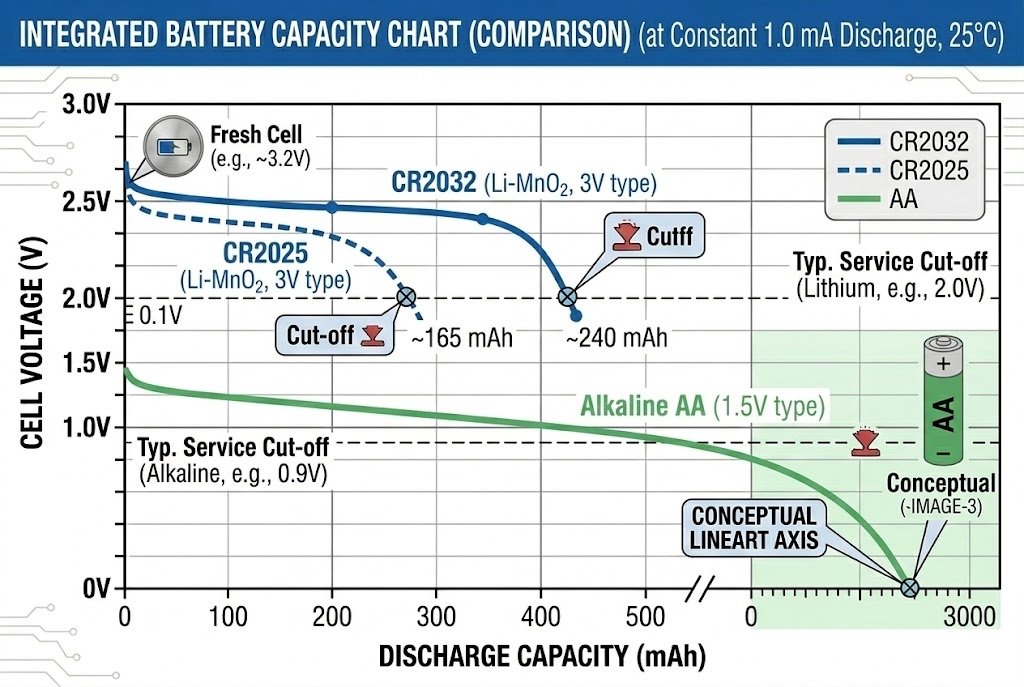
The CR20322 typically holds 225mAh, whereas the CR20251 holds around 165mAh. This means the CR20322 lasts roughly 35-40% longer under the same load, making it the better choice for high-drain devices10 or products that need long standby times.
Analyzing the Trade-off: Power vs. Space
The capacity difference is the most critical functional difference. I want to break this down using some critical thinking regarding electronics usage.
A battery is essentially a tank of energy. The CR20322 is thicker, so it has more internal volume for the chemical materials (anode and cathode). More material equals more stored energy.
Let's look at the math in a real-world scenario. Imagine you are designing a small remote control that draws a continuous current of 0.2mA (milliamps) when a button is pressed, and negligible power when idle.
- CR20322: With 225mAh capacity, you get roughly 1,125 hours of continuous usage.
- CR20251: With 165mAh capacity, you get roughly 825 hours of continuous usage.
That is a loss of 300 hours of active use. For a user, this might mean changing the battery in their car key fob every two years instead of every three years.
I also want to mention Internal Resistance11. Because the CR20322 is larger, it generally handles "pulse" currents better. Many modern IoT devices12 sleep for a long time and then wake up to send a strong signal (like Bluetooth or Wi-Fi). This requires a sudden burst of energy. The CR20322 handles these bursts better than the CR20251 because it has a larger surface area inside the cell. If you use a CR20251 in a high-drain device, the voltage might drop too low during that burst, causing the device to reset or fail.
At Nexcir, we source original Panasonic, Murata, and Maxell batteries. We see that while the capacity varies slightly by brand, the ratio remains the same: the CR20322 always holds significantly more power.
Is it safe to interchange CR20251 and CR20322 batteries in your electronics?
Users often try to jam the wrong battery into a slot when they cannot find the exact match, risking damage or connection failure. This is a common safety concern.
Generally, you can put a CR20251 in a CR20322 slot, but it might have loose contact. You usually cannot fit a CR20322 into a CR20251 slot because it is too thick. Forcing it can damage the device casing or crack the circuit board.
Risks of Mixing and Matching
This is a question I get asked often by procurement teams who want to consolidate their inventory. They ask, "Can we just stock CR20251s and use them for everything?"
The answer is usually no. Here is why this is risky from a technical perspective:
-
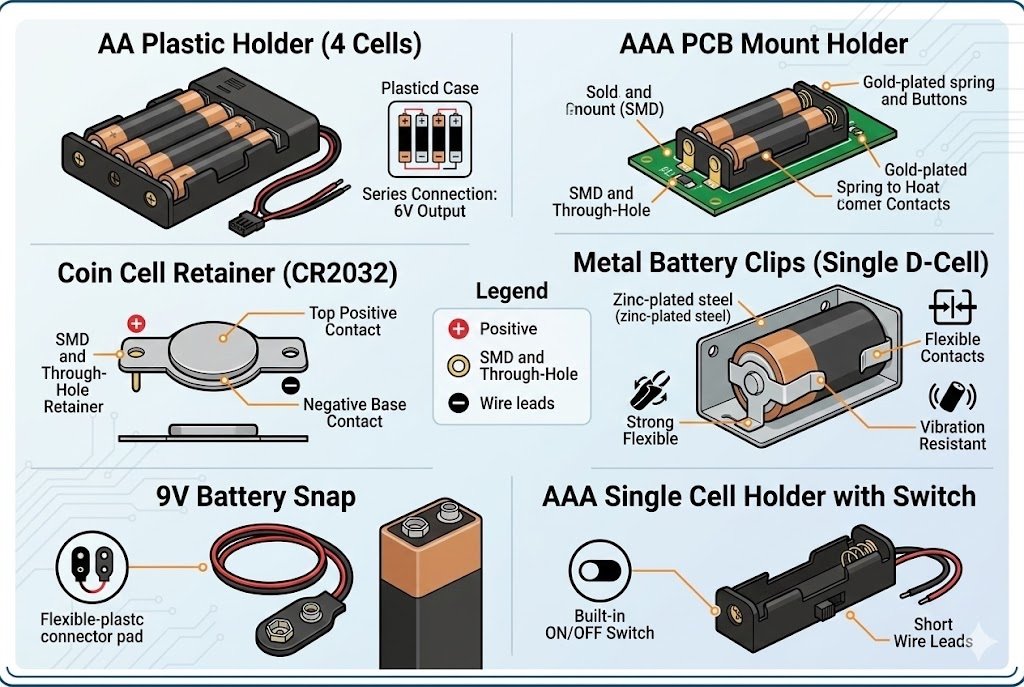
The Contact Issue (CR20251 in a CR20322 slot): Most battery holder5s use a spring mechanism on the side or a metal tab on top. Since the CR20251 is 0.7mm thinner, the top contact might not press down firmly enough. I have seen DIY fixes where people fold a piece of aluminum foil to fill the gap. I strongly advise against this. It is dangerous. It can create a short circuit, lead to overheating, or even cause the battery to leak. From a professional standpoint, if you sell a product, you cannot rely on loose batteries. It will lead to product returns.
-
The Mechanical Stress Issue (CR20322 in a CR20251 slot): If a device is designed for the thinner CR20251, the plastic housing is likely very tight. If a user forces a thicker CR20322 inside, three things can happen:
- The plastic cover snaps or bends.
- The pressure on the PCB cracks the solder joints underneath the battery holder5.
- The negative terminal shorts against the side casing if the insulation is breached.
-
Voltage Stability: Even if it fits, as I mentioned before, the CR20251 has higher internal resistance. A device calibrated for a CR20322 might detect a "low battery" signal earlier than expected if you swap in a CR20251, simply because the voltage sags more under load.
My recommendation to our OEM clients8 is simple: Design for the battery you intend to use. Do not rely on interchangeability. If you need flexibility, select a holder that accommodates both height ranges effectively, but be aware of the vibration risks.
Why does the 0.7mm thickness difference matter for modern product design?
In wearables and IoT devices12, every millimeter costs money and impacts aesthetics significantly. A bulky device often loses to a slimmer competitor in the market.
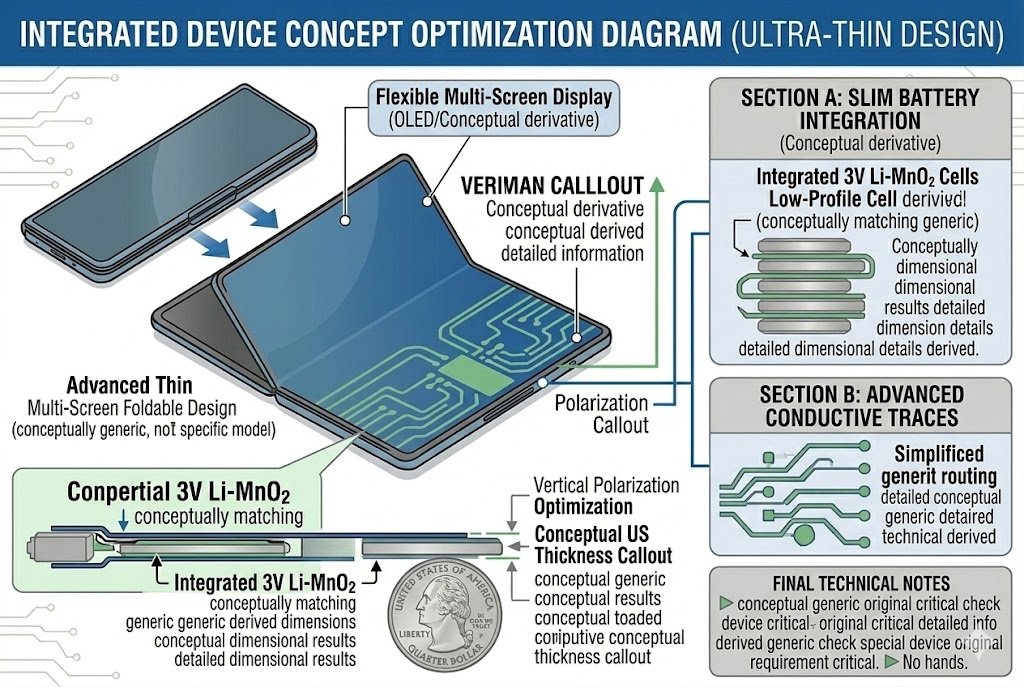
That 0.7mm reduction allows for thinner PCBs and sleeker enclosures. For smart cards13, key fobs, and medical patches, the CR20251 is the superior engineering choice despite its lower capacity. It enables designs that physically would not exist with a CR20322.
The "Space Constraint" Competitive Advantage
This is where I want to share a specific insight based on market trends we see at Nexcir. We have analyzed competitor data and technical forums, and the conversation is shifting. It is no longer just about "how long does it last?" It is about "how small can we make it?"
I want you to think about that 0.7mm difference again. In the context of a car, 0.7mm is nothing. But in the context of a smart tag that you put in your wallet (like an AirTag style device), the total thickness might only be 6mm or 7mm. In that scenario, 0.7mm represents 10% to 15% of the entire device thickness.
Here is how choosing the CR20251 changes the design philosophy:
- Wearable Tech: If you are designing a fitness tracker or a heart rate monitor patch that sticks to the skin, bulk is the enemy. A CR20322 creates a "bump." A CR20251 allows the device to lie flatter against the skin. This improves user comfort and sensor accuracy.
- Smart Cards and OTP Tokens: Banking security tokens need to slide into a wallet. A CR20322 is often too thick to fit comfortably between layers of leather. The CR20251 is the standard here.
- Miniature Remote Controls: For LED lighting strips or car audio remotes, the manufacturer wants the remote to feel sleek and modern. A thin remote feels "high tech." A thick remote feels "old fashioned."
Critical Thinking on Lifecycle vs. Size: You might argue, "But the battery dies faster!" That is true. However, for many of these applications, the power draw is incredibly low. A remote control sends a signal only once a day. A security token generates a code only when pressed. In these cases, a CR20251 might still last 3 to 5 years. If the device becomes obsolete or is discarded after 4 years, the extra capacity of the CR20322 is wasted.
Therefore, you are not just "losing" capacity; you are "trading" excess capacity for a better physical design.
Application Table for Decision Making
To help you decide, I have categorized common devices by which battery they should prioritize:
| Application | Recommended Battery | Reason |
|---|---|---|
| PC Motherboard (CMOS) | CR20322 | Space is plentiful; longevity is the only goal (10+ years). |
| Car Key Fob | CR20251 / CR20322 | Depends on the key design. Slim keys use 2025; chunky keys use 2032. |
| Fitness Watch | CR20322 | High power drain requires the extra mAh. |
| Credit Card Calculator | CR2016 or CR20251 | Must be ultra-thin. CR20322 is impossible here. |
| Medical Skin Patch | CR20251 | Comfort and low profile are critical. |
At Nexcir, we help clients weigh these options. If you are building a device that needs to disappear into the user's pocket, go with the CR20251. If you are building a workhorse device that needs to run for a decade, stick with the CR20322.
Conclusion
The CR20322 is the king of longevity, but the CR20251 is the master of slim design. Choose the 2032 for power, and the 2025 when space is tight.
Learn how the CR2025's thinner profile benefits compact device designs and its impact on product aesthetics. ↩
Explore why the CR2032 is preferred for devices requiring longer battery life and how it supports high-drain applications. ↩
Understand the importance of battery capacity in determining device longevity and user experience. ↩
Learn how fitting tests prevent design failures and ensure proper battery integration. ↩
Find out how battery holder design affects device compatibility and battery performance. ↩
Discover how IEC standards ensure consistency and reliability in battery specifications and performance. ↩
Explore the stability and efficiency of $LiMnO_2$ chemistry in providing a steady 3V output for devices. ↩
Discover how OEMs decide on battery types based on design and performance needs. ↩
Discover how Z-height clearance affects battery fitting and overall device design. ↩
Explore the battery needs of high-drain devices and why CR2032 is often preferred. ↩
Learn how internal resistance impacts a battery's ability to handle pulse currents and device reliability. ↩
Explore the balance between battery size and capacity in designing efficient IoT devices. ↩
Learn how the slim profile of CR2025 batteries makes them ideal for smart card applications. ↩