Machine crashes cause costly downtime. You worry about safety and broken equipment. I will explain how limit switches solve these problems and keep your factory running safely.
A limit switch is an electromechanical device1. It detects the physical presence or absence of an object. It uses mechanical movement2 to open or close electrical contacts3. This action controls machinery, limits movement, and provides vital safety protection4 in automated industrial production lines.
You might wonder about these simple devices. How does a basic switch prevent a million-dollar machine from destroying itself? I learned this the hard way early in my career. A cheap, fake sensor failed on a busy Tuesday. It stopped a whole assembly line for six hours. The factory lost thousands of dollars. Let us look closely at how these devices work. Let us see why you need authentic parts5 for your factory.
How Do the Working Principles of Limit Switches Operate in Practice?
Hidden faults disrupt production. Finding the exact cause takes hours. I will show you the basic working principles of limit switches so you can fix issues fast.
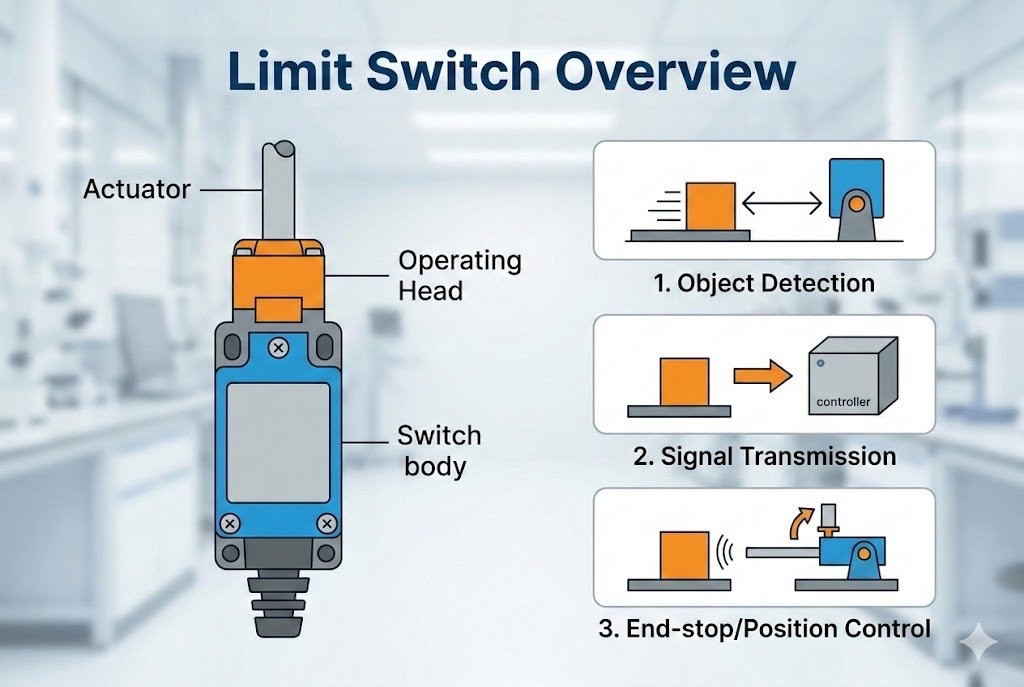
A limit switch works by physical contact6. An object hits the actuator7. This physical force moves an internal mechanism. The movement snaps electrical contacts3 open or closed. This breaks or makes an electrical circuit to control the machine safely.
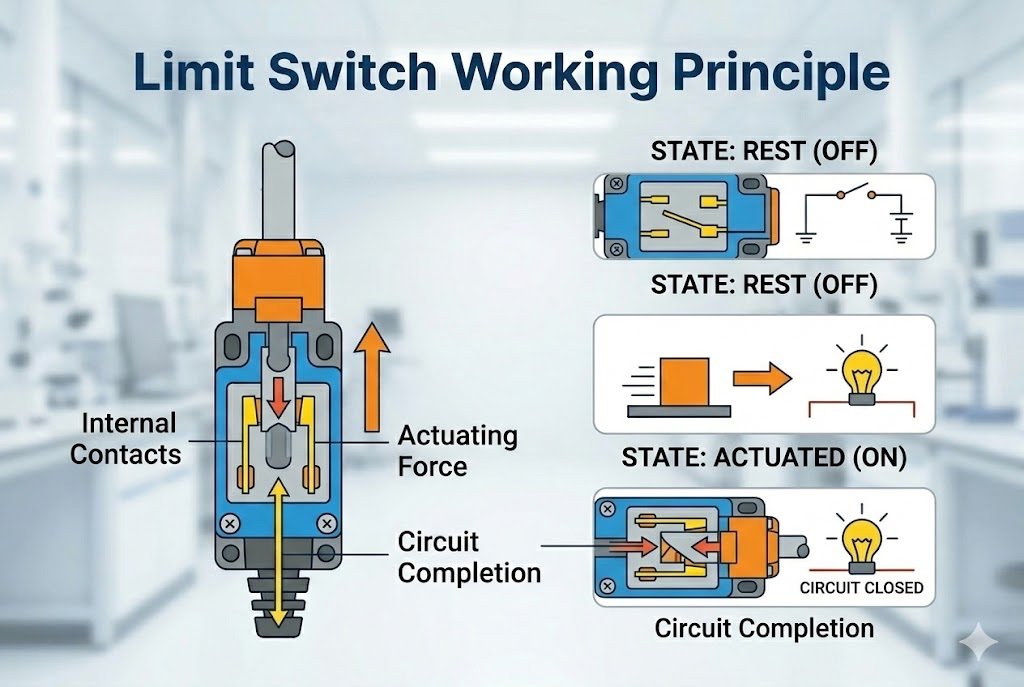
Breaking Down the Mechanical Action
I often see engineers struggle with control systems. The systems look very complex. But the limit switch is very simple. We must look at its three main parts. These parts work together. They turn physical movement into an electrical signal.
First, the actuator7 touches the moving object. Second, the switch body holds the internal parts. Third, the electrical contacts3 send the signal. I remember a time early in my career. A customer bought the wrong switch for a heavy door. The heavy door crushed the switch. The actuator7 was too weak for the job. You must match the switch to the physical force of your machine. This prevents early failures.
Why Mechanical Contact Matters
Mechanical switches are very reliable. They do not get confused by dirt. They do not fail in bright lights. But they do wear out over time. You must plan for regular maintenance. Let us look at the states of the switch.
| Switch State | Physical Action | Electrical Result | Machine Action |
|---|---|---|---|
| Normal | No object touches actuator7 | Contacts stay in rest position | Machine runs normally |
| Triggered | Object pushes actuator7 | Contacts snap to new position | Machine stops or changes direction |
| Released | Object moves away | Contacts return to rest position | Machine resumes normal state |
You must understand these basic states. This knowledge helps you buy the exact right parts. At Nexcir, we talk to hardware engineers every day. We help them find switches with the correct mechanical life8. We look at their specific projects. We suggest the best components from our global supply network. We make sure the parts are 100% original. This saves time and money for everyone.
What Are the Main Types of Limit Switches You Can Choose?
Picking the wrong switch causes failures. Your machine might break down often. I will explain the three main types of limit switches so you make the right choice.
The three main types are roller, plunger, and inductive limit switches9. Roller switches use a small wheel. Plunger switches use a direct push-button design. Inductive switches use magnetic fields to detect metal objects. They do this without any physical contact6 at all.
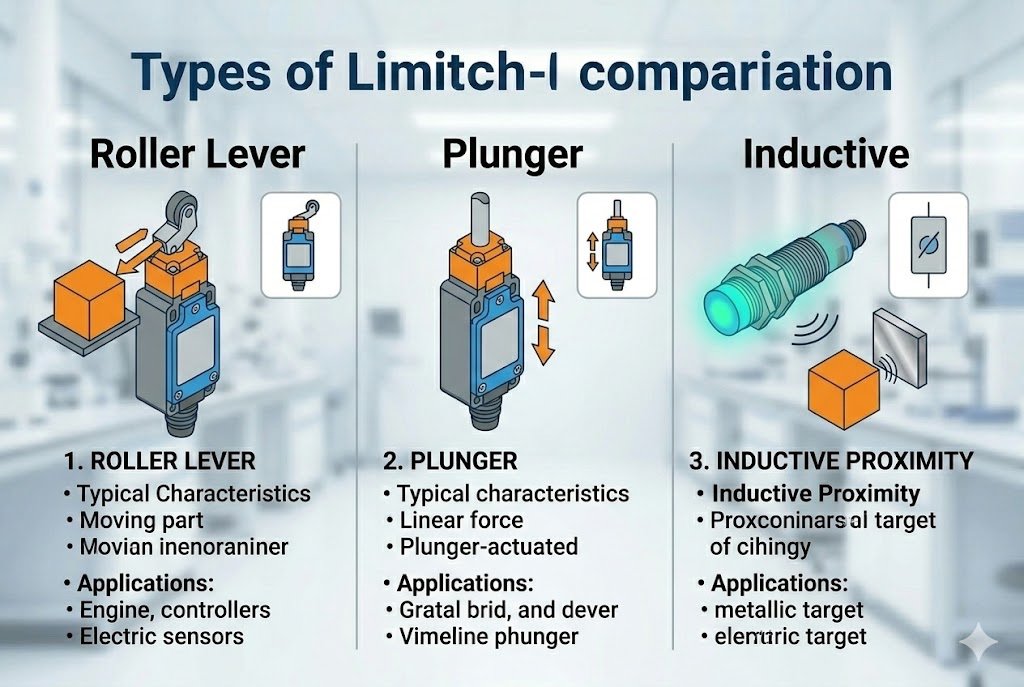
Roller and Plunger Switches
I talk to many OEM procurement managers. They always ask me the same question. They want to know which switch to buy. The answer depends on your machine design. Roller lever switches are very popular in factories. A small wheel rolls over the moving part. This rolling action reduces friction. It is great for fast conveyor belts. The switch lasts longer.
Plunger switches have a different design. The machine pushes straight down on the plunger. There is no side movement at all. I once helped a factory manager. He wanted to replace his broken roller switches. I told him to use plunger switches10 instead. The new switches lasted five times longer. The direct movement was better for his stamping machine.
Inductive Limit Switches
Sometimes, physical contact6 is a bad idea. Heavy impacts can destroy mechanical parts quickly. This is where inductive limit switches9 help a lot. They do not touch the object. They use a magnetic field. They sense metal parts from a small distance.
Comparing the Switch Types
You must look at your needs carefully. You must do this before you buy anything.
| Switch Type | Sensing Method | Best Use Case | Main Advantage |
|---|---|---|---|
| Roller Lever | Physical rolling contact | Conveyor belts, sliding doors | Handles sliding movement well |
| Plunger | Direct physical push | Machine tools, stamping presses | Very high precision |
| Inductive | Magnetic field (no touch) | High-speed lines, dirty areas | No physical wear and tear |
We supply all these types at Nexcir. We source them directly from authorized makers. This means you always get 100% original components. You never have to worry about fake parts. Fake parts ruin good designs. We help you avoid this risk entirely.
How Do Limit Switches Provide Critical Safety in Automated Lines?
Accidents on production lines are dangerous. They hurt people and destroy expensive tools. I will show you how limit switches act as the ultimate safety guard for your factory.
Limit switches provide critical safety11 by acting as a hard stop12. They detect when a machine moves too far. They instantly cut the power. This prevents equipment collisions, stops dangerous movements, and protects both human operators and expensive automated machinery.
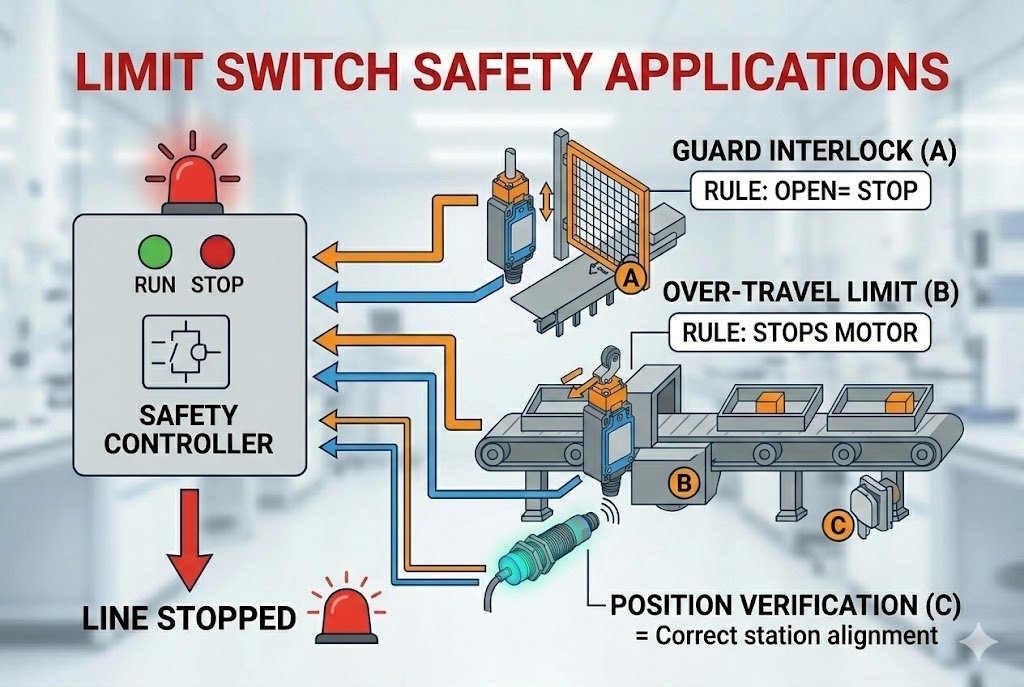
The Last Line of Defense
Software can fail at any time. Computers can freeze without warning. When this happens, a machine might move out of control. A limit switch acts as a physical backup. It does not rely on computer software at all. If a robot arm moves too far, it hits the limit switch. The switch physically breaks the electrical circuit. The robot stops instantly.
I remember visiting a large automotive plant. A software bug13 caused a heavy metal press to drop early. The limit switch caught the error. It stopped the press immediately. It saved a fifty-thousand-dollar tool from total destruction. It also kept the human workers safe.
Safety in Different Industries
Different factories use limit switches in different ways. But the final goal is always safety. The goal is always control. Procurement teams must buy highly reliable switches. This keeps the production lines safe. This keeps the production lines running on time.
Common Safety Applications
| Industry | Machine | Safety Role of Limit Switch |
|---|---|---|
| Automotive | Robotic welding arms | Stops the arm from hitting the car body |
| Industrial | Overhead cranes | Prevents the hoist from lifting too high |
| Consumer Electronics | Assembly conveyors | Stops the belt if a part gets jammed |
You cannot take risks with factory safety. Fake switches fail easily. They fail when you need them the most. Our core team at Nexcir has over 20 years of experience. We understand these industrial risks. We ensure you only get authentic components. We help you protect your production schedule. We help you protect your human workers. We provide stable pricing for these critical safety11 parts.
Conclusion
Limit switches use simple actions to detect objects. They are vital for machine control and safety. Choosing the right authentic switch keeps your automated lines running safely and smoothly.
Understanding electromechanical devices helps you grasp how limit switches function in industrial settings. ↩
Exploring mechanical movement in limit switches reveals how they ensure safety and control in machinery. ↩
Explore how electrical contacts in limit switches manage machine operations and ensure safety. ↩
Learn how limit switches act as safety devices to prevent accidents and equipment damage in factories. ↩
Discover the risks of using fake parts and the benefits of authentic components in maintaining factory efficiency. ↩
Understanding physical contact in limit switches helps you see how they control machine operations effectively. ↩
Learn about the actuator's role in limit switches and how it contributes to machine control and safety. ↩
Understanding mechanical life helps you choose the right limit switch for durability and reliability in your factory. ↩
Explore inductive limit switches to understand their non-contact sensing method and benefits in harsh environments. ↩
Discover the unique features of plunger switches and their advantages in specific industrial applications. ↩
Learn how limit switches act as safety guards to prevent accidents and protect machinery in automated lines. ↩
Understanding the hard stop function in limit switches reveals how they prevent dangerous machine movements. ↩
Discover how limit switches act as physical backups to protect machines from software failures. ↩