Struggling with signal processing? Need to convert a square wave into a triangle wave? An op-amp integrator1 might be the simple, powerful solution you are looking for.
An op-amp integrator1 is an electronic circuit that performs mathematical integration2. It produces an output voltage that is proportional to the integral of the input voltage over time. This is achieved by using a capacitor in the feedback path of an inverting operational amplifier configuration.
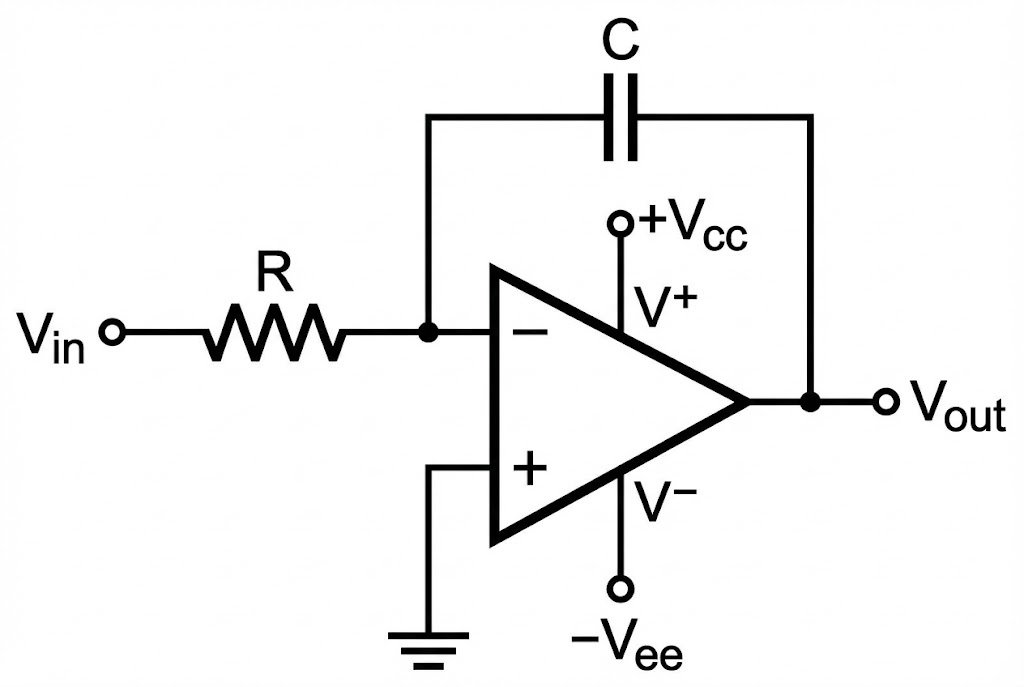
This simple circuit is a fundamental building block in analog electronics. But understanding the theory is just the first step. Let's look at how to build one that actually works reliably in a real-world application, because I've seen many engineers get stuck on the transition from theory to practice.
How Do You Build a Practical Op-Amp Integrator Circuit?
Is your ideal integrator circuit drifting and saturating the op-amp? This common problem happens because of DC offset3. A simple component change can fix this issue completely.
To build a practical op-amp integrator1, you add a large resistor (Rf) in parallel with the feedback capacitor4 (Cf). This resistor limits the DC gain, preventing the output from drifting and saturating due to small input offset voltage5s. This simple addition makes the circuit stable.
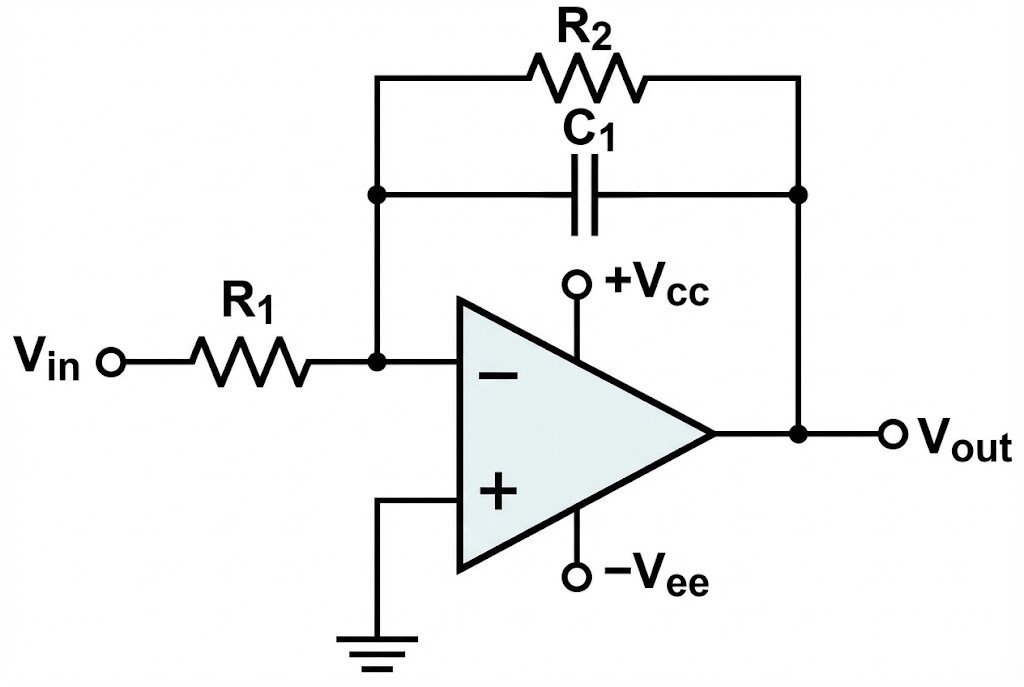
In theory, an integrator is just an op-amp with a resistor on the input and a capacitor in the feedback loop. It's beautifully simple. However, in the real world, this ideal circuit fails. The problem is that all op-amps have a tiny DC input offset voltage5. The ideal integrator has near-infinite gain at DC (zero frequency), so it integrates this tiny offset voltage over time. I've seen it on my oscilloscope many times: the output slowly creeps up or down until it hits the power supply rail and stays there. It's saturated and useless.
The solution is to make the circuit practical. We add a large feedback resistor6 (Rf) in parallel with the feedback capacitor4 (Cf). This single component changes everything.
Limiting DC Gain
The feedback resistor provides a path for DC current, which the capacitor blocks. This limits the circuit's DC gain to -Rf/R1, just like a standard inverting amplifier. This stops the slow drift caused by the offset voltage.
Frequency Behavior
This practical circuit now has two modes of operation based on frequency.
- At low frequencies, the resistor's impedance is much lower than the capacitor's, so the circuit acts like an inverting amplifier.
- At high frequencies, the capacitor's impedance is much lower, so it dominates the feedback path and the circuit acts like an integrator.
| Feature | Ideal Integrator | Practical Integrator |
|---|---|---|
| DC Gain | Infinite | Limited (-Rf/R1) |
| Stability | Unstable, drifts easily | Stable at DC |
| Feedback Path | Capacitor only | Capacitor in parallel with Resistor |
| Best Use Case | Theoretical analysis | Real-world applications |
What Are the Key Applications for Op-Amp Integrators?
Need to create specific waveforms or measure total charge? Standard circuits might not work. An integrator can solve these problems elegantly, turning one signal type into another.
Op-amp integrators are widely used in waveform generation7, like creating triangle waves from square waves. They are also essential in analog-to-digital converters8 (ADCs), filters, and systems that measure the total accumulated charge from a sensor over a period of time.
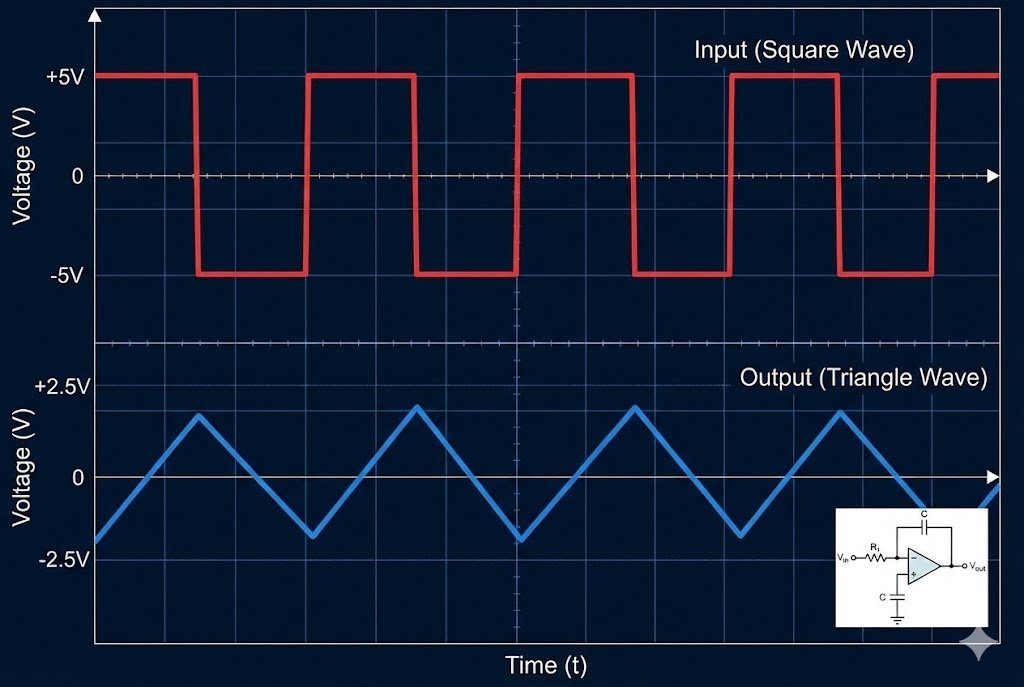
The ability to integrate a signal over time is incredibly useful in many areas of electronics. I have personally used them in test equipment and sensor interfaces. They are not just for textbook examples; they solve real engineering problems every day. The key is to see where a "sum over time" function is needed. For example, if you want to know the total energy a solar panel produced, you would integrate its power output over the day. An op-amp integrator1 can do this in the analog domain.
Common Uses in Electronic Systems
Here are a few of the most common applications I've encountered:
- Waveform Generation: This is the classic application. If you feed a square wave into an integrator, the output will be a triangle wave. This is because the circuit integrates the constant positive and negative voltage levels of the square wave, which produces steady negative-going and positive-going ramps.
- Analog-to-Digital Converters (ADCs): A specific type called a "dual-slope" ADC uses an integrator to convert an analog voltage into a time period, which can then be measured by a digital counter.
- Sensor Signal Conditioning: Some sensors produce a current that represents a rate of change. To find the total amount, you need to integrate that current. For instance, a photodiode can measure light intensity (power), but integrating its signal gives you the total light exposure (energy).
| Application | How the Integrator is Used | Example |
|---|---|---|
| Waveform Shaping | Converts one waveform to another | Square Wave to Triangle Wave |
| Measurement | Accumulates a signal over time | Measuring total charge from a sensor |
| Control Systems | Part of a PID controller9 (the 'I' term) | Smoothing out system responses |
| Filtering | As a key block in active filters10 | Creating low-pass filters |
Which General-Purpose Op-Amps Are Best for Integrator Circuits?
Choosing the wrong op-amp can ruin your integrator's performance. Input bias current and offset voltage are critical. Let's find a reliable part for your design needs.
For integrator circuits, choose op-amps with low input bias current11 and low input offset voltage5. JFET or CMOS input op-amps like the TL07x series12 or OPAx192 series are excellent choices. For less critical applications, a standard bipolar op-amp like the LM358 can also work.
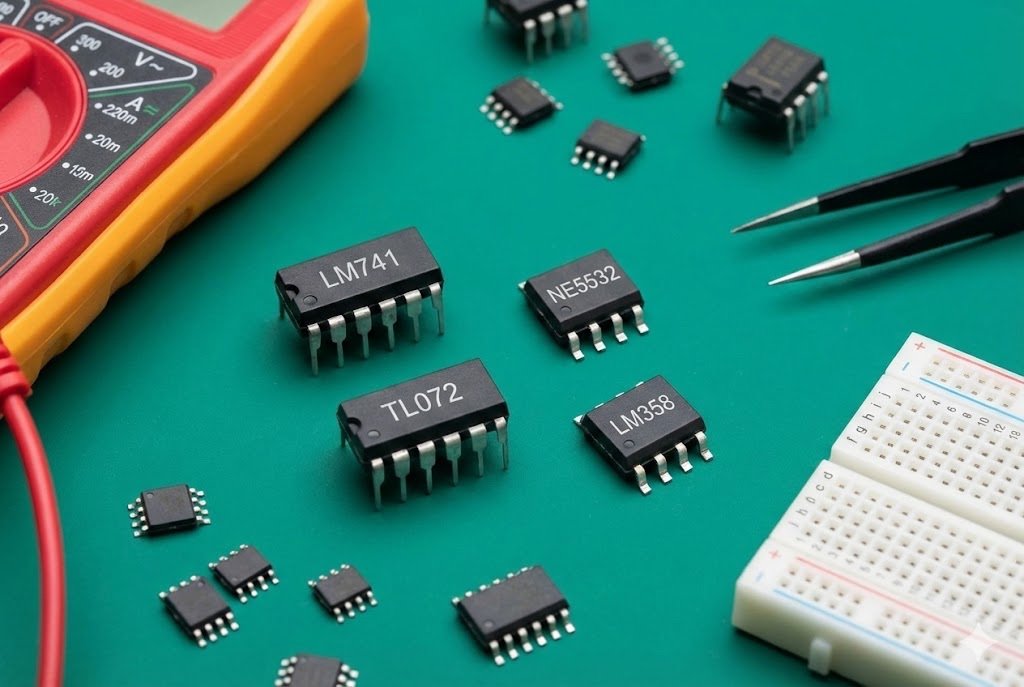
When building an integrator, the op-amp itself is the most important component choice. Even in a practical circuit with a feedback resistor, certain op-amp imperfections can cause errors. At NexCir, we often help our clients source parts that meet these specific technical needs. Two parameters are most important.
Key Op-Amp Parameters
- Input Offset Voltage (Vos): This is a small DC voltage error at the input. The circuit will amplify this voltage by its DC gain, causing a DC error at the output. A lower Vos is always better.
- Input Bias Current (Ib): This is a small DC current that flows into the op-amp's input pins. This current will flow through the input resistor, creating another voltage error that gets integrated. For this reason, op-amps with FET or CMOS inputs are much better than bipolar (BJT) inputs, as their bias currents are thousands of times smaller.
I've put together a table of common op-amps that I often recommend to engineers, depending on their project's requirements.
| Part Number | Input Type | Key Feature | Typical Application |
|---|---|---|---|
| LM358 | Bipolar (BJT) | Very low cost, widely available | Non-critical, general-purpose designs |
| TL072 | JFET | Low noise, very low bias current | Audio, waveform generation7 |
| OPA219213 | CMOS | Precision, low offset and drift | Industrial sensors, test equipment |
Choosing the right part involves a trade-off between performance and cost. For a simple function generator, a TL072 is perfect. For a high-precision measurement system, investing in a part like the OPA219213 is necessary.
Conclusion
The op-amp integrator1 is a simple yet powerful analog building block. By understanding its practical limitations and choosing the right component, you can use it effectively in many designs.
Explore this resource to understand the fundamentals of op-amp integrators and their applications in electronics. ↩
Learn about the role of mathematical integration in electronic circuits and its significance. ↩
Find solutions to DC offset issues in op-amp circuits to improve performance. ↩
Discover how feedback capacitors influence circuit behavior and stability in op-amp designs. ↩
Understand the impact of input offset voltage on the accuracy of op-amp circuits. ↩
Understand the importance of feedback resistors in stabilizing op-amp integrators. ↩
Learn about different techniques for generating waveforms using op-amp circuits. ↩
Discover the role of op-amp integrators in the functioning of ADCs. ↩
Learn about the role of integrators in PID controllers and their impact on system performance. ↩
Explore the concept of active filters and their applications in signal processing. ↩
Learn about the significance of input bias current in selecting op-amps for circuits. ↩
Explore the specifications and applications of the TL07x series op-amps for your designs. ↩
Discover the advantages of using the OPA2192 op-amp in high-precision electronic systems. ↩