Struggling to choose the right programmable logic? FPGAs can feel like overkill, driving up costs and complexity. CPLDs offer a simpler, more efficient solution for many common industrial tasks.
A Complex Programmable Logic Device (CPLD)1 is a non-volatile programmable logic device. It is ideal for "glue logic2," state machines3, and simple control functions due to its instant-on capability, predictable timing, and lower power consumption4 compared to FPGAs for smaller designs.
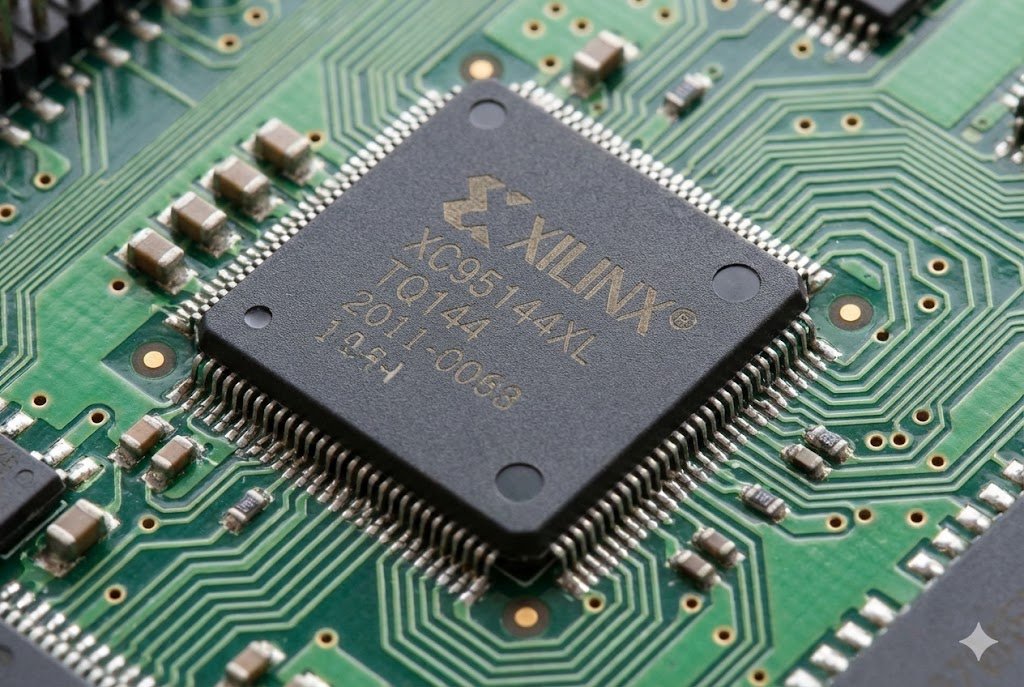
The choice between a CPLD and an FPGA is a common one in our industry. I've sat in many design review meetings where engineers debate the pros and cons. The key is to understand the fundamental differences and how they apply to your specific project needs. Let's break it down further so you can make the right call every time for your Bill of Materials (BOM).
What is a CPLD and how does it really work?
Unsure how CPLDs really function inside? This confusion can make it hard to specify them correctly for your design. Let's break down the simple, powerful architecture of macrocells and interconnects.
A CPLD works by connecting logic blocks, called macrocells, through a central programmable interconnect5. Each macrocell contains logic gates and a flip-flop. This structure provides predictable timing and allows for simple, non-volatile programming, making the device operational instantly upon power-up.
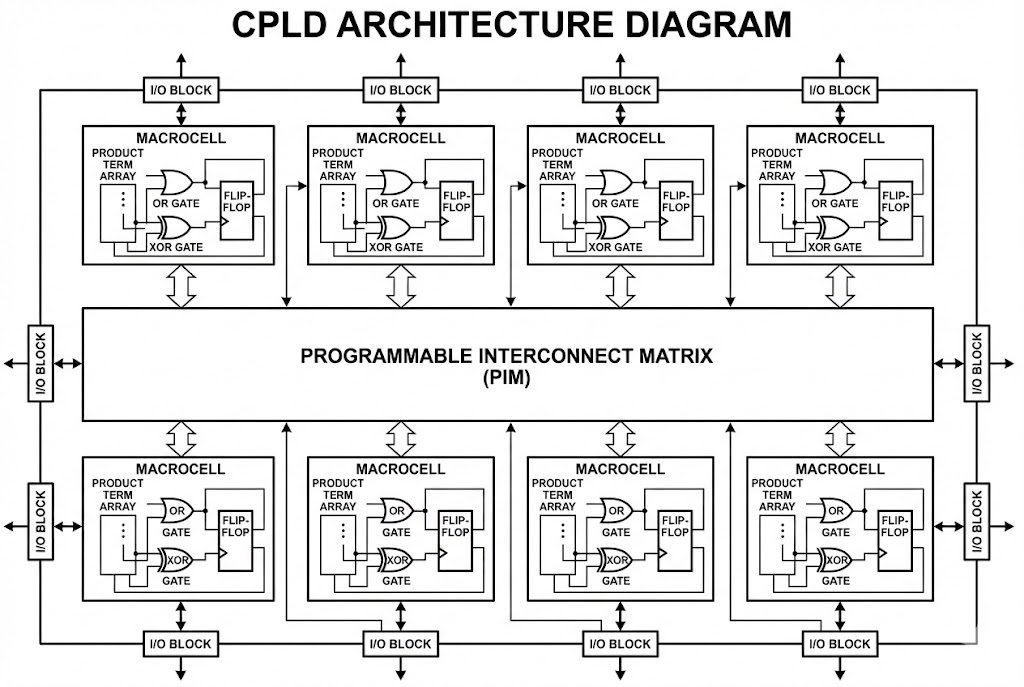
A CPLD's architecture is what makes it so predictable and reliable. Unlike the fine-grained, fabric-like structure of an FPGA, a CPLD has a more coarse, block-based design. I remember a project where we needed instant boot-up for a safety-critical system. The CPLD was the only choice because it didn't need to load a configuration from external memory. Let's look at the core components.
Key Architectural Components
The magic of a CPLD happens with three main parts working together:
- Logic Blocks: These are the brains of the device, often called Function Blocks or Logic Array Blocks (LABs).
- Macrocells: Inside each logic block are several macrocells. A macrocell is a fundamental building block containing a logic array (like an AND-OR plane) and a configurable flip-flop. The flip-flop allows the CPLD to store a state, which is essential for creating sequential logic like counters and state machines3.
- Programmable Interconnect Matrix (PIM): This is a central switch matrix that connects all the logic blocks. Because it's a single, unified matrix, the signal timing from any input pin to any output pin is very consistent and predictable. This is a huge advantage in timing-critical applications6.
The most important feature is that the configuration is stored in non-volatile memory7, like EEPROM or Flash, right on the chip. This means the CPLD "remembers" its logic even when the power is off. When you power it on, it's ready to go instantly.
When should you choose a CPLD over an FPGA?
Defaulting to an FPGA for every logic task? This common choice can inflate your BOM cost and power budget. Let's identify the specific scenarios where a CPLD is the superior and more cost-effective choice8.
Choose a CPLD over an FPGA for simpler applications requiring instant-on functionality, predictable timing, and lower static power consumption4. CPLDs are ideal for glue logic2, address decoding9, and simple state machines3 where the high gate count of an FPGA is unnecessary and not cost-effective.
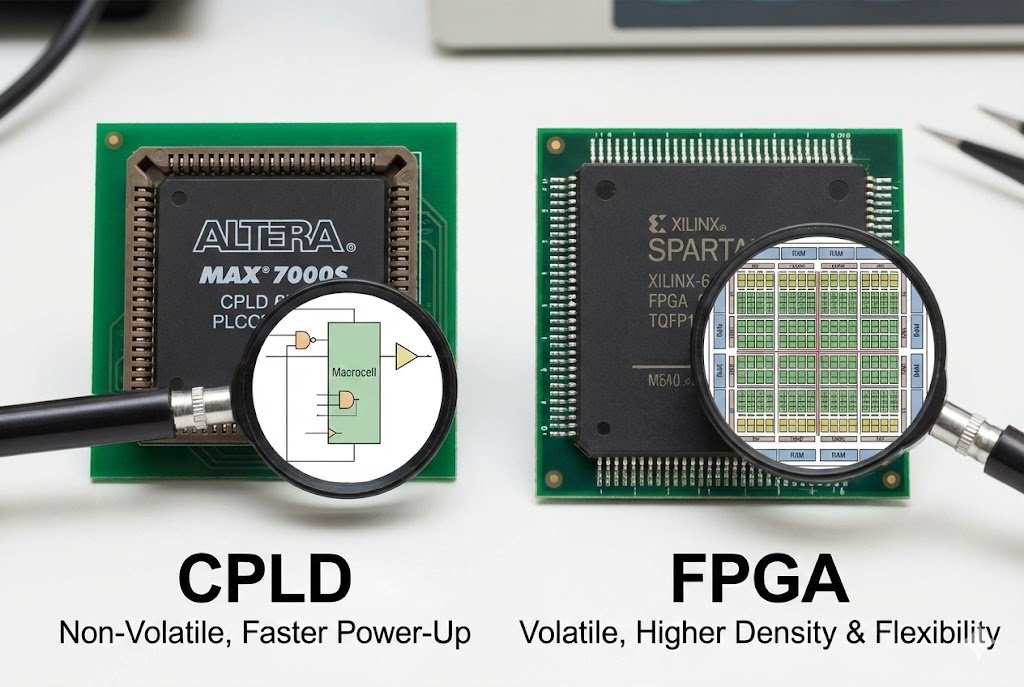
The decision between a CPLD and an FPGA comes down to "right-sizing" your solution. Using a powerful FPGA for a simple task is like using a sledgehammer to crack a nut. It works, but it's inefficient and expensive. We recently helped a client redesign a control board for an industrial machine. They were using a small FPGA just for I/O expansion10 and to manage a few control signals. It was overkill. By switching to a CPLD, we cut the component cost by nearly 40%, reduced the static power draw, and simplified the board's power-up sequence. This was a huge win for both their engineering and procurement teams.
CPLD vs. FPGA: A Clear Comparison
To make the best choice, you need to compare them across key metrics that matter for industrial designs.
| Feature | Complex Programmable Logic Device (CPLD)1 | Field-Programmable Gate Array (FPGA) |
|---|---|---|
| Architecture | Coarse-grained, macrocell-based. | Fine-grained, Look-Up Table (LUT) based. |
| Logic Density | Lower (hundreds to thousands of logic elements). | Higher (thousands to millions of logic elements). |
| Boot Time | Instant-on. The configuration is non-volatile. | Slower. Must load configuration from external memory. |
| Power Consumption | Lower static power consumption4. | Higher static power consumption4, especially in larger devices. |
| Timing | Highly predictable and deterministic. | More complex and variable timing. |
| Cost | Generally lower for smaller logic requirements. | More cost-effective for high-complexity designs. |
The most critical difference for many industrial applications is the boot time. A CPLD is ready the moment power is stable. An FPGA needs to wake up, read its configuration file from an external Flash chip, and then configure itself. This delay, while often short, is unacceptable for systems that need to control safety interlocks or manage critical power-on sequencing from the very first microsecond.
What are the key applications for CPLDs in industrial control11?
Wondering where CPLDs are used in the real world? Overlooking them can mean missing out on significant cost and efficiency gains. Here are some key industrial applications where they still shine today.
In industrial control11, CPLDs are perfect for tasks like I/O expansion10, address decoding9 for memory and peripherals, and implementing simple state machines3 for motor control12 or system startup. Their reliability and instant-on nature make them ideal for safety interlocks and system monitoring functions.
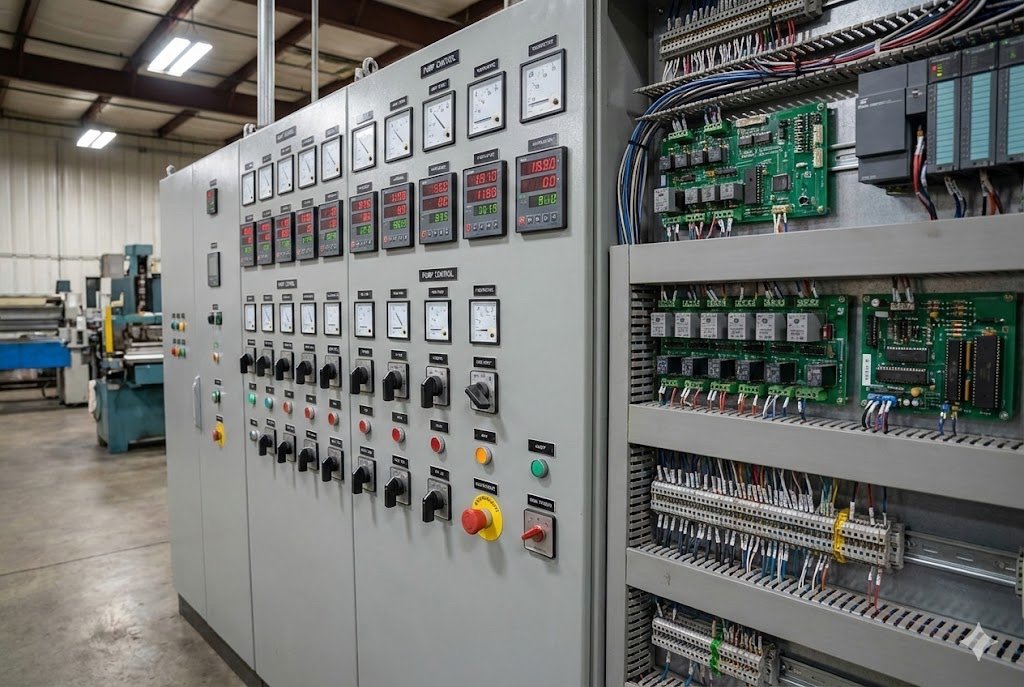
In a factory setting, you simply cannot afford unpredictable boot times or logic failures. That's why CPLDs are still so trusted for these foundational tasks—they just work, every single time you power them on. Their deterministic nature13 gives engineers peace of mind. We see them used constantly in designs that prioritize reliability and simplicity over raw processing power. Let's look at some specific examples I've encountered with my clients.
Glue Logic and Bus Interfacing
This is the classic CPLD application. Imagine you have a new microprocessor but need it to talk to an older peripheral with a different bus protocol. A CPLD is perfect for acting as a fast, reliable translator or "bridge" between the two. It can handle address decoding9, signal-level shifting, and bus contention logic, tying different parts of a system together seamlessly.
System Initialization and Reset Logic
Many complex systems require a precise power-on sequence. Different power rails need to come up in a specific order, and reset signals must be held for a certain duration. A CPLD can manage this entire process. Because it's instant-on, it can control power regulators and monitor system voltages before the main processor even starts booting.
I/O Expansion
Sometimes, a microcontroller just doesn't have enough General Purpose I/O (GPIO) pins. A CPLD is a simple and cost-effective way to add more. You can use a few pins on your MCU (like an SPI or I2C interface) to control dozens of additional inputs or outputs on the CPLD, which can then drive LEDs, read sensors, or control relays.
Simple State Machines
For controlling a sequence of operations, a CPLD is ideal. Think about a simple motor control12ler that needs to manage start, stop, forward, and reverse signals based on inputs from sensors and switches. This can be implemented as a simple state machine inside the CPLD, providing a very robust and responsive control solution without burdening the main system processor.
Conclusion
In summary, CPLDs are not outdated. They are a smart, cost-effective choice8 for specific industrial tasks that need absolute reliability and instant-on performance. Always match the component to the application.
Explore this link to understand the fundamentals of CPLDs and their applications in various industries. ↩
Learn about glue logic and how it connects different components in a system, enhancing your design knowledge. ↩
Discover the workings of state machines and their importance in control systems and digital design. ↩
Explore the impact of power consumption on design choices and efficiency in electronics. ↩
Find out how programmable interconnects function and their role in CPLD architecture. ↩
Learn about timing-critical applications and why precise timing is crucial in electronic systems. ↩
Understand non-volatile memory types and their significance in electronic devices like CPLDs. ↩
Understand the cost benefits of using CPLDs in specific applications compared to other solutions. ↩
Understand address decoding and its role in memory management and peripheral communication. ↩
Discover how I/O expansion works and its importance in enhancing microcontroller capabilities. ↩
Discover how CPLDs are applied in industrial control systems for enhanced reliability and efficiency. ↩
Discover the principles of motor control and its applications in various electronic devices. ↩
Learn about deterministic nature and its significance in ensuring reliable electronic operations. ↩