Do you design circuits but feel unsure about high voltage diodes? The wrong part causes total board failure. I will show you why the 1N4007 solves this problem perfectly.
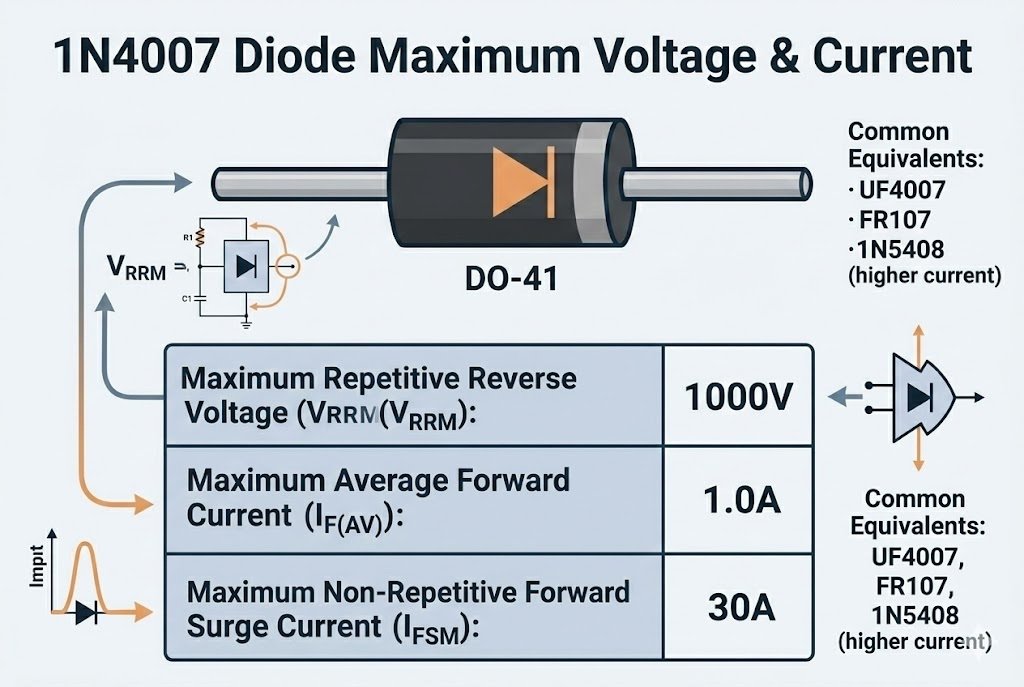
The 1N4007 diode has a maximum repetitive peak reverse voltage1 of 1000V and a continuous forward current2 of 1A. Common equivalents include the 1N5408, EM513, and 1N4148. It is the most versatile rectifier diode3 for power supplies, adapters, and general-purpose blocking applications.
Do you feel tired of stocking too many different diode part numbers in your warehouse? I know this feeling well. You want to simplify your parts list. You want to save money. Let us explore the exact details of the 1N4007 diode together. This guide will help you understand its power. You will see why it is the top choice for electronic designs.
What are the exact voltage and current limits of the 1N4007?
High power spikes4 can destroy weak diodes. This ruins your entire project. The 1N4007 gives you a massive safety margin for your power supply designs.
The 1N4007 handles up to 1000 volts of peak reverse voltage. It carries 1 amp of continuous forward current2. It can survive a peak surge current5 of 30 amps. This makes it incredibly tough.
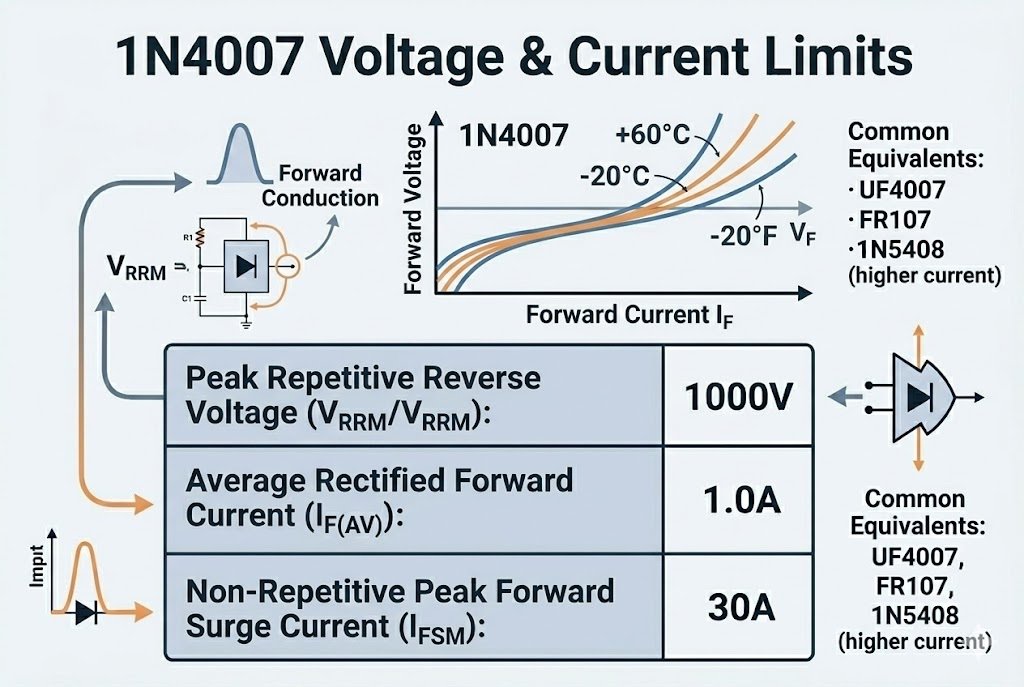
I have seen many engineers struggle with voltage ratings. You must understand the data sheet numbers clearly. Let us break down the exact specifications of the 1N4007 diode.
Core Specifications
The 1N4007 is a standard recovery rectifier diode. It changes alternating current (AC) to direct current (DC). The "1000V" rating means a specific limit. It can block 1000 volts in the reverse direction. The diode will break and fail if the voltage goes higher. The "1A" rating means a safe daily limit. It safely allows 1 amp of current to pass through continuously. You must respect these two primary numbers.
Surge Current Protection
Sometimes a circuit gets a sudden burst of power. The 1N4007 handles up to 30 amps for a very short time. We call this the surge current5. This feature protects your circuit during startup. A power supply often pulls extra current when you first plug it into the wall.
| Specification | Value for 1N4007 | Importance |
|---|---|---|
| Peak Reverse Voltage | 1000 Volts | Stops backward power flow |
| Forward Current | 1 Amp | Safe daily operating limit |
| Surge Current | 30 Amps | Survives sudden power spikes4 |
| Forward Voltage Drop | 1.1 Volts | Power lost as heat |
I always check these limits when I design a power adapter. You must keep your normal operating voltage below 1000V. You must keep your normal current below 1A. The 1N4007 will last a very long time in your product if you follow these simple rules.
What is the difference between the 1N4001 and the 1N4007?
The choice between the 1N4001 and 1N4007 confuses many people. A 1N4001 in a high-voltage circuit causes a fire risk. Let us compare them directly.
The only difference between the 1N4001 and the 1N4007 is the maximum reverse voltage. The 1N4001 handles 50V. The 1N4007 handles 1000V. All other specifications remain exactly the same.
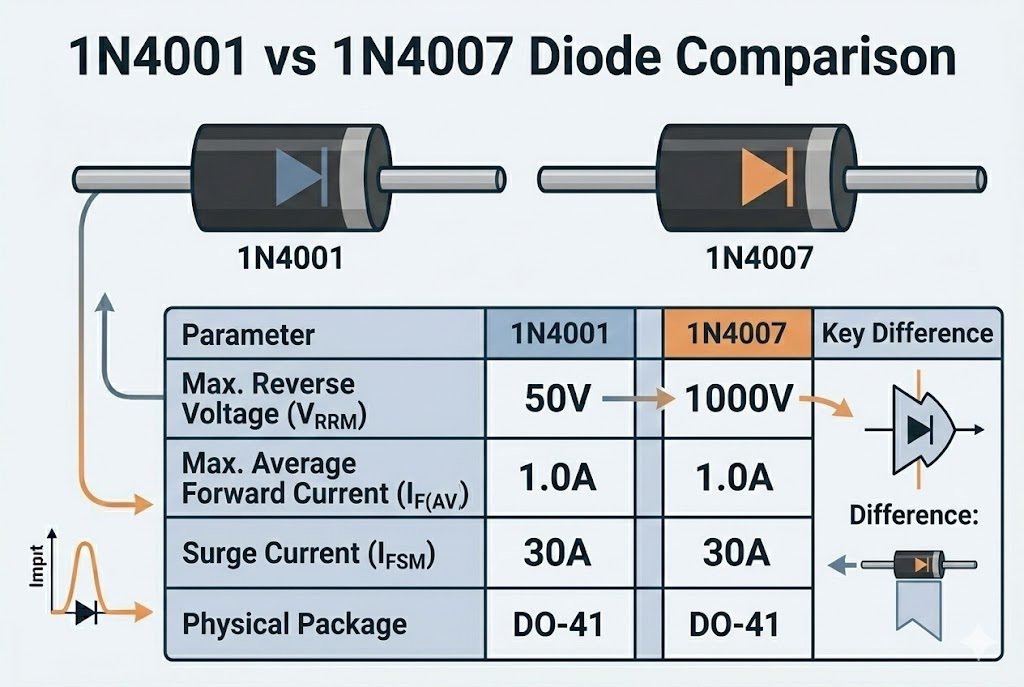
Many buyers ask me about the 1N400x series. We sell millions of these diodes at Nexcir. The entire series from 1N4001 to 1N4007 uses the exact same silicon die size. They use the same plastic package. They look identical on the outside.
The Voltage Family6
The manufacturing process creates diodes with different voltage tolerances. The factories test them on the production line. The factories sort them into different groups based on their strength. The lowest group is 50V. The highest group is 1000V.
Comparing the Series
Let us look at the voltage changes across the family.
| Diode Model | Maximum Reverse Voltage (VRRM) | Forward Current |
|---|---|---|
| 1N4001 | 50 Volts | 1 Amp |
| 1N4002 | 100 Volts | 1 Amp |
| 1N4003 | 200 Volts | 1 Amp |
| 1N4004 | 400 Volts | 1 Amp |
| 1N4005 | 600 Volts | 1 Amp |
| 1N4006 | 800 Volts | 1 Amp |
| 1N4007 | 1000 Volts | 1 Amp |
Why does this matter to you? You can only use a 1N4001 in low-voltage battery circuits. A 1N4001 will explode immediately in a 110V power supply. The 1N4007 handles all these voltage levels safely. I always tell engineers to focus on the 1N4007. It is the safest choice for almost every standard rectification task7. It removes the risk of a low-voltage explosion.
Why is the 1N4007 the best choice for general inventory?
A massive parts list costs time and money. Seven different diode models waste your warehouse space. The 1N4007 solves your inventory headache permanently.
The 1N4007 can replace any diode in the 1N4001 to 1N4006 series. Stocking only the 1N4007 reduces your inventory costs. It simplifies your purchasing process. It is the ultimate universal part.
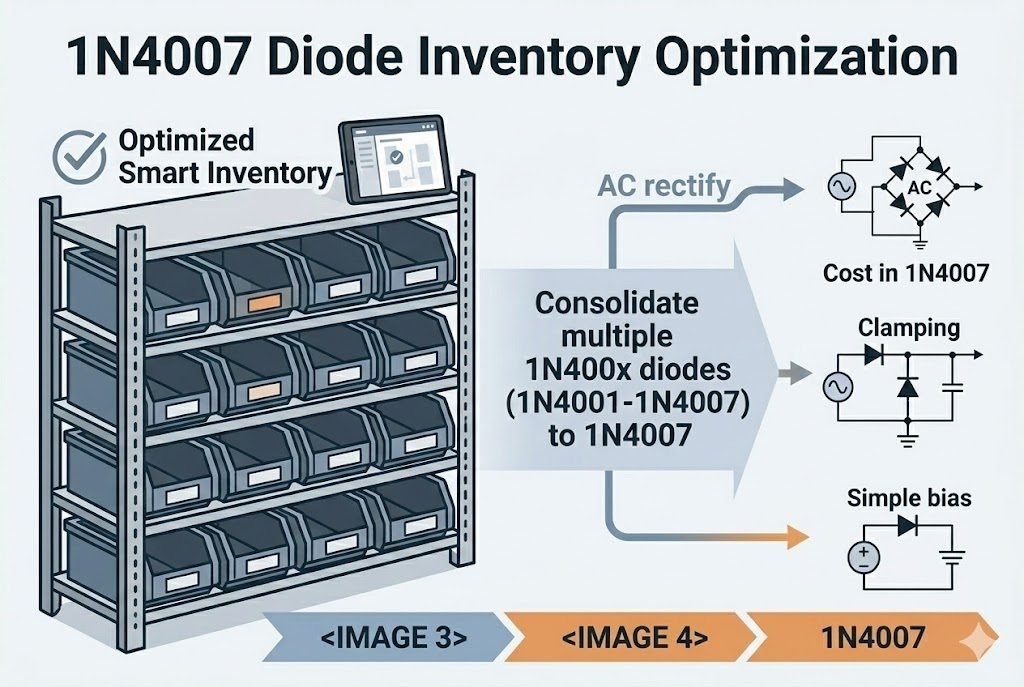
We call the 1N4007 the "king of traffic" at Nexcir. It is the most popular general-purpose diode in the world. I have helped many procurement managers shrink their Bill of Materials (BOM). A smaller BOM makes your supply chain much stronger.
The Universal Replacement8
The 1N4007 has the highest voltage rating of 1000V. It naturally covers all lower voltage requirements. Your circuit board might call for a 400V 1N4004. You can solder a 1N4007 in its place. The circuit will work perfectly. The forward voltage drop9 is exactly the same.
Cost and Space Savings10
Let us break down the benefits of stocking only the 1N4007.
| Benefit Area | The Old Way | The Smart Way with 1N4007 |
|---|---|---|
| Storage Space | Seven different bins needed | One single bin needed |
| Purchasing Power | Small orders for each type | One huge bulk order |
| Assembly Errors | Workers mix up parts | Impossible to pick wrong part |
| Supply Chain | Seven different lead times | One simple lead time |
You might think the 1N4007 costs much more than the 1N4001. That was true twenty years ago. The manufacturing cost is almost identical today. The mass production volume of the 1N4007 makes it incredibly cheap. You save money by buying the 1N4007 in massive bulk quantities. You also protect your factory from sudden part shortages. This is the smart way to manage electronic component procurement.
What are the exact equivalents for the 1N400711 diode?
Sometimes the 1N4007 is out of stock. A stopped production line is a disaster. You need reliable alternative parts to keep your factory running smoothly.
Good equivalents for the 1N400711 include the 1N5408, EM513, and UF4007. The 1N5408 handles 3 amps. The UF4007 is an ultrafast version. Always check the physical size before replacing a component.
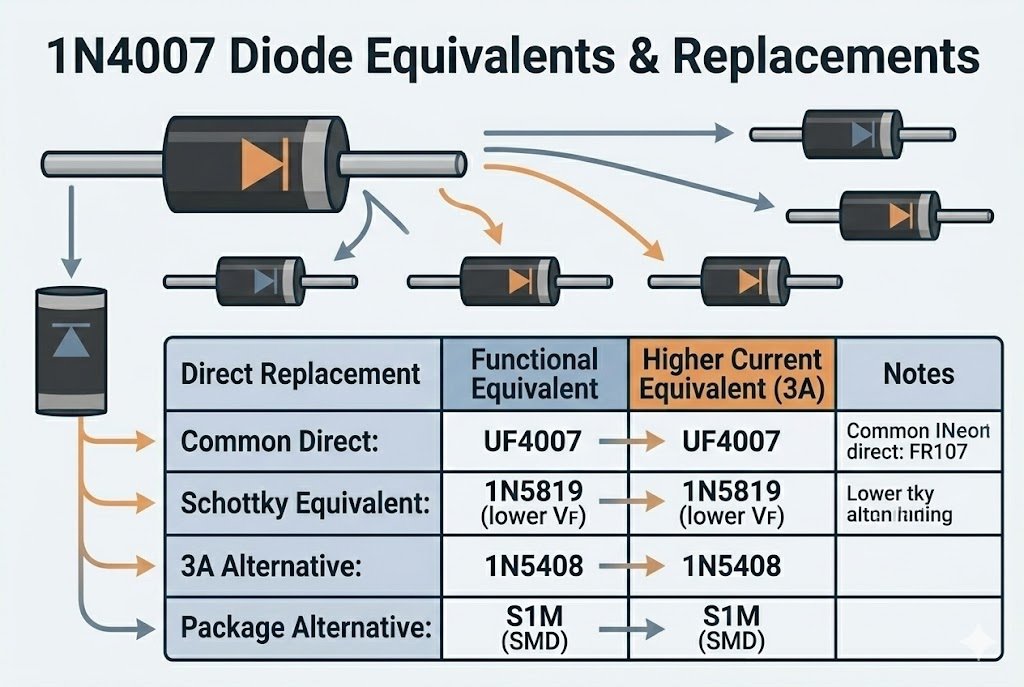
Original and authentic components are hard to find. Counterfeit parts12 cause huge problems for hardware engineers. I see fake diodes in the market every day. You must choose carefully when you need a substitute for the 1N4007. A fake diode will ruin your product quality.
Upgrading the Current13
The 1N5408 is a great choice for more current. It handles 3 amps instead of 1 amp. It also blocks 1000V. The physical body is larger. You must make sure it fits on your printed circuit board (PCB). It requires bigger holes in the board.
Upgrading the Speed14
The 1N4007 is a slow diode. It is perfect for 50Hz or 60Hz AC power. The 1N4007 will get too hot and fail in a high-frequency switching power supply. You need the UF4007. The "UF" stands for ultrafast. It recovers much faster during rapid switching.
| Equivalent Part | Voltage | Current | Best Use Case |
|---|---|---|---|
| 1N5408 | 1000V | 3A | Higher current capacity needed |
| UF4007 | 1000V | 1A | High-frequency switching circuits |
| EM513 | 1600V | 1A | Extreme voltage blocking needed |
| 1N4007G | 1000V | 1A | Glass passivated15 for reliability |
My team ensures every diode you buy is 100% authentic. We source only from authorized channels. We help OEM procurement managers avoid counterfeit risks. We provide stable pricing and safe global delivery for the standard 1N4007 or a special equivalent. We build long-term trust with every single order.
Conclusion
The 1N4007 is the ultimate 1000V, 1A rectifier diode. It easily replaces the entire 1N400x series. Stocking this versatile component lowers your costs and simplifies your daily procurement process.
Understanding the voltage limits of the 1N4007 ensures safe and effective use in high-voltage applications. ↩
Knowing the current rating helps in designing circuits that operate within safe limits, preventing damage. ↩
Exploring its versatility can help in choosing the right diode for various applications, simplifying inventory. ↩
Understanding its ability to handle power spikes ensures reliability and longevity in power supply designs. ↩
Knowing the surge current capacity is crucial for protecting circuits during sudden power increases. ↩
Understanding the voltage family aids in selecting the appropriate diode for various voltage applications. ↩
Understanding its suitability for rectification tasks ensures efficient and safe circuit designs. ↩
Exploring its universal replacement capability can simplify inventory and reduce costs. ↩
Understanding the voltage drop helps in assessing power loss and efficiency in electronic designs. ↩
Understanding the savings can help in optimizing inventory management and reducing expenses. ↩
Knowing the equivalents ensures continuity in production and flexibility in sourcing components. ↩
Avoiding counterfeit parts ensures product quality and reliability in electronic manufacturing. ↩
Exploring current upgrades helps in adapting to higher current requirements in circuit designs. ↩
Understanding speed upgrades ensures compatibility with high-frequency applications. ↩
Exploring glass passivation can enhance reliability and performance in harsh environments. ↩