You want the newest technology for your power supply designs, but production failures are costing you money. Why do so many engineers stick with older chips?
The TOP253PN1 remains the preferred choice because it balances performance with extreme design maturity. It lowers total system costs through high integration and offers a forgiving design margin that ensures high production yields for small and medium factories.
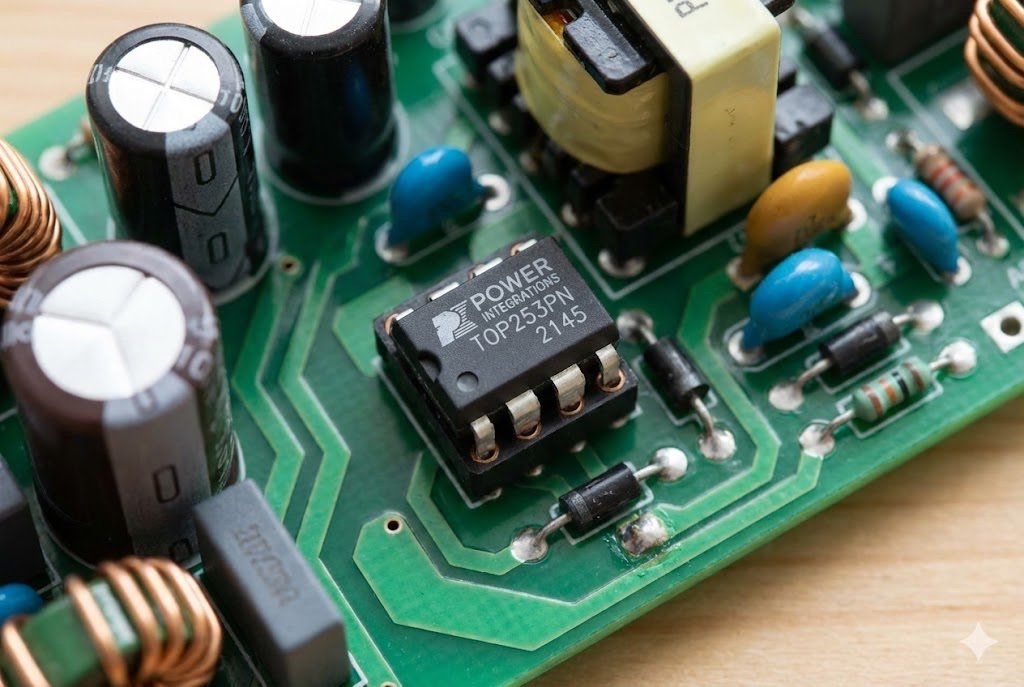
Many people think that the latest chip is always the best chip. I see this often in the industry. A young engineer chooses a high-frequency switcher2. The specs look amazing on paper. But when the factory tries to build it, problems start. The yield rate drops. The costs go up. This is why we need to look back at the TOP253PN1. It is not the newest, but it is often the smartest choice. Let me tell you why.
Is Newer Always Better When It Comes to Power Supply Design?
We often chase better efficiency and higher speeds in electronics design. However, does a complex, high-performance chip actually help a standard factory production line?
The TOP253PN1 wins because its feedback loop design3 is incredibly forgiving compared to modern chips. It does not require high-precision transformer winding4, which makes it much easier and safer to manufacture in bulk.
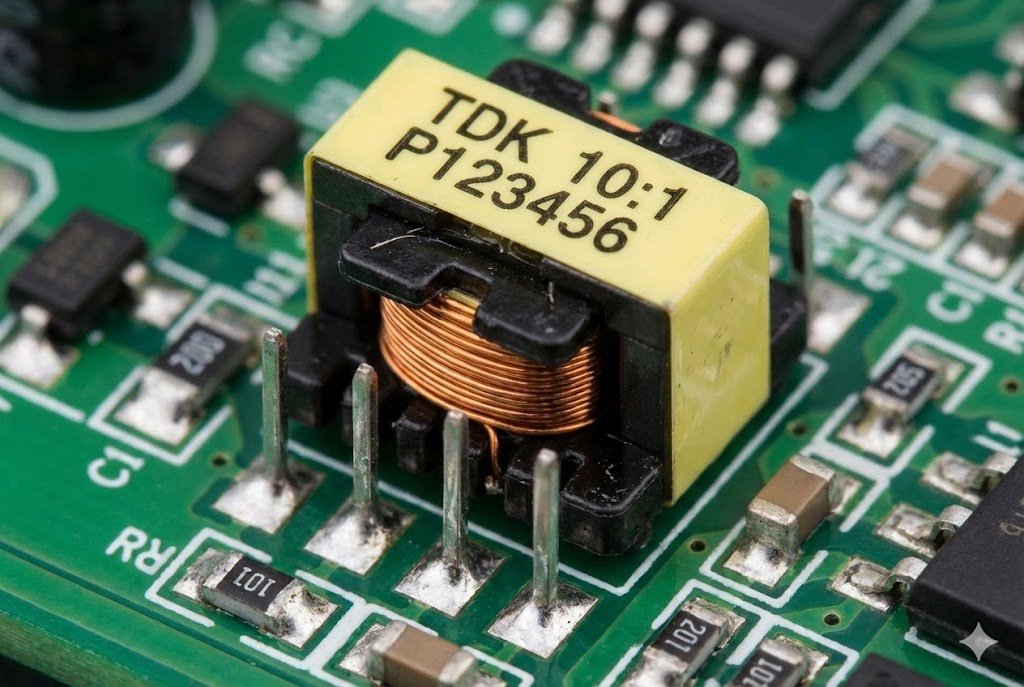
The Battle Between Maturity and Performance
I have worked with many clients at Nexcir who come to us with a specific problem. They switched to a modern, high-frequency chip like the InnoSwitch series. These new chips are fantastic. They offer incredible efficiency. But there is a catch. They are very sensitive.
The TOP253PN1 is different. It is mature. In the world of hardware, maturity means stability. The most critical insight here is about the transformer.
When you design a power supply with a very modern chip, the transformer must be perfect. The winding capacitance must be low. The leakage inductance must be exact. If the worker in the factory winds the wire slightly loosely, the modern chip might fail. It might trigger a protection mode. It might not start up.
The TOP253PN1 is "forgiving." Its feedback loop design3 allows for errors. It tolerates a transformer that is not perfect.
Why Design Tolerance Matters
| Feature | Modern High-Freq Chips | TOP253PN1 (TOPSwitch-HX) |
|---|---|---|
| Sensitivity | High sensitivity to parasitics | Low sensitivity, very robust |
| Transformer Rules | Strict winding techniques required | Standard winding is acceptable |
| EMI Noise | Hard to control, requires complex filters | Easier to manage with frequency jittering |
| Production Risk | High risk of batch failure | Low risk, consistent output |
I remember a project where a customer tried to save money by using a local factory for transformers. They used a high-end controller. The failure rate was 15%. They switched back to the TOP253PN1. The failure rate dropped to near zero.
This is critical thinking applied to manufacturing. Performance is not just about the datasheet. Performance is about whether you can build it consistently. The TOP253PN1 allows small and medium factories to produce high-quality power supplies without buying expensive, high-precision winding machines. It lowers the barrier to entry. This is why it remains the "First Choice."
Does a Cheaper Chip Really Mean a Cheaper Power Supply?
You might see a domestic clone chip that costs 20% less than the TOP253PN1. Does buying that cheaper component actually save you money in the end?
The TOP253PN1 reduces the Total System Cost5 because it integrates essential functions like current limits and thermal shutdown. This removes the need for 5 to 8 external components, saving board space and assembly costs.

The Truth About Total System Cost5
This is the most common trap in procurement. I see it all the time. A purchasing manager looks at the Bill of Materials (BOM). They see the TOP253PN1 costs, for example, $1.00. They see a generic clone that costs $0.80. They think, "I will save 20%."
But this is wrong. You must look at the Total System Cost5.
The TOP253PN1 is a highly integrated solution. It is not just a switch. It contains a lot of "smarts" inside the package.
- Soft-start: You do not need external capacitors to manage startup.
- Frequency Jittering6: This spreads the EMI spectrum. You can use a smaller, cheaper input filter.
- Current Limiting7: You do not need precise external sensing resistors.
- Thermal Shutdown8: It protects itself.
If you use a cheaper, less integrated chip, you must add components to the board to get these features.
The Math of Integration
Let's break it down.
- Passive Components: To match the TOP253PN1 performance with a cheaper chip, you might need to add 5 to 8 extra passive components (resistors, capacitors, diodes).
- Placement Cost: Every component you place on a PCB costs money. The pick-and-place machine takes time.
- Inventory Cost: You have to stock those 5 to 8 extra parts.
- Board Space: More parts mean a bigger PCB. A bigger PCB costs more.
A Real-World Example
I analyzed a board for a client recently.
- Scenario A: Cheap Clone Chip ($0.80) + 7 External Components ($0.15) + Extra Assembly Time ($0.05) = $1.00
- Scenario B: TOP253PN1 ($1.00) + 0 External Components + Fast Assembly = $1.00
The price is the same. But wait. We have not talked about the "Hidden Cost9."
The TOP253PN1 has a production pass rate10 (yield) of nearly 100%. The clone chip might vary from batch to batch. If you have to rework 5% of your boards, your cost skyrockets. The labor to fix a broken board destroys all your savings.
So, large OEMs stick with TOP253PN1. They know that the "chip price" is just the tip of the iceberg. The real savings come from a simple BOM and a production line that never stops.
How Does Reliability Affect Your Brand Reputation?
We have discussed the factory side, but what about the user side? Does using a proven component like the TOP253PN1 actually protect your business from future claims?
The reliability of the TOP253PN1 ensures that your product keeps working in harsh conditions for years. This builds trust with your customers and eliminates the massive expense of product returns and warranty claims.
The Long-Term Value of "Set It and Forget It"
At Nexcir, we talk a lot about "authenticity" and "reliability." These are not just buzzwords. They are financial safety nets.
When you ship a product, you want to forget about it. You do not want to see it again. If a power supply fails after six months, the customer returns it.
The Cost of Failure The TOP253PN1 is famous for its ruggedness. It handles "dirty power" very well. In many parts of the world, the AC grid is not stable. The voltage spikes. It dips.
A cheaper, less robust chip might explode under these conditions. The TOP253PN1 has excellent breakdown voltage margins. It can handle the stress.
Why does this matter to a procurement manager? Imagine you sell 10,000 units.
- With TOP253PN1: Failure rate is 0.01%. You get 1 return.
- With a Weak Clone: Failure rate is 1%. You get 100 returns.
Processing 100 returns is a nightmare. You have to pay for shipping. You have to analyze the failure. You have to send a replacement. Worst of all, your customer loses trust in you.
The "Sleep Well" Factor
I often tell my clients: "You are paying a little extra for the ability to sleep well at night."
The TOP253PN1 includes comprehensive protection features:
- Line Undervoltage (UV) detection: It prevents glitches when the power goes off.
- Line Overvoltage (OV) shutdown: It stops the chip from frying during a surge.
- Hysteretic Thermal Shutdown11n](https://www.ultralibrarian.com/2023/10/17/top253pn-datasheet-explanation-and-analysis-ulc/)%%%FOOTNOTE_REF_8%%%: It turns off if it gets too hot and turns back on when it cools down.
These features are automatic. You do not have to design them. They are built-in.
By using the TOP253PN1, you are essentially buying an insurance policy for your product. For small and medium factories, this is vital. They cannot afford a massive recall. A massive recall can bankrupt a small company.
Therefore, the decision to use TOP253PN1 is a strategic business decision. It protects your brand. It ensures that your end-users remain happy. In the long run, reliability is the only currency that matters.
Conclusion
The TOP253PN1 remains the top choice because it is easy to manufacture, lowers the total cost through integration, and guarantees long-term reliability for your products.
Explore why the TOP253PN chip is favored for its balance of performance and design maturity, ensuring high production yields and cost efficiency. ↩
Understand the challenges faced when using high-frequency switchers, including sensitivity and production risks, which can affect yield rates. ↩
Learn how the forgiving feedback loop design of TOP253PN allows for manufacturing errors, making it a reliable choice for factories. ↩
Discover the importance of precise transformer winding in modern chips and how it affects production success and chip performance. ↩
Find out how the integration of essential functions in TOP253PN lowers overall system costs by reducing the need for external components. ↩
Learn how frequency jittering spreads the EMI spectrum, allowing for smaller and cheaper input filters in power supply designs. ↩
Explore the significance of current limiting in reducing the need for precise external sensing resistors, enhancing chip reliability. ↩
Discover how thermal shutdown features in TOP253PN safeguard against overheating, ensuring long-term reliability. ↩
Uncover the hidden costs of using less integrated chips, including rework and labor expenses, which can negate initial savings. ↩
Learn about the importance of a high production pass rate in minimizing rework and ensuring consistent output in manufacturing. ↩
Discover the role of hysteretic thermal shutdown in automatically managing overheating, ensuring chip safety and durability. ↩