
Loose electrical connections1 cause dangerous fires and system failures. If you choose the wrong connector size2, you risk safety and compliance. I will explain color codes3 to help you pick the perfect wire nut.
Wire nut colors represent size and wire capacity. Blue is for small gauge wires4, orange and yellow are for general house wiring5, and red or gray are for heavy loads6. Matching the specific color to your wire gauge (AWG) ensures a tight, fire-safe connection.
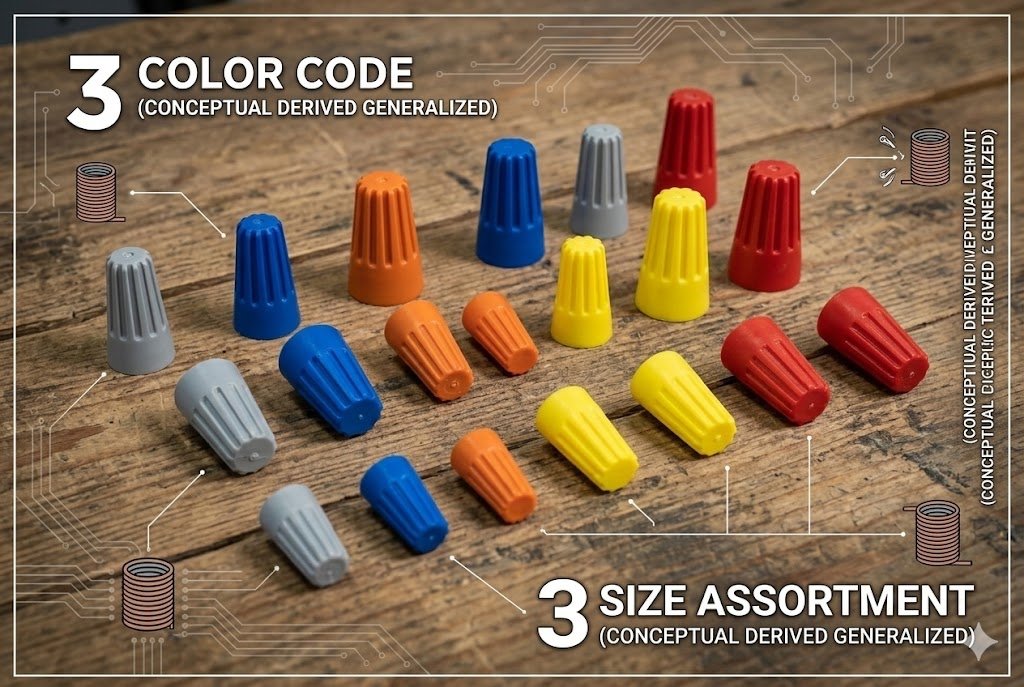
I have seen many engineers focus heavily on complex integrated circuits but neglect basic physical connections. This oversight can ruin an entire project. At Nexcir7, we supply high-end components, but we know that basic connectivity is the foundation of electronics. I want to guide you through the specifics of wire nut sizing so your final assembly is safe and reliable.
Why do wire nut colors matter for safety and performance?
Electrical failures often start at the physical connection point. Ignoring specifications leads to dangerous shorts or arcing. You need a standardized system8 to prevent these risks on your production line.
The colors are not just for decoration; they follow industry standards9 to indicate the minimum and maximum wire gauge (AWG) a connector can hold. This visual coding prevents overloading and ensures mechanical stability.
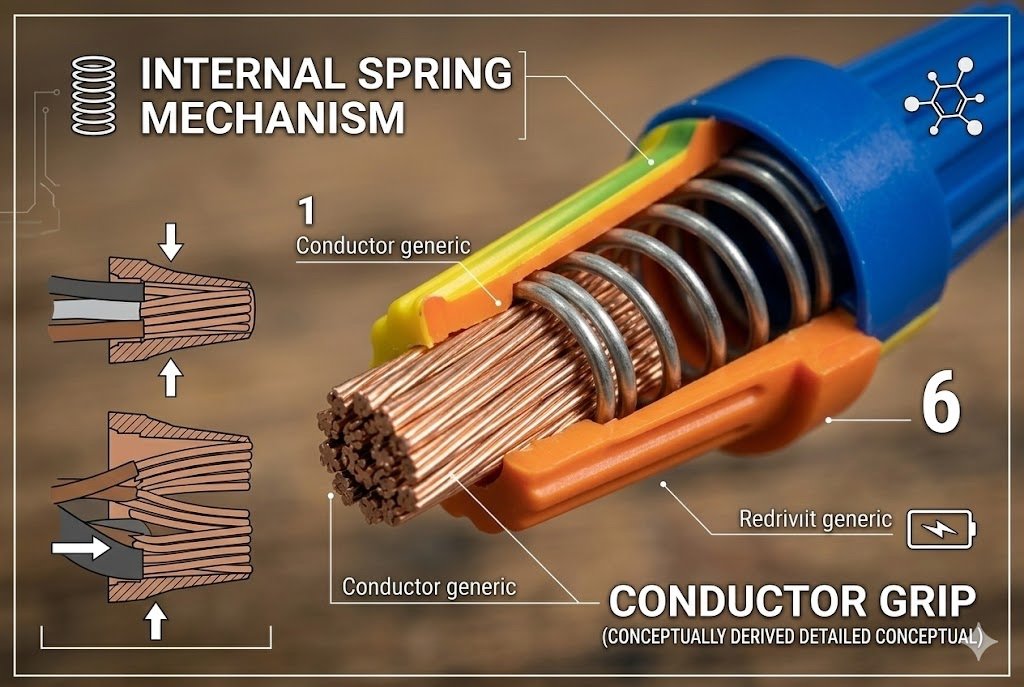
I often tell our OEM clients that the smallest component can cause the biggest headache. Wire nuts are a perfect example of this. The color coding system is a universal language in the electrical industry. It exists because you cannot easily measure the internal volume of a connector with your eye. If you use a connector that is too big, the internal spring will not grip the copper conductors. This leads to a loose connection. Loose connections create resistance. Resistance creates heat. Eventually, that heat can melt the plastic housing or start a fire.
On the other hand, if you use a connector that is too small, you might force it. This can crack the plastic shell. A cracked shell exposes live wires10 to the environment. This is a major safety violation. The color code tells you exactly what the internal spring can handle. It defines the range of the American Wire Gauge (AWG)11 that fits safely. For example, a blue nut cannot handle the same current load as a red nut. The plastic thickness and the metal spring tension are different for each color. Understanding this helps you maintain quality control in manufacturing. It ensures that every product leaving your facility meets safety standards.
What are the standard wire nut color codes3 and their AWG capacities?
Memorizing every wire combination is impossible on a busy job site or assembly floor. Guessing leads to costly rework. You need a reliable reference guide right now to verify your choices.
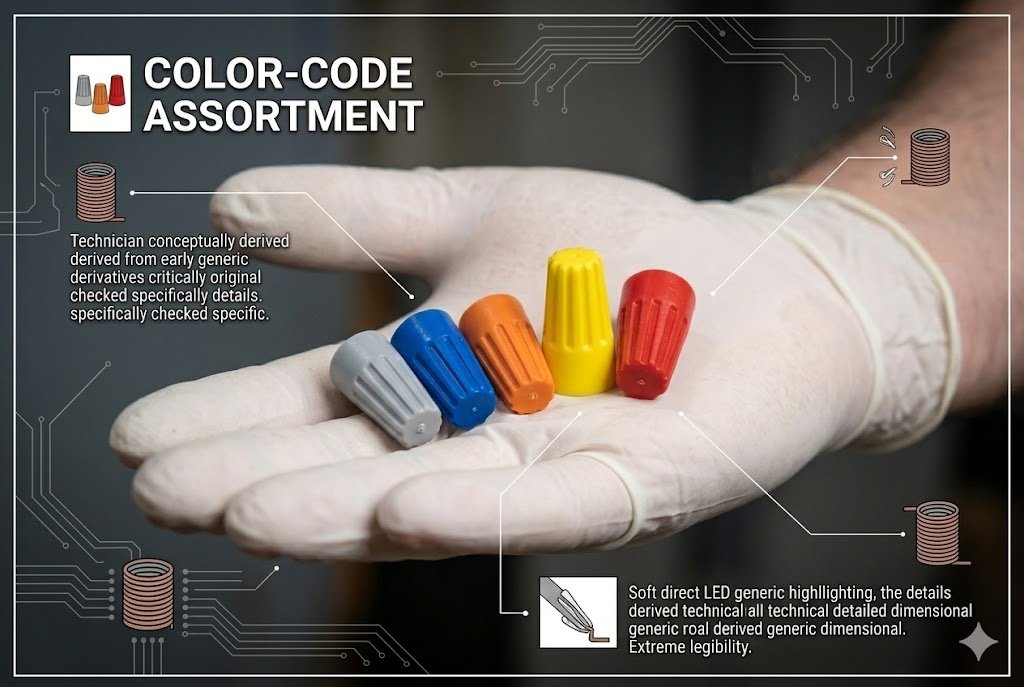
The standard progression is Grey (tiny), Blue (small), Orange (common lighting), Yellow (outlets), and Red (heavy duty). Each handles a specific range of American Wire Gauge (AWG)11 sizes and wire combinations.
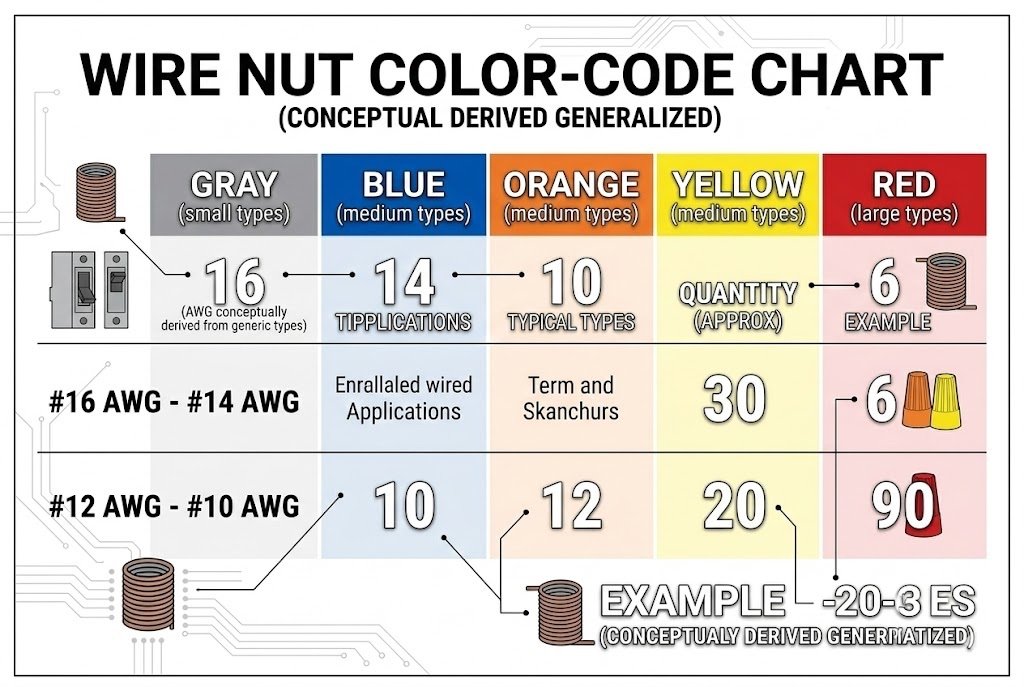
I have created a detailed breakdown below. This serves as a quick tool for your technicians and engineers. Please note that while brands may vary slightly, these are the general industry standards9 for twist-on wire connectors.
Quick Reference Guide: Color vs. Wire Gauge12
| Color Code | Size Category | Minimum Capacity | Maximum Capacity | Common Applications |
|---|---|---|---|---|
| Grey | Ultra-Small | 2x #22 AWG | 2x #16 AWG | Low-voltage wiring, device controls. |
| Blue | Small | 2x #22 AWG | 3x #16 AWG | Ballasts, control circuits, small appliances. |
| Orange | Medium-Small | 1x #18 + 1x #20 | 4x #16 AWG | Light fixtures, ceiling fans, switches. |
| Yellow | Medium | 2x #18 AWG | 3x #12 AWG | Residential outlets, switches, general circuitry. |
| Red | Large | 2x #14 AWG | 4x #10 AWG | 220V circuits, large appliance feeds, sub-panels. |
| Blue (Big) | Extra Large | 3x #12 AWG | 1x #6 + 2x #8 | Industrial feeds, heavy machinery connections. |
Detailed Breakdown
Grey and Blue Connectors13 These are the smallest standard sizes. I usually see these in delicate electronics or lighting ballast connections. They are perfect for stranded wires found in fixture leads. If you are working with thin control wires in an IoT device, these are your go-to choices. They do not hold much, so do not try to jam standard building wire into them.
Orange Connectors14 These are the workhorses for light fixtures. If you are connecting a ceiling fan or a light fixture to the main power, you will likely use orange. They bridge the gap between thin fixture wires and standard building wiring.
Yellow Connectors15 This is perhaps the most common size in residential and commercial wiring. I see these everywhere. They are designed to connect two or three standard 12-gauge or 14-gauge wires. If you are wiring electrical outlets, yellow is usually the correct choice.
Red Connectors When you have a lot of wires coming together in a junction box, you need red. They have a much wider opening and a stronger spring. They are necessary for heating units or when you need to bond four or five neutral wires together.
Big Blue/Grey (Industrial) These are huge. You will not find them in a typical home. They are for heavy industrial equipment. Since Nexcir7 deals with industrial clients, we know these are vital for heavy machinery power feeds.
How do you select the right wire nut for your specific project?
Having the right chart is useless if you do not know your total wire count. Jamming too many wires causes cracks and failures. You must calculate the combination correctly before twisting.
Count your wires and check their gauge to verify the total bulk. Add the wire sizes together or follow the manufacturer's combination chart. Never force a connector onto a bundle that exceeds its maximum rating.
I want to explain the process of selection because reading a chart is only the first step. You must use critical thinking to apply that data to the physical wires in your hand.
Step 1: Analyze the Wire Type
You must look at the wire itself. Is it solid copper or stranded copper? Stranded wire takes up slightly more space than solid wire because it flattens out. Most wire nut ratings are based on solid wire. If you are mixing solid and stranded wire, you need to be extra careful. I always recommend leading the stranded wire slightly ahead of the solid wire before twisting the nut on. This ensures the stranded wire gets caught by the spring.
Step 2: The "Circular Mil" Concept
Technically, wire size is measured in "circular mils." This is the cross-sectional area. A connector has a maximum capacity in circular mils.
- A #14 wire is smaller than a #10 wire.
- Two #14 wires take up less space than two #10 wires. Even if a red nut says it fits "up to 4 wires," that depends on the size of those wires. It might fit four #14 wires, but only two #10 wires. You cannot just count the number of wires; you must account for their thickness.
Step 3: Environmental Factors
You also need to consider where the connection lives. Is it a dry environment or a damp one?
- Standard Nuts: These are for dry locations only.
- Waterproof Nuts: These are usually filled with silicone sealant. They often have a different color scheme (like blue and gray caps) or specific labels. If you use a standard yellow nut outdoors, moisture will corrode the copper. The connection will fail. I have seen outdoor signage fail simply because the installer used an indoor wire nut.
Step 4: The Pull Test
After you select the color and twist it on, you must perform a pull test. Hold the nut and pull each individual wire gently. If a wire comes out, the connector is the wrong size, or you did not strip the wire correctly. The color code is a guide, but the physical connection is the proof. If the blue nut feels loose, move up to orange. If the orange nut feels like it is stripping the plastic threads, move up to yellow.
Step 5: Voltage Ratings
Most standard colored wire nuts are rated for 600 volts maximum for building wiring and 1000 volts for signs and fixtures. If you are working on high-voltage industrial electronics—an area where Nexcir7 has deep expertise—standard twist-on connectors might not be enough. You might need terminal blocks or compression lugs. However, for most control wiring and power distribution, the color codes3 hold true up to these voltage limits.
Conclusion
Correct wire nuts prevent fires and ensure equipment reliability. Use the color chart to match your wire gauge (AWG) to the connector. Nexcir7 supports your supply chain from simple components to complex ICs.
Understanding the risks of loose electrical connections can help you prevent fires and system failures in your projects. ↩
Learn why selecting the correct connector size is crucial for maintaining safety and compliance in electrical systems. ↩
Explore the significance of wire nut color codes to ensure you pick the right size for a safe and reliable connection. ↩
Discover which wire sizes are compatible with blue wire nuts to ensure a secure connection for small gauge wires. ↩
Find out how orange and yellow wire nuts are used in general house wiring to maintain safety and efficiency. ↩
Learn when to use red or gray wire nuts for heavy loads to prevent overloading and ensure mechanical stability. ↩
Explore Nexcir's range of high-end components and how they support basic connectivity in electronics. ↩
Understand the importance of a standardized system in preventing electrical risks and ensuring safety on production lines. ↩
Learn about the industry standards for wire nut color codes to ensure compliance and safety in your projects. ↩
Learn about the risks associated with a cracked wire nut shell and how it can expose live wires, leading to safety violations. ↩
Explore the American Wire Gauge (AWG) system to understand wire sizes and their compatibility with different wire nuts. ↩
Access a quick reference guide to easily match wire nut colors with the appropriate wire gauge for your projects. ↩
Find out where grey and blue wire connectors are typically used, especially in delicate electronics and lighting ballast connections. ↩
Learn about the common applications of orange wire connectors, particularly in light fixtures and ceiling fans. ↩
Discover when to use yellow wire connectors, especially in residential and commercial wiring for outlets and switches. ↩