AI servers use too much power1. Traditional power setups cause huge energy bills and heat problems. HVDC solves this by cutting energy waste2 right at the rack level.
High-Voltage Direct Current (HVDC) powers AI server racks by delivering 400V DC directly to the servers3. This method skips traditional DC-AC-DC conversions. It saves up to 20% in energy losses4. It also reduces cooling needs5 and increases the overall power density6 for high-performance AI computing.
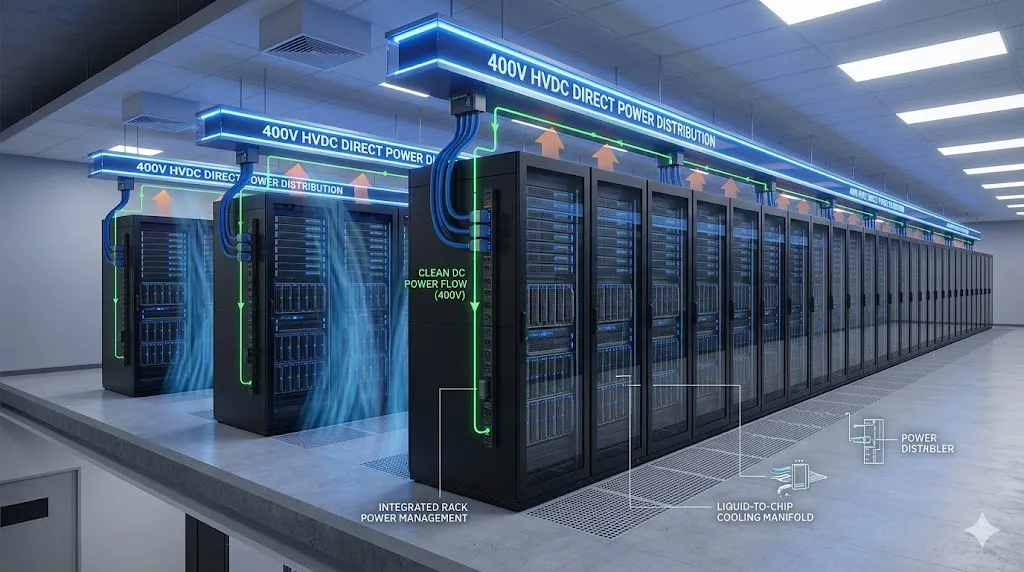
I remember walking through a massive data center last year. The heat hit me like a wall. The facility manager looked stressed. He told me their energy costs were out of control. That moment made me realize we need a better way. I saw that traditional power delivery was failing modern AI demands. Let us look closely at how HVDC changes the game for power delivery.
Why Are AI Data Centers Shifting to 400V DC Power?
Upgrading AI hardware demands more power. Standard 48V or AC systems cannot handle this load without massive cables. A 400V DC system delivers more power with less copper.
AI data centers shift to 400V DC power7 because it cuts cable size and copper costs8. Higher voltage means lower current for the same power. This reduces heat in the cables. It directly supports the massive power needs of modern AI chips9 like GPUs.
I review power designs with hardware engineers often. I always see the same problem. AI chips draw too much current. Standard systems fail. We must break down why 400V is the new standard.
The Math Behind 400V DC
Power equals voltage times current10. If we keep voltage low, we need high current. High current creates heat. It also requires thick, heavy cables. By moving to 400V, we drop the current. We use thinner cables. We save space in the rack.
Hardware Changes
The shift to 400V changes the components we need. Engineers must select new connectors, fuses, and power management ICs (PMICs). At Nexcir, we help teams find these high-voltage parts.
| Feature | Traditional AC System | 400V HVDC System |
|---|---|---|
| Cable Size | Thick and heavy | Thin and light |
| Copper Cost | High | Low |
| Rack Space | Crowded | Open for airflow |
| Scalability | Limited | High for AI GPUs |
This simple change makes a huge difference. I see clients save thousands of dollars on copper alone. They also improve the airflow in their racks. Airflow keeps the AI chips cool. Cool chips run faster and last longer.
How Does HVDC Reduce Power Conversion Losses?
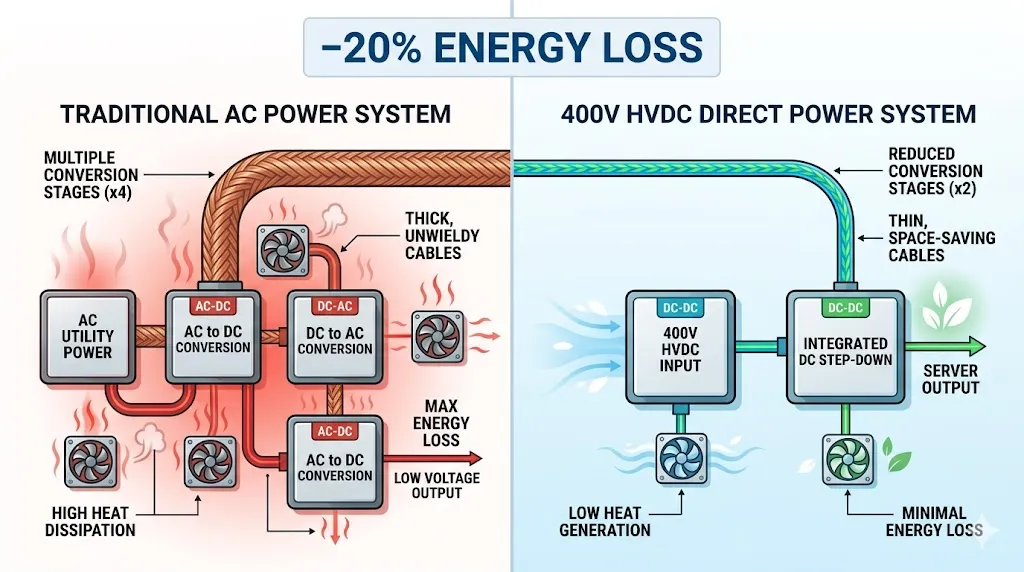
Every power conversion wastes energy as heat. Traditional setups convert power from AC to DC multiple times. HVDC stops this waste by keeping the power in DC format.
HVDC reduces power conversion losses11 by removing the DC-AC-DC steps12. The grid provides AC power. The facility converts it to 400V DC once. The rack distributes this DC power directly to the servers. This single conversion saves massive amounts of electricity and lowers cooling costs.
I talk to OEM procurement managers about energy waste a lot. They hate paying for power that just turns into heat. Let us look at the traditional power path.
The Problem with DC-AC-DC
In older systems, the UPS converts AC to DC. Then it converts DC back to AC. Finally, the server power supply converts AC back to DC. Each step loses about 5% of the power. This is a huge waste.
The HVDC Solution
HVDC fixes this. The facility converts AC to 400V DC one time. The power stays DC all the way to the AI chip.
| Power Stage | Traditional System | HVDC System |
|---|---|---|
| Grid Input | AC | AC |
| Facility UPS | AC to DC to AC | AC to DC (400V) |
| Server Input | AC to DC (12V/48V) | DC to DC (48V) |
| Total Conversions | 3 to 4 steps | 2 steps |
| Energy Lost | 15% to 20% | 5% to 10% |
Fewer conversions mean less heat. Less heat means we need fewer cooling fans. This saves even more power. I helped a client redesign their power supply chain last month. They removed two conversion steps. Their total power bill dropped by 12%. This kind of saving is vital for large AI facilities. We must eliminate unnecessary steps to protect the budget.
Why Are GaN Devices Surging in HVDC Power Modules?
Silicon chips cannot handle fast switching at high voltages well. They get too hot and waste space. Gallium Nitride (GaN) devices solve this by switching faster and staying cool.
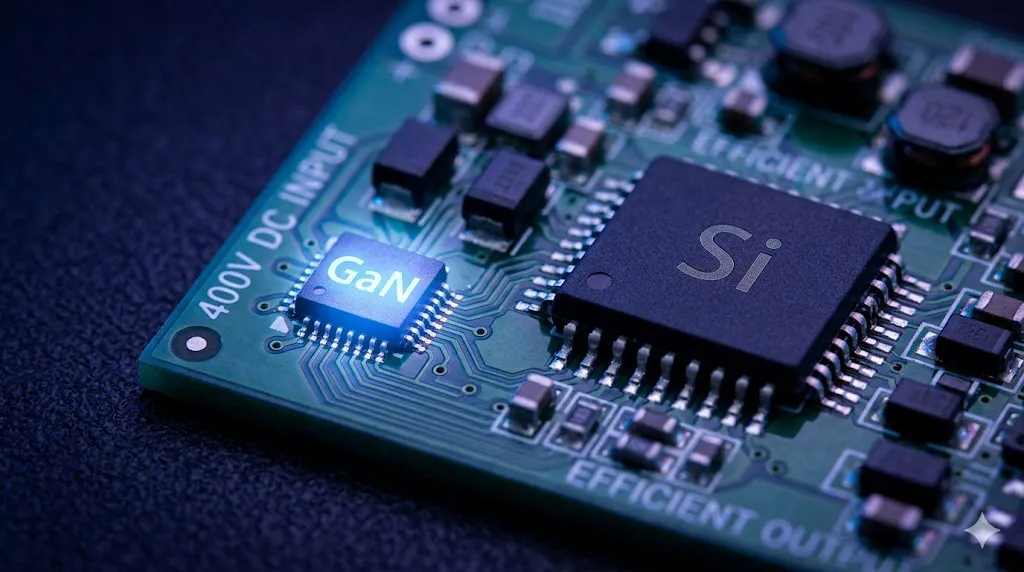
GaN devices are surging in HVDC power modules13 because they offer superior efficiency14. GaN handles 400V DC easily15. It switches faster than standard silicon. This allows engineers to use smaller capacitors and inductors. The final power module becomes much smaller, more efficient, and perfect for dense AI racks.
In my 20 years in the electronics industry, I have rarely seen a technology grow as fast as GaN. AI racks have no extra space. Every inch matters. This creates a massive demand for smaller power modules.
The Limits of Silicon
Silicon MOSFETs have reached their limit. If you push them to switch faster at 400V, they overheat. They require large heat sinks. Large heat sinks take up valuable space in the AI server.
The Power of GaN
GaN is a wide-bandgap material. It handles high voltage without breaking a sweat.
| Metric | Silicon (Si) MOSFET | Gallium Nitride (GaN) |
|---|---|---|
| Switching Speed | Slow | Very Fast |
| Size | Large | Small |
| Heat Generation | High | Low |
| Efficiency at 400V | Good | Excellent |
Because GaN switches so fast, the surrounding passive components shrink. The whole power supply unit gets smaller. I source thousands of GaN parts every week at Nexcir. Our customers demand them constantly. They need to pack more AI power into the same rack space. GaN is the only way to achieve this high power density. We see GaN replacing silicon in almost every new AI power design.
How Can Procurement Teams Source Reliable GaN and Power ICs?
Finding authentic GaN chips is hard. Fake components cause AI servers to crash and burn. You need a trusted supply chain to get real parts on time.
Procurement teams can source reliable GaN and power ICs by partnering with experienced global distributors. You must verify that all parts come from authorized sources. You should demand full traceability. A strong partner will lock in stable pricing and protect your production from sudden market shortages.

I talk to hardware engineers every day. Their biggest fear is a fake component. A counterfeit GaN chip in a 400V system will explode. It will destroy a very expensive AI GPU. This is a risk you cannot take.
The Risk of Counterfeits
The high demand for AI power parts creates a black market. Brokers sell untested chips. Procurement teams sometimes buy these parts to save time. This is a huge mistake.
The Nexcir Approach
At Nexcir, we solve this pain point directly. We have a strict zero-counterfeit policy. We only source from authorized distributors and original makers.
| Sourcing Method | Risk Level | Pricing | Delivery |
|---|---|---|---|
| Open Market Brokers | Very High | Unstable | Unpredictable |
| Nexcir Global Network | Zero Risk | Stable | Fast and Safe |
We bring 20 years of experience to the table. We know how to spot market trends early. We help our clients find alternative parts when original items are End-of-Life. We give you total transparency. You will always know exactly where your high-voltage chips come from. This trust keeps your AI production lines running smoothly. We protect your supply chain from start to finish.
What is the Future of HVDC in High-Density AI Architectures?
AI models are growing rapidly. Next-generation servers will need even more power. If we do not plan now, current data centers will fail to support future AI.
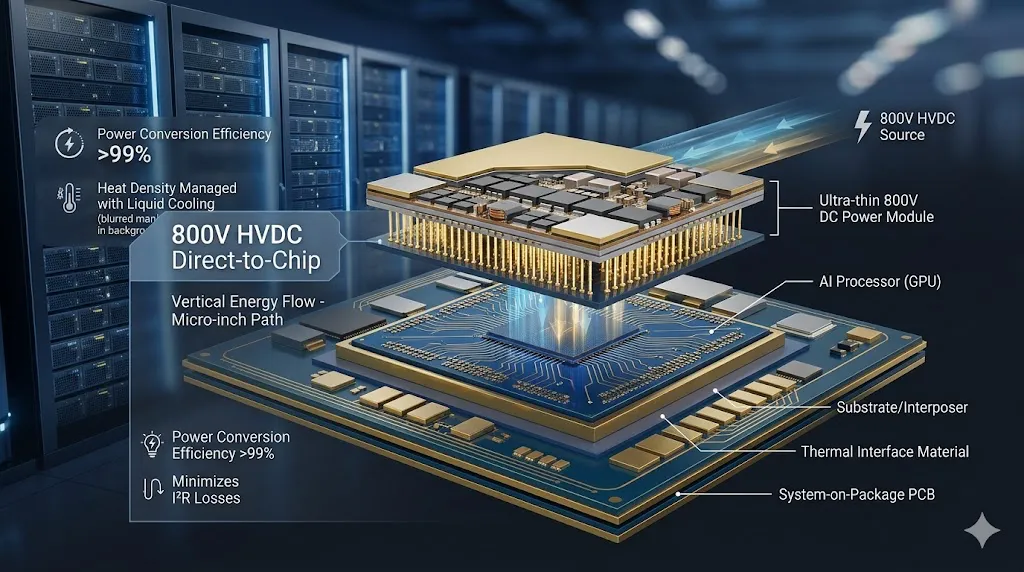
The future of HVDC in AI architectures16 points toward even higher voltages and direct-to-chip power delivery. We will see systems move beyond 400V to 800V17. Power modules will sit closer to the AI processors. This will eliminate almost all distribution losses and support extreme computing densities.
I always tell my clients to look ahead. What works today will not work tomorrow. AI chips consume 1000 watts today. Soon, they will consume 2000 watts. We must prepare for this future.
Moving to 800V
Automotive electric vehicles already use 800V systems. AI data centers will follow this trend soon. 800V will cut cable sizes in half again. It will make power delivery even more efficient.
Direct-to-Chip Delivery
We will also see power modules moving directly onto the processor board.
| Architecture | Power Path | Efficiency | Target Application |
|---|---|---|---|
| Current 12V | Rack to Board | Low | Old Servers |
| Current 400V HVDC | Rack to Shelf | High | Current AI |
| Future 800V HVDC | Rack to Chip | Maximum | Next-Gen AI |
As these new architectures emerge, the demand for advanced semiconductors will explode. We will need new silicon carbide and GaN solutions. At Nexcir, we are already mapping out these future supply chains. We want our clients to be ready for the next wave. We want to be your long-term partner in building a smarter future. We will secure the parts you need for the next decade.
Conclusion
HVDC at 400V and GaN devices cut AI power losses drastically. Nexcir provides the authentic, stable supply chain you need to build these advanced, high-density AI power systems safely.
Understanding why AI servers consume so much power can help in finding solutions to reduce energy costs and improve efficiency. ↩
Exploring how HVDC reduces energy waste can provide insights into more sustainable and cost-effective power solutions for AI servers. ↩
Discovering the benefits of 400V DC delivery can highlight its impact on efficiency and performance in AI data centers. ↩
Learning about the energy savings from HVDC can guide decisions on implementing this technology for cost reduction. ↩
Understanding how HVDC reduces cooling needs can lead to more efficient thermal management strategies in data centers. ↩
Exploring how HVDC increases power density can reveal its role in enhancing the performance of AI computing systems. ↩
Investigating the shift to 400V DC power can provide insights into the evolving power needs of AI data centers. ↩
Understanding how 400V DC reduces cable size and copper costs can highlight its economic benefits for data centers. ↩
Learning how 400V DC supports AI chips can help in designing systems that meet the demands of advanced AI technologies. ↩
Understanding this fundamental relationship can aid in optimizing power delivery systems for efficiency. ↩
Exploring how HVDC reduces conversion losses can lead to more efficient power management in data centers. ↩
Learning about the benefits of removing conversion steps can highlight ways to improve energy efficiency. ↩
Understanding the popularity of GaN devices can reveal their advantages in modern power systems. ↩
Exploring the efficiency of GaN devices can provide insights into their growing use in power modules. ↩
Learning how GaN devices manage 400V DC can highlight their role in advanced power systems. ↩
Exploring the future of HVDC can provide insights into upcoming trends and innovations in AI power systems. ↩
Understanding the shift to 800V can reveal its potential benefits and impact on future AI data center designs. ↩