Failing EMI tests can ruin your production schedule and budget. It forces you to redesign boards and add costly parts. But there is a smarter way to handle noise without extra filters.
Frequency jittering1 in the LNK304DN2 spreads switching energy3 across a wider frequency band. This lowers the average EMI levels below limit lines. It allows engineers to pass strict appliance certifications4 like EN55014 without adding large, expensive common mode chokes5, saving over 30% of PCB space6.
I have seen many engineers struggle with noise issues7 in tight spaces. They often think they need more components to fix it. Let me explain why that is not always true.
What Exactly Is Frequency Jittering and How Does It Reduce EMI?
You might hear this term often in power supply design. But understanding how it actually works is key to fixing your noise problems permanently.
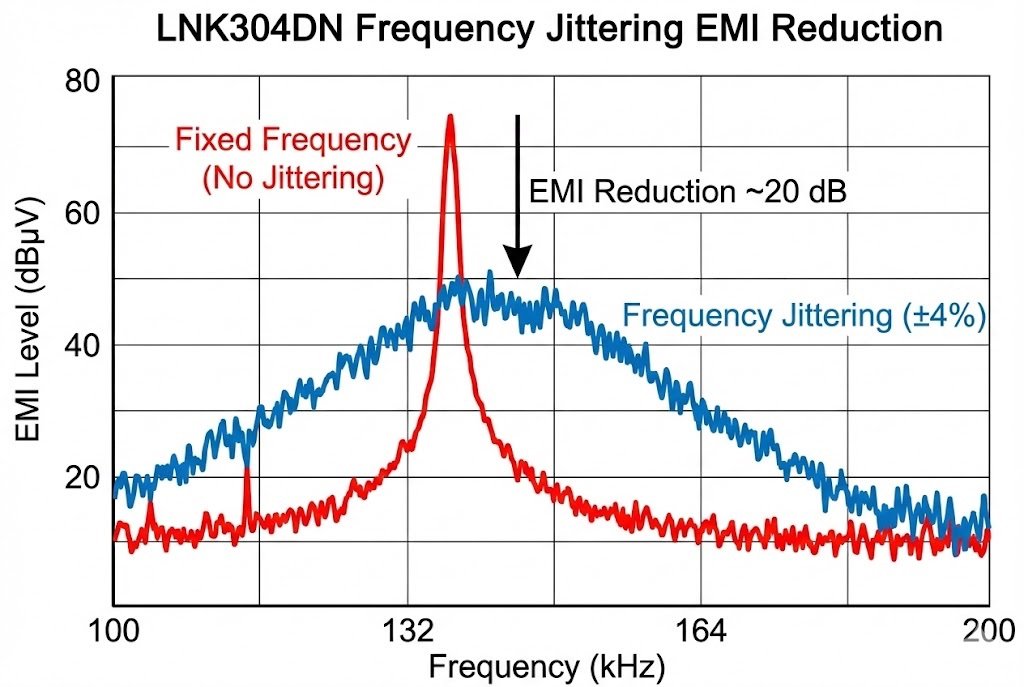
The frequency jittering feature modulates the switching frequency of the power supply chip8. Instead of concentrating energy at one peak, it spreads the noise over a range. This lowers the peak amplitude significantly.
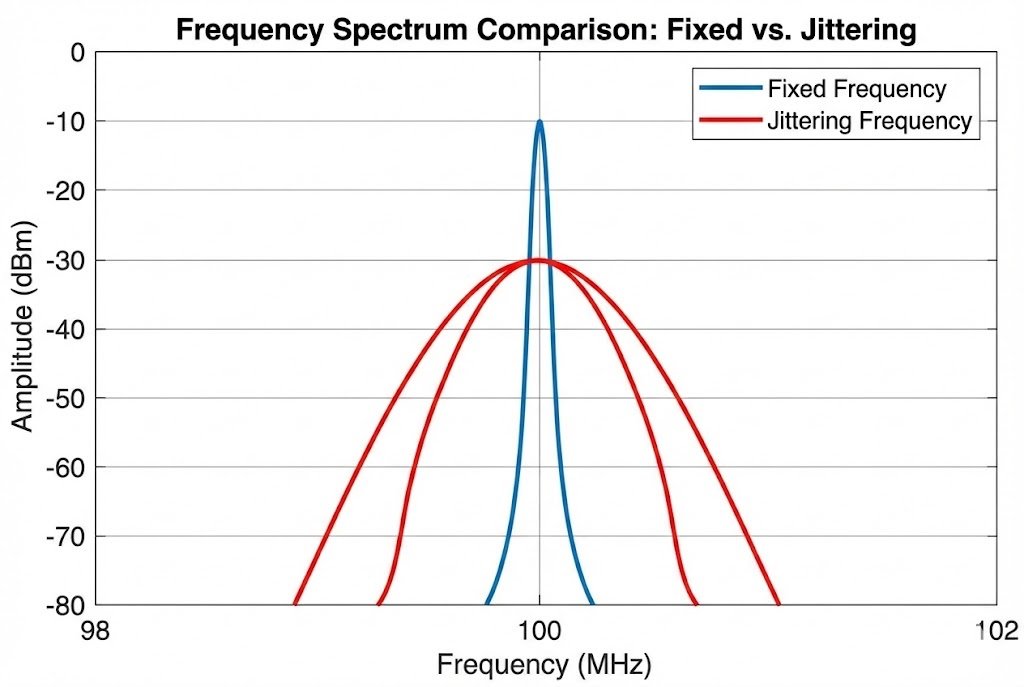
I want to explain this concept simply. Imagine you are hitting a drum. If you hit it at the exact same speed every second, the sound becomes a very loud, constant tone. This tone is easy to detect. This is how a standard fixed-frequency switching controller works. It creates a large spike of energy at a specific frequency, like 66 kHz. This spike often goes above the limit line in an EMI test.
Now, imagine you change your speed slightly. You hit the drum a little faster, then a little slower. The total amount of energy you put into the drum is the same. But the sound is not a constant tone anymore. It is a "shushing" sound. The peak volume at any single moment is lower. This is what the LNK304DN2 does. It has an internal oscillator. This oscillator changes the switching frequency by a small amount, typically around 4 kHz.
This technique spreads the harmonic energy9. It moves the energy to "sidebands." When an EMI receiver measures the noise, it uses a specific bandwidth. Because the energy is spread out, the receiver measures less noise at the center frequency. This is critical for Quasi-Peak and Average detection modes10. You do not need to understand complex math to see the benefit. The result is a drop in measured noise by 5 dB to 10 dB. This drop is often the difference between passing and failing a test.
| Feature | Standard Controller | LNK304DN2 |
|---|---|---|
| Switching Mode | Fixed Frequency | Jittered Frequency |
| Energy Distribution | Concentrated at Harmonics | Spread over Sidebands |
| Peak EMI Level | High | Low |
| Filter Requirement | Complex (High Order) | Simple (Low Order) |
How Can LNK304DN2 Save Over 30% of Your PCB Space?
Space is money in modern electronics design. Finding room for big filters in a compact device like a coffee maker is very hard.
By lowering the noise floor, the LNK304DN2 removes the need for bulky input filters. You can use smaller, cheaper components. This frees up critical board real estate for other features.
I have worked with many clients at Nexcir who design small home appliances. Think about a hair curling iron or a smart coffee machine. The shape of these products is very specific. The curling iron handle is a tube. You have almost no space for the circuit board. Every millimeter counts. This is where the "inch of land, inch of gold" concept applies.
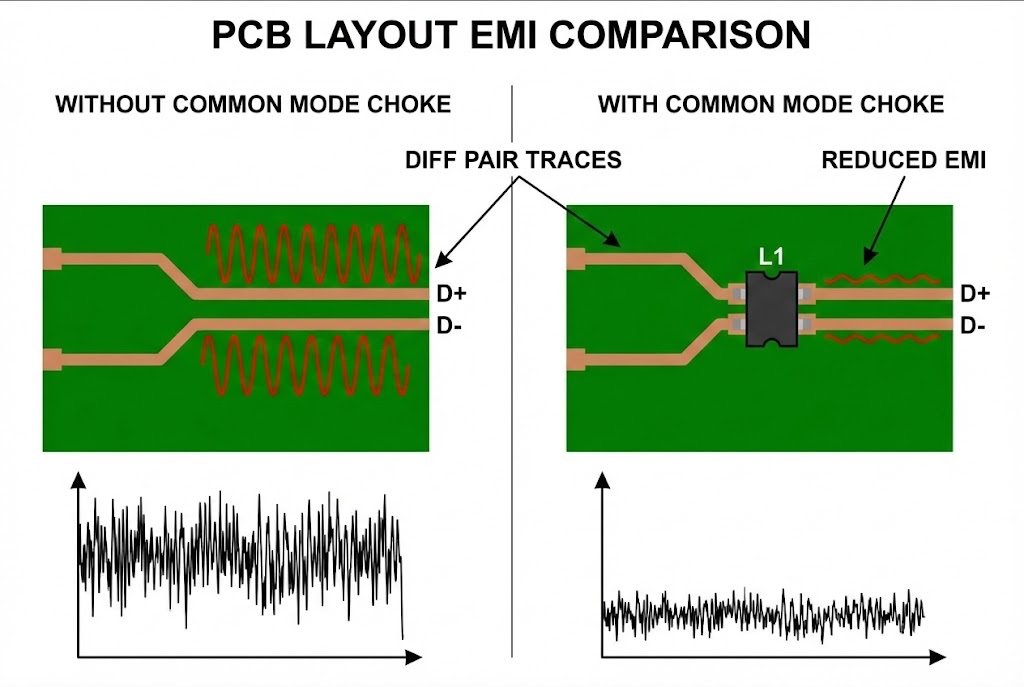
Many cheap power solutions require a Common Mode Choke (CMC)11 to pass EMI tests. A CMC is a magnetic component with two windings. It is usually bulky. It might be 10mm by 10mm or larger. It is also tall. In a slim handle, a tall component is a disaster. It might force you to change the plastic mold. That costs thousands of dollars.
The LNK304DN2 solves this. Because the frequency jittering reduces the noise at the source, you do not need the CMC. You can often use a simple "Pi" filter. This consists of two small capacitors and a cheap inductor. Sometimes, you only need an input capacitor.
Let us look at the math of the space.
- Remove: Common Mode Choke (approx. 100 mm²).
- Remove: X-Capacitor (often large, approx. 80 mm²).
- Add: Simple inductor (drum core, approx. 20 mm²).
The net saving is huge. You can reduce the EMI filter section of your PCB by 30% to 50%. This allows you to make the board smaller. Or, you can add more features, like a Bluetooth module12 or a better display driver, in the same space. For my clients, this flexibility is a "fatal attraction." It makes their product look better and sell better.
Why Is This Approach Better Than Using Expensive Common Mode Chokes?
We all want to cut costs in manufacturing. But we cannot sacrifice quality or safety just to save a few cents on a component.
Common mode chokes are heavy, expensive, and fragile. Relying on the chip's internal logic eliminates this part cost. It also simplifies your supply chain13 and reduces assembly time.
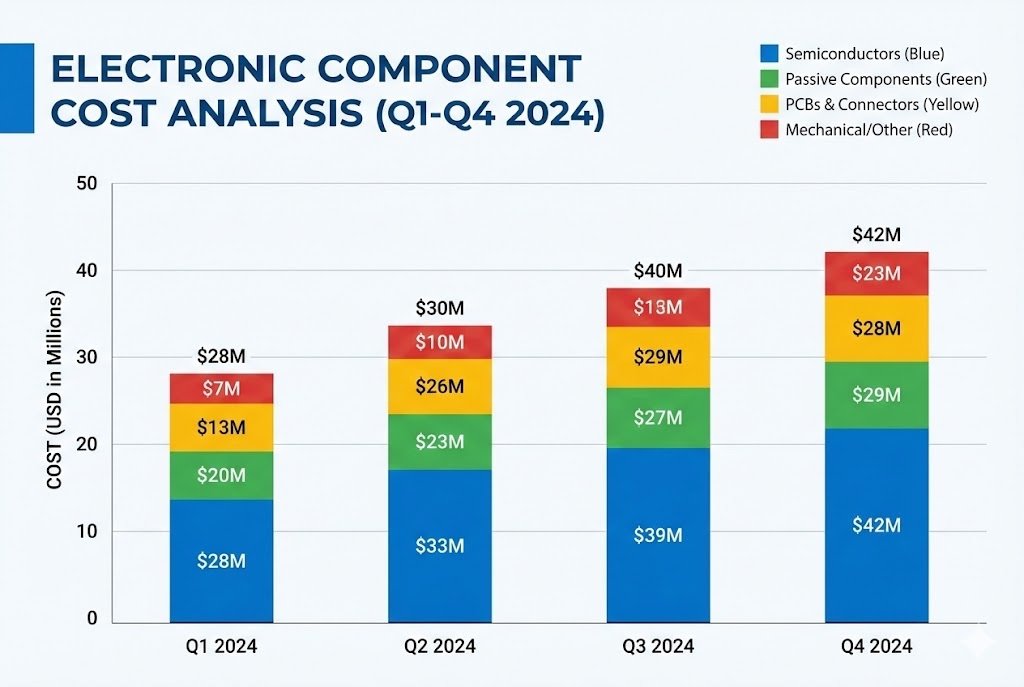
I often see a common mistake in procurement. Buyers look at the price of the IC alone. They see a generic chip that costs $0.05 less than the LNK304DN2. They think they are saving money. But they are missing the bigger picture. This is a trap.
If you use a cheap, fixed-frequency chip, you will fail the EMI test. To fix it, you must add a Common Mode Choke. A good quality choke costs anywhere from $0.10 to $0.30. It is much more expensive than the savings on the chip.
Also, magnetics are heavy. In high-vibration environments, like a blender or a washing machine, heavy parts can break their solder joints. This leads to field failures. The LNK304DN2 solution is solid-state. The jittering happens inside the silicon. Silicon does not break from vibration.
There is also the supply chain13 aspect. At Nexcir, we know that sourcing custom magnetics can be a headache. Lead times for specific chokes can be long. Standard inductors and capacitors are easy to find. They are always in stock. By using the LNK304DN2, you simplify your Bill of Materials (BOM)14. You rely on standard parts. This makes your production line more stable.
Here is a breakdown of the hidden costs of using a CMC:
- Part Cost: High copper and core cost.
- Assembly: Heavier parts may require manual insertion or glue.
- Logistics: Heavier boards cost more to ship.
- Reliability: Risk of coil whining or solder fatigue.
The LNK304DN2 avoids all of this. It uses "intellectual property" inside the chip to replace "copper and iron" on the board. This is smart engineering.
How Does This Technology Simplify the Home Appliance Certification Process?
Certification labs are strict and unforgiving. Failing a test there costs thousands of dollars and weeks of wasted time.
The LNK304DN2 is designed to meet standards like EN55014 and CISPR 22 class B. The jittering ensures ample margin below the limits, giving you confidence during the final testing phase.
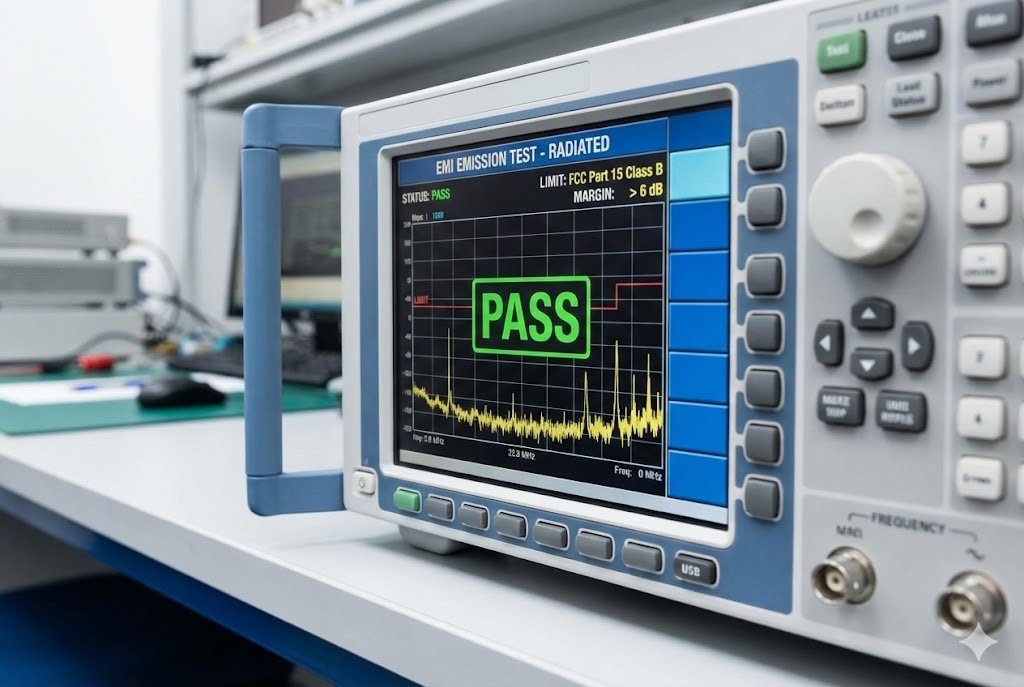
I have been in the lab when a product fails certification. It is a stressful moment. The engineers look at the screen. They see a red spike crossing the limit line. Usually, it is at the fundamental switching frequency. If you are using a fixed-frequency chip, that spike is stubborn. It is hard to push down without adding big filters.
With the LNK304DN2, the graph looks different. The peaks are lower and wider. This is very important for the "Quasi-Peak" measurement. This measurement weighs the signals based on how often they happen. Because the jittering keeps moving the frequency, the detector does not see a constant noise at one spot. This results in a much lower reading.
The goal is not just to pass. The goal is to pass with "margin." You want your noise to be at least 6dB below the limit line. Why? Because components vary. The capacitor you buy today might be slightly different next year. If you pass with only 1dB margin, a small change in production could cause a failure later.
Frequency jittering1 gives you that safety margin. It provides a buffer. This is essential for mass production. It means you can sleep well at night knowing your products shipping to Europe or North America will not be seized by customs for non-compliance.
At Nexcir, we ensure our clients get authentic LNK304DN2 parts. Counterfeit chips often lack this precise jittering circuit. They might look the same, but they run at a fixed frequency. Using a fake chip will cause you to fail these tests immediately. We verify the origin of every reel to ensure the jittering technology is active and effective.
Conclusion
The LNK304DN2 uses frequency jittering to lower EMI noise, remove the need for bulky filters, save PCB space6, and ensure you pass certification easily without expensive magnetics.
Understanding frequency jittering can help you reduce EMI noise effectively without adding costly components. ↩
Learn how LNK304DN can save PCB space and reduce EMI noise, making it ideal for compact electronic devices. ↩
Discover how spreading switching energy across a wider frequency band can lower EMI levels and improve device performance. ↩
Explore how meeting strict appliance certifications can ensure product compliance and avoid costly redesigns. ↩
Find out why common mode chokes are often used to pass EMI tests and how alternatives can save space and cost. ↩
Find out how minimizing EMI filters can free up PCB space for additional features in electronic devices. ↩
Learn effective strategies to handle noise issues without adding extra components, saving space and cost. ↩
Understand how modulating the switching frequency of a power supply chip can lower peak EMI levels. ↩
Discover the benefits of spreading harmonic energy to lower peak amplitude and pass EMI tests. ↩
Explore how Average detection modes can help in accurately measuring EMI noise levels. ↩
Discover the drawbacks of using CMCs, including their size, cost, and impact on product design. ↩
Learn how freeing up PCB space can enable the integration of additional features like Bluetooth modules. ↩
Explore the advantages of a simplified supply chain, including reduced lead times and stable production. ↩
Learn how simplifying the BOM can streamline production and reduce costs in electronics manufacturing. ↩