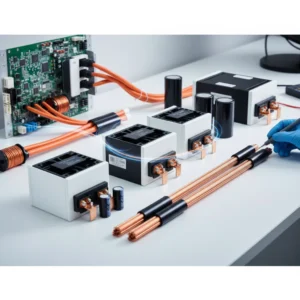
Choosing between an IGBT (Insulated Gate Bipolar Transistor) and a MOSFET is one of the most important decisions in power electronics design.
Both devices are widely used in motor drives, power converters, EV systems, industrial controls, and renewable energy equipment.
However, their electrical characteristics differ significantly. Selecting the wrong device may cause excessive heat, switching loss, or even system failure.
This article explains the differences between MOSFETs and IGBTs and provides clear guidance on when to use each one.
⚡ 1. Understanding the Basic Difference
MOSFET (Metal-Oxide-Semiconductor FET)
-
Voltage-controlled
-
Fast switching
-
Low conduction loss at low voltages
-
Ideal for high-frequency applications
IGBT (Insulated Gate Bipolar Transistor)
-
Hybrid device (MOSFET input + BJT output)
-
Handles high voltage and high current
-
More efficient at high power levels
-
Better for medium-frequency applications
🚀
2. Switching Speed Comparison
MOSFET
✔ Extremely fast
✔ Suitable for 100 kHz – MHz switching
✔ Ideal for SMPS, DC-DC converters
IGBT
✔ Slower switching
✔ 1–20 kHz typical
✔ Higher switching loss
If your design requires very high switching frequency, MOSFET is almost always the better choice.
🔌 3. Voltage and Current Handling
MOSFET
-
Performs best below ~250–300V
-
Efficiency drops at high voltage
-
Lower conduction loss at low voltage
IGBT
-
Ideal for 300V – 1200V+
-
Handles high current extremely well
-
Better efficiency at high power levels
For applications above 600V, IGBT is usually the preferred device.
🌡️ 4. Efficiency and Thermal Behavior
MOSFET
✔ Lower switching loss
✔ Lower gate charge
✔ Better at light-load efficiency
✔ Less heat at high-frequency operation
IGBT
✔ Lower conduction loss at high voltage
✔ Better thermal stability in high-load systems
✔ Ideal for heavy-duty industrial use
📦 5. Cost Considerations
MOSFETs are generally:
-
Cheaper in low-voltage ranges
-
More expensive for high-current, high-voltage devices
IGBTs are generally:
-
Cost-effective for high-power designs
-
Cheaper alternatives for motor drives and inverters
🧩 6. Typical Application Comparison
MOSFET Applications
-
DC-DC power supplies
-
Low-voltage motor control
-
Battery-powered devices
-
Robotics, drones
-
LED lighting
-
Consumer electronics
IGBT Applications
-
Industrial motor drives
-
Electric vehicle inverters
-
UPS systems
-
Solar inverters
-
High-voltage power converters
-
Welding machines
-
HVAC compressors
If the application is high-power and above 400V → use IGBT.
If the application is fast-switching and low-voltage → use MOSFET.
📘 7. Quick Selection Guide
|
Specification |
MOSFET |
IGBT |
|---|---|---|
|
Switching Speed |
⭐⭐⭐⭐⭐ |
⭐⭐ |
|
Voltage Range |
<300V |
>300V |
|
Power Level |
Low → Medium |
Medium → High |
|
Efficiency at High Frequency |
High |
Low |
|
Efficiency at High Voltage |
Medium |
High |
|
Applications |
DC-DC, SMPS, portable |
EV, industrial drives, solar |
🧾 Conclusion
Both MOSFETs and IGBTs are essential in modern power electronics.
Your choice should be based on voltage, switching frequency, power level, and efficiency requirements.
-
Choose MOSFET for low-voltage, high-speed, high-efficiency applications.
-
Choose IGBT for high-voltage, high-power, industrial applications with lower switching frequencies.
Selecting the right device ensures reliability, performance, and long-term system stability.