Do you struggle with noisy data when reading pressure sensors in a factory environment?
The 4-20mA current loop1 is the industry standard for transmitting sensor data over long distances because it is immune to voltage drops and electrical noise. To implement this, you need a precise operational amplifier2 (Op-Amp) to create the transmitter and a high-resolution ADC3, like the ADS11154, to read the signal accurately.
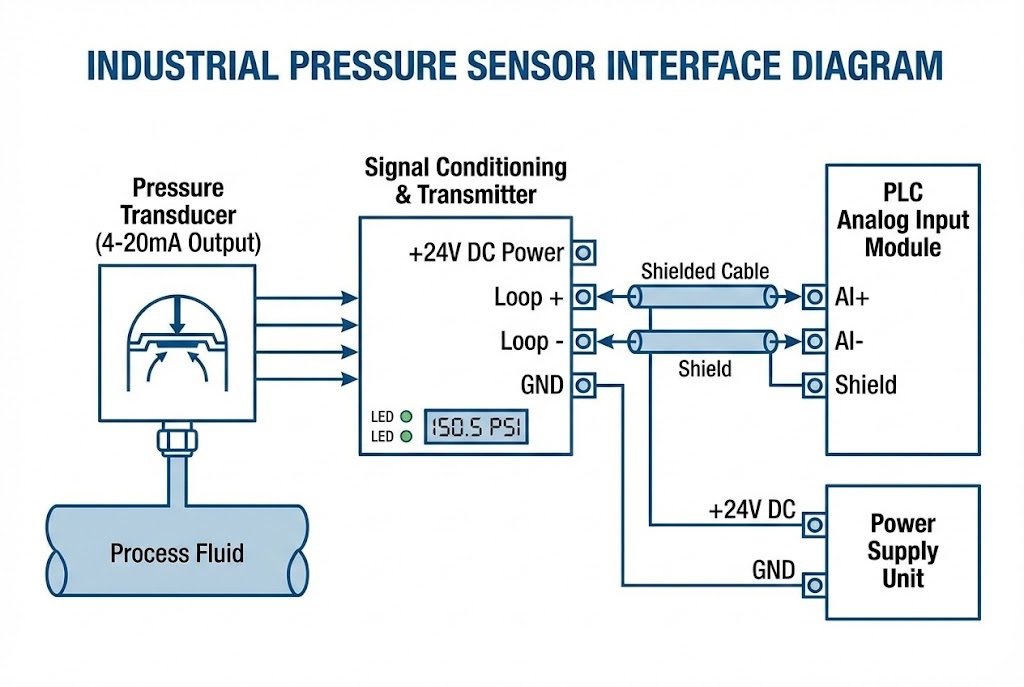
Many engineers focus too much on the sensor itself. They forget that the interface circuit is what actually ensures data integrity5. I have seen expensive sensors fail because of poor circuit design. In this post, I will explain how to build a robust interface. We will look at the 4-20mA standard, the Op-Amp circuits needed to drive it, and how to read it using an ADC.
Why is 4-20mA the Gold Standard for Industrial Signal Transmission?
Voltage signals degrade quickly over long cables, leading to inaccurate pressure readings.
A 4-20mA current loop1 maintains signal integrity because current remains constant throughout the series circuit, regardless of cable length or wire resistance. Furthermore, the 4mA baseline acts as a "live zero," allowing the system to instantly detect broken wires or sensor faults.
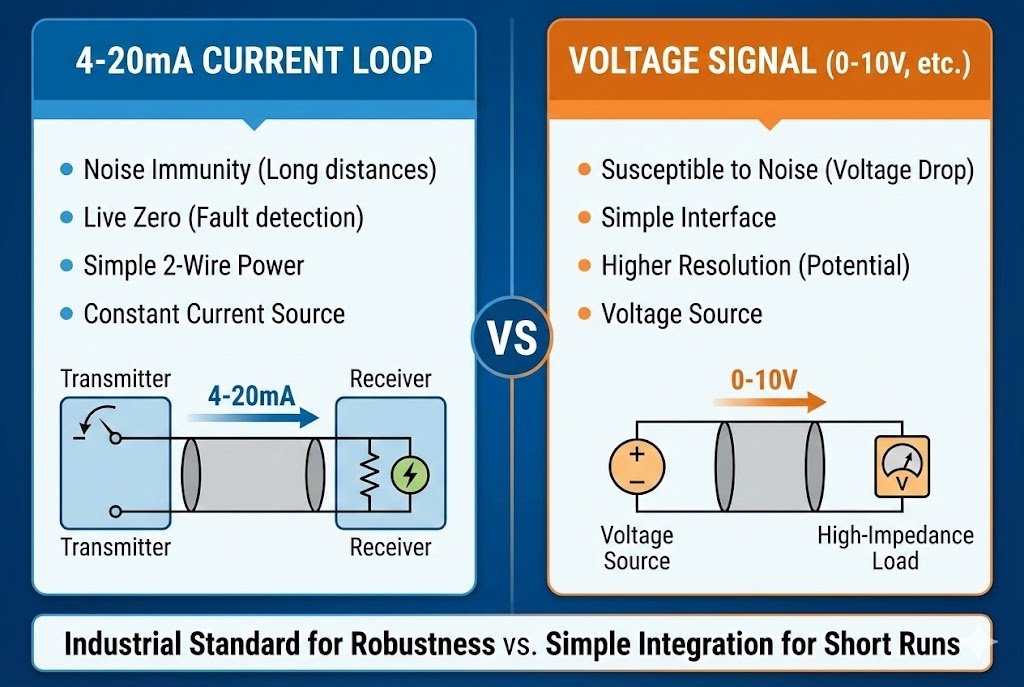
Let us look closer at why this standard dominates the industry. When I first started working with electronics, I tried using 0-5V signals for a project in a machine shop. It was a disaster. The heavy motors nearby created magnetic fields that induced noise voltage on my wires. My readings were jumping all over the place. This is where the physics of a current loop saves the day.
In a current loop, the transmitter regulates the flow of electrons. According to Kirchhoff's laws, the current entering a node must equal the current leaving it. This means the current at the sensor end is exactly the same as the current at the receiver end, even if they are 500 meters apart. The resistance of the wire does not change the current level.
Here is a breakdown of why we prefer current loops over voltage signals:
| Feature | Voltage Signal (0-10V) | Current Loop (4-20mA) |
|---|---|---|
| Noise Immunity | Low. Picks up EMI/RFI easily. | High. Low impedance makes it robust. |
| Distance | Short distances only. | Long distances (1km+). |
| Cable Resistance | Causes voltage drop (Error). | No effect on accuracy. |
| Fault Detection | Hard to distinguish 0V from a cut wire. | Easy. 0mA = Fault. 4mA = Zero Pressure. |
Also, the "live zero" is critical for safety. If your pressure sensor reads 0 psi, the loop sends 4mA. If the wire is cut, the loop drops to 0mA. Your controller knows immediately that something is wrong. At Nexcir, we supply the components that make these reliable loops possible. We understand that industrial clients cannot afford downtime due to signal errors6.
How to Design a Reliable V/I Converter Using Operational Amplifiers?
Raw pressure sensors usually output a tiny voltage that is too weak for transmission.
To convert this weak voltage into a robust current signal, you must design a Voltage-to-Current (V/I) converter7 using a precision operational amplifier2. This Op-Amp adjusts its output to force a specific current through the loop based on the input voltage from the sensor bridge.
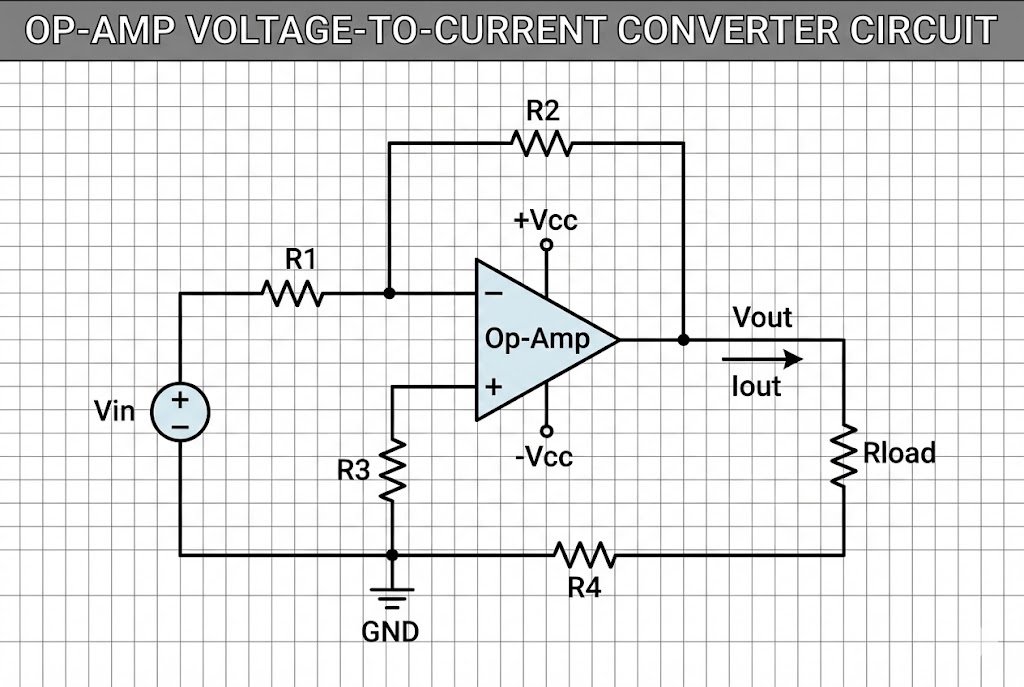
Designing the transmitter is the most challenging part of the hardware process. A typical industrial pressure sensor uses a Wheatstone bridge8. This bridge outputs a differential voltage, often in the millivolt range. You cannot send millivolts across a factory floor. You need to amplify this and convert it to current.
This is where the Operational Amplifier (Op-Amp) becomes your most important component. The circuit typically works in two stages:
- Instrumentation Amplifier Stage9: This stage takes the differential signal from the sensor and amplifies it. It rejects common-mode noise.
- V/I Conversion Stage: This stage takes the amplified voltage and drives a transistor10 (usually a BJT or MOSFET) to regulate the loop current.
You need to select the right Op-Amp. General-purpose amplifiers often drift too much with temperature changes. In an industrial setting, temperatures can vary wildly. If your Op-Amp drift is high, your pressure reading will change even if the pressure is constant.
Key Components for Design
- Precision Op-Amps: Look for low offset voltage and low temperature drift.
- Precision Resistors: Use 0.1% or better tolerance resistors to set the gain.
- Transistors: A pass transistor10 handles the actual current regulation.
At Nexcir, we often help customers source integrated solutions like the XTR series or high-precision discrete Op-Amps from top manufacturers. Using a discrete design gives you more control over cost and performance. You must ensure the Op-Amp has "rail-to-rail" capability if you are working with low supply voltages. The goal is linear performance: 0% pressure equals exactly 4.00mA, and 100% pressure equals exactly 20.00mA.
How to Interface the Current Loop with an ADC like ADS11154?
Your microcontroller cannot read current directly; it can only read voltage.
To read the 4-20mA signal, you pass the current through a precision shunt resistor11 to generate a voltage, which is then read by an Analog-to-Digital Converter (ADC). A dedicated ADC like the ADS11154 is preferred over internal microcontroller ADCs for its higher resolution and noise rejection.
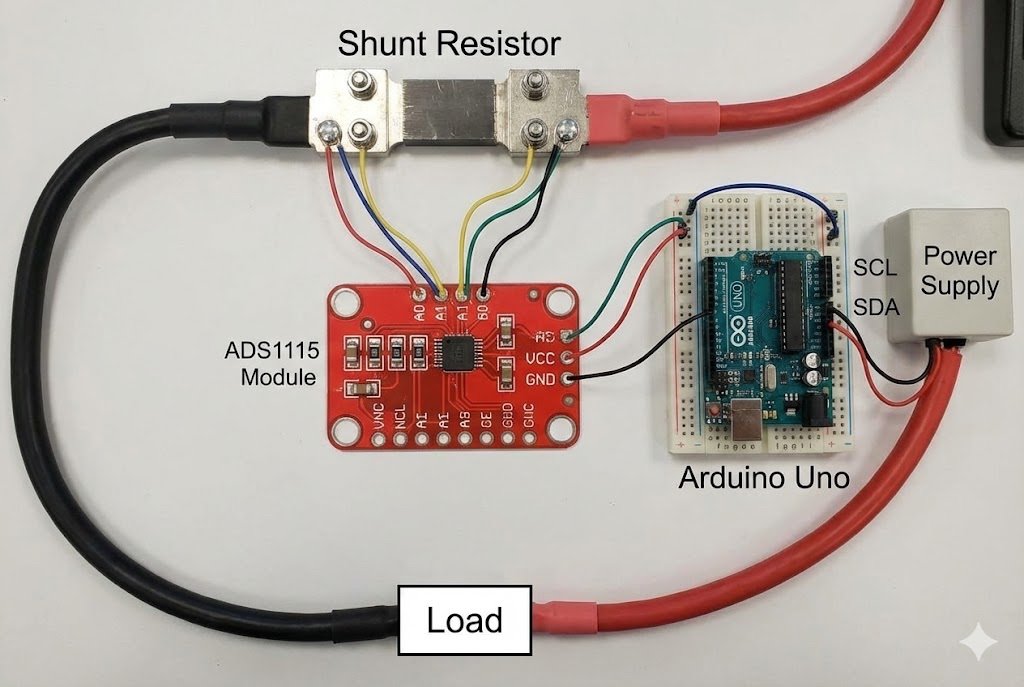
Once the signal reaches your control board, you need to digitize it. This is the "receiver" side of the loop. The concept is simple: Ohm’s Law ($V = I times R$). By placing a resistor between the current return line and the ground, the current creates a voltage drop.
For example, if you use a 250-ohm resistor:
- at 4mA: $0.004A times 250Omega = 1V$
- at 20mA: $0.020A times 250Omega = 5V$
Now you have a 1-5V signal. However, simply connecting this to a basic microcontroller is often not enough. Most microcontrollers have internal ADCs that are only 10-bit or 12-bit. They are also noisy because they share power with the digital processor.
Why Use the ADS11154?
I frequently recommend the ADS11154 to our clients for a few reasons. It is a 16-bit ADC. This gives you much higher precision.
- Resolution: A 10-bit ADC gives you 1024 steps. A 16-bit ADC gives you over 65,000 steps. For a pressure sensor measuring 0-1000 psi, a 10-bit ADC jumps in 1 psi increments. The ADS11154 can detect changes as small as 0.01 psi.
- PGA (Programmable Gain Amplifier12): The ADS11154 has an internal amplifier. If your shunt resistor11 is small (to save power) and only generates 0-1V, the PGA can boost this signal internally before measuring it.
- Differential Input: You can measure the voltage across the resistor differentially. This cancels out ground loops, which are common in factories.
Implementation Steps
- Select the Shunt Resistor: Choose a high-precision resistor (0.1% tolerance). Common values are 120Ω, 250Ω, or 500Ω.
- Protection: Add a Zener diode across the ADC input. If the current loop accidentally shorts to a high voltage, the diode protects your expensive chips.
- Filtering: Add a simple RC low-pass filter13 (a resistor and a capacitor) before the ADC pin. This removes high-frequency electrical noise.
Nexcir supplies both the passive components (precision resistors14) and the active ICs (ADCs and Op-Amps) to build this entire chain. We ensure you get original parts, so your readings are always accurate.
Conclusion
Designing a pressure sensor interface requires a stable 4-20mA transmitter using precision Op-Amps and a high-resolution receiver using chips like the ADS11154. At Nexcir, we supply the authentic components you need to build these reliable industrial systems.
Explore this link to understand why the 4-20mA current loop is crucial for reliable sensor data transmission. ↩
Learn about operational amplifiers and their role in enhancing sensor signal integrity. ↩
Discover the advantages of high-resolution ADCs for accurate data conversion in sensor applications. ↩
Explore the features of the ADS1115 and why it's preferred for high-precision applications. ↩
Find resources on maintaining data integrity in sensor systems to avoid costly errors. ↩
Find out how to identify and mitigate signal errors in industrial sensor systems. ↩
Understand the function of V/I converters in transforming weak sensor signals for transmission. ↩
Learn about the Wheatstone bridge and its application in measuring pressure accurately. ↩
Explore the importance of instrumentation amplifiers in amplifying sensor signals effectively. ↩
Find out how transistors regulate current in sensor applications for reliable performance. ↩
Learn about the critical role of shunt resistors in converting current to voltage for ADCs. ↩
Understand how PGAs enhance signal measurement in low-voltage applications. ↩
Learn about the benefits of low-pass filters in reducing noise in sensor signals. ↩
Discover the significance of precision resistors in ensuring accurate sensor readings. ↩