Are your industrial control boards failing due to poor relay choices? Unexpected downtime and sourcing headaches can ruin your production schedule. Let me help you decide.
Choose Mechanical Relays1 for low-cost, high-current switching where switching frequency is low. Select Solid State Relays (SSR)2 for high-speed, frequent switching applications requiring long lifespans and noise immunity. Your choice depends on balancing cost, load type, and thermal management capabilities.
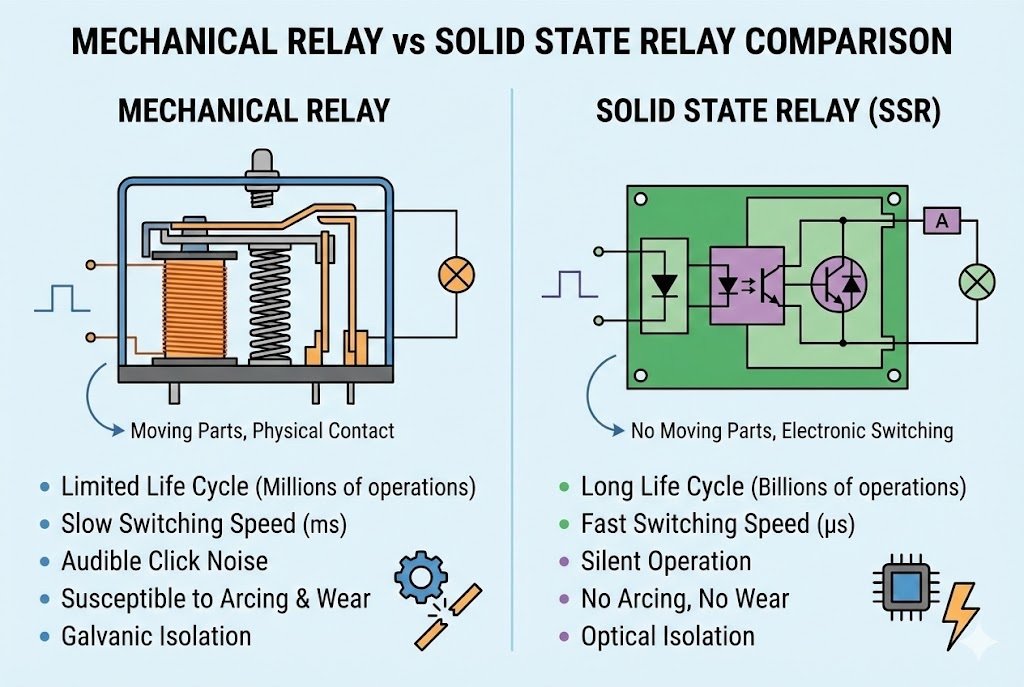
I remember a project last year where a client almost halted production. They picked a mechanical relay for a high-frequency heater control. It failed every two weeks. It was a mess. In this guide, I will walk you through the differences to ensure your supply chain stays stable.
What are the critical technical differences between Mechanical Relays1 and SSRs?
You need to know more than just the price tag. The internal mechanics define how your board performs under stress and affects your long-term maintenance costs.
Mechanical relays use physical contacts, offering low resistance but wear out over time. SSRs use semiconductors for switching, providing infinite life and fast response but generate heat. Understanding these specs is vital for reliable industrial design.
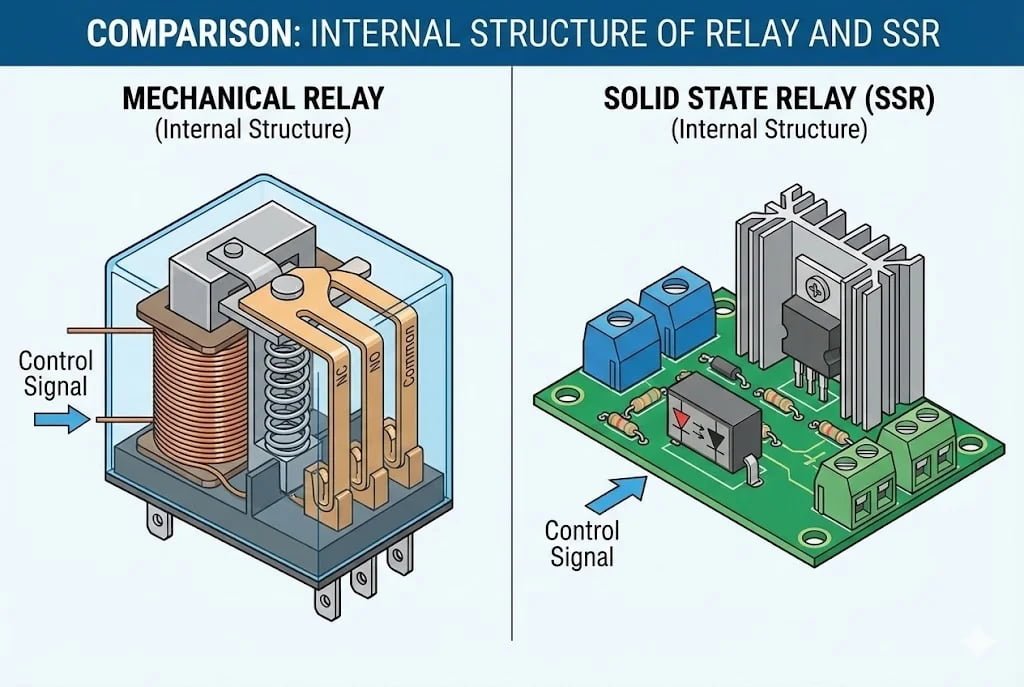
Let's look closer at the engineering side of this choice. When I help customers source parts, I often see that they ignore the "Contact Life" specification. A mechanical relay has moving parts. Every time it clicks, a small spark happens. This is called arcing. Over time, this arcing eats away at the metal contacts. If your machine switches on and off once a minute, a mechanical relay is fine. But if it switches every second, that relay will die very quickly.
On the other hand, an SSR (Solid State Relay) has no moving parts. It uses light and silicon to switch power. This means it can switch millions of times without wearing out. But there is a catch. SSRs get hot. When electricity passes through them, they lose some energy as heat. You almost always need a heatsink for high currents. This takes up space in your control cabinet. Also, mechanical relays provide "Galvanic Isolation" naturally. When they are off, there is an air gap. SSRs have a tiny bit of leakage current even when off.
Here is a breakdown of the key technical differences you must consider:
| Feature | Mechanical Relay | Solid State Relay (SSR) |
|---|---|---|
| Life Span | Limited (100k - 1M cycles) | Unlimited (if cooled properly) |
| Switching Speed | Slow (ms range) | Very Fast (us range) |
| Contact Resistance | Very Low (No voltage drop) | Higher (Voltage drop creates heat) |
| Electrical Noise | Generates noise (Bounce) | Silent operation |
| Size | Generally compact | Larger (due to heatsink) |
| Cost | Low | High |
How do you secure stock for major brands like Omron, Panasonic, and TE?
Designing the board is one thing. Actually buying the parts during a shortage is a completely different challenge that keeps procurement teams awake at night.
Top brands like Omron, Panasonic, and TE set the standard for quality but often face allocation issues. To ensure production continuity, you need a sourcing partner with a global network who can access verified stock when local distributors run dry.
At NexCir, we do not just sell what we have on a shelf. We look for what you need. In the world of relays, three names come up constantly: Omron, Panasonic, and TE Connectivity. These are the gold standards. Engineers love them because they are reliable. But this popularity creates a big problem. When the market gets tight, these brands are the first to run out of stock. I have seen lead times stretch to 50 weeks for simple power relays.
This is where a "Stockist" differs from a "Sourcing Partner." A stockist says, "Sorry, I don't have it." We say, "Let me find it for you." We look at the global market. Maybe the part is sold out in Asia, but there is stock in Europe. We verify the authenticity to ensure you get original parts. We focus on specific series that are critical for industrial users.
For example, the Omron G2R series is legendary in industrial automation. The Panasonic PA-N series is vital for PLCs. TE’s Potter & Brumfield line is the backbone of heavy machinery. If you rely on just one local supplier, you are at risk. You need a partner who understands the lifecycle of these components. We monitor which parts are NRND (Not Recommended for New Design) so you don't design a board with a dying part.
Common Series We Source
| Brand | Series | Typical Application |
|---|---|---|
| Omron | G2R / G5Q | General Purpose Power |
| Panasonic | PA-N / JQ | PLC & Interface |
| TE Connectivity | T9A / RT | HVAC & Industrial |
Where should you strictly use one type over the other?
Theory is great, but let’s look at real-world factory floors. Some environments will destroy a mechanical relay instantly, while others will overheat an SSR.
Use SSRs in heater controls, PID loops, and environments with vibration. Use Mechanical Relays1 for safety interlocks, motor reversing, and cost-sensitive general switching. Matching the relay to the specific load type prevents premature failure.
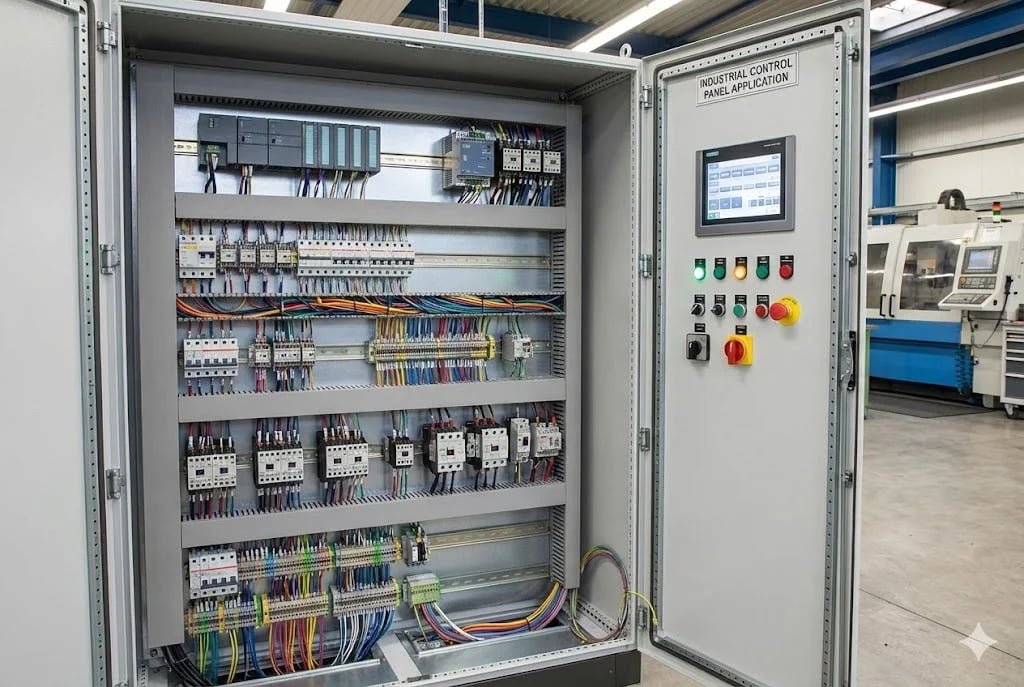
I want to share a specific insight about "Heater Control." This is the classic battleground for relays. In plastic injection molding or packaging machines, you need to control temperature very precisely. This uses a method called PID control. The controller pulses the power on and off very fast to keep the heat steady. If you use a mechanical relay here, the clicking noise will drive you crazy, and the part will fail in a month. This is the perfect place for an SSR. It is silent and loves fast switching.
However, let's look at a safety circuit. An Emergency Stop button usually cuts power to a machine. Here, you want a Mechanical Relay. Why? Because of the air gap. When a mechanical relay is open, there is a physical separation. It is safe. Also, mechanical relays are much better for "Motor Reversing." If you use SSRs to reverse a motor, you risk a "shoot-through" short circuit if the timing isn't perfect. Mechanical relays often have interlocks to prevent this.
Vibration is another factor. I visited a factory where the control panel was mounted right on a stamping press. The vibration was shaking the mechanical relays so much that the contacts were opening by themselves. We switched them to SSRs. Since SSRs have no moving parts, vibration does not affect them. It solved the problem immediately.
Application Quick Guide
| Application | Recommended Device | Reason |
|---|---|---|
| Heater Control (PID) | SSR | High switching frequency required. |
| Emergency Stop | Mechanical | Physical air gap ensures safety. |
| Motor Reversing | Mechanical | Cost-effective and robust against inrush. |
| High Vibration Area | SSR | No moving parts to shake loose. |
| Simple On/Off Lights | Mechanical | Lowest cost solution. |
How can you find reliable alternatives when your primary part is obsolete?
There is nothing worse than an "Obsolete" notification. You need a backup plan before the production line stops, and you need it fast.
Finding equivalents involves matching pin layout, coil voltage, and contact rating. Often, brands like Hongfa or Finder offer drop-in replacements for hard-to-find Omron or Panasonic parts. A proactive sourcing strategy identifies these alternatives early to reduce risk.
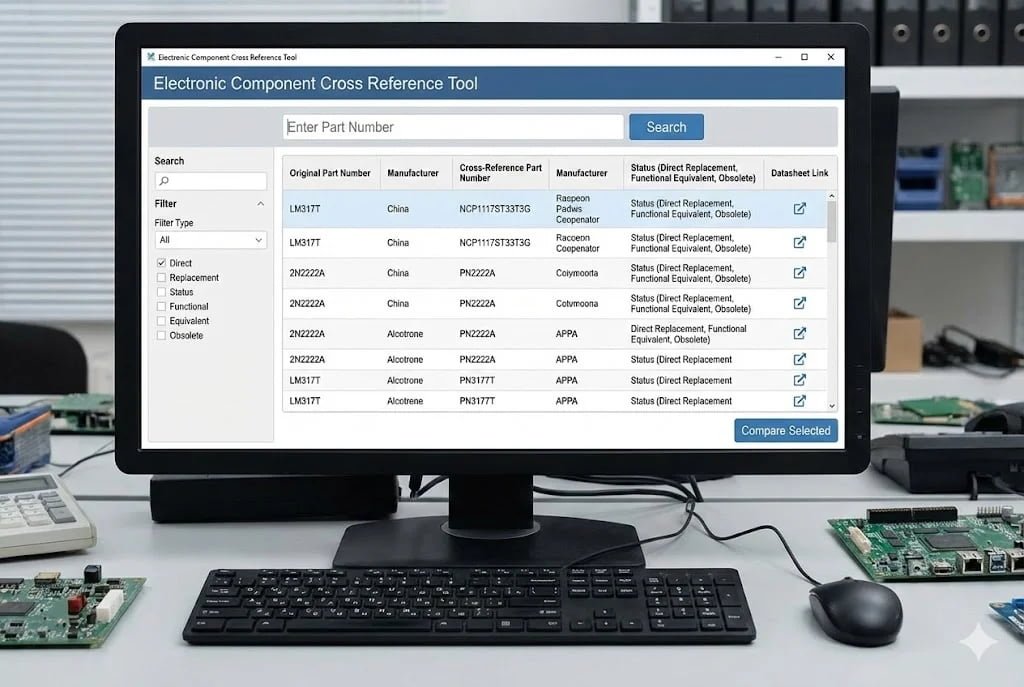
We recently helped a customer who was using a specific Panasonic relay that went End-of-Life (EOL). They were panicking. They thought they had to redesign their whole PCB. That costs a lot of money and takes months of testing. I told them, "Wait, let's look at the footprint." In the relay world, many parts are "Pin-to-Pin" compatible. This means the metal legs are in the exact same spots.
We looked at the specs. The coil voltage was 24V DC. The contact rating was 10A. The pin pitch was standard. We found a Hongfa relay and a Finder relay that were exact matches. They fit on the board without any changes. We sent samples to their R&D team. They tested them, and they worked perfectly. This saved them thousands of dollars in redesign costs.
This is a big part of what we do at NexCir. We provide "Cross-Reference" support. We don't just say "It is out of stock." We give you options. Sometimes, you might need to move from a Japanese brand to a European or Chinese brand to keep production running. We verify the quality so you don't have to worry. We check the datasheets line by line. We look at the physical height, too. Sometimes a replacement fits the holes but is too tall for the case. We check all of that.
Key Parameters for Cross-Referencing
- Pin Configuration: Do the legs fit the holes?
- Coil Voltage: Is it 5V, 12V, or 24V?
- Contact Rating: Can it handle the current (Amps)?
- Dimensions: Will it fit inside the plastic case?
- Agency Approvals: Does it have UL or CE marking?
Conclusion
Choosing between Mechanical Relays1 and SSRs balances cost, speed, and lifespan. NexCir secures your supply chain with global sourcing and reliable alternatives for all major brands.