Do you remember the "Flux Capacitor" from the movie Back to the Future? It promised massive energy delivery in a split second to travel through time. Today, we face a similar problem in electronics: standard batteries are often too slow to deliver high power bursts1 when modern devices need them most.
A supercapacitor2, or supercap, is the real-world answer to instant energy needs. Unlike batteries that rely on chemical reactions, supercapacitor2s store energy electrostatically. This allows them to charge and discharge in seconds, survive over a million cycles, and function in extreme temperatures, making them ideal for peak power assistance in IoT and automotive applications3.
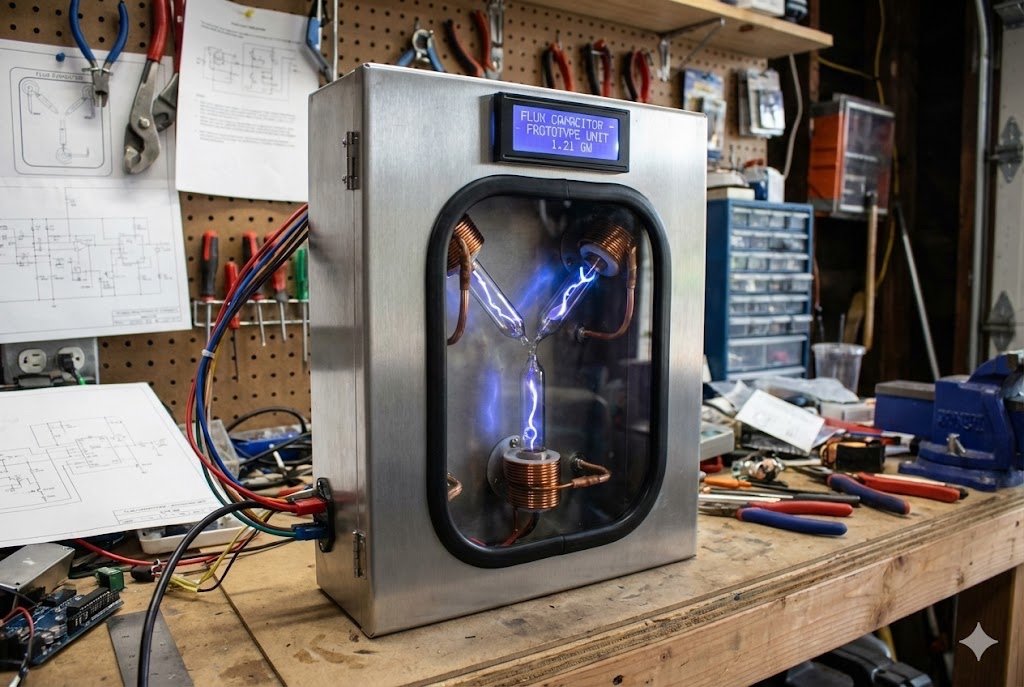
While we cannot time travel yet, the technology behind rapid energy storage4 has evolved significantly. Many engineers and procurement managers struggle to choose between batteries and capacitors. However, the best solution is often a mix of both. Let me take you through the details of this technology and how it powers our world today.
What makes Supercapacitors different from standard batteries?
We all hate it when batteries degrade after a year or take hours to charge. It slows down production and frustrates users. This is where the physics of storage changes the game.
Supercapacitors bridge the gap between electrolytic capacitors and rechargeable batteries. They offer high power density5, meaning they release energy quickly, but have lower energy density6 than batteries. This makes them perfect for short, high-power bursts rather than long-term supply.
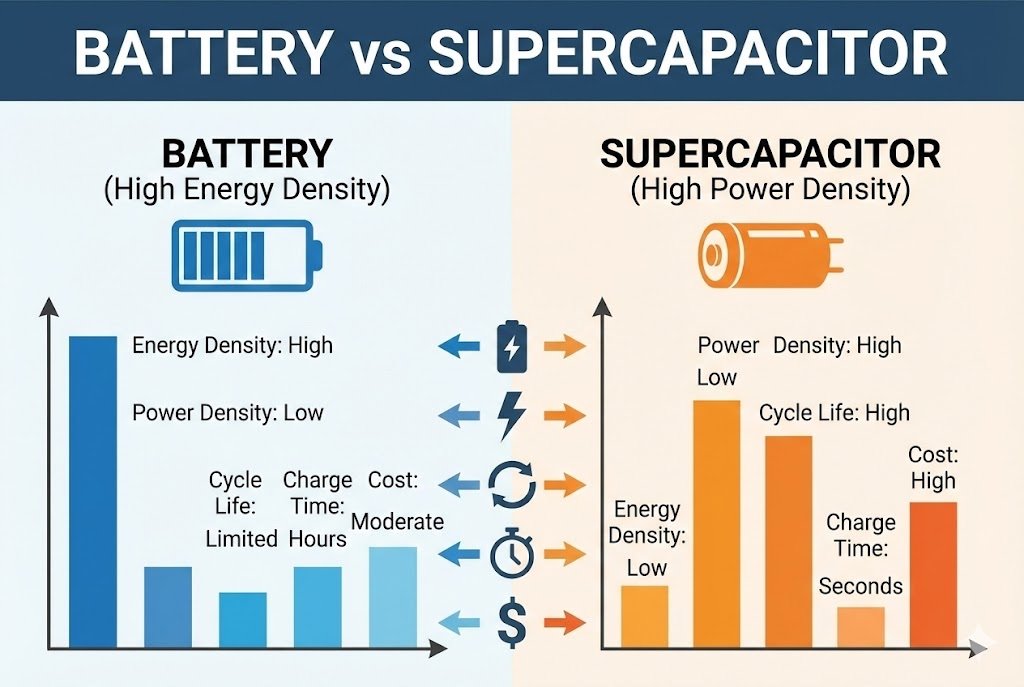
To understand this better, I like to think of a water analogy. Imagine a standard Lithium-ion battery is a large water tank. It holds a lot of water (energy), but the faucet is small, so the water comes out slowly. You can run a shower for a long time, but you cannot blast away dirt instantly.
A supercapacitor2 is like a pressure washer bucket. It holds less water total, but it can dump that water out with massive force in a single second. In the world of electronics, we call this "Power Density."
Here is a breakdown of the key differences that I see when helping clients select components:
| Feature | Lithium-ion Battery | Supercapacitor |
|---|---|---|
| Charge Time | Hours | Seconds to Minutes |
| Cycle Life | 500 - 2,000 cycles | 500,000 - 1,000,000 cycles |
| Specific Energy | High (100-265 Wh/kg) | Low (1-10 Wh/kg) |
| Specific Power | Low | High (Up to 10,000 W/kg) |
| Operating Temp | -20°C to +60°C | -40°C to +85°C |
When I talk to engineers, they often realize they do not need to replace the battery. Instead, they need to place a supercapacitor2 alongside it. This "hybrid" approach protects the battery from high current spikes, extending the life of the entire system. It is not science fiction; it is smart circuit design.
Why are brands like Maxwell and Eaton7 dominating the market?
Choosing a cheap, unknown brand for energy storage4 is dangerous. Components can leak, fail, or explode. You need proven reliability for industrial and automotive projects.
Maxwell Technologies8 and Eaton7 are the industry leaders in supercapacitor2 innovation. Maxwell is famous for its large cell technology used in transportation, while Eaton7 provides a wide range of supercaps for computing and industrial backup power. Their products define the standard for quality and safety.
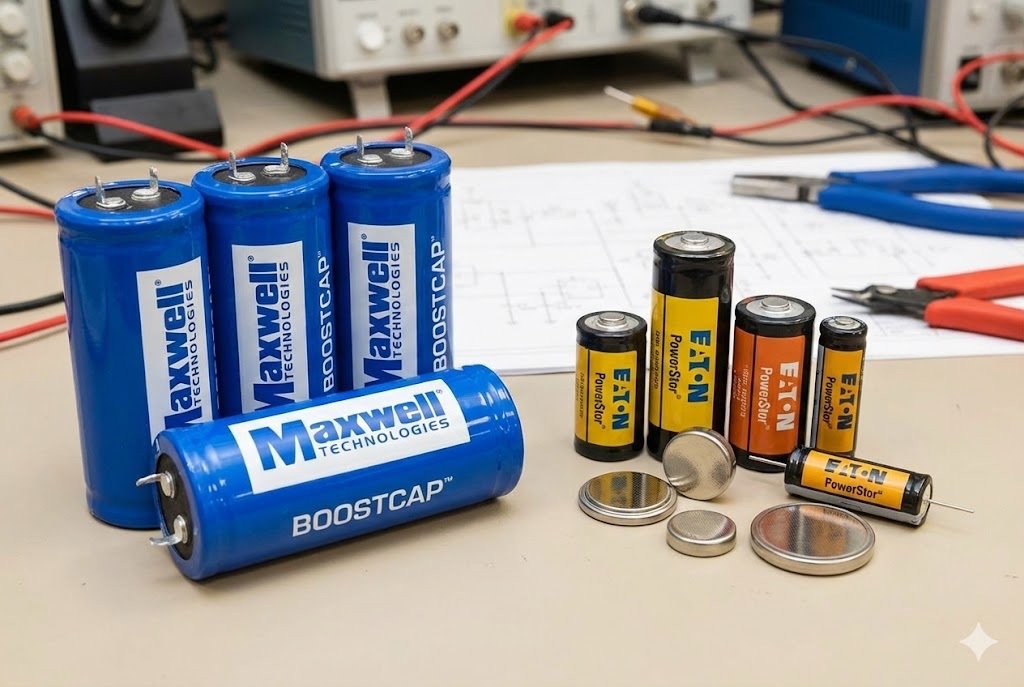
In my experience at Nexcir9, when a client asks for supercapacitor2s, they usually ask for Maxwell or Eaton7 by name. There is a good reason for this.
Maxwell Technologies8 made headlines when Tesla acquired them. This validated the technology for the electric vehicle market. Maxwell is known for its "DuraBlue" shock and vibration technology. This is critical for heavy transport. If you are building a hybrid bus or a wind turbine, the parts will shake. Maxwell parts are built to handle that physical stress without failing.
Eaton7, on the other hand, is a giant in power management. I often source Eaton7’s "PowerStor" series for clients building smart meters or medical devices. They excel in making smaller, coin-cell style supercapacitor2s as well as large cylindrical packs. Their focus is on high capacitance in small footprints.
However, sourcing these specific brands can be tough. The demand is high. Lead times from the factory can stretch to 50 weeks or more. This is where the market gets tricky. Many distributors claim to have stock, but they might be offering older date codes or refurbished parts. At Nexcir9, we see this often. Our team spends a lot of time verifying the traceability of these specific brands because we know that for our customers, a failure in a capacitor means a failure of the whole system.
Where can you actually use these energy storage4 solutions?
You might wonder if you really need this technology for your product. Is it just for cars? No, the applications are much wider and impact our daily lives.
Supercapacitors are essential in regenerative braking systems10, wind turbine pitch control, and memory backup in servers. They provide the necessary power to smooth out voltage drops and ensure data is saved during sudden power outages.
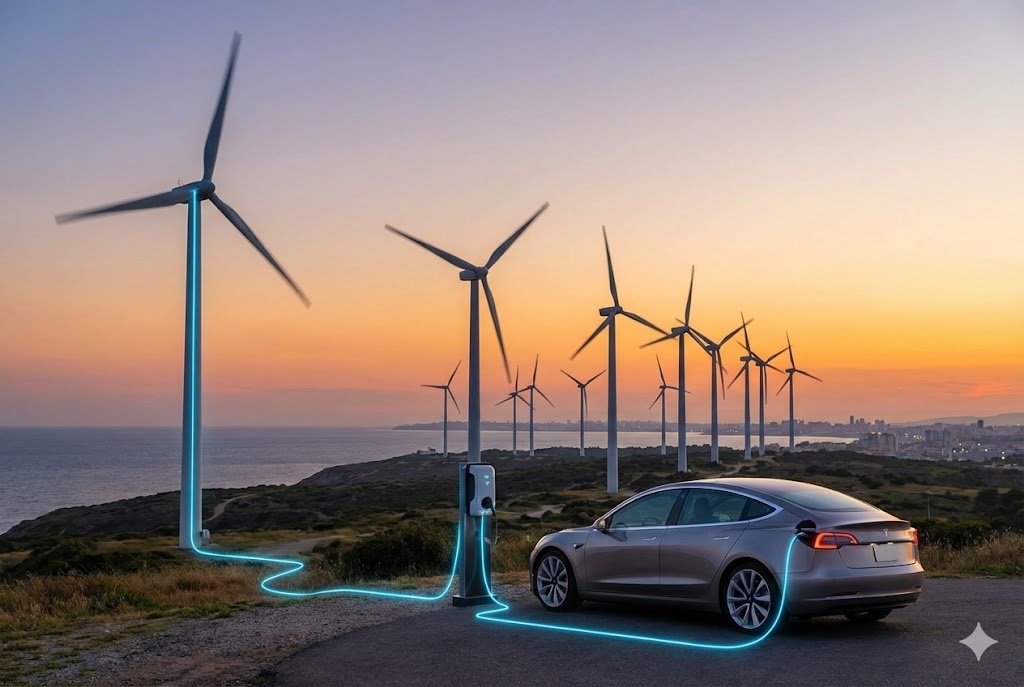
Let’s dig deeper into the real-world scenarios where I see these components being used. It goes far beyond just the "Flux Capacitor" fantasy.
1. Renewable Energy Systems Wind turbines are massive. The blades need to adjust their angle (pitch) to catch the wind or stop during a storm. If the main power grid fails during a storm, the turbine still needs power to turn the blades to a safe position. Batteries might fail in the cold weather at the top of a turbine. Supercapacitors work perfectly in the cold and provide that one reliable burst of energy to feather the blades safely.
2. Automotive and Transportation In hybrid buses, every time the driver hits the brakes, energy is generated. Batteries cannot absorb that energy fast enough. Supercapacitors can. They soak up the braking energy instantly and then release it to help the bus accelerate again. This saves a huge amount of fuel.
3. IoT and Smart Meters I have many clients in the IoT sector. Their devices sleep most of the time but wake up to send a signal via 5G or LoRaWAN. That transmission requires a spike of current. A small battery would drop its voltage too much under that load. A supercapacitor2 acts as a buffer, providing the peak current while the battery just trickles energy to recharge the cap.
4. Data Center Backup If power cuts at a server farm, the diesel generators take about 10 seconds to start. In those 10 seconds, you could lose terabytes of data. Supercapacitors handle that short gap, keeping the servers alive just long enough for the generators to kick in.
How can Nexcir9 help you source original Supercapacitors?
The supply chain for niche electronic components is full of risks. Counterfeit parts are a reality. You need a partner who values authenticity as much as you do.
Nexcir9 utilizes a global network of authorized distributors and verified suppliers to source 100% authentic components. We help you navigate long lead times and obsolete parts, ensuring your production line never stops due to a missing supercapacitor2.
At Nexcir9, we understand that sourcing components11 like the Maxwell BCAP series or Eaton7’s HV series is not just about finding a part number online. It is about trust.
Since our team has over 20 years of experience, we have seen the market fluctuate wildly. When a part goes "End of Life" (EOL) or when a factory has a shortage, prices spike, and fake parts flood the market. I have seen customers buy parts from unauthorized brokers only to find out the capacitors were dried out or relabeled.
We solve this in three ways:
- Vetting: We only buy from authorized channels or suppliers we have audited for years.
- Testing: If we source from the open market to solve a shortage, we use rigorous testing to ensure the capacitance and ESR (Equivalent Series Resistance) match the datasheet perfectly.
- Stocking: We can hold stock for you. If you know you need these parts for a year, we secure them now so you are not affected by price hikes later.
Our vision is "Next Circuit, Next Future." We believe that by providing you with the real, high-quality "Flux Capacitors" of today, we are helping you build the technology of tomorrow. We take the stress out of procurement so you can focus on engineering.
Conclusion
Supercapacitors are the real-life version of sci-fi energy storage4, offering speed and power that batteries cannot match. Whether you need Maxwell or Eaton7 parts, sourcing authentic components is critical for safety. Nexcir9 is here to ensure your supply chain is as reliable as the capacitors you use.
Discover the critical applications that demand high power bursts and how supercapacitors meet these needs. ↩
Explore the unique benefits of supercapacitors, including rapid charging and long cycle life, which are crucial for modern electronics. ↩
Find out how supercapacitors improve energy efficiency and performance in automotive applications. ↩
Learn about the latest advancements in energy storage technology and its impact on various industries. ↩
Gain insights into the concept of power density and its significance in energy storage solutions. ↩
Learn about the key differences between energy density and power density in energy storage technologies. ↩
Learn about Eaton's range of supercapacitors and their applications in various industries. ↩
Explore Maxwell's contributions to supercapacitor technology and their impact on the electric vehicle market. ↩
Discover how Nexcir can help you source high-quality supercapacitors and ensure supply chain reliability. ↩
Learn how supercapacitors improve the efficiency of regenerative braking systems in vehicles. ↩
Find out the best practices for sourcing authentic electronic components to ensure reliability. ↩