Struggling to pick the right Microchip MCU1? The choice between PIC, AVR, and SAM can be overwhelming. This confusion can delay your project and increase costs.
Choosing the right Microchip MCU1 depends on your project's needs. PICs are great for robust, low-power applications2. AVRs are popular in the hobbyist and rapid prototyping space. SAM MCUs3 offer high-performance 32-bit processing for complex tasks. Each has unique strengths in architecture and peripherals.
I remember my first embedded project. I spent weeks just trying to understand the datasheets. It felt like learning a new language. But once you grasp the core differences, the decision becomes much clearer. As a component distributor, we see engineers make this choice every day. We help them find the right parts for their designs, from industrial controllers to IoT devices4. Let's break down each family so you can confidently select the perfect MCU for your next design.
What Makes PIC MCUs a Go-To Choice for Industrial Applications?
Need a reliable MCU for a harsh environment? PICs are known for their toughness. But is their architecture right for your design's performance needs? Let's find out.
PIC microcontrollers5 are a top choice for industrial and automotive use because of their robust architecture, low power consumption, and wide operating voltage range. Their extensive peripheral set and focus on reliability make them ideal for control systems where stability is critical.
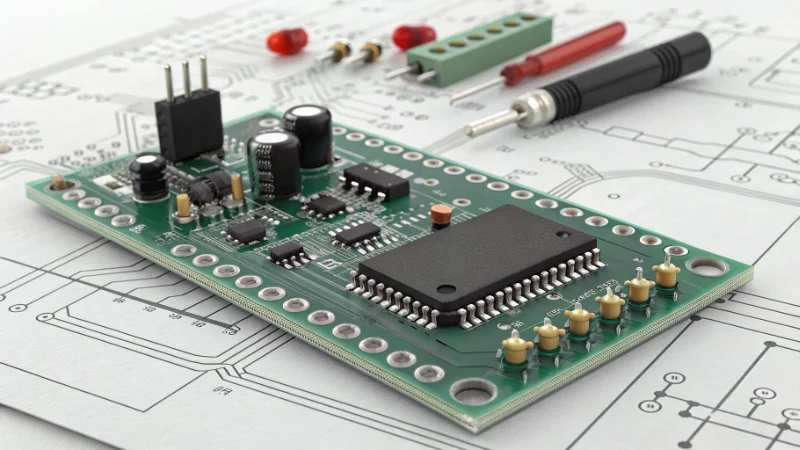
In my 20 years in the electronics industry, I've seen PIC microcontrollers5 become a staple in designs that just have to work, no matter what. They are the workhorses of the embedded world. Their strength comes from a few key areas. First is their core architecture, which is built for simplicity and efficiency. Most PICs use a RISC (Reduced Instruction Set Computer) design. This means they have a smaller, more optimized set of instructions. This makes their behavior very predictable, which is critical for real-time control systems. They are also known for their Core Independent Peripherals6 (CIPs). These are smart peripherals that can handle tasks on their own without waking up the main CPU. This is a huge advantage for low-power applications2. A sensor node, for example, can use CIPs to read data and only wake the CPU when something important happens. This saves a lot of power.
Breaking Down the PIC Families
Microchip has organized the PIC family into several series, each targeting different levels of performance and complexity. Understanding these helps you narrow down your choice quickly.
- 8-bit (PIC16, PIC18): These are the classic PICs. They are perfect for simpler control tasks, sensor interfaces, and battery-powered devices. They offer a great balance of performance, low cost, and a huge variety of integrated peripherals.
- 16-bit (PIC24, dsPIC): When you need more processing power or specialized capabilities, you move to the 16-bit families. The dsPIC series is particularly interesting. It includes a Digital Signal Processor7 (DSP) engine. We often source these for clients building smart motor controls or digital power supplies.
- 32-bit (PIC32): For the most demanding applications, the PIC32 series provides 32-bit performance. These are powerful chips capable of running operating systems and handling complex user interfaces.
| Family | Core | Key Features | Typical Application |
|---|---|---|---|
| PIC16/PIC18 | 8-bit | Low-power, robust, Core Independent Peripherals6 (CIPs) | Simple control, sensors |
| PIC24/dsPIC | 16-bit | DSP capabilities, higher performance | Motor control, digital power |
| PIC32 | 32-bit (MIPS) | High performance, rich peripheral set | Complex embedded systems, HMI |
Why Do So Many Makers and Prototypers Prefer AVR MCUs8?
Want to get your project running fast? AVRs are famous for their ease of use. But are they powerful enough for a commercial product? Let's explore this.
AVR MCUs8 are popular with makers and for rapid prototyping because of their simple architecture, C-friendly design, and the vast open-source support from the Arduino ecosystem9. This makes it incredibly easy to find libraries and get a proof-of-concept working quickly.
The rise of the AVR family is directly linked to the maker movement and Arduino. Before Arduino, getting started with microcontrollers was a difficult process. You needed specialized programmers and complex software. The AVR architecture, particularly the ATmega328P10, changed everything. The architecture was designed to be very efficient when running code compiled from the C language. This made it accessible to a much wider audience of developers. Then, Arduino came along. It combined an easy-to-use AVR board with a simple software environment. Suddenly, anyone could start building electronics. This created a huge community that produced thousands of free libraries and tutorials. For us at Nexcir, this has a direct business impact. We often help startups who built their first prototype on an Arduino. When they're ready to scale to mass production, we help them source the same ATmega chips in bulk. It's a smooth transition because the core technology is proven, reliable, and well-documented.
Exploring the AVR Lineup
While the ATmega328P10 is the most famous, the AVR family has several series designed for different needs.
- tinyAVR11 (ATtiny series): As the name suggests, these are the smallest and most cost-effective AVRs. They have fewer pins and less memory. They are perfect for simple tasks like blinking an LED, reading a single sensor, or replacing a few logic gates in a design.
- megaAVR12 (ATmega series): This is the workhorse family. It offers a great balance of memory, peripherals, and pin count. The ATmega328P10 is here, but so are many other powerful options. They are suitable for a wide range of general-purpose embedded applications.
- AVR XMEGA13: This series offers a step up in performance from the megaAVR12. They have features like DMA (Direct Memory Access) and an advanced Event System. This allows peripherals to communicate directly with each other, again reducing the load on the CPU.
| Series | Core | Key Features | Best For |
|---|---|---|---|
| tinyAVR11 | 8-bit | Compact size, low pin count, low cost | Simple logic replacement, small sensor nodes |
| megaAVR12 | 8-bit | More memory/pins, rich peripherals | Hobbyist projects, general-purpose control |
| AVR XMEGA13 | 8/16-bit | Higher speed, DMA, Event System | More demanding real-time control applications |
When Should You Choose a SAM MCU for Your High-Performance Design?
Does your project need serious processing power? SAM MCUs3 are built on ARM Cortex cores14. But that complexity can be daunting. Let's see if it's the right choice for you.
You should choose a SAM MCU when your application requires 32-bit performance, advanced connectivity like USB and Ethernet, or complex real-time processing15. Based on the industry-standard ARM Cortex-M architecture, they offer a powerful and scalable solution for demanding embedded systems.
When a project's requirements go beyond what 8-bit or 16-bit MCUs can offer, we start looking at the SAM family. SAM stands for "SMART ARM-based Microcontrollers." These devices are all built around the industry-standard ARM Cortex-M processor cores. This is a huge advantage. The ARM ecosystem is massive. It includes professional-grade development tools, real-time operating systems (RTOS), and a global community of experienced engineers. By choosing a SAM device, you are tapping into this entire ecosystem. I recently worked with a client developing an advanced IoT gateway. They needed Ethernet, multiple USB ports, and enough processing power to handle encrypted data streams in real time. An 8-bit MCU just couldn't handle it. The SAM E series, with its ARM Cortex-M7 core, was the perfect fit. It provided the high performance they needed, along with all the required high-speed peripherals integrated into a single chip. This simplified their hardware design and sped up their time to market.
Navigating the SAM Series
The SAM family is large, but it's logically divided based on the ARM core it uses. This helps match the MCU's capabilities to your project's needs.
- Low-Power (SAM D/L/C): These use the highly efficient ARM Cortex-M0+ and Cortex-M23 cores. They are designed for applications where power consumption is the most important factor. Think of battery-powered IoT sensors, wearables, and simple handheld devices. The SAM D21 is an extremely popular choice in this space.
- High-Performance (SAM E/S/V): These MCUs use the more powerful ARM Cortex-M4 and Cortex-M7 cores. These cores include features like a Floating-Point Unit16 (FPU) for fast math calculations and DSP instructions17. They are built for applications that need to process a lot of data quickly, such as industrial gateways18, audio processing equipment, and advanced motor control systems.
| Series | ARM Core | Key Features | Common Use Cases |
|---|---|---|---|
| SAM D/L/C | Cortex-M0+/M23 | Ultra-low power, touch control, USB | IoT nodes, wearables, simple HMIs |
| SAM E/S/V | Cortex-M4/M7 | High performance, FPU, DSP, Ethernet, CAN-FD | Industrial gateways, audio processing |
Conclusion
Choosing between PIC, AVR, and SAM depends on your project. PICs are for robust control, AVRs for rapid prototyping, and SAMs are for high-performance tasks19.
Explore this link to understand the fundamentals of Microchip MCUs and their applications. ↩
Understand the significance of low-power applications and how they impact design choices. ↩
Find out how SAM MCUs can enhance your high-performance embedded designs. ↩
Understand the unique requirements of IoT devices and how to meet them with MCUs. ↩
Learn about the versatility of PIC microcontrollers and their applications in various industries. ↩
Explore how CIPs enhance the functionality of PIC microcontrollers. ↩
Discover the role of DSPs in enhancing the capabilities of microcontrollers. ↩
Discover the advantages of AVR MCUs, especially for hobbyists and rapid prototyping. ↩
Explore the vast resources available in the Arduino ecosystem for AVR development. ↩
Learn about the popular ATmega328P and its applications in embedded systems. ↩
Find out how tinyAVR microcontrollers can simplify your embedded projects. ↩
Discover the capabilities of megaAVR microcontrollers for general-purpose applications. ↩
Explore the advanced features of AVR XMEGA for demanding applications. ↩
Understand the significance of ARM Cortex cores in modern microcontroller design. ↩
Learn about the importance of real-time processing in embedded applications. ↩
Discover how FPU enhances the performance of microcontrollers in complex calculations. ↩
Explore the role of DSP instructions in improving data processing capabilities. ↩
Learn about the role of industrial gateways in connecting devices and systems. ↩
Explore the characteristics of high-performance tasks and suitable microcontroller options. ↩