You check your watch and realize it has stopped moving. You open the back case and see a confusing code on the tiny battery. You feel worried about buying the wrong replacement and damaging your favorite timepiece.
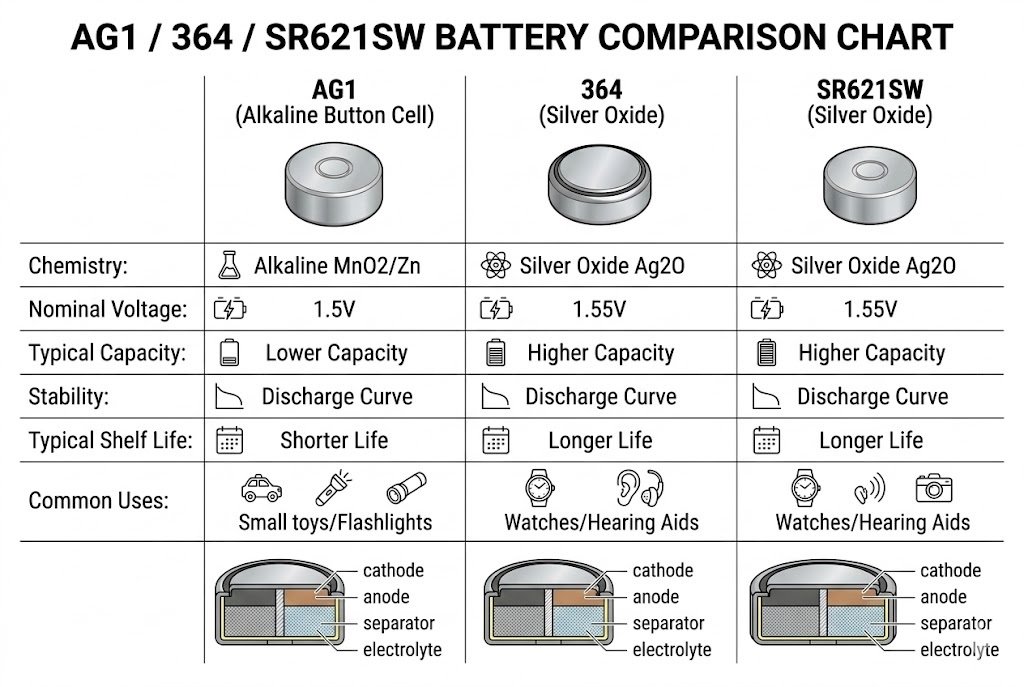
AG1, 364, and SR621SW1 actually refer to the same physical battery size (6.8mm x 2.1mm). However, they use different chemistries. AG1 is alkaline, while 364 and SR621SW are silver oxide2. Always choose silver oxide2 (SR) for reliable, long-term voltage stability3 in precision watches.
I remember when I first started in the electronics industry twenty years ago. I tried to fix my grandfather's vintage watch with a cheap battery I found at a local store. It fit perfectly, but a month later, the watch stopped again. Worse, the battery had leaked inside the case. That mistake taught me a valuable lesson. It is vital to understand what you are putting into your devices. Just because a battery fits does not mean it is the right energy source for your machine. Today, I want to share my knowledge to help you avoid that same mistake.
Why Do One Battery Size Have Three Different Names?
You see "AG1" on one blister pack and "364" on another nearby. It feels like a trick to make you buy more or confuse you. Why is this naming system so messy and hard to read?
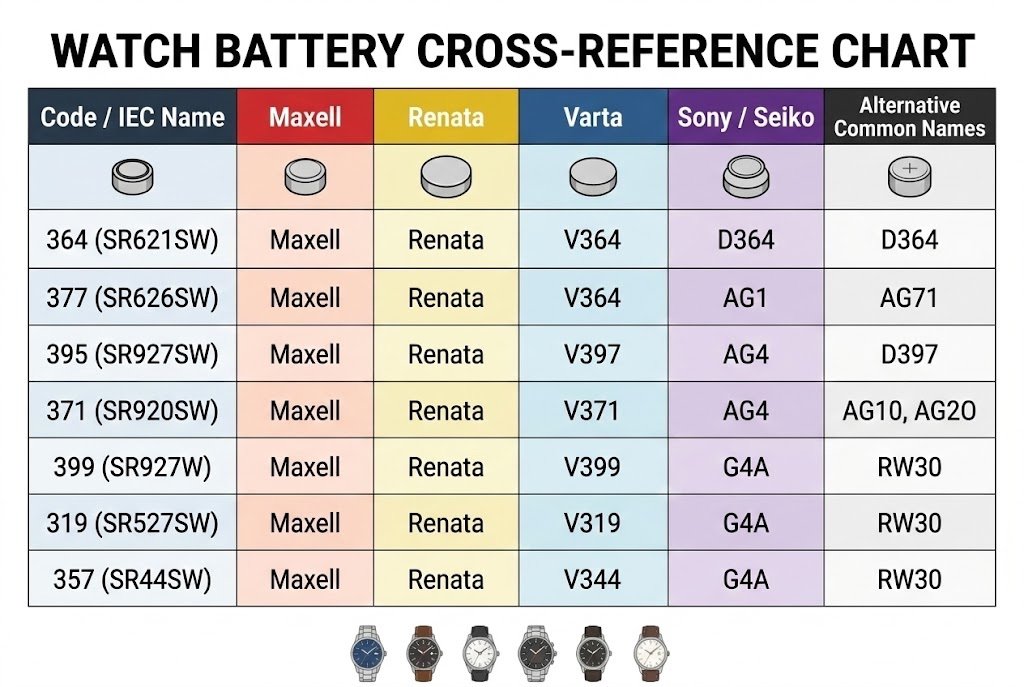
Manufacturers use different coding standards based on their region and brand history. "AG1" is a common label for alkaline versions. "364" is the standard American/Swiss watch industry code. "SR621SW" is the international IEC standard4 code indicating Silver Oxide (SR), diameter (6), and height (21).
At Nexcir, I deal with component codes5 every single day. I often tell my clients that standardization is a bit of a myth in our industry. Each region and manufacturer likes its own system. To understand this, we need to break down where these codes come from. It is not just random numbers; there is a logic behind the madness.
The IEC Standard (SR621SW)
The International Electrotechnical Commission (IEC) uses the most logical system. If you look at SR621SW, it tells you the physical specs:
- SR: This stands for Silver Round. It tells you the chemistry is Silver Oxide.
- 6: This indicates the diameter is in the 6mm range (specifically 6.8mm).
- 21: This indicates the height is 2.1mm.
- SW: This indicates it is a Low Drain battery6 (I will explain this later).
The Common Names (AG1)
The code AG1 is very popular in mass-market stores.
- A: Stands for Alkaline.
- G: Stands for General usage.
- 1: This is just a size category in this specific series. When you see "AG," you immediately know it is an alkaline battery7. This is usually the cheapest option, but rarely the best one for a watch.
The Manufacturer Codes (364)
Codes like 364 come from specific manufacturers like Renata, Energizer, or Bulova. Over decades, these numbers became the "shorthand" for watchmakers. If you go to a professional watch repair shop, they will likely ask for a "364" because that is the language they speak.
Here is a simple table to help you match them up:
| Common Name | IEC Code | Chemistry | Typical Voltage | Best Use |
|---|---|---|---|---|
| AG1 | LR621 | Alkaline | 1.5V (Drops fast) | Toys, Calculators |
| 364 | SR621SW | Silver Oxide | 1.55V (Stable) | Analog Watches |
| SG1 | SR621 | Silver Oxide | 1.55V (Stable) | Analog Watches |
By understanding these codes, you can look past the marketing on the package. You can focus on the actual specifications that matter for your device.
Is There a Real Performance Difference Between AG1 and SR621SW?
You might think all button batteries are the same inside since they look identical. Using the cheaper AG1 option seems smart to save money. But does the chemistry actually matter for your watch's accuracy?
Yes, the chemistry changes everything. AG1 (Alkaline) drops voltage gradually as it drains, causing watches to lose time. SR621SW (Silver Oxide) maintains a constant 1.55V until the very end. Silver oxide provides the stable energy required for accurate timekeeping.
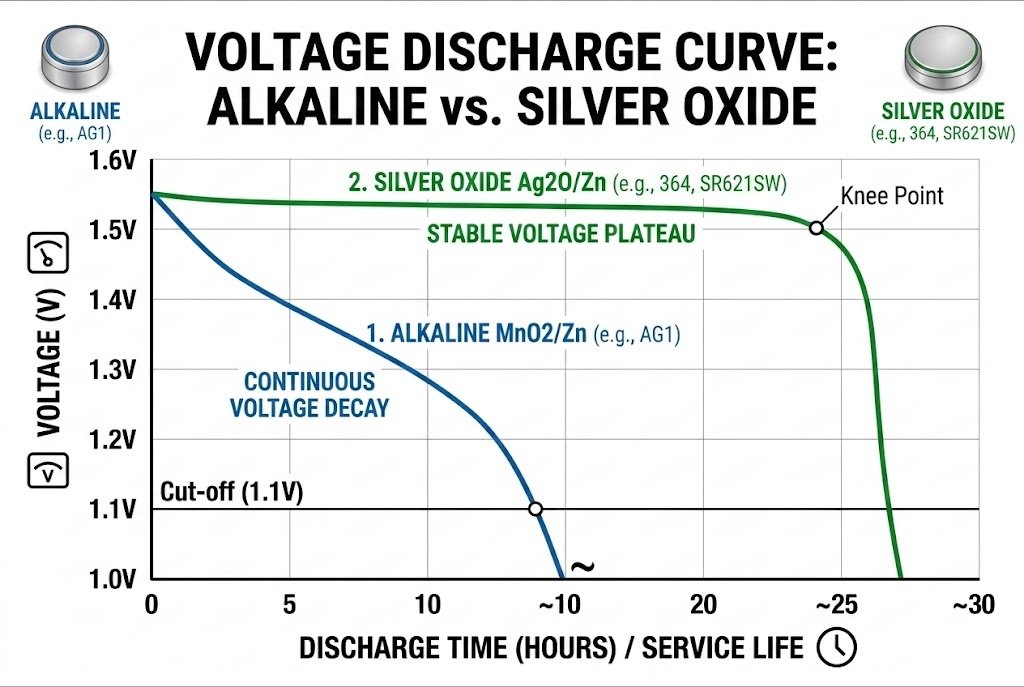
I have spent years sourcing components for OEMs at Nexcir. One thing I always emphasize is the "discharge curve8." This is a technical term, but the concept is simple. It describes how a battery behaves as it gets older.
The Problem with Alkaline (AG1)
Imagine a car that slows down as the gas tank gets empty. That is how an alkaline battery7 works. It starts strong at 1.5V. However, as you use it, the voltage slides down to 1.3V, then 1.1V, and finally dies. For a simple toy that makes noise, this is fine. The toy just gets quieter. But for a watch, this is a disaster. A quartz crystal needs a specific voltage to vibrate at the correct frequency. When the voltage drops, the vibration changes. Your watch might start losing five minutes a week. You might think the watch is broken, but it is just a bad battery.
The Power of Silver Oxide (SR621SW/364)
Silver Oxide batteries are different. Imagine a car that drives at full speed until the very last drop of gas, and then stops instantly.
- Stability: It stays at 1.55V for almost its entire life.
- Capacity: It holds about 50% more energy than an alkaline battery7 of the same size.
- Leakage: Silver oxide batteries are much less likely to leak chemicals. Alkaline batteries release gas as they discharge, which can push corrosive acid out of the seals.
Cost vs. Value
An AG1 battery might cost you $0.50. A branded SR621SW might cost $2.00. However, the SR battery will last 2-3 years, while the AG1 might die in 6 months and potentially ruin your $200 watch.
Technical Comparison
| Feature | Alkaline (AG1) | Silver Oxide (SR621SW) |
|---|---|---|
| Voltage Profile | Sloping (Unstable) | Flat (Constant) |
| Energy Density | Low | High |
| Leakage Risk | High | Low |
| Typical Lifespan | 6-12 Months | 24-48 Months |
If you care about the device you are powering, the choice is clear. The small price difference is worth the protection and accuracy.
What Does the "SW" or "W" Mean at the End of the Battery Code?
You found the right size, but now you see extra letters like "SW" or just "W". You worry that picking "SW" instead of "W" might break your device or provide not enough power. What do these suffixes mean?
These letters indicate the electrolyte type and drain capability. "SW" stands for Low Drain, used for analog watches9 with just hands. "W" stands for High Drain, used for digital watches10 with backlights or alarms. Using a High Drain battery11 in a simple watch is safe, but not vice-versa.
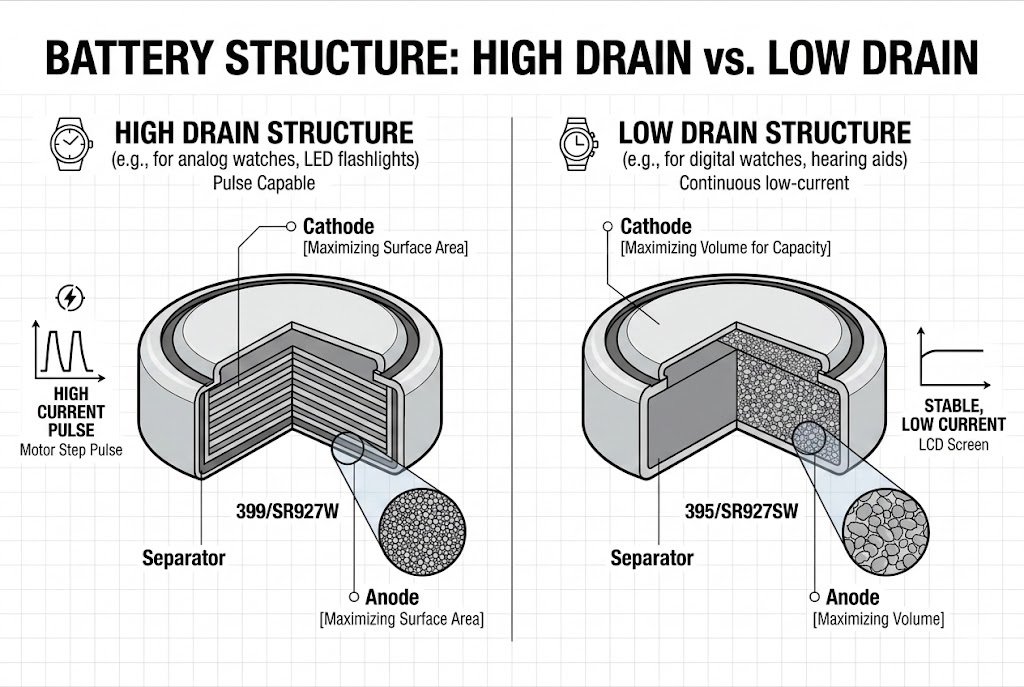
This is a detail that even some professionals miss. In my work with industrial clients, selecting the wrong "drain" type can lead to product recalls. Let's break down why this matters using some critical thinking.
The Chemistry of Electrolytes
The difference lies in the liquid inside the battery.
- Low Drain (SW): Uses Sodium Hydroxide (NaOH). This chemical is very gentle. It has a low self-discharge rate. This means the battery can sit on a shelf for years and still be fresh. It releases power slowly and steadily. This is perfect for a watch that only has hands moving.
- High Drain (W): Uses Potassium Hydroxide (KOH). This chemical is more aggressive. It conducts electricity better. It allows the battery to release a big burst of energy quickly. This is necessary if your watch has a light, a sound alarm, or digital numbers.
Can You Swap Them?
I often get asked if these are interchangeable. Here is the rule of thumb I use:
- High Drain device (Light/Alarm): You MUST use a High Drain (W) battery. If you use a Low Drain (SW) battery, the light will be very dim, or the alarm will kill the battery instantly.
- Low Drain device (Simple Watch): You CAN use a High Drain (W) battery. It will work fine. However, High Drain batteries have a shorter shelf life12. They might lose power faster just by sitting there.
Real-World Application
I once helped a client who was manufacturing smart tags. They used High Drain batteries because they thought "High" meant "Better." But their devices sat in storage for a year before being sold. By the time customers got them, the batteries were dead. We switched them to Low Drain (SW) models, and the problem was solved.
| Suffix | Electrolyte | Best Application | Shelf Life |
|---|---|---|---|
| SW | Sodium Hydroxide | Analog watches (hands only) | Excellent (5+ years) |
| W | Potassium Hydroxide | Digital watches, G-Shocks, Calculators | Good (2-3 years) |
Always check if your watch has extra features. If it just tells time, stick to the SW version for the best longevity.
How Do You Spot Fake or Low-Quality Watch Batteries?
You buy a pack of ten batteries for a dollar online. You feel happy about the deal until they leak inside your watch. How can you ensure you are buying authentic components that won't destroy your electronics?
Counterfeit batteries often lack date codes and have poor packaging printing. Genuine batteries from brands like Renata, Sony (Murata), or Maxell have clear expiration date13s and holographic packaging14. Always buy from authorized distributors to ensure the chemicals inside are fresh and stable.
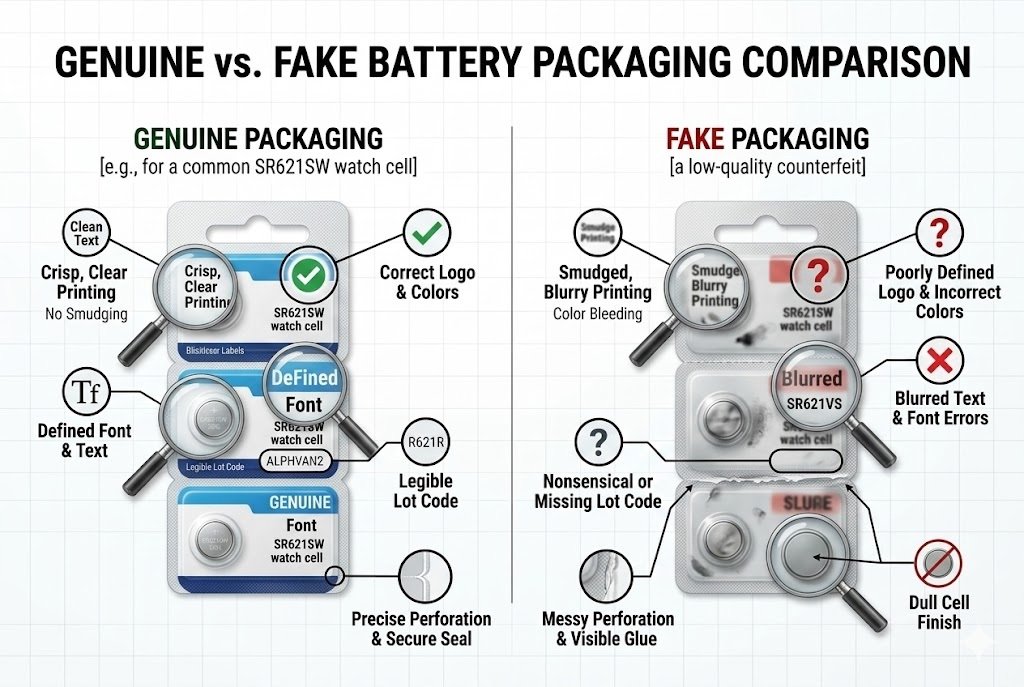
At Nexcir, we take authenticity very seriously. The market is flooded with fake batteries. I have seen "brand new" batteries that were actually five years old and repackaged. Using these is a gamble.
The Risk of Old Stock
Batteries are chemical cans. Over time, the chemicals degrade. A Silver Oxide battery loses about 2-5% of its capacity every year it sits on a shelf. If you buy a "cheap" battery that has been sitting in a hot warehouse for four years, it is already half dead. Authentic manufacturers print a "Use By" date on the package. Counterfeiters often skip this or print a date that is impossible.
Visual Inspection Tips
When I inspect stock for our clients, I look for these signs:
- The Hologram: Brands like Sony (now Murata) use holographic designs on the blister pack. Fakes usually have flat, dull printing.
- The Bottom Stamp: A real battery usually has a code stamped on the negative side (the bottom). Fakes are often smooth.
- The Voltage Check: If you have a multimeter, measure the battery before you install it. A fresh Silver Oxide battery should read above 1.55V (often 1.58V or 1.59V). If it reads 1.50V or lower out of the box, it is old or fake.
Why Sourcing Matters
This goes back to supply chain trust15. We only source from authorized lines at Nexcir because we need traceability. If a battery leaks and ruins a $5,000 medical device or a vintage Rolex, "saving a few pennies" is not a valid excuse.
Authenticity Checklist
| Checkpoint | Genuine | Counterfeit |
|---|---|---|
| Packaging | Sharp text, Holograms | Blurry text, Typos |
| Expiration Date | Clearly printed on back | Missing or Smudged |
| Price | Reasonable market rate | Suspiciously cheap |
| Voltage | > 1.55V | < 1.50V |
Protect your investment. Buy from reputable sources, even if it costs a dollar more.
Conclusion
Understanding the difference between AG1, 364, and SR621SW1 ensures your watch runs accurately and safely. Always choose Silver Oxide (SR) over Alkaline (AG) for precision, longevity, and leak protection.
Understanding these codes helps you choose the right battery for your watch, ensuring optimal performance and longevity. ↩
Silver oxide batteries provide stable voltage and longer life, making them ideal for precision devices like watches. ↩
Stable voltage is crucial for accurate timekeeping in watches, preventing time loss and ensuring reliability. ↩
The IEC standard provides a logical system for identifying battery specifications, ensuring you select the right type for your device. ↩
Understanding these codes helps you navigate the market and choose the right battery for your specific needs. ↩
Low Drain batteries are ideal for devices with minimal power needs, like analog watches, ensuring long-lasting performance. ↩
Alkaline batteries can cause watches to lose time due to voltage drop, affecting accuracy and potentially damaging the device. ↩
Understanding the discharge curve helps you choose a battery that maintains consistent performance over time. ↩
Silver oxide batteries provide the stable voltage needed for accurate timekeeping in analog watches. ↩
Digital watches often require High Drain batteries to support features like backlights and alarms. ↩
High Drain batteries are essential for devices with higher power demands, like digital watches with alarms or lights. ↩
A longer shelf life ensures the battery remains effective and reliable, even after extended storage periods. ↩
An expiration date ensures the battery is fresh and capable of delivering the expected performance and longevity. ↩
Holographic packaging is a sign of genuine products, helping you avoid counterfeit batteries that could harm your device. ↩
Trustworthy supply chains ensure you receive authentic, high-quality batteries that won't damage your devices. ↩