Hardware engineers face a huge problem today. Small chips overheat and fail easily. But we can solve this by understanding the physical limits of through-silicon via technology.
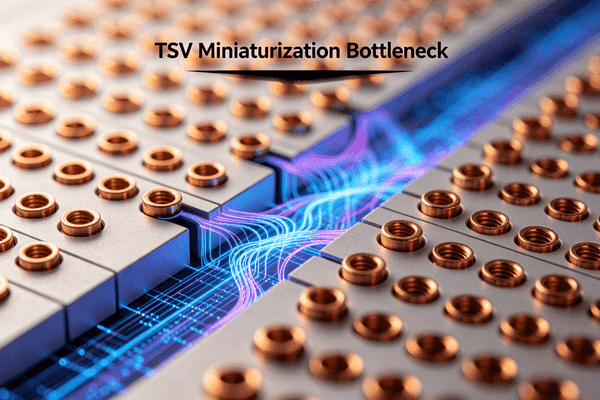
The miniaturization bottleneck of TSV1 occurs because making vertical interconnect channels2 smaller increases electrical resistance and signal crosstalk. As memory stacks like HBM43 grow taller, the tiny gaps between copper TSVs4 cause data errors. The industry must find new filling materials to fix this limit.
I see these design struggles every day when I talk to procurement managers. You might think shrinking electronic components is an easy task, but physics often gets in the way. Let me show you exactly why this happens and what comes next in the supply chain.
How do vertical interconnect channels2 penetrate the silicon wafer?
You need fast data transfer for modern devices. Flat chip designs are too slow and bulky. Vertical stacking solves this, but the manufacturing process is very hard to control.
Vertical interconnect channels penetrate the silicon wafer using a deep etching process. Lasers or chemicals drill tiny holes straight through the silicon. Then, manufacturers fill these holes with conductive metals like copper to connect multiple chip layers together.

I remember visiting a chip fabrication plant a few years ago. I watched them build these 3D chip stacks5. They do not use wires around the outside edges anymore. They drill right through the middle of the wafer. This is the core logic of TSV.
The Etching and Filling Process
Manufacturers use a method called Deep Reactive Ion Etching6. This machine digs a deep, narrow hole into the silicon base. After the hole is ready, they must line the walls with a special insulator. If they skip this step, the electrical current will leak into the silicon. Next, they fill the hole with copper. Copper carries electricity very well.
Why We Need Vertical Connections
At Nexcir, I supply many processors and PMICs to IoT and automotive companies7. My clients always ask for smaller parts with better performance. Vertical connections make the distance between chips much shorter. A shorter distance means faster data speed. It also means lower power use. When I source these parts, my clients expect stable performance. They do not want parts that fail under heat. TSV helps keep the heat low. Our global supply network8 ensures we get the best 3D packaged chips. We check every part carefully. This stops counterfeit products from entering the market and protects our customers.
| Connection Type | Data Speed | Power Use | Space Needed |
|---|---|---|---|
| Traditional Wire Bond | Slow | High | Large |
| TSV (Vertical) | Very Fast | Low | Very Small |
Why does shrinking TSV pitch cause signal crosstalk in HBM49?
High-Bandwidth Memory needs to be perfect. Data errors ruin the whole computer system. When we pack too many TSVs close together, they interfere with each other and cause failures.
Shrinking TSV pitch causes signal crosstalk in HBM49 because the copper channels sit too close. When electrical signals travel through these tight spaces, their magnetic fields overlap. This overlap leaks data into nearby channels, corrupting the memory signals.

A hardware engineer called me last month. His team was testing a new AI server board. They tried to use the newest HBM4 memory chips. But the system kept crashing during tests. We found out the problem was signal crosstalk.
The Problem with HBM4 Stacks
HBM4 stacks memory chips very high. Sometimes they stack 12 or 16 layers. To fit all these connections, the factories must make the TSV pitch very small. The pitch is the distance between the center of one hole and the next hole. When the pitch gets too small, the copper wires act like tiny radio antennas. They broadcast their signals to the wires next to them. This is crosstalk.
The Cost of Data Errors
Crosstalk is a huge business pain point. It forces the chip to send the data again. This wastes time and energy. It also creates extra heat. I always tell my OEM clients to check the thermal limits of their designs. If a production line stops because of memory errors, the cost is massive. My customers expect stable pricing and reliable delivery. When crosstalk ruins a batch of chips, market supply drops. Then prices jump. We use our 20 years of experience to find material alternatives when this happens. We help our clients keep their production running smoothly.
| TSV Pitch Size | Crosstalk Risk | Heat Generation | Best Use Case |
|---|---|---|---|
| 50 micrometers | Low | Low | Older memory stacks |
| 20 micrometers | Medium | Medium | HBM2 and HBM3 chips |
| Under 10 micrometers | Very High | High | HBM4 and future chips |
Will new materials like cobalt and ruthenium10 replace copper in TSV filling by 2026?
Copper is reaching its physical limit today. Relying on it will stall new chip development. We must switch to new filling materials to keep technology moving forward.
Yes, new materials like cobalt and ruthenium10 will likely replace copper in TSV filling by 2026. These alternative metals have lower resistance at very small sizes. They do not require thick barrier layer11s, which leaves more room for the actual conductive metal.
At Nexcir, my team and I track market trends closely. We have over 20 years of experience in the electronic components supply chain. We know when a big change is coming. Right now, I see a major shift happening for 2026.
The Limits of Copper
Copper was the best choice for many years. But copper has a fatal flaw at small sizes. The copper atoms like to drift into the silicon. Manufacturers use a barrier layer11 to stop this drift. In a very small TSV hole, the barrier takes up too much space. There is almost no room left for the copper. This makes the electrical resistance shoot up.
Cobalt and Ruthenium as Solutions
Cobalt and ruthenium act differently. They do not drift easily. They need very thin barrier layer11s, or no barrier at all. This means the hole can be smaller, but it still conducts electricity well. I tell my clients to prepare their supply chains for this shift now. Procurement managers will face new challenges when these new materials launch. The early batches might be hard to find. Prices might fluctuate a lot. At Nexcir, we offer long-term supply programs. We help clients lock in prices before the market goes crazy. We only buy from authorized distributors to guarantee authenticity for these new, expensive parts.
| Material | Barrier Layer Needed | Resistance at Small Size | Migration Risk |
|---|---|---|---|
| Copper | Thick | Very High | High |
| Cobalt | Thin | Low | Low |
| Ruthenium | None to Thin | Very Low | Very Low |
Conclusion
TSV miniaturization struggles with copper limits and signal crosstalk in HBM49 stacks. But new materials like cobalt and ruthenium10 will soon solve these issues and power future electronic components.
Understanding the miniaturization bottleneck of TSV is crucial for improving chip performance and overcoming current limitations in electronic design. ↩
Exploring vertical interconnect channels reveals how they enhance data transfer speed and efficiency in modern electronic devices. ↩
Exploring the challenges of memory stacks like HBM4 provides insights into the future of high-performance computing. ↩
Exploring the limitations of copper TSVs is essential for identifying potential improvements in chip manufacturing materials. ↩
Understanding 3D chip stacks reveals the advantages of vertical integration in semiconductor design, enhancing device performance. ↩
Learning about Deep Reactive Ion Etching provides insight into the precision techniques used to create advanced semiconductor devices. ↩
Exploring the needs of IoT and automotive companies highlights the demand for innovation in electronic component design. ↩
Understanding the role of a global supply network is vital for maintaining quality and authenticity in the electronic components market. ↩
Investigating signal crosstalk in HBM4 helps in understanding data integrity issues and the challenges in high-density memory design. ↩
Discovering the benefits of cobalt and ruthenium over copper in TSV filling can lead to advancements in semiconductor technology. ↩
Exploring the function of barrier layers in TSV technology is crucial for improving the reliability and performance of semiconductor devices. ↩