Your old computer struggles with new AI tasks. This slows down your work and frustrates your team. A device with a 40 TOPS NPU1 solves this exact problem.
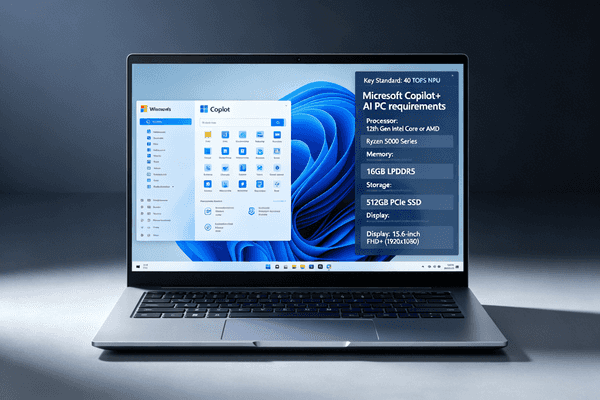
The NPU 40 TOPS threshold is Microsoft's minimum computing power standard2 for Copilot+ AI PCs. It means the Neural Processing Unit can perform 40 trillion operations per second. This speed allows computers to run advanced AI tasks locally without relying on cloud servers, ensuring data privacy and fast responses.
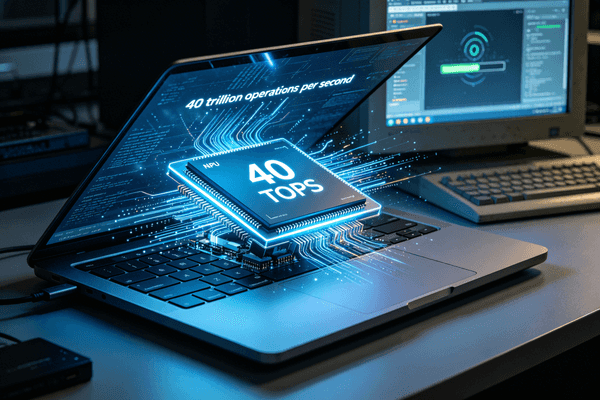
You might wonder why everyone in the hardware industry talks about this specific number right now. I remember a client asking me if they needed to upgrade their entire office fleet immediately. Let us explore what this means for your procurement strategy3 and how it affects the hardware supply chain.
Why did Microsoft set the minimum standard at 40 TOPS?
Buying new PCs without clear standards wastes money. You risk getting machines that become useless next year. Microsoft created this rule to guarantee a smooth AI experience.
Microsoft set the 40 TOPS standard because local AI models4 need this much power to run smoothly in the background. It allows features like live translation and smart search5 to work instantly. Less power means the system will lag and ruin the user experience.
The Math Behind AI Compute
I often speak with hardware engineers who design new laptops. They tell me that running a basic Large Language Model (LLM) locally requires massive data processing. The CPU and GPU drain too much battery for these tasks. Therefore, the system needs a dedicated Neural Processing Unit (NPU)6.
Why Not 30 or 50 TOPS?
You might ask how Microsoft chose the number 40. I looked into the technical requirements of Windows Copilot+. The system needs to process audio and video in real time. If the NPU has only 30 TOPS, the computer drops frames during video calls. If the NPU has 50 TOPS, the chip becomes too expensive for standard office computers. The 40 TOPS mark is the perfect balance between good performance and low cost.
Component Supply Impact
As a distributor at Nexcir, I see a huge shift in our orders. Buyers now demand specific chips that meet this standard. We help them find the right components. Here is a simple breakdown of how different processors handle AI tasks:
| Processor Type | Main Function | Power Efficiency for AI | Meets Copilot+ Standard |
|---|---|---|---|
| CPU | General tasks | Low | No |
| GPU | Graphics | Medium | No (drains battery) |
| NPU | AI tasks | High | Yes (if >= 40 TOPS) |
This standard forces OEM managers to rethink their bill of materials. They must source new ICs that include these powerful NPUs. We work hard to secure authentic parts for them so their production lines never stop.
How do chip makers solve the cost and power problem for new PCs?
Traditional office computers face a massive wave of obsolescence. Upgrading costs too much power and money. Chip makers must deliver high performance without melting the battery.
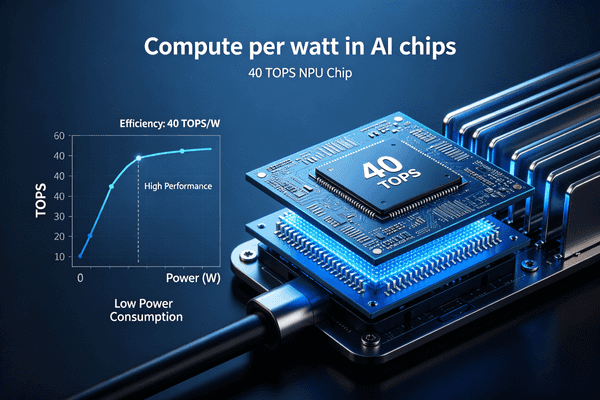
Chip makers solve this by focusing on compute per watt7. They design NPUs that deliver 40 TOPS while using very little electricity. This efficiency keeps laptops cool, extends battery life, and makes the new AI PCs cost-effective for everyday office work.
The Death of Traditional Office PCs
Last month, a procurement manager from a large enterprise called me. He was worried. His company bought 2,000 standard laptops last year. Now, his team cannot use the new AI software. Traditional PCs simply lack the hardware. This situation creates a huge pain point for businesses. They must buy new machines, but they want good value.
The Compute Per Watt Challenge
Chip makers face a hard task. They must put a 40 TOPS NPU1 into a thin laptop. If the chip uses too much power, the laptop gets hot. The battery dies in two hours. I learned from our supply chain partners that compute per watt7 is the new golden rule. Engineers focus on how much AI work the chip can do with just one watt of power.
Strategies for Cost-Effectiveness
Manufacturers use different methods to make these chips affordable. They improve the silicon architecture. They also use advanced packaging techniques. Here is how they manage the balance:
| Strategy | Goal | Benefit for Buyers |
|---|---|---|
| Smaller node size (e.g., 3nm) | Reduce power use | Longer battery life |
| Integrated NPU | Save space on board | Thinner laptops |
| High compute per watt7 | Lower heat output | Cheaper cooling parts |
At Nexcir, we help our clients source these efficient power management ICs and processors. We know that stable pricing for these new chips is critical. When chip makers lower their production costs, we pass those savings to our customers. This helps them build affordable AI PCs.
Will 40 TOPS become a basic standard for all computers by 2026?
Paying extra for AI features hurts your budget today. But hardware standards change fast. Soon, you will not have to pay a premium for basic AI power.
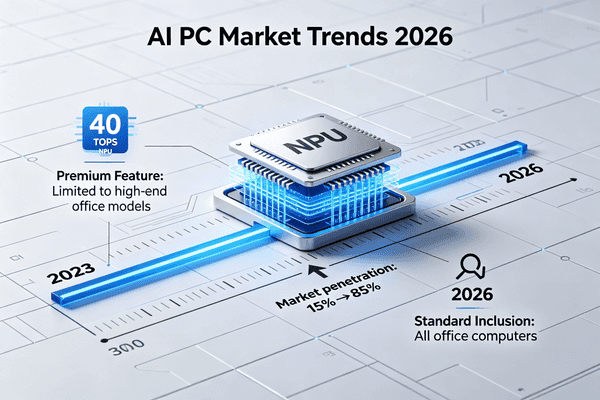
Yes, by 2026, the 40 TOPS NPU1 will become a standard feature for low-to-mid-end office computers. It will no longer be a premium selling point. Just like Wi-Fi or solid-state drives today, basic AI computing power will be included in every cheap device.
The Shift from Premium to Standard
I remember when solid-state drives were very expensive. Only high-end gaming computers had them. Today, every cheap laptop has a solid-state drive. I predict the same thing will happen with the 40 TOPS NPU1. Right now, marketing teams use "AI PC" as a big selling point. They charge more money for it. But our supply chain data shows a different future.
Market Predictions for 2026
By 2026, the cost to make a 40 TOPS chip will drop. Foundries will produce these chips in massive volumes. When supply goes up, prices go down. I talk to OEM customers every week. They plan their product designs two years in advance. They tell me that their cheap office models for 2026 all include a 40 TOPS NPU1.
How Procurement Needs Will Change
This shift changes how companies buy electronic components. Buyers will no longer treat NPUs as special items. They will treat them as common parts.
| Timeframe | Market Status of 40 TOPS | Price Premium | Procurement Focus |
|---|---|---|---|
| 2024 | High-end selling point | High | Securing limited stock |
| 2025 | Mid-range adoption | Medium | Finding stable prices |
| 2026 | Basic standard feature | None | Managing bulk costs |
As a distributor, my goal is to prepare our clients for this change. We build long-term supply programs. We ensure our customers get original components without market price jumps. When 40 TOPS becomes standard, we will provide the steady supply they need to keep their production lines moving.
Conclusion
The 40 TOPS NPU1 is changing office PCs forever. It offers efficient local AI power. Soon, it will become a basic standard, making smart computing affordable for every business.
Understanding the 40 TOPS NPU helps you grasp its role in enhancing AI capabilities in modern computers, ensuring efficient performance. ↩
Learn why Microsoft established this standard to ensure optimal AI performance and future-proof your technology investments. ↩
Get insights on adapting procurement strategies to align with evolving AI technology standards and market demands. ↩
Discover how local AI models leverage the 40 TOPS NPU to operate efficiently without cloud dependency, enhancing privacy and speed. ↩
Explore how these features utilize the 40 TOPS NPU to provide seamless and instant AI-driven functionalities. ↩
Gain insights into how NPUs are revolutionizing computing by handling complex AI tasks efficiently. ↩
Understand the significance of compute per watt in creating energy-efficient AI chips that enhance battery life and performance. ↩