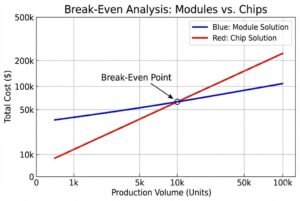
Car makers face a huge problem today. The cost of chips in cars is growing fast. If you ignore this trend, your supply chain will fail.
Yes, the average silicon content per car1 is fast approaching $2,300. This massive increase happens because modern vehicles use advanced L3 autonomous driving systems2 and complex smart cockpits3. These features require thousands of high-performance semiconductors4, changing the total bill of materials forever.
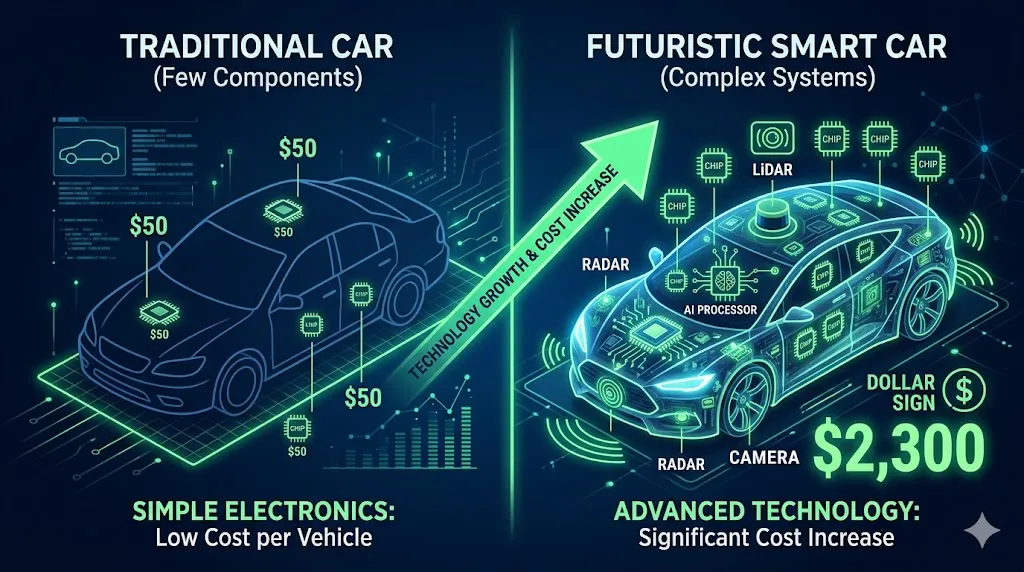
I remember when a car only needed a few basic chips to run the radio and engine. Today, cars look more like supercomputers on wheels. This fast change brings huge risks for procurement managers. Let us explore what this means for your daily work and how you can stay ahead.
How Do L3 Autonomous Driving and Smart Cockpits Drive Up BOM Costs?
You want to build smart cars, but the bills keep getting higher. Advanced driving systems need too many chips. This hurts your profit margins badly.
L3 autonomous driving and smart cockpits3 drive up BOM costs by requiring expensive sensors, MCUs, and power management ICs. A traditional car used about 500 chips. A new smart car needs over 3,000 chips. This pushes the semiconductor cost to nearly $2,300 per vehicle.
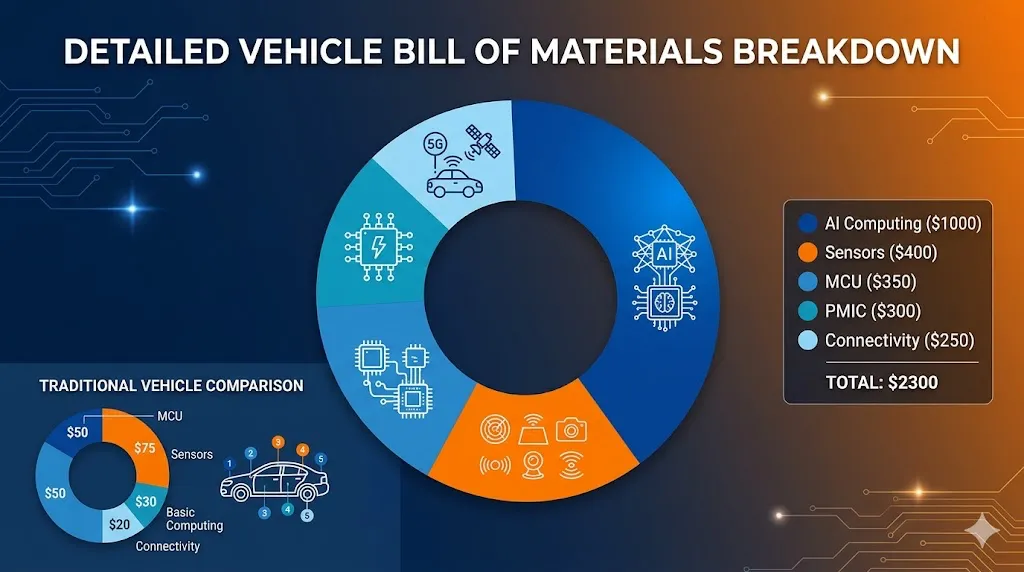
I see many hardware engineers struggle with this new reality. They must fit more electronics into the same car body. We need to look closely at the bill of materials (BOM)5. The cost structure is completely different now.
The Shift in Automotive BOM
In the past, steel and engines were the most expensive parts of a car. Now, silicon takes the top spot. L3 autonomous driving needs LiDAR, radar, and cameras6. Each of these parts needs its own processing chips. Smart cockpits need large screens and fast processors to run smooth software.
I made a simple table to show this change. It compares a traditional car to a modern L3 smart car.
| Component Type | Traditional Car Chip Cost | L3 Smart Car Chip Cost | Main Function |
|---|---|---|---|
| Control (MCUs) | $50 | $350 | Core system control |
| Sensors | $30 | $400 | Vision and radar data |
| Power (PMICs) | $40 | $300 | Battery and energy management |
| Computing | $10 | $1,000 | AI and driving decisions |
| Connectivity | $20 | $250 | 5G and V2X communication |
You can see the big jump in computing costs. The AI processors7 are very expensive. When my team at Nexcir helps OEMs source these parts, we notice a huge demand for high-end computing chips. These chips must not fail. They control the car and keep people safe. This strict quality rule makes the chips even more expensive. You cannot just use normal consumer chips. You must buy automotive-grade parts8. This drives the total silicon cost up to $2,300.
Why Are Automakers Shifting From Buying Parts to Defining Chips?
Relying on standard chips causes major delays. Automakers wait months for parts that do not fit their exact needs. This slows down production and kills innovation.
Automakers shift to defining chips9 because standard parts cannot meet the specific needs of their custom software. By designing their own chips, car companies can control the supply chain, reduce costs, and match the hardware perfectly with their unique smart vehicle features.
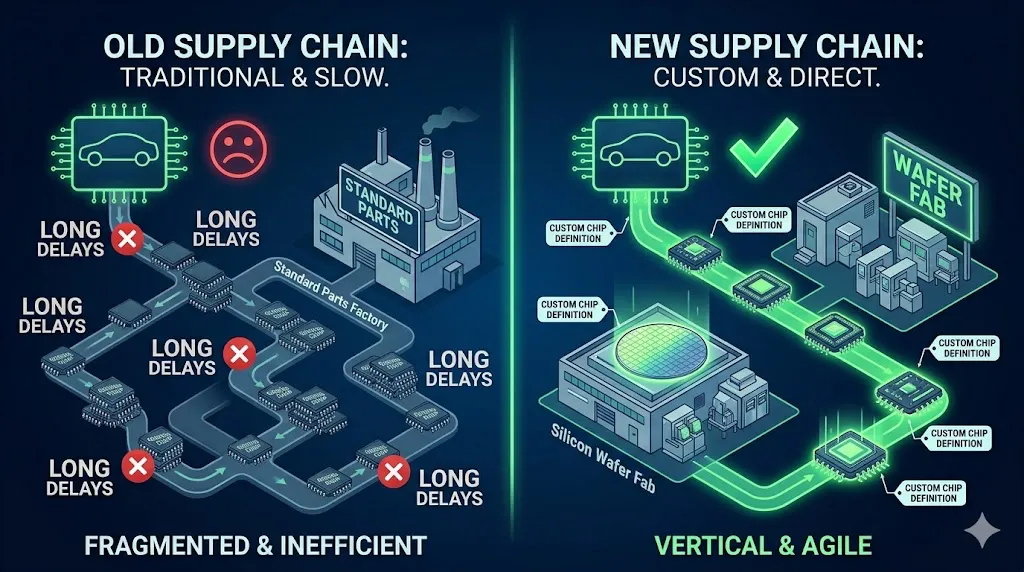
I talk to OEM procurement managers every week. They all share the same frustration. They hate waiting for standard chips that do not do exactly what they want. In the past, a car company just bought finished parts from suppliers. Now, this old way does not work.
The Rise of In-House Chip Design
Car companies want to stand out. They use special software to make their cars feel different. But standard chips limit what the software can do. So, automakers now work directly with foundries. They help design the chips from the start. We call this "participating in chip definition."
This shift changes the whole supply chain. Let us break down the differences between the old way and the new way.
| Business Model | Old Way (Buying Parts) | New Way (Defining Chips) |
|---|---|---|
| Role of Automaker | Buyer | Co-designer / Creator |
| Hardware Fit | Generic | Custom built for specific cars |
| Supply Chain Control | Low (depends on Tier 1 suppliers) | High (direct link to foundries) |
| R&D Cost | Low | Very High |
| Competitive Advantage | Weak | Strong |
This new model brings big challenges. It takes years to design a chip. It also costs millions of dollars. But car makers must do it. If they do not, they will lose to companies that do. I saw one client struggle for two years to find the right standard chip. They finally decided to build their own. Now, they have full control over their production schedule. At Nexcir, we support this shift by sourcing the surrounding components they still need.
What Are the Supply Chain Risks for High Silicon Content Vehicles?
Buying thousands of chips creates massive risks. One missing part stops the whole factory. This causes huge money losses and ruins your brand reputation.
High silicon content vehicles face severe supply chain risks10 like counterfeit parts11, sudden price jumps, and long delivery times. Because a modern car needs over 3,000 chips, the chance of a single component shortage halting the entire production line is much higher than before.
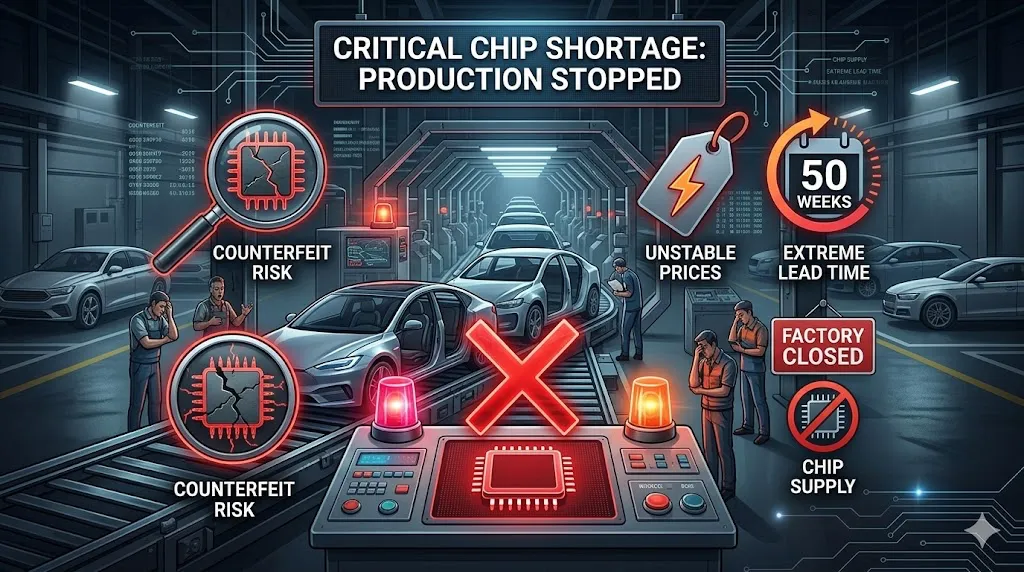
I have seen production lines stop completely because one ten-cent chip was missing. This is the dark side of the $2,300 silicon era. When you need thousands of chips, your risk multiplies by thousands.
Breaking Down the Major Procurement Risks
Procurement managers face a very tough job. They must find completely original electronic components. They also need stable prices. The market changes fast. Prices go up and down every day. Counterfeit chips are a massive problem. If a fake chip goes into a car brake system, people can die.
Let us look at the main risks and how they impact the factory.
| Risk Type | Cause | Impact on Production |
|---|---|---|
| Fake Components | Buying from unverified brokers | System failure, safety recalls, brand damage |
| Price Spikes | Market shortages | High BOM costs, low profit margins |
| Long Lead Times | Factory capacity limits | Delayed car deliveries, angry customers |
| EOL (End of Life) | Manufacturer stops making the chip | Need to redesign the board, huge delays |
At Nexcir, we help clients avoid these traps. My core team has over 20 years of experience in the electronic components industry. We know how to spot fake parts. We only buy from authorized distributors and original manufacturers. This guarantees authenticity. We also help find alternatives for EOL parts. When a client cannot find a specific MCU, we look through our global network. We find safe replacements so the factory keeps running.
How Can You Optimize Costs When Buying Automotive Semiconductors?
High chip costs destroy your budget. You need to buy original parts, but you also need low prices. Balancing quality and cost is extremely hard.
You can optimize costs by building long-term supply programs12 and using global sourcing networks13. Working with a reliable specialized distributor helps you secure bulk pricing, avoid market fluctuations, and find original components at prices lower than your local market offerings.
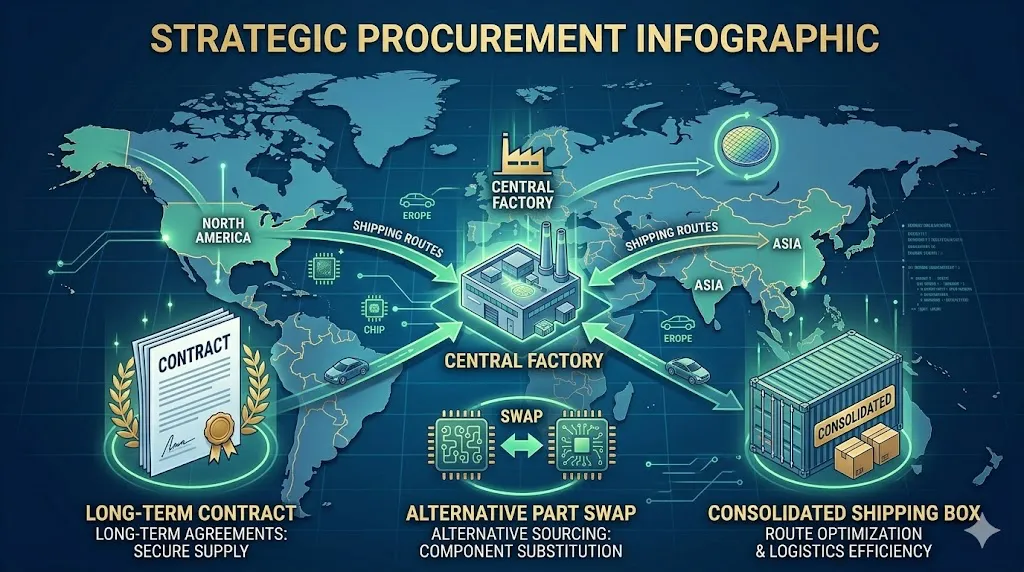
I always tell my clients that cheap chips are not always good chips. But you still need to save money. The $2,300 silicon cost per car is a heavy burden. You must find smart ways to lower this cost without taking safety risks.
Strategies for Cost Optimization
You cannot just search for the lowest price on the internet. That is dangerous. Instead, you need a smart buying strategy. You must look at the total cost of ownership. This includes the price of the chip, the shipping cost, and the cost of delays.
Here are the best ways to optimize your chip buying process.
| Strategy | How It Works | Benefit to Procurement Manager |
|---|---|---|
| Global Sourcing | Buy from different regions (Asia, Europe, US) | Find lower prices and more stock |
| Long-Term Contracts | Agree to buy chips over a long time | Lock in a stable price, ignore market spikes |
| Alternative Parts | Find different chips that do the same job | Avoid paying high prices for scarce parts |
| Consolidated Shipping | Ship many parts together | Lower logistics costs and faster delivery |
My team at Nexcir uses these strategies every day. We maintain stable supply channels across North America, Europe, and Asia. This means we can often find prices lower than your local market. We also provide insights on supply chain optimization. We do not just sell parts. We act as your partner. We help you plan ahead. This keeps your production schedule stable and your costs low.
Conclusion
The $2,300 silicon era changes car manufacturing forever. Automakers must control chip designs and secure reliable supply chains. Nexcir provides the global sourcing and trusted support you need to succeed.
Understanding the average silicon content helps gauge the technological advancement and cost implications in modern vehicles. ↩
Exploring L3 autonomous driving systems reveals how they enhance vehicle safety and functionality, justifying their cost. ↩
Smart cockpits transform the driving experience, making it essential to understand their features and benefits. ↩
High-performance semiconductors are vital for advanced vehicle functions, impacting the overall cost and efficiency. ↩
The BOM outlines the cost structure, helping to understand the financial impact of advanced technologies in cars. ↩
These technologies are key to autonomous driving, enhancing safety and navigation, thus increasing vehicle costs. ↩
AI processors are central to smart vehicle operations, making them a significant cost factor in car manufacturing. ↩
Automotive-grade parts ensure reliability and safety, crucial for maintaining high standards in vehicle manufacturing. ↩
Defining chips allows automakers to tailor technology to their needs, enhancing performance and innovation. ↩
Understanding supply chain risks helps in mitigating potential production delays and financial losses. ↩
Counterfeit parts pose safety risks and can damage brand reputation, making their identification crucial. ↩
Long-term supply programs stabilize prices and ensure consistent supply, crucial for cost management. ↩
Global sourcing networks provide access to diverse markets, helping to secure better prices and availability. ↩