Are you struggling to shrink chip sizes without expensive EUV lithography machines? This problem limits your production. ALE pitch splitting1 offers a smart way around this barrier.
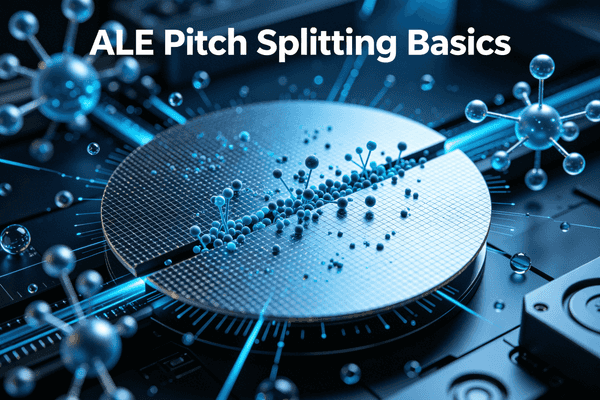
Atomic Layer Etching (ALE)2 pitch splitting1 allows you to create finer feature sizes without advanced lithography. It uses chemical processes3 to remove material layer by layer. This technique doubles or quadruples pattern density4, helping you build advanced chips using older, existing equipment.
You might think you must buy the newest machines to stay in the game. But wait, there is a different path to explore. Let us break down how this process can save your projects and keep your production lines moving forward.
What Exactly Is Atomic Layer Etching (ALE)2 Pitch Splitting?
Old etching methods lack control. They cause ruined wafers and lost money. You need a precise fix. ALE pitch splitting1 solves this by controlling the etch at the atomic level.
ALE pitch splitting1 is a multi-step process5 that divides a single printed pattern into smaller patterns. It uses chemical reactions6 to remove exactly one atomic layer at a time. This creates highly accurate, ultra-small chip features7 without needing newer light-based scanners.
To really understand this, I like to think about my early days testing components. We had simple tools, but we needed high precision. ALE gives you that precision. It breaks the traditional limits of light wavelengths. We use it to build better chips.
The Core Steps Of ALE
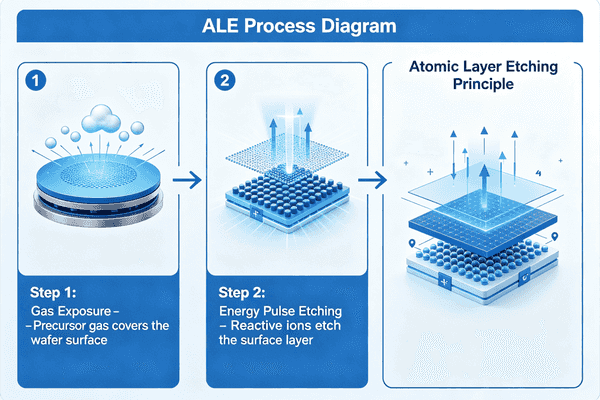
First, a chemical gas covers the wafer surface. It sticks to just the top atomic layer. Next, an energy pulse hits the surface. It only removes that top layer. You repeat this loop over and over.
Why Pitch Splitting Matters
Pitch splitting takes a basic pattern and builds spacer walls8 around it. Then, it removes the original pattern. Now, you have two walls where you only had one shape before.
| Traditional Etching | Atomic Layer Etching (ALE)2 |
|---|---|
| Removes large chunks of material quickly. | Removes one single atomic layer at a time. |
| Leaves rough edges and gives poor control. | Leaves smooth edges and gives perfect control. |
| Limits chip size by the light mask. | Doubles the density of the mask pattern. |
By combining ALE with pitch splitting1, engineers push older machines to do the work of next-generation tools. It is slow but very exact.
Why Do We Need ALE When Advanced Lithography Machines Are Missing?
Buying EUV lithography machines is nearly impossible today. High costs and long waits stall your projects. ALE gives you a way to keep upgrading your chip designs.
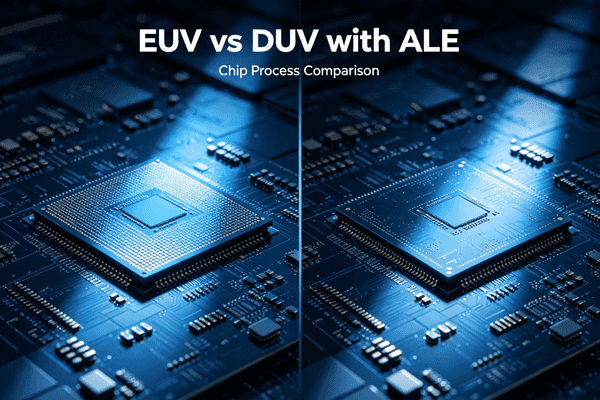
Without advanced lithography machines, you cannot print smaller chip lines directly. ALE pitch splitting1 bypasses this limit. It uses chemistry instead of light to shrink the pitch. You can manufacture 7nm or 5nm equivalent features using older DUV machines9 you already own.
I remember a time when our supply chain partners panicked over equipment bans. They could not get the latest EUV scanners. Their production plans looked dead. But critical thinking showed us a backdoor. We found a new way to work.
The Light Wavelength Problem
Older DUV machines9 use 193nm light. They cannot draw lines thin enough for modern chips. The light is just too thick. It is like trying to draw a fine portrait with a thick marker. You cannot get the details right.
The Chemistry Solution
Instead of a thinner marker, ALE pitch splitting1 uses a smart trick. You draw a thick line, coat its sides, and then wash away the middle part.
| Machine Type | Typical Limit | Limit with Pitch Splitting |
|---|---|---|
| ArF Immersion (DUV) | ~38nm pitch | ~19nm pitch (or smaller) |
| EUV Scanner | ~26nm pitch | Single exposure needed |
This logic is powerful. It shifts the heavy work from the optical machine to the etching machine10. Etching machines are cheaper. They are also easier to buy. This keeps your hardware engineers happy and your factory running smoothly.
How Does ALE Pitch Splitting Work In Actual Chip Production?
Theory is great, but applying this in a real factory is hard. Mistakes waste expensive silicon. Understanding the exact steps helps you control quality and prevent bad yields.
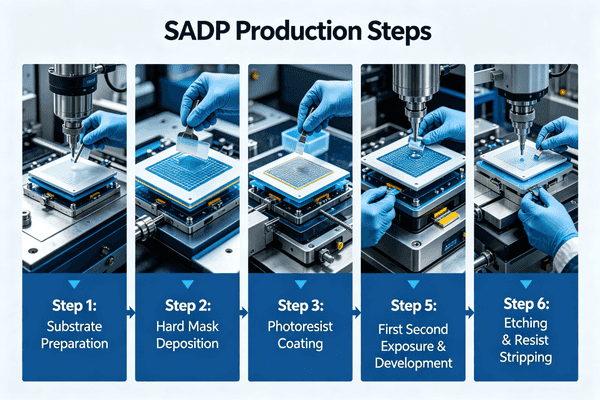
In production, ALE pitch splitting1 involves Self-Aligned Double Patterning (SADP)11. You print a dummy pattern and add a spacer layer. Then, you use ALE to etch exactly the right amount. Finally, you remove the dummy core, leaving perfectly spaced, tiny lines.
When I visit our partner foundries, I see this process in action. It is like a very slow, careful dance. Every step must be perfect. If the etch is off by one single atom, the whole chip might fail.
The SADP Process Breakdown
Self-Aligned Double Patterning (SADP)11 is the most common method. The steps are strict. First, you make a temporary block. Second, you cover it with a spacer material. Third, you use ALE to cut the top and bottom of the spacer. Fourth, you remove the block.
Controlling The Variables
The key is uniformity12. The gas flow and the energy must be exactly the same across the whole wafer.
| Production Step | Tool Used | Critical Factor |
|---|---|---|
| Block Print | DUV Lithography | Line straightness |
| Spacer Coating | Deposition Tool | Exact thickness |
| Spacer Etch | ALE Tool | Directional control |
| Block Pull | Wet/Dry Etch | Keeping spacers safe |
Using ALE here ensures the spacer walls8 do not get damaged. Traditional etching would destroy the delicate walls. This careful process guarantees the final electronic components you buy are reliable. They will perform exactly as you need them to.
What Are The Costs And Risks Of Using ALE Pitch Splitting?
Adding steps to your production line increases costs. It also increases the chance of errors. You worry about lower profits. Knowing the risks helps you plan better budgets.
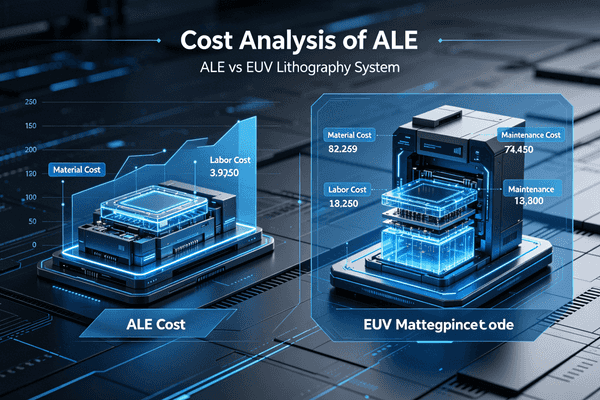
ALE pitch splitting1 is slower than traditional etching, which lowers factory output. It requires more process steps, meaning more chances for defects. But, compared to buying a $150 million EUV machine, the overall capital cost is much lower. You trade time for money.
Over my 20 years in the electronics industry, I have seen many companies try to cut corners. It never works. You must balance the cost with the quality. ALE is no different. You must plan carefully.
The Time Penalty
Because ALE removes one atomic layer at a time, it is very slow. A process that used to take seconds now takes minutes. This reduces the number of wafers a factory can finish in a single month.
The Defect Risk
More steps mean more risk. If dust falls on the wafer during step three, the error multiplies.
| Cost Factor | EUV Lithography | ALE Pitch Splitting |
|---|---|---|
| Equipment Cost | Very High ($150M+) | Low to Medium |
| Running Speed | Fast (Single step) | Slow (Many steps) |
| Defect Chance | Lower | Higher |
| Accessibility | Banned in some areas | Widely Available |
For OEM procurement managers, this means you must watch your supply chain closely. Lead times might get longer. But, by working with a reliable distributor, you can secure stable pricing. You can avoid bad delays.
How Can Nexcir Help You Source Components Made With These Technologies?
Finding authentic chips made with these complex methods is tough. Counterfeits flood the market and risk your products. You need a trusted partner13 to secure your supply chain safely.
Nexcir Technology14 provides 100% original electronic components from authorized global channels. Our team understands advanced manufacturing like ALE. We help you find exact parts or reliable alternatives. We ensure your production stays on schedule without the risk of fake materials.
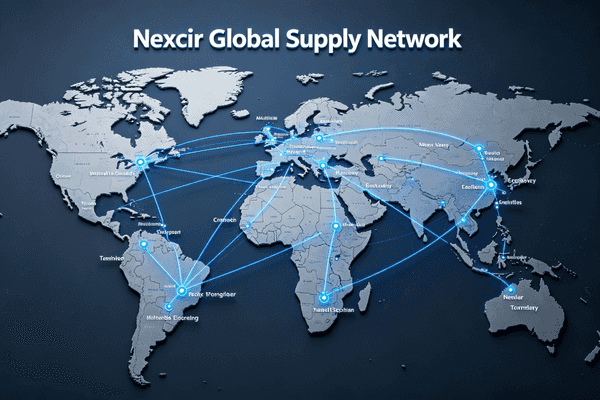
I started Nexcir because I saw too many hardware engineers struggle with bad parts. When factories make chips with complex methods like ALE pitch splitting1, quality control is everything. You cannot afford to buy from shady sources. You need real trust.
Our Global Reach
We have built strong supply channels in North America, Europe, and Asia. We only buy from original manufacturers and authorized distributors. This guarantees every MCU or PMIC you buy from us is real and tested.
Solving Your Pain Points
We know you need stable prices and fast delivery. Market changes can ruin your budget. We fix this for you.
| Your Pain Point | Nexcir Solution |
|---|---|
| Fear of fake chips | 100% authorized sourcing and tracking. |
| Wild price changes | Long-term partnerships for stable costs. |
| Production delays | Fast global logistics and safe delivery. |
| Parts going obsolete | Expert advice on good material alternatives. |
We are not just a seller. We act as your supply chain guard. By trusting us, you reduce your procurement risks. You can focus on building great products. You know your component supply is safe and steady.
Conclusion
ALE pitch splitting1 beats lithography limits by using precise chemistry. It keeps chip production moving forward. Nexcir ensures you get these advanced, authentic components safely and on time.
Pitch splitting allows for finer chip features using existing equipment, offering a cost-effective solution for manufacturers. ↩
Understanding ALE is crucial for producing advanced chips without expensive equipment, making it a valuable technique for manufacturers. ↩
Exploring the chemical processes in ALE can provide insights into how this method achieves precision in chip manufacturing. ↩
Increasing pattern density is key to advancing chip technology, and ALE offers a way to achieve this with older equipment. ↩
Understanding the multi-step process of ALE is essential for implementing this technique in chip manufacturing. ↩
Chemical reactions are fundamental to ALE, enabling precise material removal and feature creation. ↩
Creating ultra-small features is vital for modern chips, and ALE offers a way to achieve this without costly new equipment. ↩
Spacer walls are crucial for doubling pattern density, making them a key component of the ALE process. ↩
DUV machines, when combined with ALE, can produce advanced chip features, offering a cost-effective alternative to EUV. ↩
Etching machines are central to ALE, shifting the workload from optical machines and enabling precise chip production. ↩
SADP is a common method in ALE, and understanding it can help in applying ALE effectively in production. ↩
Uniformity ensures consistent quality across wafers, reducing defects and improving chip reliability. ↩
A trusted partner ensures the authenticity and quality of components, safeguarding production and product integrity. ↩
Nexcir provides reliable sourcing of components, ensuring quality and authenticity in the supply chain. ↩